

 Posted By
By Bob Lai, Tawcan
Special to Financial Independence Hub
I started investing in mutual funds and stocks shortly after entering the workforce. Back then, I didn’t really know what I was doing, so I followed many “ investment hot tips.” Over time, I made a lot of investment mistakes and encountered my fair share of failures.
Even if you look at professional sports, there’s no such thing as a 100% batting average, a 100% passing completion rate, or a 100% 3-point percentage. Being “100%” is simply not possible.
In case you’re wondering, in baseball, a batting average of 0.300 or higher is generally considered excellent; in hockey, a shooting percentage above 15% (number of goals scored divided by number of shots taken and multiplied by 100) or higher is considered excellent; in football, a 70% or higher completion percentage is considered excellent; in basketball, a 40% or higher 3-point percentage is consider excellent.
There are two key things in investing:
- Limit mistakes and failures
- Maximize winners
That’s why legendary investors like Warren Buffett, Charlie Munger, Mohnish Pabrai, Bill Ackman, and John Templeton all have made millions but still have had their shares of mistakes.
Since I started investing as a young adult, then started our Financial Independence journey in 2011, Mrs. T and I have built our investment portfolio from almost nothing to over seven figures. Over that time, we have made mistakes, which I have shared a few times on here.
Looking at these mistakes posts I wrote, I thought they were too general. So, I thought it would be interesting to share more specifics and details.
Here are the five worst investments we’ve owned.
Note: I went through our historical investment transactions for this post. I couldn’t help but laugh at some of these bad investments.
1.) HNU – BetaPro Natural Gas Leveraged Daily Bull
HNU is a leveraged ETF from Global X. It aims to provide investors up to double the exposure to the daily performance of the BetaPro Natural Gas Rolling Futures Index. The idea is to provide investors the opportunity to benefit from daily price increases in natural gas.
I was trading HNU between 2009 and 2011. The basic idea is to trade often and try to take advantage of the 2x leverage exposure from this ETF.
There were a few things stacked up against me:
- Futures trading is extremely complicated. I had no clue how the natural gas index would perform over time.
- I had a very simplistic view when it came to natural gas price – price would go up in winter and price would go down in summer, simply due to demand
- There was no such thing as free trades back then, so I was paying $4.95 (Questrade) per transaction
- The natural gas index was highly unpredictable (at least to me)
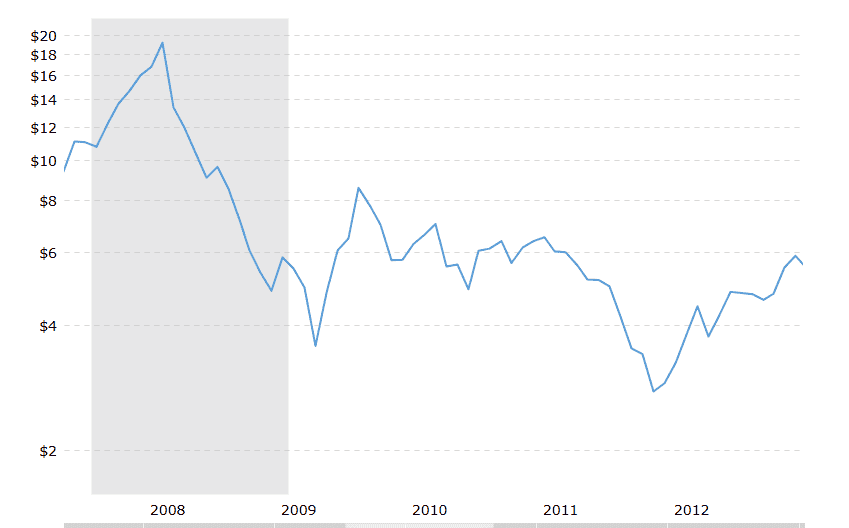
Natural gas index from 2008 to 2012
Initially, I had some small successes, making between 10% to 40% gains with my trades. That was the proverbial ‘kiss of death’ as I thought making money was easy!
Because of the 2x bull nature of the ETF, things turned ugly in early 2011 when the natural gas price went into a free fall. The 2x bull thing worked against me and meant I was losing money fast! Twice as fast as “normal.”
I learned my lesson and got out of the silly leveraged ETF trading practice and never got back into it.
2.) Just Energy (JE.TO)
When we first started dividend growth investing, we knew very little about the key stock metrics like the P/E ratio and the payout ratio. We were simply focused on dividend yield (such a rookie mistake!)
Naturally, we went to an online stock tool and ranked Canadian dividend stocks by dividend yield. Just Energy was a stock with one of the highest yields, so we sank a few thousand dollars into Just Energy.
We spent very little research on the money and knew nothing about how Just Energy operated and how they were making money. All we knew was that Just Energy was a Canadian-based electricity and natural gas retailer operating in North America.
Note: That’s why you should take a look at the Best Canadian Dividend Stocks list.
Like HNU, the stock performed alright initially and we were happy collecting dividends (JE was mentioned in many of our monthly dividend reports early on).
Eventually JE stock price went into a tailspin and we closed out the position in mid-2014, losing about $1,500 or about 47% of our initial investment (yes, we collected about $520 in dividends, but half of that was reinvested for more shares).
In case you’re wondering, I googled Just Energy out of curiosity and this is what I found:
- On December 15, 2022, the company announced it would be delisted from the NEX board of the TSX Venture Exchange
- The company’s shares now trade on the Over-the-Counter (OTC) market, typically with lower liquidity and potentially higher volatility compared to the TSX
Ouch!
3.) Laurentian Bank (LB.TO)
For a long time, we owned the Big Six Banks in Canada – Royal Bank, TD, Bank of Montreal, Bank of Nova Scotia, CIBC, and National Bank. Since we have done quite well with all six of these positions, I thought it would be a good idea to continue investing in Canadian banks.
Laurentian Bank was enticing because it had a solid dividend growth history and a good initial yield. We filtered LB.TO as one of the potential stocks to purchase after going through the Canadian Dividend All Star list.
Below is what I wrote about Laurentian Bank in my 2018 dividend consideration:
“Laurentian Bank has seen its share price retreating over the last little while. At a PE ratio of 9.9, it is one of the cheapest Canadian banks available from a PE ratio evaluation point of view. With a 10-year dividend payout increase streak and a 10-year dividend growth rate of 7.8%, LB has a solid dividend track record.
LB certainly isn’t as big as the big 5 Canadian banks, with most of its branches in eastern Canada. So from a future growth point of view, LB may not grow as quickly compared to its Canadian peers.
One of the concerns with Laurentian Bank is that it has high exposure to residential mortgages. In the fourth-quarter earnings, LB disclosed that an internal audit found some documentation issues on some mortgages it had sold to a third-party company. As a result, the bank has decided to buy back $392 million of problematic mortgages from the third-party.
Having said all that, I think at the current share price, it may make sense to purchase some shares of LB, collect dividend income, and see what the future holds.
Furthermore, it also makes sense to expand our banking exposure to outside of the Canadian big 6. Laurentian Bank of Canada is relatively small compared to the Canadian Big 6. If LB manages to grow outside of eastern Canada and possibly internationally in the future, the earnings will go up.”
The problem with Laurentian Bank? The share price started to slide shortly after we initiated the position and the share price never went back up to $46, our cost basis.
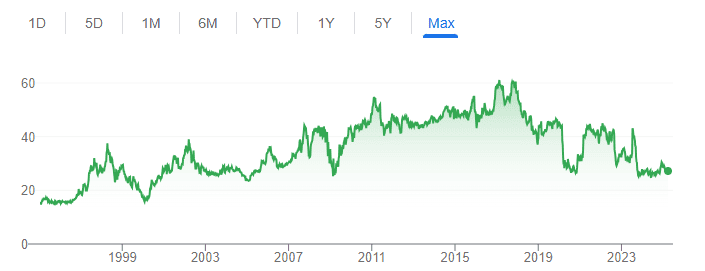
Looking back, my mistakes with the LB.TO purchase were:
- I pointed out the following in my original statement – “Laurentian Bank isn’t as big as the big 5 Canadian banks,” “LB may not grow as quickly compared to its Canadian peers,” and “LB has a high exposure to residential mortgages.” Well, they all turned out to be true
- I failed to look at the big picture. A bank that was concentrated in Quebec had significant limitations in terms of growth
Laurentian Bank tried to sell itself over the past few years but there was no buyer. None of the Big Six Banks wanted to touch LB. That itself is a tell-tale sign of the state of the Laurentian Bank’s business!
4.) HND – Betapro Natural Gas Inverse Leverage Daily Bear
Since I wrote about HNU earlier, I had to mention HND, GlobalX’s Betapro Natural Gas Inverse Leveraged Daily Bear ETF, to keep myself accountable.
HND is like HNU but works in reverse. HND aims to give investors up to double the inverse exposure to the daily performance of the Betapro Natural Gas Rolling Future Index, providing a strategic opportunity to potentially benefit from price declines in natural gas.
I started buying HND as a way to protect myself from the daily movements of the natural gas index. The idea is to buy some HNU and HND and come out positive in the end.
Since I couldn’t accurately predict which way the natural gas index would go, I was betting blind. That was a very stupid strategy!
In reality, things didn’t work that way. I was getting a double whammy from both HND and HNU!
5.) Algonquin Power & Utilities Corp (AQN.TO)
I can’t mention the five worst investments we’ve owned without mentioning AQN.
AQN used to be one of the darlings in the Canadian dividend growth investor community. The company had solid renewable energy assets, good revenues, an attractive yield, and a solid dividend growth record.
Due to poor company decisions, excessive spending, and weak mismanagement, the stock price went into a death spiral. The company sold some assets to try to stabilize its books rather than cutting dividends. When that didn’t work out, the company eventually cut its dividends a couple of times, but it was a little too late. The stock price went from a high of $20 to below $8.
We closed AQN in November 2023 and ended up with a loss of 40%, not including dividends.
This was a very humbling learning mistake and one of the worst investments we have owned.
Summary – The five worst investments we’ve owned
There you have it, the five worst investments we’ve owned. I had a few laughs at myself looking back at these terrible investments and wondering what the heck I was thinking. At the same time, it was good that we made most of these mistakes early on during our financial independence journey (except AQN) so we can learn from these mistakes.
What are the key lessons I have learned and the key principles I have developed from owning these five investments?
- Never leverage, that includes borrowing money to invest and use leveraged ETFs
- No penny stocks (I didn’t include any here but owned a few in the past)
- No niche ETFs, especially ones I don’t understand
I can’t say we won’t make any more mistakes as we move forward. The key, as mentioned, is to limit the number of mistakes and maximize winners.
What are some of your worst investments?
 Hi there, I’m Bob from Vancouver, Canada. My wife & I started dividend investing in 2011 with the dream of living off dividends in our 40’s. Today our portfolio generates over $5,000 in dividends per month. We originally dreamed to become financial independent and live off dividends by 2025. Although we could live off dividends by supplementing it with a part time income in 2025, we aren’t in a rush to cross so called “finish line.” Therefore, we are taking it easy and we plan to realize the dream of living off dividends before 2030. This post originally appeared on Tawcan on July 7, 2025 and is republished on Findependence Hub with the permission of Bob Lai.