News

News

Iran War and Defending investments from Stagflation


By Dale Roberts, Retirement Club/Cutthecrapinvesting

Special to Financial Independence Hub

It has been more than two weeks since the U.S. attacked Iran. And while the U.S. was quick to knock out much of Iran’s traditional military capability, Iran has turned to asymmetric war and has also weaponized oil, fertilizers and other materials that pass through the Hormuz Strait. With threats and some strategic attacks on shipping, Iran has essentially closed the Hormuz Strait. About 20-25% of the world’s oil and a third of the world’s fertilizer needs flow through the Strait. We now face a potential energy shock and there are rumblings that we might experience a period of stagflation. In the 1970s an energy crisis created the conditions for stagflation. How do we defend against stagflation?

As always, the following is not advice.

First off, and as always, no one knows what will happen. No one knows how this war will proceed and what it will mean for investment assets and the economies of the world. Trump could announce today that he’s packing up and heading home or this could continue for years. That said, history does teach us how assets react. History teaches us how to hedge most any threat.

What is Stagflation?

Stagflation happens when several factors combine to create an especially difficult economic environment. To get stagflation, three things must occur together:

  • Slow economic growth
  • High inflation
  • A high unemployment rate

Stagflation is an economic double-whammy where stagnant growth and high unemployment collide with rising inflation. This rare, painful cycle is difficult to fix because traditional policies to lower inflation often worsen unemployment, and vice versa.

In Canada’s case we’d say we are economically up Schitt’s Creek. Investopedia does a decent job of explaining what is stagflation and why it is nasty.

Here’s a very good overview from RBC:  On the horns of the stag.

Wars and the portfolio

Market strategists have been quick to point out that rarely do conflicts have any long-lasting impact on stock prices. In 20 major episodes since the Second World War compiled by analysts at RBC Wealth Management, the S&P 500 index fell by an average of just 6 per cent.

The outliers in that list, however, involve major oil market disruptions, like the Arab oil embargo in 1973 and the Iraqi invasion of Kuwait in 1990. We had more significant drawdowns.

For accumulators, they should stick to the investment plan. We should always be compounding.

At Retirement Club for Canadians and in our secure online community space, I shared this message …

It has been the most common message on this blog: get an investment plan and stick to it like glue. Here’s the full graphic that was shared at Retirement Club (and on X (Twitter).

War is something we can ignore like every other risk, when we have our stock-solid investment plan and retirement plan.

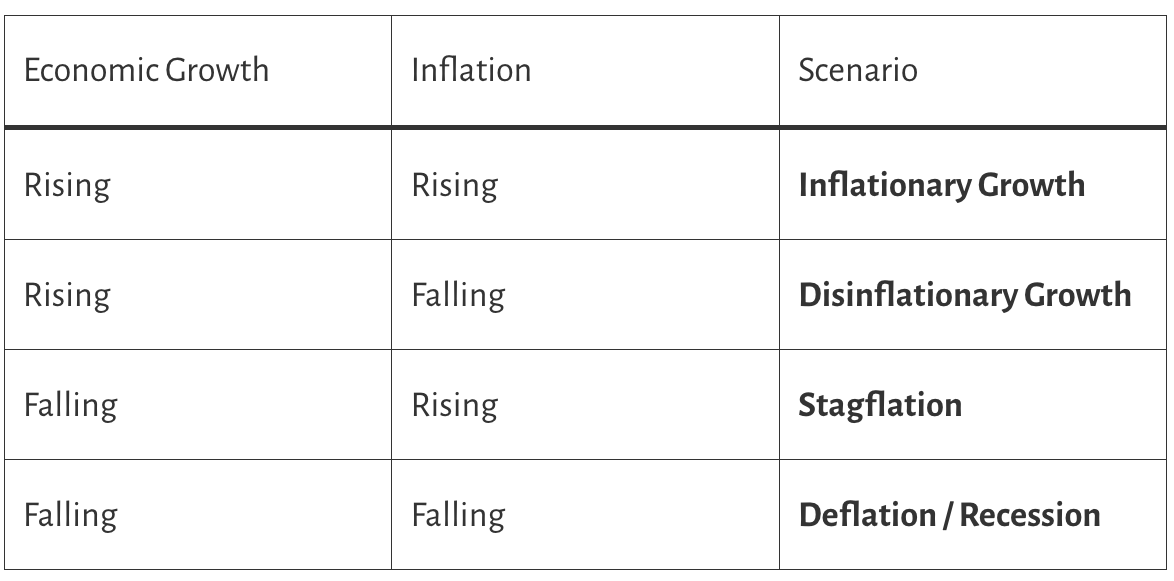
The 4 economic scenarios

The economy can shift along two axes:

  • Economic growth (rising or falling)
  • Inflation (rising or falling)

Combining them gives four possible economic scenarios:


1. Inflationary Growth

Growth ↑ + Inflation ↑

  • Economy expanding strongly
  • Demand pushes prices higher
  • Often occurs during late expansions

Assets that tend to do well

  • Commodities
  • Real estate
  • Some stocks

Example period: parts of the global economy during the early 2000’s commodity boom.


2. Disinflationary Growth

Growth ↑ + Inflation ↓

  • Economy grows but inflation stays low or falls
  • Considered the best environment for stocks

Assets that tend to do well

  • Stocks
  • Growth companies
  • Corporate credit
  • Bond market

Example: much of the period after the Global Financial Crisis recovery.


3. Stagflation

Growth ↓ + Inflation ↑

  • Economy slows but prices keep rising
  • Very difficult for policymakers

Assets that tend to do well

  • Commodities
  • Gold
  • Inflation-protected assets
  • Oil and gas stocks

Classic example: the 1970’s Oil Crisis.


4. Deflation / Recession

Growth ↓ + Inflation ↓

  • Demand collapses
  • Prices and wages fall
  • Debt burdens become heavier

Assets that tend to do well

  • Government bonds
  • Cash
  • Defensive assets

Example: the Great Depression and recessions

Fortunately we are almost always in scenario 2 and some of scenario 1. High inflation and stagflation is rare. Deflation or a Depression is rare and market recessions shown in scenario 4 is why many will embrace bonds and cash to create a balanced portfolio that is lower risk. Continue Reading…

The Politics of Portfolio Management

Image courtesy Pexels/Karola G.

By John De Goey, CFP, CIM

Special to Financial Independence Hub

The interplay between politics and economics has never been starker. We have an American President who is doing more to stick his nose into the affairs of those that are supposed to be at arms length than any of his predecessors ever dreamed.

Despite this, people who offer commentary on both the economy and capital markets (they are separate things) act as though what’s going on on Capitol Hill is so unremarkable that they conspicuously fail to work any acknowledgement of the dysfunction into their commentary.

Last week, I sat in on a webinar hosted by Jeff Schulze, CFA, who is managing director, head of economic and market strategy for Clearbridge Investments. In his presentation, Schulze noted that the S&P 500 is currently trading at 23 times forward earnings and that only the late 1990s saw a higher number. He added that there has been recent downward pressure on the federal funds rate and opined that the ‘one big beautiful bill’ will offer further fiscal stimulus down the road.

In a dashboard of 12 indicator variables, only one was flashing red (recession). Four were yellow (neutral) and seven were green (expansion).  He went on to opine that corporate profits don’t look recessionary. He concluded that a near-term recession is unlikely. I’m not disputing his economic evidence:  I’m simply noticing that there was not a word about political implications or developments. That silence strikes me as conspicuously odd.

There are many smart people who look closely at all manner of economic indicators who also look the other way regarding politics. As if they are not related. Why is that? They don’t talk about what’s going on Capitol Hill at all. The topic is taboo. It’s “polarizing.” Some even allege it’s beyond the purview of their mandate. I disagree.

EMH vs Active Management

The efficient market hypothesis (EMH) posits that capital markets do an excellent job of digesting all available information (from all fields of endeavour) quickly and accurately. By synthesizing information into a consistent worldview, EMH implies that no one can reliably ‘beat the market’ through security selection or timing strategies.

The economic forecast offered by Clearbridge seemed predicated on the assumption that what’s going on in Washington is normal, but it also seemed predicated on market inefficiency since Schulze made multiple references to the need for active management. If the market is efficient, then it is already reliably taking the dysfunction in Washington into account. If, on the other hand, it is inefficient, then the vagaries of an unpredictable President stand out as being meaningful and should be noted. So if the conduct of the President is a meaningful consideration, why wasn’t it mentioned by a guy who implicitly rejects EMH? Continue Reading…

Access Canada’s Best with Harvest High Income Shares: Built for High Yield, Every Month


Image courtesy of Harvest ETFs

By Ambrose O’Callaghan, Harvest ETFs

(Sponsor Blog)

Harvest High Income Shares™ turned a year old this week. This rounds out 12 months of continued success, as the single-stock ETF suite has accumulated more than $2.5 billion in total assets under management (AUM). The Harvest Diversified High Income Shares ETF (TSX: HHIS) has made a huge splash among investors with its combination of access to the growth of top U.S. stocks and high monthly cash distributions. HHIS and its corresponding single-stock ETFs target trending U.S. companies that have high growth prospects.

Now investors can access top Canadian issuers using Harvest Canadian High-Income Shares. In August Harvest launched the Harvest Canadian High Income Shares ETF (TSX: HHIC), and 10 new Canadian single-stock High Income Shares ETFs. Canadian High Income Shares are designed to generate high monthly cash distributions from an active covered call writing strategy and use of modest leverage.

Affordable Access to Canada’s Best Companies

Canada is home to many great companies that investors have been able to rely on to generate consistent earnings for the long term. Many of these companies operate as oligopolies. This means they have very little competition and are also able to generate large and steady cashflows. Many of these names are price setters with the ability to change prices to their benefit.

These companies are dominant players in their respective sectors.  With Harvest Canadian Single-stock ETFs, investors now have a straightforward and affordable way to make some of these Canadian giants part of their portfolio. Investors will be able to tap into their growth potential while benefiting from high monthly income supported by an active covered call strategy.

In this blog we will review each new ETF and examine, in general, the quality characteristics of the company in which each invests.

*Initial distribution announced on August 21, 2025. Payable on October 9 to unitholders on record as of September 29, 2025.

Shopify | A Canadian Tech Darling

The Harvest Shopify Enhanced High Income Shares ETF (TSX: SHPE) invests all its assets in shares of Shopify. SHPE overlays an active covered call writing strategy and employs modest leverage at approximately 25% to generate higher monthly income and boost growth potential.

The Canadian technology space has lacked a name with the ability to punch with U.S.  heavyweights since the fall of Blackberry. Fortunately, Shopify has proven capable of filling that void, quickly developing into one of the most exciting Canadian technology stories.

Shopify snapshot:

  • Profitability: Shopify posted strong recent earnings, with net income of $906 million in Q2 2025
  • Balance sheet: The company boasts a healthy cash position with nearly US$6 billion in liquid assets and minimal debt
  • Long-Term potential: Shopify has pursued aggressive investment in AI, enterprise, and international growth to propel its business forward

Getting Income from Canadian Banks

The Harvest Royal Bank Enhanced High Income Shares ETF (TSX: RYHE) and the Harvest TD Bank Enhanced High Income Shares ETF (TSX: TDHE) invest all their assets in shares of Royal Bank and TD Bank, respectively. Both are overlayed with an active covered call writing strategy and employ modest leverage at approximately 25% to generate higher income and growth prospects.

The Royal Bank of Canada and Toronto-Dominion Bank are the two largest banks in Canada, by market capitalization and by total assets. Indeed, RBC and TD Bank are the number one and the number three stocks on the S&P/TSX Composite Index by market cap.

RBC and TD Bank snapshot:

  • Profitability: In fiscal 2024, RBC reported adjusted net income over $16 billion. TD Bank reported adjusted net income over $14 billion
  • Well capitalized: RBC & TD Bank both possess total assets over $2 trillion
  • Dividend history: RBC & TD 10+ years of dividend growth, respectively
  • Long-term potential: Strong earnings & revenue growth and long-term catalysts like population growth

Higher Monthly Income from Communications

The Harvest BCE Enhanced High Income Shares ETF (TSX: BCEE) and the Harvest TELUS Enhanced High Income Shares ETF (TSX: TEHE) invest all their respective assets in shares of BCE and TELUS. These ETFs are overlayed with an active covered call strategy and both employ modest leverage at about 25% to enhance cashflow and growth potential.

Canadian telecommunication companies like BCE and TELUS are often described as oligopolies due to their concentration of market power in this space.

TELUS and BCE snapshot:

  • Profitability: In 2024, TELUS delivered adjusted basic earnings per share (EPS) growth of 9.5% to $1.04 | BCE posted adjusted EPS of $0.63
  • Infrastructure Investment: TELUS has pledged over $70 billion through 2029 to expand its network infrastructure, including two AI data centers | BCE is redirecting capital toward the Ziply Fiber acquisition and $1.2 billion towards “Bell AI Fabric”, which promotes AI infrastructure
  • Dividend history: TELUS boasts a 20-year consecutive dividend-growth streak | BCE has hiked its dividend for 15 straight years
  • Long-Term potential: Both TELUS and BCE well-positioned due to emerging AI growth and telecom infrastructure upgrades

Fuel with Higher Income  

The Harvest Enbridge Enhanced High Income Shares ETF (TSX: ENBE), the Harvest Suncor Enhanced High Income Shares ETF (TSX: SUHE), and the Harvest CNQ Enhanced High Income Shares ETF (TSX: CNQE) offer access to Canada’s energy giants. All three are overlayed with Harvest’s proven covered call writing strategy and employ modest leverage to generate high levels of monthly income. Continue Reading…

Tariffs: Great in Theory … Dumb in Practice

Public domain image via Outcome

I saw her today at the reception
In her glass was a bleeding man
She was practiced at the art of deception
Well, I could tell by her blood-stained hands, sing it

You can’t always get what you want
But if you try sometimes, well, you just might find
You get what you need —
You Can’t Always Get What You Want, by The Rolling Stones


By Noah Solomon

Special to Financial Independence Hub

Apropos of what has been clearly driving markets over the past several weeks, in this month’s commentary I will discuss tariffs. Specifically, I will demonstrate that although they can, in theory, produce certain benefits, in reality, they are far more likely to cause more harm than good, both for economies and markets.

A Boon to Humanity

The entire world has benefitted immeasurably from global trade in the postwar era. Its expansion has vastly expanded the supply of most goods, leading to lower prices. In simple terms, globalization has led to more things at lower prices, which has made the world far wealthier and led to a phenomenal increase in standards of living.

Consumers and businesses in the U.S. and other developed nations have benefitted from the fact that most things can be made for less in other countries. To be sure, the windfall of cheaper goods has involved the dislocation of manufacturing jobs over the last several decades. However, the percentage of the American workforce in manufacturing currently stands at roughly 8%, and less than 14% in 2000.

Furthermore, most experts agree that technology and automation, as opposed to trade, have been primarily responsible for the decline in manufacturing employment in the U.S. Also, given that the U.S. is currently at full employment, it stands to reason that dislocated jobs have been replaced. Importantly, the net benefit of trade has been massive, enabling citizens of advanced economies to enjoy higher standards of living than if they were forced to buy only domestically produced goods.

The Theoretical Benefits of Tariffs

Although the benefits from free trade are undeniable, governments are periodically tempted to tweak trade relationships in their favour to maintain or augment globalization’s existing benefits while minimizing or eliminating its relatively minor drawbacks. These initiatives entail some degree of restrictions on trade. Today, the U.S. is pursuing such policies by imposing tariffs on imported goods.

The purported benefits of these particular tariffs are:

Benefit #1: Improved government finances: This argument contends that tariff revenues will afford the government some flexibility with respect to fiscal policy. Specifically, the revenue which is collected via tariffs will be used to reduce the ever-expanding U.S. deficit. Alternatively, these revenues could serve to increase government spending and/or reduce taxes without a deterioration of the government’s fiscal position.

Promise #2: A manufacturing renaissance: Another potential benefit involves the bolstering of certain industries via reduced competition from imports, with an associated boost to employment in these areas. The current U.S. administration has been particularly vocal about the ability of tariffs to revitalize manufacturing in states where it was once prominent.

Promise #3: A Better Deal: This argument holds that tariffs will force other countries to the negotiating table and put the U.S. in a strong position to secure better trade agreements and/or end unfair trade practices that hurt its economy.

Einstein’s Warning

Albert Einstein famously stated, “In theory, theory and practice are the same. In practice, they are not.” In theory, tariffs can deliver on the aforementioned promises, but the reality is that not only are they unlikely to do so but stand a very good chance of causing more harm than good.

Very little, if anything, in the modern global economy occurs in a vacuum. One specific policy or event can easily start a chain reaction of subsequent policies and events. Although some of these cascading effects can be anticipated, their magnitude is almost impossible to predict. More ominously, many of them are unforeseeable (the technical term used by economists for such developments is “unintended consequences”). As a result of such reverberations, few, if any of the purported benefits of tariffs are likely to materialize, should they remain in place. Moreover, their associated consequences could prove severe.

Improved Government Finances: Robbing Peter to Pay Paul

Escalating tensions and the prospect of long-lasting trade wars have resulted in a heightened state of uncertainty among both businesses and consumers, which may have a significant impact on their investment and spending. Continue Reading…

Gen Z driving surge in mobile Debit spending

Image courtesy Interac Corp.

An Interac survey being released today finds that more than two thirds (69%) of Canada’s Gen Z generation [defined as Canadians aged 18 to 27] have embraced the mobile wallet, while almost as many (63%) would rather leave their old-fashioned physical wallets at home for short trips. Gen Z’s Interac contactless mobile purchases also rose 27% in the first half of 2024, compared to the same period a year earlier.

Gen Z appears to be more enthusiastic than their counterparts in older cohorts: 60% of Millennials [aged 28-43]  embraced mobile wallets, compared to 44% of Gen Xers [aged 44-59] and just 27% of Baby Boomers [aged 60-78.] Only 10% of the older Silent Generation [age 79 or older] did so.

A whopping 63% of Gen Z mobile wallet users have loaded their Interac debit card on their smartphones, and 31% plan to set debit as their default method of payment. For 63% of them, the reason is perceived faster payment times compared to physical card payments.

 “Choosing your default payment method may feel like a small step, but it can play a big role in shaping Canadians’ ongoing spending habits,” said Glenn Wolff, Group Head and Chief Client Officer, Interac in a press release. “When consumers tap to pay with their phones, the decision to select a card from the digital wallet is easy to miss. Canadians could end up unintentionally using a default payment method that prompts them to take on more debt. This differs from traditional physical wallets where the consumer had to select the card they wanted to use each time.”

Majority want to be smarter with money

62% of Gen Z want to be “more mindful when spending” with 57% saying they want the option to use debit when paying in store or online; 79% of them say the cost of living is too expensive and 59% feel the need to be smarter with their money.

Interact says this generation’s desire to control overspending is heightened by back-to-school season: last year, family clothing stores saw almost twice as many Interac Debit mobile purchases in September and October compared to earlier that year in January and February. 54% of Gen Zs see the need to develop new habits to stay in control over their finances, while 56% are setting a timeline for this September to introduce new habits. Continue Reading…