

 Posted By
By Stephen Dover, CFA, Franklin Templeton Institute
(Sponsor Blog)
Any consideration of emerging markets must begin with the case for global investment strategy. The decision to allocate capital internationally is not just about geographic diversification. Rather, it is increasingly driven by fundamental shifts in absolute and relative returns that drive global capital flows, by the discovery of new investment opportunities, and by the need to identify and manage concentration risk.
This section establishes the reasons why active international allocation strengthens institutional portfolios that also reinforces the rationale for emerging market allocations.
In an extended period of “US exceptionalism”—roughly spanning the 15 years from the global financial crisis to the middle of the current decade — investors increasingly gravitated to US equity and credit markets. That was understandable, given the superior returns — in absolute and risk-adjusted terms — delivered by US financial assets.
Importantly, superior returns on US assets were driven by superior fundamentals, including growth, institutional solidity, vast market liquidity, innovation and historic levels of profitability.
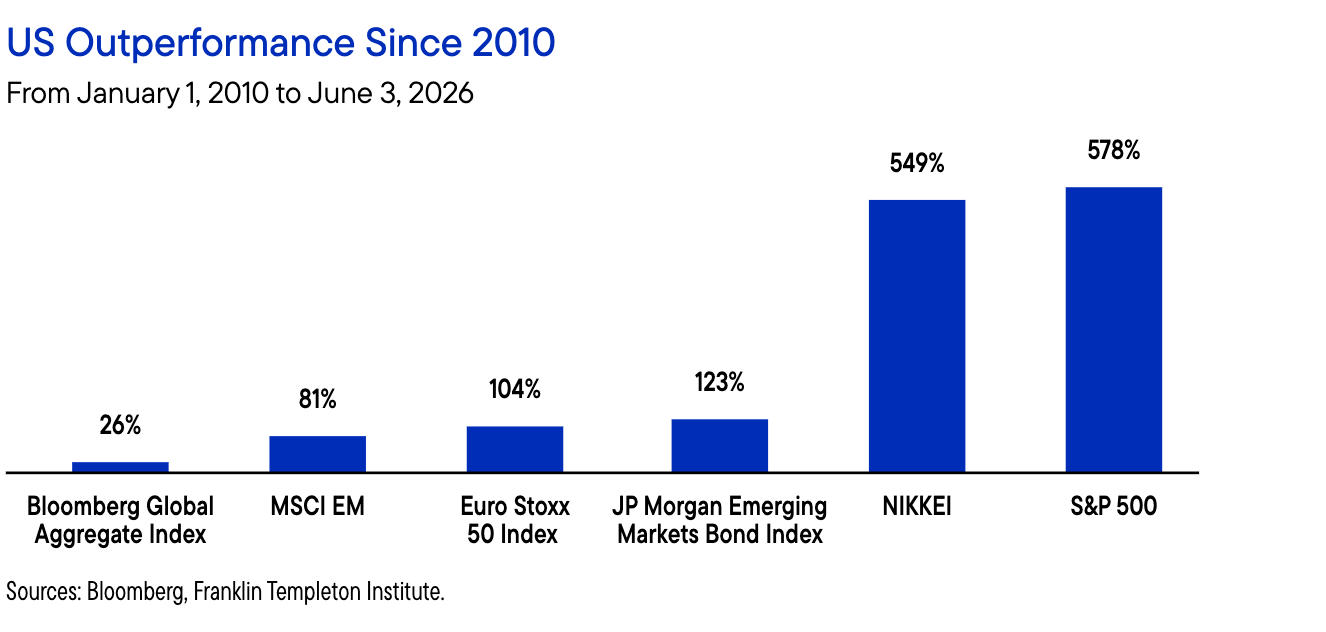
At the same time, however, US-based equity returns became more concentrated, as mega-
capitalization stocks accounted for a growing share of widely followed market-capitalization indexes.
Partly driven by concerns about concentration risk and partly because of improving returns in other
markets, investors have more recently begun to look for opportunities in other markets.
Over the past year, European, Japanese and emerging equities, and particularly emerging debt, have episodically produced superior returns to those found in US equity and fixed income markets. Those outcomes have begun to raise awareness of global opportunities, among them in emerging markets.
Renewed interest in global investing stems from other factors as well. Economic and monetary policy
divergence is becoming more significant. Prior to the US-Iran War, the Federal Reserve (Fed) was
biased to cut rates, the European Central Bank (ECB) had paused its easing cycle, the Bank of Japan
(BoJ) had already cautiously begun to hike rates, and various emerging central banks were prepared
to cut rates amid falling inflation. Those divergences in policies had contributed to a weakening of
the US dollar since early 2025, which in turn boosted investor interest in non-US markets, including
in emerging markets.
With the outbreak of the war and the impairment of shipping via the Strait of Hormuz, policy
perceptions have again shifted. The Fed and emerging central banks are now (mostly) on hold, the
ECB and the BoJ are inclined to tighten their monetary policies. Unsurprisingly, volatility, correlation
and returns have shifted markedly.
But the underlying point remains: Divergence in the conduct of monetary policy creates opportunity for tactical re-allocation. And it isn’t just about monetary policy. In many respects, fiscal policy divergence is even more notable.
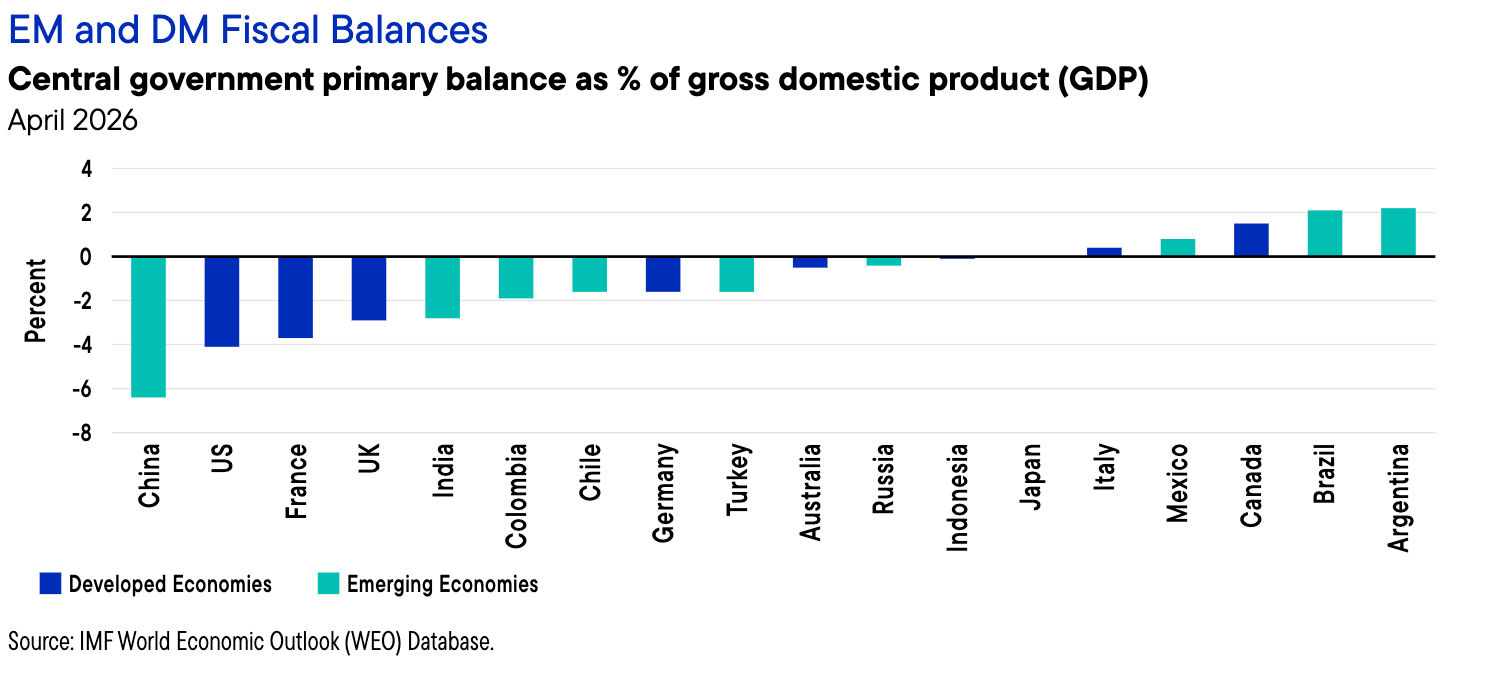
In the United States, large structural budget deficits are forecasted over the next decade.
Meanwhile, Japan’s new government is promising more fiscal stimulus as well. So, too, are Germany and the European Union.
In contrast, over the past decade many emerging countries have been pursuing more disciplined,
orthodox fiscal policies, with the upshot that their sovereign credit fundamentals are improving in
absolute and relative terms. That trend lends support to secular declines in risk premia and should
manifest in even lower nominal and real interest rates, as well as stronger emerging currencies.
Directly, that boosts emerging debt returns, but it also lends greater resilience to many parts of the
emerging complex.
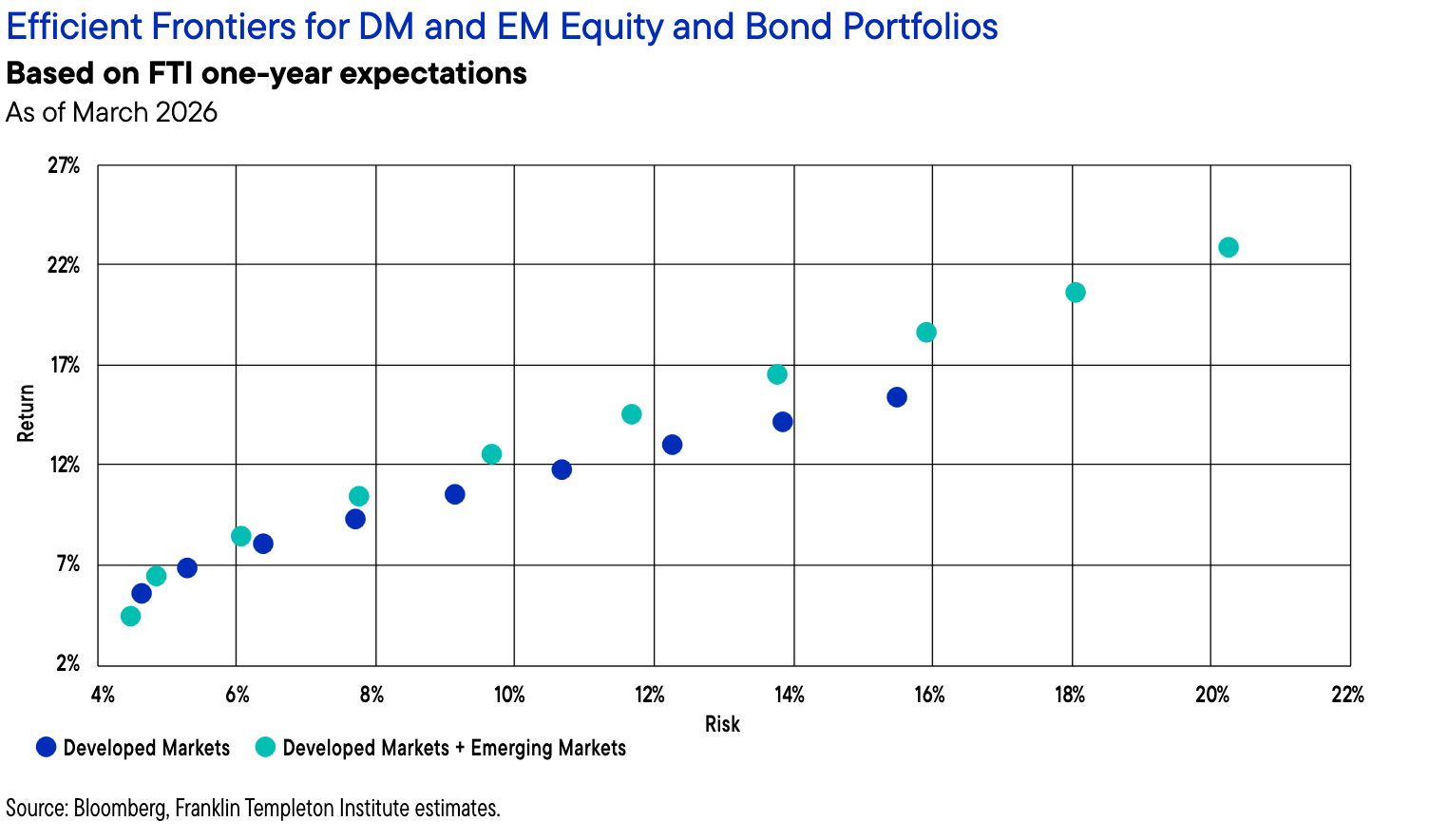
As noted, global markets — including emerging markets — have recently exhibited episodes of
outperformance relative to US equity and fixed income returns. That is important, because for most of
the past 15 years US exceptionalism has been dominant. So much so, indeed, that if one compares the
efficient frontiers of investing with and without emerging markets since 2010, it is clear emerging
market allocations had almost no positive impact on portfolio returns, adjusted for risk, over the past 15
years.
But we believe those historic results are not likely to persist. Owing to improving emerging market
fundamentals, which we describe in detail in the next section of this paper, absolute and relative
expected returns are shifting in their favor. Using our estimated year-ahead returns across all
markets — developed and emerging, public equity and debt — a clear upward and leftward shift in the
efficient frontier is apparent when comparing a developed market only to a blended emerging and
developed portfolio. We believe emerging markets (alongside other non-US developed markets) are
therefore poised to contribute to improved portfolio performance in the year ahead: and most
probably for longer.
EMs are undergoing a profound transformation, one that is not cyclical in nature but structural, durable and increasingly self-reinforcing. The traditional narrative of emerging markets as externally dependent, volatility-prone economies is being reshaped by a new set of underlying forces that are redefining their role in the global economy.
EMs have generally shown significant resilience this decade, facing down a series of shocks arising from the COVID-19 pandemic, the inflationary outcome of the Russia-Ukraine war and the US Fed’s sharp interest-rate hikes during 2022-2023, and last year’s substantial tariff volatility. Not only did EMs survive this period, but many have thrived.
As world trade reconfigures and global actors realign geopolitically, EMs have found themselves generally well-placed to benefit from these global shifts: including some that are likely to benefit under the new tariff regime. This compares to earlier years when EMs would often face crises (whether debt, balance of payments and/or in banking systems) from global shocks.
The fact that EMs are in a favorable position now is largely a result of policy choices that have situated them handsomely to face a rapidly changing world economy. In this regard, we note three significant global regime changes that we believe EMs are now well-placed to benefit from: structural improvements in EMs, global trade econfiguration, and a shift in the US dollar’s ability to attract global capital inflows.
Regime change: EMs are structurally sounder
Policy responses with respect to both monetary and fiscal policy have improved significantly across EMs over the past couple of decades. Adoption of sound, credible policies and nurturing of institutions (such as inflation targets, fiscal rules and independent central banks) have helped policy formulation and improved the market’s perception of the credibility of EM policymakers.
These policy adoptions have put many EMs in a more favorable position globally. Being in a position of relative strength in the contexts of trade, investment and global supply chains when the globe has experienced a series of shocks is, perhaps, surprising given the traditionally volatile history of these countries.
Broadly, EMs have reached this point through a series of macro-policy reforms arising from the need to
draw lessons from past crises. This is crucial, because economies that are more structurally sound (rather than simply reaping cyclical benefits when they come around) are more likely to stay strong and even improve from here. We discuss here how EMs have generally changed their policy approach over the years to reach this stage of resilience, including monetary and fiscal policy, how EMs have evolved in managing their balance of payments, and the effect this has had on financing flows and structural macroeconomic reforms.
The reforms and better policy approaches that EMs have undertaken in recent decades arose from learning the lessons of both the EM crisis periods of the 1980s and 1990s as well as those of global crises, including the global financial crisis (GFC) of 2007-2009. Prior to the late 1990s, most EMs had yet to adopt inflation targeting or fiscal rules.
On the external front, they generally lacked substantial foreign exchange reserves, and many still had some form of fixed exchange rate. As a result of these structural vulnerabilities, exchange-rate shocks and fiscal shocks tended to lead to episodes of domestic disruption and crisis. Addressing these vulnerabilities through various reforms—including inflation targeting frameworks with independent central banks, fiscal rules and fiscal councils for fiscal policy, as well as significantly higher foreign exchange reserves and floating exchange rates to reduce external vulnerability: substantially improved EMs’ resilience.
Monetary policy
Historically, EMs were marked by high and even hyper-inflation, as central bank interest rate policy was
often subordinated to political aims. Central bank financing of government deficits — also a politically-
motivated outcome — further contributed to inflation pressures. Reforms to monetary policy in a
number of EMs have resulted in lower and more stable inflation.
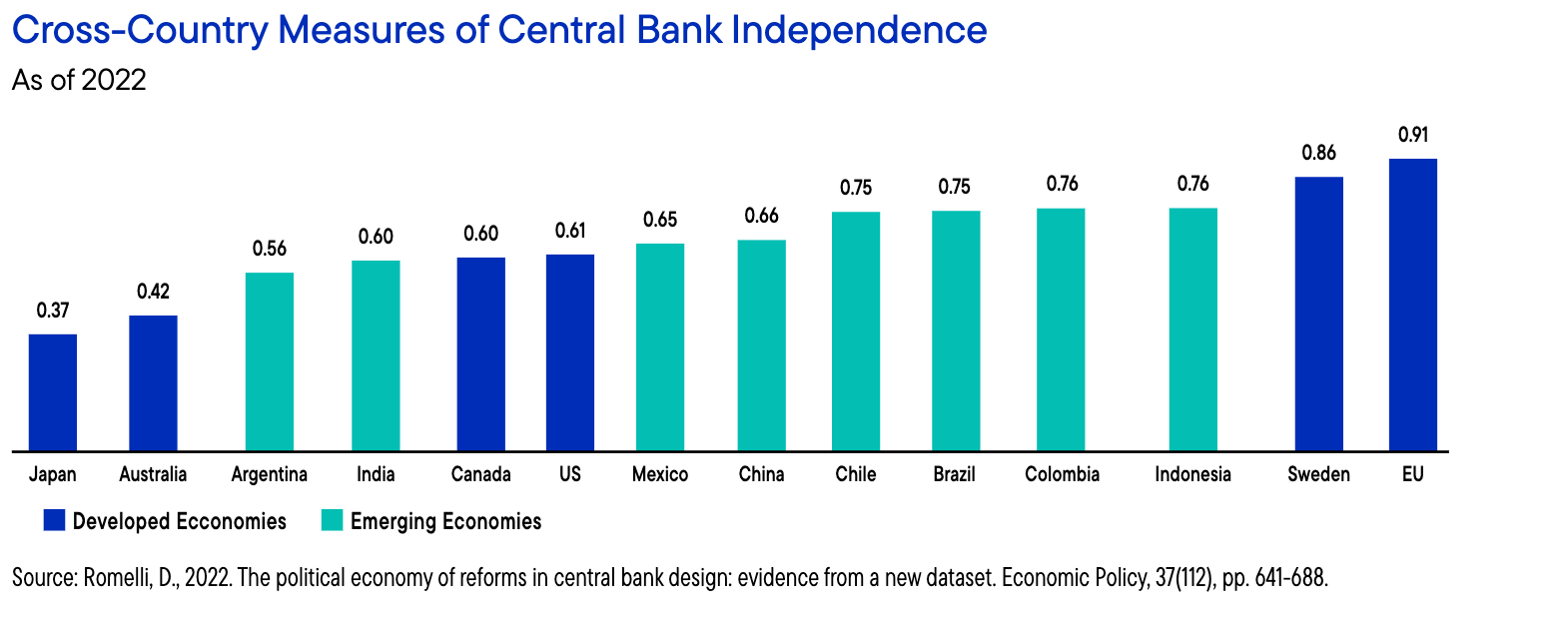
• Central bank independence — meaning that the central bank is not subject to political influence
over monetary policy decisions — is generally seen as critical for being able to implement
appropriate monetary policy. Independence in this context has been steadily increasing in EMs for
some time, since starting to pick up noticeably in the 1990s and early 2000s.
• Inflation targeting was initially adopted by smaller open advanced economies, first by New Zealand
in 1990 then by some other developed markets. Some EMs across various regions — including
Central and Eastern European countries then in transition to market economies, various Latin
American countries and South Africa — had adopted inflation targets in the late 1990s and early
2000s. The number of inflation-targeting countries, including EMs, has continued to increase since
then. Inflation targeting can lend credibility to policymakers. It is often seen as a complement to
central bank independence as it presents an objective measure by which to assess whether the
central bank is implementing appropriate monetary policy.
• In tandem with the trend toward independent, inflation-targeting central banks, monetary policy
transparency in EMs has improved as well. This is an important factor as it reduces uncertainty
among market participants and, often, will increase confidence in the central bank and its decision-
making.
 Stephen Dover is Chief Market Strategist and Head of the Franklin Templeton Institute. Stephen leverages the knowledge of the firm’s autonomous investment teams to provide global capital market and long-term investment insights internally and to clients. The Franklin Templeton Institute harnesses the depth and breadth of the firm’s global investment expertise and extensive in-house research capabilities to deliver unique investment insights to clients. Mr. Dover is a member of Franklin Resources’ executive committee, a small group of the company’s top leaders responsible for shaping the firm’s overall strategy.
Prior to his current role, Mr. Dover served as Executive Vice President, Head of Equities for Franklin Templeton, leading the firm’s equity investment teams. He has also served as Chief Investment Officer of the firm’s Emerging Markets Equity group and local asset management teams. Previously, Mr. Dover was a founder and chief investment officer of Bradesco Templeton Asset Management (BTAM), a joint venture between Franklin Templeton and Banco Bradesco in Sao Paulo, Brazil.
Prior to joining Franklin Templeton in 1997, Mr. Dover was a portfolio manager with Vanguard where he co-managed an equity income strategy. He also worked for Towers Perrin Consulting (now Willis Towers Watson) in New York, London and San Francisco.
Over the course of his investment industry career, Mr. Dover has lived in China, Europe, Brazil and the United States. Mr. Dover holds a B.A., with honors, from Lewis and Clark College and an M.B.A. in finance from The Wharton School of the University of Pennsylvania. He is a Chartered Financial Analyst (CFA) charterholder. Mr. Dover is on the Board of Trustees of Lewis and Clark College and Law School.
This blog is an excerpt from a much longer essay published in the Institute’s new paper, Expanding Global Opportunities: A strategic framework for international and emerging markets allocation.
IMPORTANT LEGAL INFORMATION
This material is intended to be of general interest only and should not be construed as individual investment advice or a recommendation or solicitation
to buy, sell or hold any security or to adopt any investment strategy. It does not constitute legal or tax advice. This material may not be reproduced,
distributed or published without prior written permission from Franklin Templeton.
The views expressed are those of the investment manager and the comments, opinions and analyses are rendered as at publication date and may
change without notice. The underlying assumptions and these views are subject to change based on market and other conditions and may differ from
other portfolio managers or of the firm as a whole. The information provided in this material is not intended as a complete analysis of every material fact
regarding any country, region or market. There is no assurance that any prediction, projection or forecast on the economy, stock market, bond market
or the economic trends of the markets will be realized. The value of investments and the income from them can go down as well as up and you may not
get back the full amount that you invested. Past performance is not necessarily indicative nor a guarantee of future performance. All
investments involve risks, including possible loss of principal.
Any research and analysis contained in this material has been procured by Franklin Templeton for its own purposes and may be acted upon in that
connection and, as such, is provided to you incidentally. Data from third party sources may have been used in the preparation of this material and
Franklin Templeton ("FT") has not independently verified, validated or audited such data. Although information has been obtained from sources that
Franklin Templeton believes to be reliable, no guarantee can be given as to its accuracy and such information may be incomplete or condensed and
may be subject to change at any time without notice. The mention of any individual securities should neither constitute nor be construed as a
recommendation to purchase, hold or sell any securities, and the information provided regarding such individual securities (if any) is not a sufficient
basis upon which to make an investment decision. FT accepts no liability whatsoever for any loss arising from use of this information and reliance upon
the comments, opinions and analyses in the material is at the sole discretion of the user.
Franklin Templeton has environmental, social and governance (ESG) capabilities; however, not all strategies or products for a strategy consider “ESG”
as part of their investment process.
Products, services and information may not be available in all jurisdictions and are offered outside the U.S. by other FT affiliates and/or their distributors
as local laws and regulation permits. Please consult your own financial professional or Franklin Templeton institutional contact for further information on
availability of products and services in your jurisdiction.
Canada: Issued by Franklin Templeton Investments Corp., 200 King Street West, Suite 1400 Toronto, ON, M5H3T4, Fax: (416) 364-1163, (800) 387-0830,
www.franklintempleton.ca.
