

 Posted By

By Noah Solomon,
Special to Financial Independence Hub
You go back, Jack, do it again, wheel turnin’ ’round and ’round
You go back, Jack, do it again
— Do It Again, by Steely Dan
The Historical Track Record: What has Worked
Eugene Fama, an American economist and Nobel Laureate, is recognized for his work on portfolio theory. Fama is best known for his groundbreaking research on multi-factor models, which incorporate multiple variables to better explain portfolios’ risks and returns.
In collaboration with Kenneth French, Fama challenged the widely held belief that a portfolio’s beta (its sensitivity to overall market movements) is the sole determinant of its average return. Developed in 1992, the original Fama-French Three Factor model demonstrated that smaller companies tend to outperform larger ones, and that stocks with lower valuations tend to outperform those with higher ones.
Since Fama and French’s original findings, academic research has identified additional characteristics that further explain a portfolio’s return, including its dividend yield and volatility. Over the long-term, less volatile stocks have outperformed their more volatile counterparts, and stocks with higher dividend yields have outperformed those with no or lower ones. Moreover, both low-volatility and higher-yield stocks have exhibited considerably less volatility than the overall market.
Low Volatility & Higher Dividend Yielding Stocks vs. Overall Market (1964-2025)

If only Life were so Simple
The above table implies that investors should simply hold low-volatility companies that have higher than average dividend yields, sit back, enjoy above-market returns, and accumulate significantly more wealth over the long term.
As is often the case with investing, things are not so simple. Although these characteristics have indeed delivered impressive long-term performance, the proverbial “ride” has entailed some painful bumps in the road.
In times when investors are most optimistic and speculative fervor is widespread, markets tend to underprice risk, which leads to a relative undervaluation of companies with defensive attributes vs. their more speculative peers. Such was the case in the dotcom-fuelled bull market of the 1990s, when both low-volatility and higher-yield stocks materially underperformed their more speculative counterparts.
Low Volatility & Higher Dividend Yield Stocks vs. Overall Market (1990-1999)

Notwithstanding the long-term outperformance of low volatility and higher dividend yielders, FOMO (fear of missing out) is a powerful force that can have perverse effects on behaviour. Many investors found it excruciatingly painful sitting with these holdings as they lagged the high-flying darlings of the day. None other than J.P. Morgan himself stated, “Nothing so undermines your financial judgement as the sight of your neighbor getting rich.”
Importantly, those who had the fortitude to stick with their low volatility and higher dividend yield holdings would have reaped significant rewards over the ensuing decade.
Low Volatility & Higher Dividend Yield Stocks vs. Overall Market (2000-2009)

The trillion-dollar question is: When one incorporates the mechanics of compounding, how did low-volatility and higher-dividend-yield stocks fare over the entire twenty year “round trip” from 1990-2009? As the table below illustrates, investors who remained steadfast in the 1990s as their “boring” portfolios underperformed were more than compensated for their patience.
Low Volatility & Higher Dividend Yield Stocks vs. Overall Market (1990-2009)

Summing it all up, the historical data indicate:
- Despite underperforming during periods of well above average returns that beget speculative fervor and unusually low risk aversion, low-volatility and higher-dividend-yield stocks have outperformed materially over the long term.
- The relative performance of stocks with these characteristics is strongest in periods of market stress: they deliver outperformance and portfolio diversification when it is most needed.
Déjà Vu all over again
The outperformance of low-volatility and higher-dividend-yield stocks was particularly pronounced during the “lost decade” of 1999-2009, which is the only 10-year period since 1964 in which U.S. stocks had negative average annualized returns. However, these characteristics don’t need a highly unfavourable environment to shine, nor do rising markets necessarily cause them to underperform.
Low Volatility & High Dividend Stocks: Rolling 10-Year Annualized Returns (1964-2025)
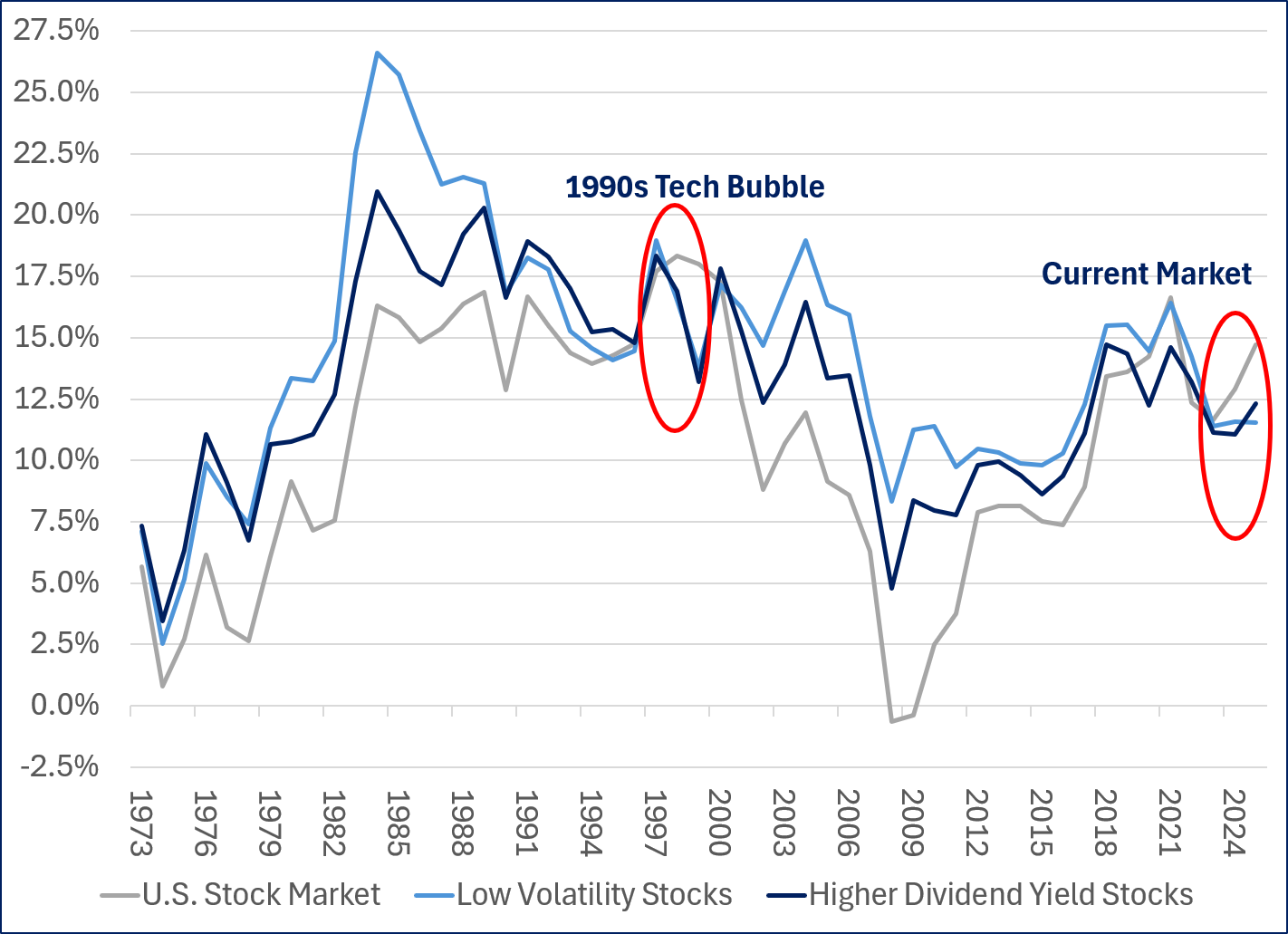
From a historical standpoint, the underperformance of low-volatility and higher-dividend yield stocks over the past ten years is highly anomalous. The only other ten-year period that witnessed this phenomenon was the dotcom-based bull market of the 1990s, which was followed by an unusually strong period of outperformance for low-volatility and higher-dividend-yield stocks.
We can do this the Easy Way or the Hard Way
Since markets bottomed in March 2009 following the global financial crisis, the S&P 500 has delivered an annualized return of 16.4%, as compared to its long-term average of 10.2%.
Importantly, this impressive streak was achieved with uncharacteristic consistency. As we approach the end of 2026, U.S. stocks are poised to have delivered negative returns in only two of the eighteen years beginning in 2009. The only comparable period in terms of both consistency and magnitude is that which preceded the peak of the dotcom bubble in early 2000.
Although more pronounced, the U.S. experience is not unique. Stocks in almost all regions have delivered well above average returns.
Equity Market Returns: A Longer-term Perspective

Legendary investor Sir John Templeton famously said that the four most dangerous words in investing are “This time it’s different.” Putting aside behavioural and economic explanations, the stark truth is that extended periods of above-average returns have historically been followed by ones of below-average returns, and vice versa.
If Templeton’s words hold true and historical patterns prevail, then a return to long-run average returns would necessitate a period of below-average returns. As mentioned in my past newsletter, every major asset manager is forecasting lower than average returns over the next decade across every region.
In a benign scenario, this would entail an extended period during which stocks consistently deliver below average yet positive returns. A far more tumultuous path would involve a decade of mostly average returns marred by a bear market. Regardless of the path, it is likely that markets will prove disappointing for investors who have grown accustomed to uncharacteristically high returns.
Boring is Back!
As was the case in the 1990s, investors have been emboldened by an uncharacteristically long-lived and benevolent investment environment in which more speculative assets have delivered phenomenal returns. In such an environment, the allure of prospectively high future returns from such investments has overshadowed both the defensive properties of low-volatility, higher-dividend stocks as well as their long-term record of outperformance. People have little appetite for “boring” stocks when their more “exciting” peers have been shooting the lights out.
As Buffett wrote in Berkshire Hathaway’s Annual Letter, “The line separating investment and speculation, which is never bright and clear, becomes blurred still further when most market participants have recently enjoyed triumphs. Nothing sedates rationality like large doses of effortless money.”
History doesn’t repeat itself, but it often rhymes. Although I have no idea of the precise timing, low-volatility and higher-dividend stocks are primed to come back with a vengeance, with well-above market average performance over the next ten years. Against this backdrop, Outcome’s algorithmic approach to investing in dividend-yielding, low-volatility stocks, both in Canada and internationally, is set to deliver meaningful outperformance when it will be most needed.
 Noah Solomon is Chief Investment Officer for Outcome Metric Asset Management Limited Partnership. From 2008 to 2016, Noah was CEO and CIO of GenFund Management Inc. (formerly Genuity Fund Management), where he designed and managed data-driven, statistically-based equity funds. Between 2002 and 2008, Noah was a proprietary trader in the equities division of Goldman Sachs, where he deployed the firm’s capital in several quantitatively-driven investment strategies. Prior to joining Goldman, Noah worked at Citibank and Lehman Brothers.
Noah holds an MBA from the Wharton School of Business at the University of Pennsylvania, where he graduated as a Palmer Scholar (top 5% of graduating class). He also holds a BA from McGill University (magna cum laude). Noah is frequently featured in the media including a regular column in the Financial Post and appearances on BNN. This blog originally appeared in the September 2026 Outcome newsletter and is republished on Findependence Hub with permission.
