

 Posted By
From household finances to healthcare spending and workforce productivity, the cost of losing independence extends far beyond the individual.
By Lu Han, Chair of the Board of Ontario Society of Occupational Therapy
(Special to Financial Independence Hub)
Ten years ago, I spent approximately $12 installing grab bars in my grandmother’s home. She was beginning to experience hip and shoulder pain, and as an occupational therapist, I recognized an opportunity to address potential safety risks before they became more significant.
Today, at 87, she continues to live independently in that same home.
I cannot quantify how many falls those grab bars may have prevented, if any. But that modest investment illustrates a much larger economic question: What does it cost society when an older adult loses the ability to live independently?
We often approach aging through the lens of healthcare expenditure or personal retirement savings. Yet the economics of aging are far more interconnected, extending from individual households to labour markets, healthcare systems, and ultimately the broader Canadian economy.
The opportunity cost
At the household level, declining functional independence introduces new financial pressures. For example, an older adult who begins requiring assistance with bathing, dressing, meal preparation, or household activities. At an illustrative private home-care rate of $30 per hour, 20 hours of weekly assistance represents more than $31,000 annually.
For someone living on a fixed retirement income, that expense can fundamentally alter their financial security.
However, the economic implications rarely stop with the individual.
When formal care is unavailable or unaffordable, family members often step in. An adult child may reduce working hours, decline a promotion, or leave employment altogether to provide care.
In economics, we call this opportunity cost: the value of what must be given up when we choose one course of action over another.
The cost of unpaid caregiving is therefore not zero. It may include foregone earnings, reduced pension contributions, diminished career progression, and the personal consequences of balancing employment with caregiving responsibilities.
What begins as one person’s functional limitation can quickly become an economic constraint for an entire household.
When individual costs become system costs
The same pressures extend into our healthcare system.
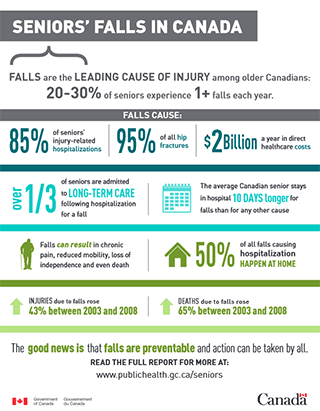
Falls account for approximately 85% of injury-related hospitalizations among older Canadians, according to the Public Health Agency of Canada. Their consequences can include emergency care, hospitalization, rehabilitation, and increased demand for community or long-term care services.
These services operate within finite resources, so every hospital bed occupied, every hour of professional care delivered, and every dollar allocated represents a resource that cannot simultaneously be used elsewhere.
When older adults remain in hospital because appropriate community supports are unavailable, the consequences extend beyond the individual patient. Hospital capacity is constrained, other patients may face delays, and scarce healthcare resources are used in ways that may not reflect the most appropriate level of care. While prevention cannot eliminate these pressures, it can influence when, where, and how resources are required, and thus enters occupational therapy.
The profession of occupational therapy contributes by identifying functional risks, adapting environments, and supporting individuals to both maintain and regain their ability to perform everyday activities. For OTs, the economic objective is preserving independence, dignity, and quality of life, and when we do that, we relieve the ever growing demand of resource scarcity in the system.
The macroeconomic consequences of aging
At a broader level, the economics of aging intersect with Canada’s workforce and productivity. When working-age Canadians reduce their participation in paid employment to care for aging relatives, the consequences often extend to employers through lost labour hours, reduced productivity, and presentee-ism just to name a few.
Across many households, these individual decisions can influence aggregate labour supply, economic output, and tax revenues. Meanwhile, increasing demand for healthcare and long-term care places additional pressure on public expenditures and an already constrained care workforce.
This creates an important challenge: how do we support an aging population without transferring unsustainable financial and caregiving responsibilities onto younger generations?
Part of the answer lies in recognizing functional independence as an economic consideration, not exclusively a healthcare outcome. This is what we do best as Occupational Therapists.
Prevention as an investment in economic resilience
Recent research commissioned by the Ontario Society of Occupational Therapy found that among Ontarians reporting barriers to making their homes suitable for aging, 56% cited cost, while 26% were uncertain about what modifications were needed.
These findings highlight two distinct challenges: affordability and access to appropriate guidance.
An effective intervention does not necessarily require an expensive renovation. Sometimes it involves improved lighting, assistive equipment, changes to daily routines, or relatively modest environmental modifications.
Other situations require more substantial investments or ongoing support. So, we ask, is prevention always cheaper? It is, when it is providing timely, appropriately targeted interventions which reduce avoidable downstream costs.
November marks both Fall Prevention Month and Financial Literacy Month. Their intersection reminds us that retirement planning should consider more than investment returns, inflation, and savings.
It should also account for the environments, supports, and functional abilities that allow people to remain independent as they age.
My grandmother’s grab bars were never a guarantee against future healthcare costs. They were a practical decision made before a crisis demanded one.
Financial Independence helps determine whether we can afford to retire. Functional Independence helps determine how we experience those retirement years. But you cannot have one without the other, because the loss of functional independence means the economic consequences rarely belong to one person alone. They end up shared by families, employers, healthcare systems, and ultimately, society.
 Lu Han is Chair of the Board of Directors for Ontario Society of Occupational Therapy, the provincial professional association. Lu is also an Occupational Therapist for the Government of Canada.
Lu arrived in Canada as a young Chinese immigrant, and at just 16 years old, she enlisted in the Canadian Armed Forces Reserve. Lu served for a decade, rising to Artillery Officer, until a foot injury led to her release. The OT who helped her recover tailored her rehab to her operational duties and eventual return to civilian life; that experience showed her how personal and purposeful OT can be. Lu went on to earn her own OT degree, and today, she is an occupational therapist with the Government of Canada, providing clinical leadership to the community rehab providers who support Canadian Veterans.
Lu is also an Assistant Clinical Professor (Adjunct) at McMaster’s School of Rehabilitation Science, a peer reviewer for the Canadian Institute for Military and Veteran Health Research (CIMVHR), and an MBA candidate at McMaster’s DeGroote School of Business. In 2020, she and her husband created the Diversity and Inclusion Scholarship for students from underrepresented communities pursuing medicine and OT.
Now, Lu provides strategic oversight for the provincial association representing occupational therapists and occupational therapist assistants across Ontario.