

 Posted By
By Billy and Akaisha Kaderli
RetireEarlyLifestyle.com
Special to Financial Independence Hub
I read an article by Mark Hulbert titled Why retirees are better off safe than sorry.
This article was about retirement satisfaction and asked if having little money, a reasonable amount of money or lots of money made a difference.
I have followed Mark’s writings for years and was surprised that Mark, to make his point, was hawking annuities.
Mark explains that you could put $100,000 into an annuity and receive $501 per month guaranteed for your lifetime. This equates to $6,012 per year or a 6% return.
My perspective and why
Here’s the problem that I have with this.
Inflation. As inflation has heated up after years being quiet, your $501 monthly check is going to buy you less and less over time. The erosion of buying power will not be noticed at first but over the years it certainly will. This is a huge negative for me.
Once you turn your money over to the annuity company, you no longer have control of it and possibly it is no longer part of your estate. This means you cannot leave it to your spouse, a child, grandchild or your favorite cause. And remember, your annuity is only as good as the company that backs it. If they have dereliction in management or other calamities you could be getting back pennies on the dollar. It happens.
In the example with this annuity It will take you about 16.5 years to break even with your investment.
What if you die before that?
My suggestion
There are other options if you have $100K and want a 6% yield for income and still keep control of the asset.
For instance, you could purchase any or all of these high yielding dividend-paying stocks.
AT&T (T) yield 4.04%
Plains All American Pipeline (PAA) yield 9.10%%
Energy Transfer (ET), yield 7.32%
Exxon Mobil (XOM), yield 3.84%
Main Street Capital (MAIN) yield 5.51%
In this example, you could put $20,000 into each of the above for a 5.96% average yield or $5,962 per year income. Also, there is potential for these equities to increase in value as well as raise their dividends. So, in this case, you have the possibility of being able to reinvest any amount over the 6% giving you the opportunity to increase your holdings while still covering the $6,000 annual income.
Other options
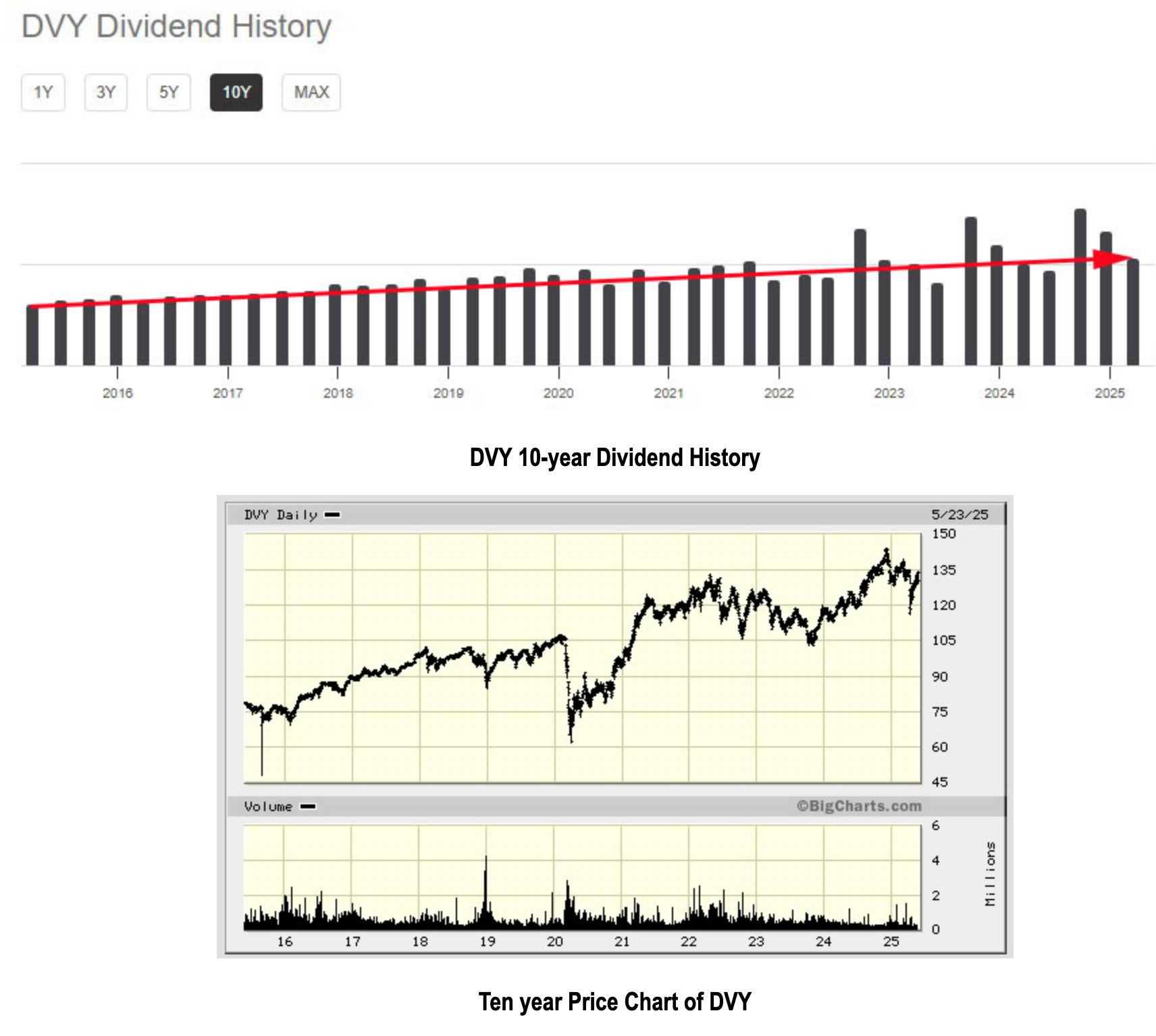
However, if you are not comfortable owning three out of the five stocks in the energy field, for more diversification, you could purchase DVY, IShares Select Dividend ETF with a portfolio of 100 different companies and with a 3.72% yield.
The idea here is to receive the 3.72% dividend distributions and sell off $2,280 worth of shares annually to make the 6% yield.
How is that done? You invest 100K into DVY taking the quarterly dividends which amount to a 3.72% yield. After one year-and-a-day (so that you meet the long-term capital gains requirement), you sell off $2,280 worth of shares.
DVY 10 Year Total Return = +9.40%
In this example based on the past 10-year performance of DVY, your principal would have grown to approximately $109,400, year one, which is a 9.4% annual total return. You receive $3720.00 in dividend income and $2280.00 in capital gains = $6000.00, leaving approximately $103,400 invested.
We all know that past performance is no indication of future results, but there are no guarantees in retirement, investments, nor annuities.
See the performance chart below.
In this example your tax liability would be lower because the shares that you sell would be taxed at a more favorable capital gains rate. Plus, DVY has a good history of increasing in value as well as increasing its dividend.
In either of these options you maintain control of your assets with the potential of your $100,000 increasing in value while at the same time still giving you the income you need.
So, in Mark Hulbert’s examples, playing it safe is like a death of 1000 cuts.
Between inflation eating away at your income and the loss of the $100K asset as being part of your net worth, these are two losing strategies. They might appear to be safe, but just as risk has a price, so does security.
 Billy and Akaisha Kaderli are recognized retirement experts and internationally published authors on topics of finance, medical tourism and world travel. With the wealth of information they share on their award winning website RetireEarlyLifestyle.com, they have been helping people achieve their own retirement dreams since 1991. They wrote the popular books, The Adventurer’s Guide to Early Retirement and Your Retirement Dream IS Possible available on their website bookstore or on Amazon.com. This blog first appeared at RetireEarlyLifestyle.com and is republished on Findependence Hub with their permission.
