All posts by Financial Independence Hub

A Canadian perspective on Health Care Overseas

By Akaisha Kaderli

Special to the Financial Independence Hub

Q and A with Jim McLeod and Retire Early Lifestyle

Billy and I are Americans. For most of our adult lives we have been self-employed, paying for our own health insurance out-of-pocket. We retired at age 38, and while initially we paid for a US-based Health Insurance policy, we eventually went naked of any health insurance coverage. Wandering the globe, we took advantage of Medical Tourism in foreign countries and again, paid out-of-pocket for services. This approach served us very well. However, we understand that choosing the manner in which one wants to pay for and receive health services is a personal matter.

In our experience, it seemed that Canadians generally were reluctant to stay away from Canada longer than six months because they would lose their access to their home country’s health care system. We did not know the full story of why many Canadians preferred not to become permanent residents of another country due to this healthcare issue. So, we asked Canadian Jim McLeod if he would answer a few questions for us to clarify! Below is our interview with Jim McLeod. He and his wife are permanent residents of Mexico, and now receive all their healthcare from there. It is our hope with this interview, to shed light on some options for Canadians who might not want to maintain two homes, be snowbirds in Mexico, or who could envision living in Mexico with its better weather and pricing.

Jim and Kathy in Mexico

Retire Early Lifestyle (REL): In the beginning, did you choose to do a part-time stint in Mexico before fully jumping in? You know, like to test the waters?

Jim McLeod (JM): Yes. Because of the following stipulations for our Ontario Health Insurance Plan (OHIP) and the possibility of getting a maximum of 180 days on a Mexican Tourist Card, we decided to do the “snowbird” thing initially: 6 months in Ontario during the warmer months, and 6 months in Mexico during the colder months. You cannot be out of Ontario for more than 212 days (a little over 6 months) in *any* 12 month period (ex. Jan – Dec, Feb – Jan, Mar – Feb, etc.) During this time, we used World Nomads for trip insurance to cover us while in Mexico. For us, this wasn’t too bad. However, according to other couples we’ve spoken with, after a certain age, depending on your health, this can become quite expensive.

Leaving the safety net behind

REL: When you retired early and left your home country of Canada, was leaving the guaranteed health care system that your country provides a large hurdle to your plans? How did you factor that cost in?

JM: After doing the snowbird thing twice, we had enough data from tracking all our spending, as per Billy and Akaisha’s The Adventurer’s Guide to Early Retirement, that we knew we would save approximately $10,000 CAD a year by moving full time to Mexico.  And we knew we would lose our OHIP coverage. As such, we budget $2000 CAD a year for out-of-pocket medical expenses. But we also knew that, at that time, we qualified for the Mexican Seguro Popular insurance coverage. Note: Seguro Popular has since been replaced with a new health Care system, el Instituto Nacional de Salud para el Bienestar (INSABI), which has the following requirements: Be a person located inside Mexico, Not be part of the social security system (IMSS or ISSSTE), Present one of the following: Mexican Voter ID card, CURP or birth certificate. As an expat, in order to obtain a CURP, you must be a Temporal or Permanent resident of Mexico.

REL: Initially, did you go home to Canada to get certain health care items taken care of and then go back to Mexico to live?

JM: No, we have not gone back to Ontario for any health care. Having said that, there is one medication that Kathy needs, that she is allergic to here in Mexico, so she gets a prescription filled in Ontario whenever we return and we pay for it out-of-pocket.

REL: What sort of medical treatments have you received here in Mexico? Continue Reading…

How to enjoy your retirement while getting paid

By Carlos Blanco

Special to the Findependence Hub

Spending a week in Napa’s wine country, enjoying the good life during retirement, and meeting new friends. Sounds like a dream, right? Having the chance to do all this and be paid might sound too good to be true, but I assure you: it’s possible!

For more than a year, I’ve been using an app called Instawork to pick up shifts whenever and wherever I want. I found the platform through a friend and began using it to pick up shifts in order to build a work schedule that best suits my personal schedule. It’s been a wonderful experience where I’ve been able to meet new people and experience different facets of the world. As a friendly guy who likes socializing, it’s been a perfect fit for me.

Prior to using Instawork, I worked as a journalist. That ranks up there as one of the most stressful careers you can have. That kind of stress can take a toll on you after a while and with me it did. The hospitality shifts I’m working now are much more relaxed and I’m truly enjoying myself. From coordinating and assisting at events throughout the year to interacting with clients and guests at a variety of different locations, no two shifts are the same. As an added bonus, I can expand my budding coaching career and attract new clients from different walks of life.

Despite Great Resignation, many still want to work

There’s a lot of talk right now in the news about the Great Resignation and the Great Reshuffle and how people don’t want to work or how the economy is dying. The pandemic shook everything up and made a lot of people reevaluate how they were living their lives and what they wanted out of work. In my view, the economy is not dying and people absolutely do want to work. They just want to do things their way, on their terms, be treated fairly, and to get paid well while doing it. The country and its hourly workers are in a period post-pandemic, where people are just transitioning from one place to another and deciding what type of jobs works best for them. Continue Reading…

Value, Growth, or Both?

Franklin Templeton/iStock

By Ryan Crowther, Portfolio Manager, Franklin Bissett Investment Management

and Yan Lager, Portfolio Manager, Equity Research Analyst, Franklin Equity Group

(Sponsor Content) 

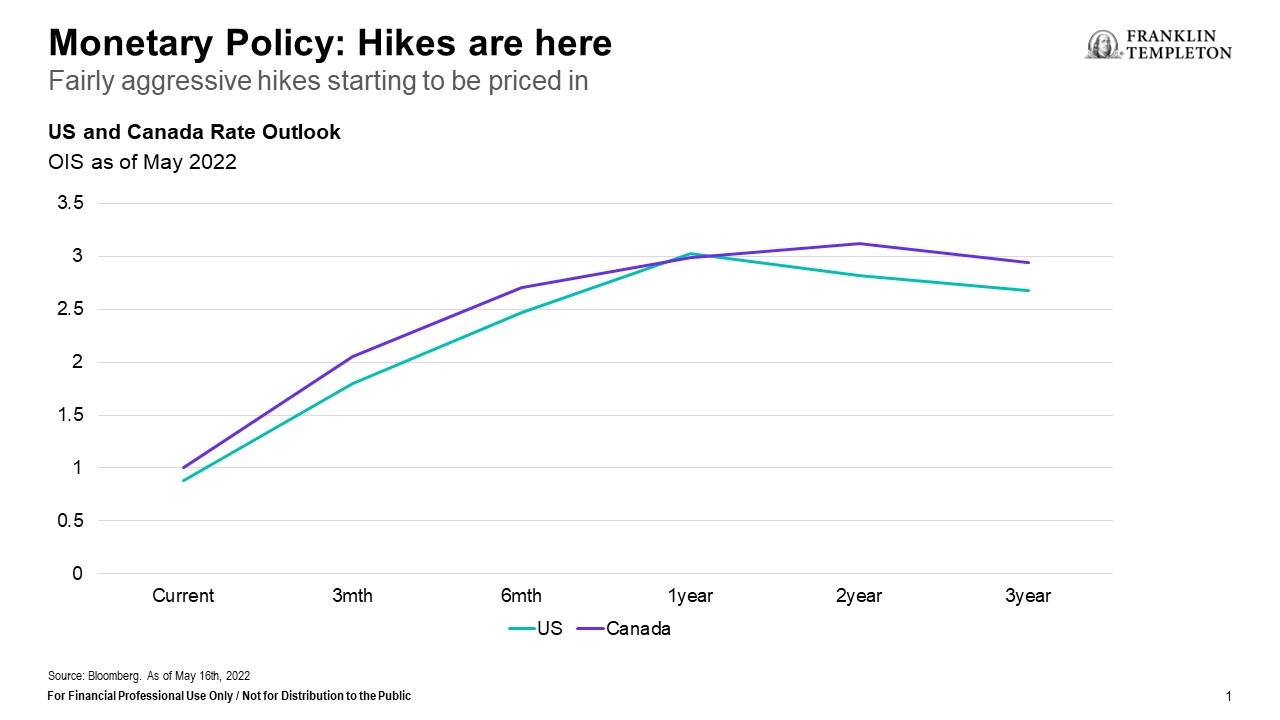
For well over a decade, investors have focused on growth stocks: shares of companies expected to grow faster than the market average. But in recent months, the calculus has changed. Market volatility, driven by ongoing COVID-19 concerns, Russia’s invasion of Ukraine, rising interest rates and inflation, has led to a noticeable shift to value stocks. As investors focus on companies with strong fundamentals and comparatively lower-cost shares, do growth stocks still have a place in a diversified portfolio?

Financial Independence Hub: How would you describe the current landscape for growth stocks?

Yan Lager: We’ve been witnessing one of the most pronounced rotations from growth to value stocks in decades. In retrospect, following a multi-year run for growth-oriented equities that were clear beneficiaries of ultra-low interest rates, a rotation to value stocks as interest rates increase is not surprising to us.

Ryan Crowther: Looking at growth stocks generally, the terrain has become much more challenging in recent months, both in terms of the outlook for business fundamentals and a more discerning investor sentiment.

Have all growth stocks been hit equally hard?

Ryan Crowther: This is an important question, because when there’s a broad sell-off and a significant number of stocks drop sharply, they might all be considered “growth” stocks; but do they really share the same fundamentals? What risk versus return is the share price truly discounting? That’s where our GARP approach (growth at a reasonable price) has proven powerful for over 40 years, as it helps avoid focusing too much on whether a stock sits in the growth or value basket.

Which stocks have been most affected by the recent pullback in equity markets?

Yan Lager: Companies that benefited from the pandemic shift to working from home and the broader adoption of e-commerce, or persistently low interest rates, have seen their shares pull back due to profit-taking or concerns that future earnings performance may fall short of pandemic-high levels. Harder-hit stocks have included earlier-stage companies in the information technology sector, which have seen significant price and valuations fluctuations. We’re constantly reassessing the fundamental, longer-term investment theses and strategic merits of our investments.

What types of companies do you look for?

Yan Lager: In managing a global growth fund, we believe that owning a diversified portfolio of high-quality companies with strong secular growth drivers, unique competitive positions and capable management teams can deliver attractive returns, as ultimately share prices follow fundamentals. This is particularly the case if you’re investing for the long term, which we believe you should be if you’re investing in equities.

Ryan Crowther: We look for businesses with strong, consistent earnings and growing cash flow—attributes that will hopefully work to offset some of the factors that can challenge growth in the near term. In addition, a company’s valuations must also be attractive. We focus on combing through our investment opportunity set to find stocks offering a good risk-adjusted return profile over the course of an economic cycle.

Where are you finding opportunities these days?

Ryan Crowther: Focusing on mid- to large-cap Canadian companies, we’ve been active in securities that sold off as part of the broad weakness in growth stocks. We took advantage of that weakness to add new, quality companies at an attractive entry point. The shift — from the largely complacent and speculative equity market generally experienced throughout the pandemic — to the less forgiving market, characterized by a more rational mindset thus far in 2022, has created opportunities for us. Continue Reading…

Tax season is over: or is it?

To reduce future tax bills, now is the time to start planning

By Rob Cordasco

Special to the Financial Independence Hub (American Content)

With this year’s income-tax-filing deadline finally past, you may have sat back with a sigh of relief, happy to forget about taxes for another year. But that’s a mistake because it’s already time to start thinking about taxes for next year if you hope to lower the amount you ultimately will owe, says Rob Cordasco (www.cordasco.cpa), a CPA and author of A Framework for Growth: Smart Financial and Tax Planning Strategies Throughout the Entrepreneurial Life Cycle.

“People often make the error of only worrying about taxes when it’s time to file,” Cordasco says. “By then, your taxes are pretty much locked in. Although you can’t avoid taxes, you can take steps to minimize them. But this requires proactive planning – estimating your tax liability, looking for ways to reduce it and taking timely action.”

And timely, he says, isn’t waiting until the week before the filing deadline. The real deadline for taxes in the United States – at least for taking action that could save you money – is Dec. 31 of the tax year, he says. (One exception is that you may be able to make a tax-deductible IRA contribution right up to the filing deadline if you meet certain criteria.)

Cordasco says some things to consider that can help you reduce the tax bill you will owe come April 2023, include:

“Bunch” charitable donations

Many people take the standard deduction when they file their taxes because that’s higher than their total itemized deductions. But Cordasco says you might benefit from “bunching” your charitable donations in alternating years, raising the amount you could itemize every other year. Here’s how that would work: If you make a large donation on Jan. 1 and another on Dec. 31, those donations are essentially a year apart, but they fall within the same tax year for itemizing purposes. In effect, you make two years worth of charitable donations in one tax year. Continue Reading…

Everything owned by Warren Buffett’s Berkshire Hathaway

Warren Buffett of Berkshire Hathaway, which just held its first live annual meeting since Covid hit.

By Akshay Singh

Special to the Financial Independence Hub

You’ve probably heard of the multi-billion dollar company Berkshire Hathaway, owned by mega-billionaire and philanthropist Warren Buffett, but what does Berkshire Hathaway do exactly?

Berkshire Hathaway Inc. is a conglomerate holding company, meaning it does not produce goods or services and instead has a controlling interest in and owns shares of other companies to form a single corporate group.

That leads us to our next question: What companies does Berkshire Hathaway own to make it one of the most valuable companies on the planet? The team at Indyfin turned to the 2021 Berkshire Hathaway annual report to create this compendium of all of the Berkshire Hathaway companies. The holding company has a controlling interest in more than 60 companies and partially owns another 20 on top of that. You’ll recognize a lot of brand names from a wide variety of industries that make up the impressive Berkshire Hathaway portfolio.

Does Berkshire Hathaway own one of your favorite or most-used brands? Check out this roundup of Berkshire Hathaway companies from Indyfin to find out.

What Is Berkshire Hathaway?

Berkshire Hathaway is an American conglomerate holding company with a market cap of US$774.24 billion, making it the seventh most valuable company in the world. What is a conglomerate? A conglomerate is a combination of businesses from a variety of different industries that operate as a single economic entity under one corporate group. Conglomerates are usually large and multinational and generally include a parent company and many subsidiaries. The “conglomerate fad” was big in the 1960s due to low interest rates, rising prices, and a decline in the stock market, which led to large corporate conglomerates like Berkshire Hathaway forming. The parent company in this scenario is also referred to as the holding company, as it holds a controlling interest in the securities of all of the other companies. Holding companies do not produce goods or services; instead, they own shares of other companies to form a single corporate group. Holding companies are beneficial because they reduce risk for shareholders and can hold and protect assets like trade secrets or intellectual property.

What Does Berkshire Hathaway own? Continue Reading…