By Shael Weinreb, CEO and Founder of The Home Equity Partners
Special to Financial Independence Hub
November marks Financial Literacy Month, a time when Canadians are encouraged to “Talk Money” and build confidence in their financial decisions. When it comes to one of the biggest financial assets we own, our homes, though, that conversation is still far too narrow.
Right now, one message dominates the conversation: if you’re a homeowner struggling with affordability, a reverse mortgage is your best bet. Reverse mortgage rates are dominating headlines, even for retirees aging in place, but it’s making the alternative financing conversation biased and incomplete.
There’s no denying that reverse mortgages can be useful for some. They provide cash on hand, but they also saddle investors with new debt, compound interest, and a shrinking equity stake over time.
As someone who spends every day helping homeowners unlock equity without new debt, I see the same pattern over and over. People feel backed into a corner because they’re told they only have one choice. That needs to change.
The Alternative no one’s talking about
There’s another way to access your home equity, one that doesn’t involve taking on more debt or losing control of your home. It’s called a Home Equity Sharing Agreement (HESA).
Here’s how it works: a HESA gives you a lump sum today in exchange for sharing a portion of your home’s future appreciation. You keep full ownership and control. There are no monthly payments, no interest, and no loan sitting on your balance sheet.
When you sell (or buy out the agreement), the investor shares in your home’s gain or loss. It’s a partnership, not a payday loan in disguise.
This model works for a much broader group than reverse mortgages: homeowners under 55, people who can’t borrow enough through traditional channels, or anyone who wants to protect their equity while sharing market risk.
At The Home Equity Partners, we’ve helped clients use this model to pay off debt, fund renovations, or supplement retirement income without taking on new financial stress.
Why you haven’t heard of it
The simple answer? Awareness. Most advisors are trained on debt-based tools such as mortgages, HELOCs, and lines of credit because that’s what the industry sells. Reverse mortgages fit neatly into that mold. HESAs don’t. Continue Reading…
When most people are touting the stock market is “too high” to invest in, then, well, it probably is…
The challenge is, as I have personally experienced over the years as a DIY investor, there is no guarantee that all-time-highs don’t keep happening. You just don’t know when the party will end.
I recognized many, many years ago, I cannot time the market so I don’t even bother. Which makes my investing philosophy extremely simple when it comes to market highs or lows, I just keep buying when I have the money to do so.
That’s it.
As the Humble article suggests, any market-timing strategies, appealing as they might seem are usually very unreliable in practice. And if you are unsure about whether you should invest at all, then at least prepare things could get worse.
“That’s why this is a good time — while the market is strong — to prepare, even if we can’t predict.”
And it’s whispered that soon if we all call the tune
Then the piper will lead us to reason And a new day will dawn for those who stand long
And the forests will echo with laughter
Stairway to Heaven, by Led Zeppelin
By Noah Solomon
Special to Financial Independence Hub
At the end of last year, the S&P 500 Index was valued at about 23 times estimated earnings over the coming year, which was significantly above its historical average. By mid-March of this year, the index had declined by roughly 10%, driven by unspectacular economic growth, inflation rates that remained stubbornly high, and related concerns that valuations reflected unwarranted optimism.
These growing concerns morphed into widespread panic on April 2nd, when the U.S. imposed tariffs on imported goods that were more severe than had been anticipated. Broad-based fears that tariffs would cause higher inflation, slower growth, or perhaps even a recession spurred a sharp drop in stock prices, with the S&P 500 falling another 5%, bringing its year-to-date loss to 15% at its low point on April 8th.
Fast forward to the present, and all is once again right in the world. The U.S. administration delayed many tariff deadlines, and those tariffs that have been imposed are below the levels that were initially announced. In addition, the feared inflationary impact of tariffs has not yet materialized. These better-than-expected developments have soothed markets, with the S&P 500 advancing 35% from its low point of the year, leaving its year-to-date gains at nearly 15% as of the end of September.
The trillion-dollar question is whether markets are currently reflecting realistic expectations. To the extent that sensible assumptions regarding risk and reward are embedded in current security prices, investors should stay the proverbial course. Conversely, portfolio adjustments are warranted if expectations are unreasonably optimistic.
Not all FOMO is Created Equal
Emotions and behavioral biases have exerted and will always exert a huge influence on investors’ decisions. Perhaps one of the most common among these is fear of missing out (FOMO), which is “the anxiety or apprehension that one is missing out on rewarding experiences, information, or events that others are having.”
Whereas FOMO can often be irrational, thereby leading to poor decisions and results, at times it can be a positive force, spurring investors to act in ways that can bolster returns.
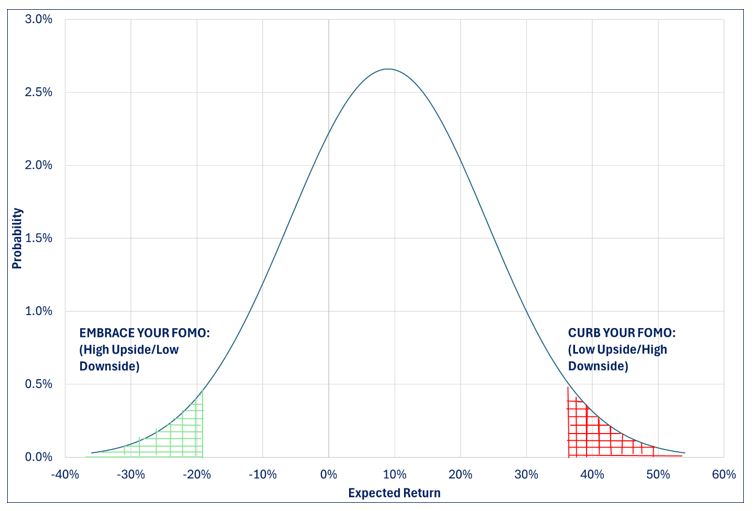
Embracing vs. Shunning FOMO: It’s all about the Odds
Historically, when markets have been saturated with a “nothing can go wrong/it can only go up” mindset, returns over the ensuing several years have fallen somewhere between subpar and negative. In such environments, those who have tempered their FOMO have achieved better returns than those who have not. Conversely, when markets have been replete with a “things can only get worse/the sky is falling” mentality, returns over the next few years have been significantly higher than average. In such circumstances, investors who have embraced their FOMO have reaped significant rewards.
If only things were so simple
Clearly, you can achieve better than average results from taking less risk when prospective returns are below average and from taking more risk in environments where prospective returns are above average. Unfortunately, there is no precise gauge (or collection of gauges) that offer any degree of certainty or precision with respect to either of these extremes. Continue Reading…
• Gold is shining again; prices have surged to record highs this year and are forecast to climb further.
• Central banks are buying at a record pace, while investors seek protection from rising debt and currency debasement through gold ETFs.
• BMO’s gold ETF suite offers choice: ZGLD for stability, ZGD for growth, and ZJG for high-octane exposure.
Gold shines in 2025
By Erin Allen, Director, Online Distribution, BMO ETFs
(Sponsor Blog)
Gold’s reputation as an ancient store of value has rarely felt more modern.
The metal has been one of 2025’s standout performers among major asset classes, surging to record highs of around US$3,900 per ounce as of September 2025. The rally has been fueled by central bank buying, rising fiscal concerns, and investors seeking protection from a weakening U.S. dollar.
BMO Capital Markets recently lifted its gold price forecasts to an average of US$3,900 for the final quarter of 2025 and US$4,400 for 2026, reflecting what analysts describe as structural changes in the geopolitical and financial landscape¹.
The key driver: debt. With deficits in the U.S., Japan, and Europe ballooning, gold is increasingly being viewed not just as a safe haven, but as a strategic hedge against long-term currency debasement.
In this piece, we unpack what’s driving gold’s renewed strength, assess whether it’s sustainable, and outline ways investors can gain exposure through BMO ETFs from the physical metal itself to large and small-cap miners.
Central banks are quietly building reserves
One of the biggest tailwinds for gold has been record levels of central bank buying.
According to Reuters, central banks now hold 36,000 tonnes of gold, having added more than 1,000 tonnes annually for three consecutive years². This surge reflects a broad reassessment of what constitutes a safe asset.
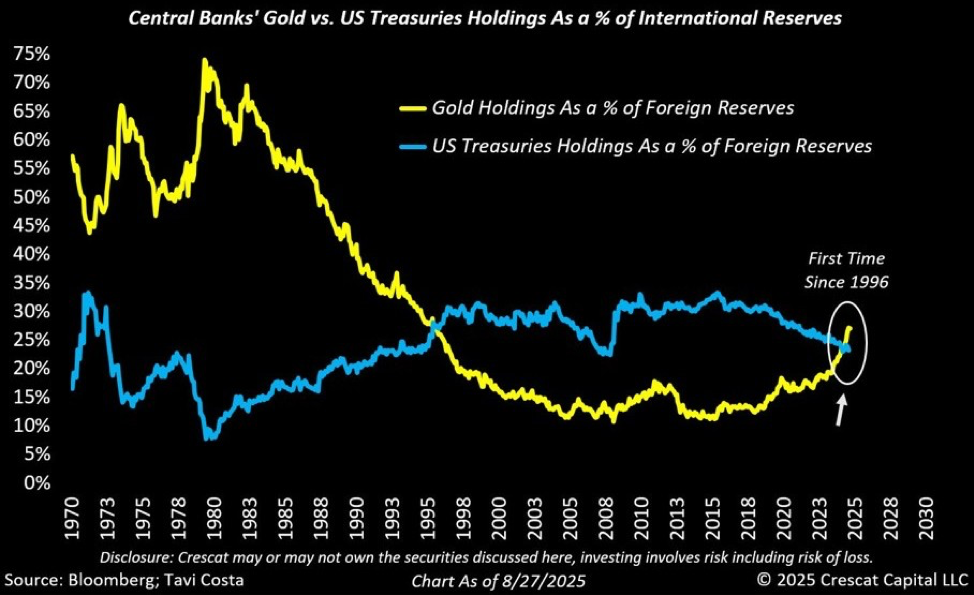
Geopolitical instability and questions over the long-term stability of U.S. Treasuries have prompted central banks to diversify reserves. Gold has even overtaken the euro to become the second-largest global reserve asset, and for the first time since 1996, represents a larger share of reserves than Treasuries².
Chart 1: Foreign central banks hold more gold than Treasuries
Gold fell from 75% to 15% of reserves; Treasuries rose and surpassed gold holdings around 2023 for central banks.
The World Gold Council notes that while emerging markets typically hold 5–25% of their reserves in gold, developed economies hold more than 70%³. This steady official-sector accumulation underscores the global shift to tangible assets amid growing fiscal and political uncertainty.
Trade tensions and currency debasement fears
Gold’s strength also reflects what Bloomberg calls the “debasement trade.” As government debt piles up and fiscal discipline erodes, investors are moving out of major currencies and into alternative stores of value such as gold, silver, and Bitcoin⁴.
The U.S. dollar is down roughly 8% year-to-date, while gold continues to post record highs. Bloomberg notes that the current cycle echoes previous bouts of U.S. dollar weakness following the global financial crisis and periods of aggressive monetary easing⁴.
As George Heppel, Vice President, Commodity Research at BMO Capital Markets, explains, both cyclical and structural forces are converging¹:
“What we’re really seeing this year is the combination of a short-term thesis and a long-term thesis for holding gold, which has created a perfect storm for the metal. And naturally all of this increases concerns around sticky or growing inflation and the potential for negative real rates next year, which makes gold an attractive asset to be holding as an inflation hedge,” he says.
With U.S. debt climbing and political gridlock persisting, investors have reason to question the durability of fiat currencies. Gold, with no counterparty risk and a finite supply, has reasserted its role as a monetary anchor.
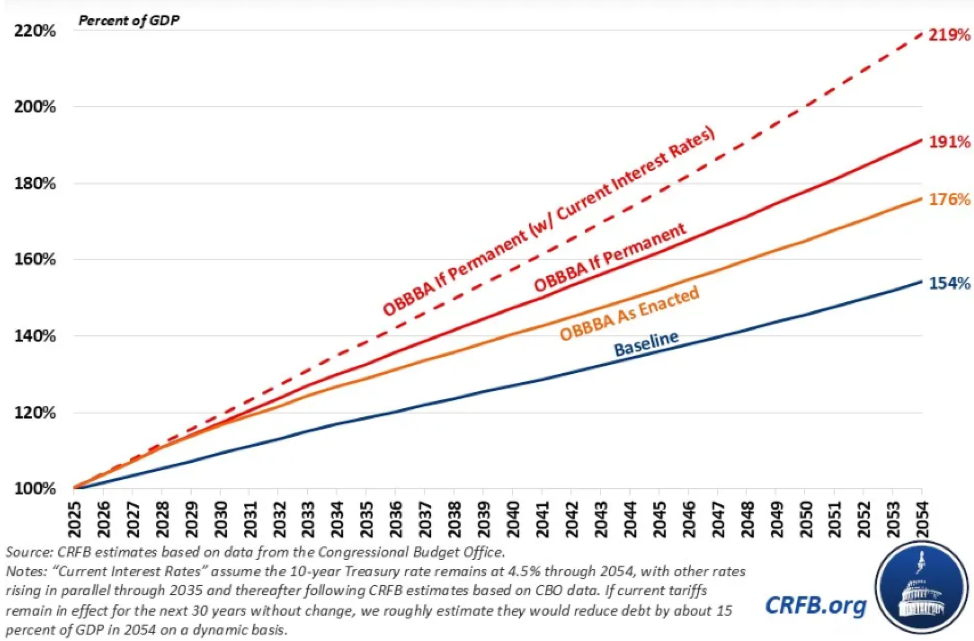
According to the Congressional Budget Office (CBO), the recently passed One Big Beautiful Bill Act (OBBBA) – also known as the “Trump tax cuts” – will add an estimated US$19 trillion to U.S. debt over 30 years as written, or US$32 trillion if made permanent⁵.
“The passage of OBBBA will put tremendous pressure on the nation’s fiscal and economic health. Layered onto an already unsustainable outlook, the new law increases the risk of higher interest costs, slower growth, volatile markets, and reduced capacity to respond to future crises or invest in national priorities,” the CBO warned.
Chart 2: Debt soars under OBBBA
Projected U.S. debt-to-GDP rises sharply from 2025 to 2054, peaking at 219% under the highest scenario in the chart.
All logos and trademarks of other companies and/or organizations are the property of those respective companies and/or organizations.
Gold ETF demand surges to near-record levels
While central banks are leading the charge, investors are not far behind.
According to ETF.com, global gold ETFs have attracted US$44 billion in inflows this year, equivalent to roughly 443 metric tonnes of the metal⁶. That puts 2025 on track to rival the record US$49.5 billion set in 2020: the strongest year ever for gold-backed funds. Canada alone saw over $1B flow into commodity ETFs, largely driven by gold, according to National Bank of Canada’s September flows report.
Gold ETFs have become the preferred way to access gold, offering liquidity, transparency, and simplicity: all without the complications of physical storage.
Investment banks turn bullish
Institutional sentiment has followed suit.
BMO analysts believe the gold market is undergoing profound structural change, driven by debt, inflation, and de-dollarization. The bank has raised its long-term gold-price assumption to US$3,000 per ounce, up from US$2,200, placing it near the top of sell-side consensus¹. Continue Reading…
Can you really achieve Financial Independence when you still have a mortgage looming over you? Our insights will help you avoid feeling trapped by payments.
Image: Iryna for Adobe
By Dan Coconate
Special to Financial Independence Hub
Achieving Financial Independence early brings freedom, flexibility, and opportunities. But entering this new chapter requires thoughtful planning, especially when it comes to housing.
Avoid being trapped by a mortgage in early retirement by adopting a strategic approach that aligns with your financial goals. Whether you plan to downsize, relocate, or stay put, being proactive can preserve your hard-earned independence without a mortgage becoming a financial burden.
Below are five essential tips to guide you through managing your mortgage while protecting your financial independence.
Prioritize Paying off your Mortgage
Carrying a mortgage into Financial Independence can feel like dragging a heavy anchor. If you can, aim to own your home outright before retiring early. This eliminates one of the largest monthly expenses, giving you greater control over your budget. Many Canadians find success by accelerating their payments or making lump-sum contributions when possible. Debt-free living provides immense peace of mind and opens up new possibilities for pursuing the lifestyle you envisioned.
Consider Downsizing
Scaling down your home can offer financial and lifestyle benefits. Downsizing can free up home equity, reduce maintenance costs, and even lower property taxes. However, a well-thought-out plan ensures you don’t trade your current home for another financial burden.
It is possible to buy a new home before selling yours: you just need to be strategic about it. You also don’t have to limit yourself to smaller square footage; consider homes in less expensive areas or those better suited to your needs.
Explore Passive Income from Real Estate
Turning your property into a source of income can significantly offset costs. For instance, renting out a portion of your home or owning a rental property can transform your mortgage payment into a cash-flow opportunity. Many pursuing Financial Independence have increasingly tapped into short-term vacation rentals or long-term tenants to supplement their budgets. Proper research and planning ensure this approach aligns with your goals while providing notable financial advantages. Continue Reading…


 Posted By