Hub Blogs

Hub Blogs contains fresh contributions written by Financial Independence Hub staff or contributors that have not appeared elsewhere first, or have been modified or customized for the Hub by the original blogger. In contrast, Top Blogs shows links to the best external financial blogs around the world.

Building Wealth through Property Investment in Emerging Geoarbitrage Destinations

Image by Stefan Schweihofer from Pixabay

By Devin Partida

Special to Financial Independence Hub

Finding new ways to build wealth beyond traditional investment options requires thinking outside the box. Geoarbittage may be one of the most interesting ways to embrace property investment with a decent return on investment (ROI). Wise investors are finding ways to overcome cost-of-living increases by studying the price differences between areas and investing in emerging global markets. In Canada, some areas have high real estate prices and capped rental fees, making investing locally less attractive.

Geoarbitrage is the practice of earning income in a high-cost area, such as major cities around the globe, but living in a lower-cost-of-living location. Earning more while paying less allows anyone to stretch their money. Property investment is just one branch of the larger geoarbitrage concept.

Using Geoarbitrage as a Property Investment Strategy

Although the June 2025 jobs report shows an increase of 147,000 jobs and an unemployment rate of 4.1%, the numbers may not show the full impact of rising costs on middle- and low-income families. Real estate investing can help pull people out of generational income gaps or maintain family wealth for future heirs.

Property investors looking for more powerful approaches to increase wealth quickly understand that investing in real estate with low entry and high growth equals significant appreciation. You can gain passive rental income and diversify your holdings nationally or internationally.

A geographically diverse portfolio also protects your investments from market fluctuations. Values may drop in one city but remain steady or grow in another. You can work alongside investment partners to increase long-term financial health, finding the right collaborations in each area and learning strategic moves to gain the most profit.

Current Geoarbitrage Hot Spots

Although the properties that make the best investments change rapidly as housing markets shift, some of the major players you should consider in 2025 include:

1.) Philippines

The country is seeing a lot of infrastructure development, making big cities the ideal location for investment. Some of the pros of buying property in the Philippines include their growing middle class with needs for rentals and high potential returns. Do be aware of foreign ownership restrictions, such as for condo ownership. Aligning with a locally based partner may be the way to go if you want to invest in condominiums. Continue Reading…

What Canadians need to know about Trump’s Big Beautiful Bill

BDO Canada’s Jason Ubeika was a guest on Darren Coleman’s Two Way Traffic podcast to discuss Trump’s Big Beautiful Bill.

Image posted on X’s White House Account

By Jason Ubeika, BDO Canada LLP

Special to Financial Independence Hub

U.S. President Donald Trump signed the One Big Beautiful Bill Act into law on July 4. It involves a staggering US$4.5 trillion in tax cuts over the next decade and focuses on his tax agenda: the idea being to boost jobs, incentives and business investments south of the border.

The bill extends legislative changes from Trump’s first term and introduces some new provisions that offer both favorable and unfavourable changes for individual taxpayers.  Key provisions that could impact Canadians are:

  • permanent increase to the estate and gift tax exemption;
  • changes to controlled foreign corporation rules;
  • a new 1% excise tax on remittance transfers to persons outside the U.S.;
  • introduction of Trump accounts for savings for qualifying children; and
  • various changes to income tax rates, deductions and credits.

Thankfully, the originally proposed new Section 899 was removed from the final version of the bill. It would have imposed retaliatory U.S. taxes on residents of countries imposing “unfair foreign taxes,” and could have raised U.S. withholding taxes and income taxes on a variety of types of U.S. source income received by Canadians.

Estate and gift tax exemption

The bill will increase the harmonized estate tax exemption and lifetime gift tax exemption amount for U.S. citizens and resident aliens to US $15 million in 2026, indexed annually to inflation. Unlike past legislation, there is no “sunset clause” where the legislation is scheduled to expire on a certain date and the exemption reverts to the previously legislated amount. The current harmonized exemption for 2025 is just under US$14 million and was supposed to decrease by half in 2026 to slightly over US$7 million.

What are the implications for Canadians? Canadians are generally subject to U.S. estate tax upon death, based on the fair market value of U.S. situs assets; this includes U.S. real estate and shares of U.S. corporations held at death: even U.S. marketable securities held in a Canadian brokerage account. However, Canadian residents have access to the same estate tax exemption as U.S. individuals by virtue of the Canada-U.S. tax treaty. As a result, Canadians are generally not subject to U.S. estate tax on death if their worldwide net worth is below the exemption amount in effect at the time of death. The exemption is effectively at least doubled if assets pass to a surviving U.S. noncitizen spouse. No sunset clause means Canadians will face less uncertainty with respect to U.S. estate tax planning.

Canadians are generally subject to U.S. gift tax based on the fair market value of tangible U.S. situs assets (e.g. U.S. real estate) that they gift during their lifetime. Unlike for estate tax, the treaty does not provide an enhanced gift tax exemption, and annual exemptions under U.S. domestic tax law are limited. For 2025, the annual taxable gift exclusion is US$19,000 per recipient (US$190,000  for gifts to a U.S. noncitizen spouse). Gifts above these annual exclusion amounts are subject to gift tax at graduated rates ranging from 18% to 40%.

Controlled foreign corporation (CFC) rules

A CFC is generally a non-U.S. corporation where more than 50% of the stock (based on aggregate voting power or value) is owned by U.S. shareholders. A U.S. shareholder is a U.S. taxpayer who owns shares representing at least 10% of the votes or value of all stock of the corporation. Such shares can be owned directly or indirectly: even constructively, based on shares owned by certain related parties.

Under the bill, U.S. shareholders of CFCs became subject to tax on global intangible low-taxed income (GILTI) in 2018, even if the income was not distributed to the U.S. shareholder. Conceptually, this represents the after-tax active business income of a CFC. The bill renames GILTI as net CFC tested income (NCTI). Prior to the bill, U.S. shareholders of CFCs were only subject to accrual-based taxation of subpart F income, which conceptually represents non-business income of a CFC.

As for favourable and unfavorable changes to the NCTI calculations, effective in 2026, the bill:

  • repeals the reduction of NCTI for the deemed return on qualified business asset investment,
  • reduces the Section 250 deduction from 50% of NCTI to 40%,
  • limits foreign tax credits to 10% of NCTI instead of 20%,
  • limits expenses allocable to NCTI to the section 250 deduction and directly allocable expenses, and
  • renders interest expenses and research and experimentation expenses not allocable to foreign-source NCTI.

Other changes to the CFC rules include:

  • permanent extension of the look-through rule for CFCs, where dividends, interest, rents and royalties received or accrued from another CFC are not taxed under the subpart F rules;
  • modifying pro rata share rules for subpart F income to apply to U.S. shareholders owning the CFC at any point during the year, rather than at the end of the year;
  • restoring the limitation on downward attribution of stock ownership; and
  • introducing Section 951B to apply the NCTI and subpart F rules beyond U.S. shareholders of CFCs, such that they apply to structures including foreign controlled U.S. shareholders and foreign controlled foreign corporations.

Implications for Canadians

What then are the implications for Canadians? The CFC rules apply to Canadian residents who are U.S. persons (i.e. U.S. citizens or Green Card holders) and who directly, indirectly or constructively own shares representing more than 50% of the total votes or value of Canadian private companies and other non-U.S. private companies.

The net effect of the changes to the Section 250 deduction and the foreign tax credit limitation are that the minimum effective foreign corporate tax rate necessary to be paid by a CFC to fully offset U.S. tax on NCTI increases from 13.125% to 14% for a U.S. corporate shareholder of a CFC, which is taxed at 21%. A U.S. individual shareholder can make an election under Section 962 to be taxed as a U.S. corporation for the purposes of the CFC rules. For Canadian CFCs generating NCTI, the Canadian corporate tax may not meet this threshold, particularly if the small business deduction is claimed.

Excise tax on remittance transfers

Effective in 2026, the bill requires that a new 1% excise tax on certain remittance transfers be collected by the remittance transfer provider and paid quarterly to the U.S. Treasury. The tax imposed will apply only to any remittance transfer for which the sender provides cash, a money order, a cashier’s check, or any other similar physical instrument through a remittance transfer provider to an account outside the U.S. Continue Reading…

7 top 401(k) mistakes Beginners make: and how to avoid them

Image by Freepik

By Donnell Stidhum 

Special to Financial Independence Hub

You may think that saving towards retirement is something that can be put off in the future, but as a matter of fact, what happens (or fails to happen) to your savings during your early working years could spell the difference between your retirement savings and failed retirement savings.

One of the most effective tools out there is the 401(k). However, with power, people have responsibility, and regrettably there are a lot of mistakes that are made by beginners that are entirely unnecessary to make. And in the long run it can cost very dearly.

Here are some of the most common 401(k) mistakes beginners make: and how to avoid them.

1.) Not Contributing early enough

It is common and pitiful that most young professionals do not put money into their 401(k) in the belief that they would start the following year when they would have more income and fewer bills. However the greatest benefit of a 401(k) is compounding as you go and the sooner the better.

How to avoid it: Add money to your 401(k) as soon as you can as much as possible (even if it is just 3 per cent of your income). Slowly adding to your payments can change a tremendous amount with time.

2.) Missing out on Employer Match

If your employer offers to match a percentage of your contributions, that’s free money: but many beginners either don’t contribute enough to get the full match or miss it entirely.

How to avoid it: At least contribute sufficient to allow the employer to give full match. E.g. say your company is matching 50% of the first 6% you put in, then you should at least be putting in 6% yourself.

3.) Being unaware of different types of 401(k) accounts

Some 401(k) plans are not equal. Not all beginners are aware that there are various types of 401(k) and most people are not aware that there are different types of 401(k) most popular being Traditional and Roth 401(k)s and that they are quite different in their tax advantages.

  • A Traditional 401(k) lowers your taxes now, but you will pay taxes in retirement when you retire.
  • A Roth 401(k) is a contribution with after-tax money, which means that money can be taken out at retirement without incurring a tax.

How to avoid it: Educate yourself on the various characteristics of both Traditional and Roth 401(k). A Roth 401(k) may be more sensible to invest in currently, should you anticipate moving to a higher bracket as you get older. Continue Reading…

Securing your family’s Financial Future: Advanced Planning Techniques for 2025

Image from Pexels: Olia Danilevich

By Devin Partida

Special to Financial Independence Hub

Life is unpredictable and as the economic landscape evolves, driven by inflation, health care expenses, tax reformation and global volatility, families need to consider proactive financial strategies. Your plan should include strategic trusts, tax optimization and investment frameworks aligned with long-term family goals. A smart approach will ensure your family’s legacy continues for generations.

Assess your Family’s Finances

Make a list of all fixed and variable income and expenses. Then, establish which expenses can be adjusted in your budget and find a clear financial goal. The most important aspect is to consult a professional about how your income and expenditure impact estate planning.

Only 24% of Americans have a will, a key estate planning document. An estate plan is a comprehensive strategy outlining how funds will be distributed throughout one’s lifetime and afterward. Your plan should include trust creation, estate tax optimization and sophisticated investment strategies. It should also adapt to inflation, health care costs and downturns.

Create a Trust

A trust is created when a settler grants permission to a third party — also known as the trustee —  to manage assets for the beneficiary. The trustee draws up the documentation, which the settler approves. When the settler seeks the guidance of a trustee, they can create a trust for three reasons: tax minimization, asset preservation and wealth protection from creditors. Trusts are tools that provide control and seamless transfers throughout generations.

Trust funds are categorized into revocable and irrevocable trusts. Revocable trusts allow the settler to remove and change the trust during their lifetime. Irrevocable trusts cannot be changed or revoked once created. Based on your family’s needs, you can choose between several types of trusts with the help of a corporate trustee.

Maximize Estate Tax Efficiency

Tax efficiency means keeping more of your money by legally reducing what you owe in taxes. Without a trust, your assets go through probate and the slow court process, which can negatively affect the amount of money you receive.

When you use a trust, your family gets the funds faster with fewer tax fees. Certain trusts — like irrevocable ones — remove assets from your tax estate, so your family may pay less taxes later.

You can also use gift exemptions. As of 2025, you [an American] can give up to US$19,000 to a person tax-free annually.

Use a Long-Term, Sophisticated Investment Strategy

Saving is important but building wealth is about how and where you save it. Smart allocation, tax efficiency and diversification are essential.  

  • Tax-inefficient investments: Place your tax-inefficient investments — like bonds — in 401 (k)s.
  • Tax-efficient investments: Place your tax-efficient investments in taxable accounts.
  • Tax-loss harvesting: Sell your investments that have declined in value so the realized losses can reduce your taxable capital gains. You can then reinvest the proceeds into another investment.
  • AI-driven planning tools: Use various platforms to assess real-time asset rebalancing.

Plan for Surprises

Inflation erodes purchasing power because when prices increase for goods and services, you get less value for your money. Plan for inflation, health care costs and economic downturns.   Continue Reading…

This Lunch is Free: Global Diversification with BMO All Equity ETF (Ticker: ZEQT)

By Sheldon Quan King, BMO Global Asset Management

(Sponsor Blog)

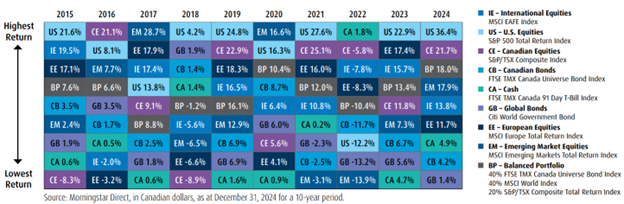
Diversification remains one of the most powerful portfolio construction tools available to investors—a principle first introduced by Harry Markowitz in the 1950s, who famously coined the phrase, “diversification is the only free lunch in investing.”1

At its core, diversification aims to maximize return for a given level of risk. This concept is the foundation behind BMO’s Asset Allocation ETFs, designed to provide investors with a globally diversified portfolio through a single, low-cost ETF. To deliver even greater value, BMO has recently reduced the management fee for some of its most popular Asset Allocation ETFs to just 0.15%.

The most important Decision

Asset allocation is widely recognized as the most critical determinant of long-term portfolio performance. The landmark research by Brinson, Hood, and Beebower (1986) revealed that 90% of return variability can be attributed to the mix of asset classes within a portfolio: not market timing or individual security selection.

For investors seeking a disciplined, strategic asset allocation[i] ETF to meet a growth objective, BMO All Equity ETF (Ticker: ZEQT) is a compelling choice. With an asset mix of 100% equities and 0% fixed income, ZEQT provides global equity exposure for long-term growth, while maintaining its target asset mix with built-in rebalancing.

Target Asset Allocations 

   Source: BMO Global Asset Management, as of May 30, 2025

Rethinking Global Diversification

Many global funds today are heavily concentrated in U.S. equities: given that a global benchmark, the MSCI World Index, allocates approximately 70% to the U.S. ZEQT offers a more balanced global allocation, reducing reliance on U.S. markets to 47%. Notably, ZEQT includes a 28% allocation to Canadian equities, appealing to investors looking to “buy Canada” amid geopolitical concerns such as trade tensions or tariff threats.

BMO Global Asset Management, as of April 30, 2025. The asset allocation is subject to change without notice.

 What’s inside: Key portfolio ingredients

The core building blocks of ZEQT are among the largest and most cost-effective ETFs in Canada. tracking well known indices like S&P and MSCI, to provide broad exposure to international markets:

  • BMO MSCI EAFE Index ETF – Ticker: ZEA (0.20% mgmt. fee): Covers developed equity markets outside North America, including Europe and Japan.
  • BMO MSCI Emerging Markets ETF – Ticker: ZEM (0.25% mgmt. fee): Adds growth potential from emerging market equities including India and Taiwan.BMO Global Asset Management, as of April 30, 2025. Investors only pay the mgmt fee at the ETF level of 0.15%, not the  underlying ETF mgmt fees of 0.20 and 0.25%.

To enhance U.S. market cap diversification and achieve more potential growth, ZEQT includes:

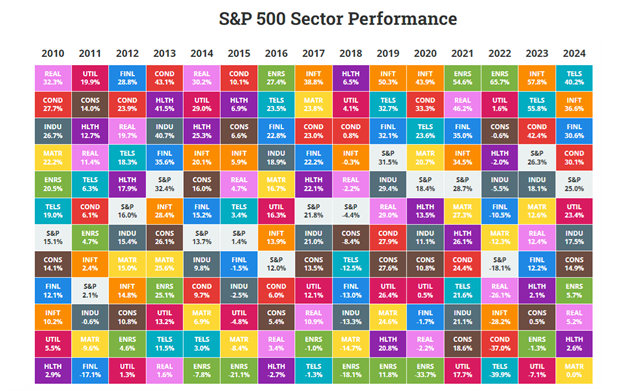
These ETFs apply a profitability screen, targeting higher-quality mid- and small-cap companies in the U.S. ZEQT also spans all major sectors, helping reduce risk as different sectors rotate in and out of favour through economic cycles.

Source: BMO Global Asset Management. The sector allocations are subject to change without notice. ZEQT sector allocation, as of June 2, 2025.

Bottom Line

For advisors who focus on delivering holistic wealth management — integrating tax, insurance, and estate planning — ZEQT offers a simple, scalable core portfolio solution for their practice. It allows advisors to efficiently manage client assets without sacrificing diversification,  transparency, or costs.

And for self-directed investors, ZEQT does all the heavy lifting. With global exposure, automatic rebalancing, and all-in-one simplicity, it truly represents a “set it and forget it” investment that is built for the long run.

Again, as of June 9, ZEQT alongside BMO’s  three other most popular asset allocation ETFs, management fees have been cut by three basis points to 0.15%: amongst the lowest in Canada.

* Effective after market close on June 6, 2025.

Footnotes

1 UBS, Diversification is the logical solution to an unpredictable future. January 10, 2025

Performance (%)

Fund Year-to-date 1-month 3-month 6-month 1-year 3-year 5-year 10-year Since inception
ZEQT 1.96 5.21 -1.37 1.01 14.77 13.92 10.82

Bloomberg, as of May 31, 2025. Inception date for ZEQT = January 24, 2022.


Definitions

[1]  Strategic Asset Allocation: a portfolio strategy where target allocations are set for various asset classes and then the portfolio is rebalanced periodically. The portfolio is rebalanced to the original allocations when they deviate significantly from the initial settings due to differing returns from the various assets.

Sheldon Quan King is Senior Product Manager for BMO Global Asset Management.  Sheldon has over 10+ years of industry experience and has spent the last 9 years growing BMO Global Asset Management’s suite of Mutual Funds and ETFs. Previously, on the ETF Institutional and Service team Sheldon and has also been a guest speaker at Canadian Universities delivering ETF education to students. His primary focus now is ETF product marketing at BMO ETFs by engaging stock exchanges, capital markets desks, index providers, and portfolio managers to grow BMO’s existing suite and and launch new ETFs. Sheldon graduated with a Bachelors Degree in Psychology from York University, and is a CFA Level 3 candidate. 

 Disclaimers:

This article is for informational or educational purposes only and does not provide investment advice or recommendations.

All investments involve risk. The value of an ETF can go down as well as up and you could lose money. The risk of an ETF is rated based on the volatility of the ETF’s returns using the standardized risk classification methodology mandated by the Canadian Securities Administrators. Historical volatility doesn’t tell you how volatile an ETF will be in the future. An ETF with a risk rating of “low” can still lose money. For more information about the risk rating and specific risks that can affect an ETF’s returns, see the BMO ETFs’ simplified prospectus. BMO Global Asset Management is a brand name under which BMO Asset Management Inc. and BMO Investments Inc. operate.

Index returns do not reflect transactions costs or the deduction of other fees and expenses and it is not possible to invest directly in an Index. Past performance is not indicative of future results.

ZEA and ZEM or securities referred to herein are not sponsored, endorsed or promoted by MSCI Inc. (“MSCI”), and MSCI bears no liability with respect to ZEA or ZEM or securities or any index on which ZEA or ZEM or securities are based. The prospectus of the BMO ETFs contains a more detailed description of the limited relationship MSCI has with BMO Asset Management Inc. and any related BMO ETFs.

An S&P, Dow Jones, Standard & Poor or S&P index (the "Index"): the Index is a product of S&P Dow Jones Indices LLC or its affiliates ("SPDJI"), and has been licensed for use by the Manager. S&P®, S&P 500®, US 500, The 500, iBoxx®, iTraxx® and CDX® are trademarks of S&P Global, Inc. or its affiliates ("S&P") and Dow Jones® is a registered trademark of Dow Jones Trademark Holdings LLC ("Dow Jones"), and these trademarks have been licensed for use by SPDJI and sublicensed for certain purposes by the Manager. ZSP, ZMID and ZSML are not sponsored, endorsed, sold or promoted by SPDJI, Dow Jones, S&P, their respective affiliates, and none of such parties make any representation regarding the advisability of investing in such product(s) nor do they have any liability for any errors, omissions, or interruptions of the Index.

Commissions, management fees and expenses all may be associated with investments in exchange traded funds. Please read the ETF Facts or simplified prospectus of the BMO ETFs before investing. The indicated rates of return are the historical annual compounded total returns including changes in unit value and reinvestment of all dividends or distributions and do not take into account sales, redemption, distribution or optional charges or income taxes payable by any unitholder that would have reduced returns. Exchange traded funds are not guaranteed, their values change frequently and past performance may not be repeated.

For a summary of the risks of an investment in the BMO ETFs, please see the specific risks set out in the BMO ETF’s prospectus. BMO ETFs trade like stocks, fluctuate in market value and may trade at a discount to their net asset value, which may increase the risk of loss. Distributions are not guaranteed and are subject to change and/​or elimination.

BMO ETFs are managed by BMO Asset Management Inc., which is an investment fund manager and a portfolio manager, and a separate legal entity from Bank of Montreal.

This material is for information purposes only. The information contained herein is not, and should not be construed as investment, tax or legal advice to any party. Particular investments and/​or trading strategies should be evaluated and professional advice should be obtained with respect to any circumstance.

The viewpoints expressed by the author represents their assessment of the markets at the time of publication. Those views are subject to change without notice at any time.

Any statement that necessarily depends on future events may be a forward-looking statement. Forward-looking statements are not guarantees of performance. They involve risks, uncertainties and assumptions. Although such statements are based on assumptions that are believed to be reasonable, there can be no assurance that actual results will not differ materially from expectations. Investors are cautioned not to rely unduly on any forward-looking statements. In connection with any forward-looking statements, investors should carefully consider the areas of risk described in the most recent  prospectus.

“BMO (M-bar roundel symbol)” is a registered trademark of Bank of Montreal, used under licence.