Hub Blogs contains fresh contributions written by Financial Independence Hub staff or contributors that have not appeared elsewhere first, or have been modified or customized for the Hub by the original blogger. In contrast, Top Blogs shows links to the best external financial blogs around the world.
Diversifying your portfolio is a cornerstone of smart investing, reducing risk and potentially enhancing returns. While the Canadian market offers diversification by sector, it represents only about 3% of the world’s capital market. 1
This means that Canadian investors are missing out on a staggering 97% of global investment opportunities. However, the hurdles of currency conversion, foreign exchange costs and currency risk often deter Canadian investors from going global. Enter CDRs, a revolutionary tool that bridges this gap.
What exactly are CDRs?
Canadian Depositary Receipts (CDRs) are financial instruments that represent beneficial ownership in shares of foreign companies but are traded in Canadian dollars on Cboe, a Canadian stock exchange. This innovation simplifies global investing for Canadians, eliminating the need to navigate foreign exchanges and manage currency fluctuations.
Comparing CDRs to traditional Stocks and American Depositary Receipts (ADRs)
While traditional stocks directly represent ownership in companies, CDRs offer a streamlined approach to investing in international firms. Unlike ADRs that trade in U.S. dollars, CDRs cater specifically to Canadians, providing similar exposure to global markets without the complexities of trading at foreign exchanges and in foreign currencies.
A quick look at CDR History
The concept of depositary receipts traces back nearly a century, with ADRs emerging in the 1920s. By 2023, major banks listed over 2400 ADRs in the U.S. market. Canada joined the depositary receipt market in 2021 with offerings focused on U.S.-based companies. In 2025, Bank of Montreal (BMO) introduced its own CDR program, expanding access to global giants from Japan, Germany, Switzerland, Denmark, and the Netherlands.
Benefits of CDRs Explained
Global Access: CDRs open doors to international investment opportunities, broadening investment horizons for Canadian investors.
Currency Risk Management: CDRs mitigate the impact of foreign currency fluctuations on returns through a notional currency hedge.
Fractional Shares: With a starting price of around CAD $10, investors can afford fractional exposure to shares of otherwise expensive global companies.
Diversification: CDRs enable effortless geographic diversification, reducing reliance on any single market.
Understanding CDR Features
Currency Efficiency: CDRs allow Canadians to get exposure to global stocks in Canadian dollars, eliminating currency conversion costs.
Currency Hedge: CDRs minimize the impact of currency fluctuations while reflecting the performance of the underlying foreign company.
Fractional Exposure: Affordable entry-point to high-priced stocks as CDRs are generally issued at a price lower than the underlying share effectively providing Canadians with fractional exposure to listed stocks of large global companies.
Dividends: Investors will be entitled to any distributions paid on the underlying shares in Canadian dollars proportional to the number of underlying shares to which they are entitled. Taxes on distributions may be withheld by the CDR underlying company’s local or national tax authority. Whether distributions, such as dividends, are subject to foreign withholding tax in the same manner as if the underlying share were directly held by the investor will vary by jurisdiction Since the dividends are paid in Canadian dollars, investors do not have to subsequently go through the process of any currency conversion.
Market Accessibility: CDRs trade seamlessly on a Canadian exchange, ensuring ease of buying and selling.
How do CDRs work in practice?
Each series of CDRs provides economic exposure corresponding to a number of underlying shares. The specific number of shares that each series of CDRs represents is called the CDR ratio. For example, if the CDR ratio for a particular series is 0.50, this means that such series of CDR represent 0.50, or half, of a company share, so an investor would need to purchase 2 CDRs of the series to obtain the economic exposure corresponding to 1 underlying share. The CDR ratio for each series of CDRs is adjusted daily to provide the notional currency hedge as the foreign currency increases/decreases in value to the Canadian dollar. Continue Reading…
In his 2024 re-election campaign, U.S. President Donald Trump vowed to pursue an aggressive trade policy that aimed to reduce or altogether eliminate what he viewed as unacceptable deficits between adversaries and allies alike. Following his January inauguration, President Trump has put Canada and Mexico into his crosshairs. Tariffs continue to be one of his favourite tools, if his rhetoric is any indication.
A tariff is a tax that is imposed by a country on the goods imported from another country. It is typically collected by a country’s customs authority. Some economists have argued that this results in a larger burden being paid by consumers, as companies will pass on tariff costs to the consumer.
In this piece, we will look at how ongoing trade tensions could impact world economies and markets. After that, we will zero in on ETFs that can potentially provide protection against the current bout of volatility.
Trade policy volatility and Canada
Last month, we looked at the impact the new GOP administration could have on the industrials space. That piece explored the trade policy volatility that existed in the first Trump administration.
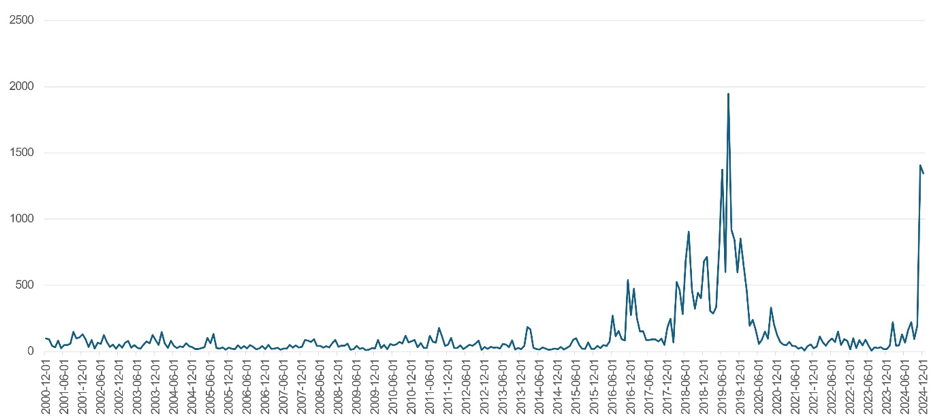
Baker, Bloom & Davis
US Categorical Economic Policy Uncertainty Index – Trade Policy
Source: Baker, Bloom & Davis. Bloomberg, Harvest ETFs, as of January 21, 2025.
On Monday, February 3, 2025, U.S. and global markets suffered sharp pullbacks in the morning hours. However, markets recovered after the Trump administration announced that tariffs on Mexico and Canada would be delayed for 30 days.
Canada finds itself at a crossroads as it contends with unprecedented pressure from a long-time ally, political uncertainty on the domestic front, and muted and decelerating economic data. The Bank of Canada must weigh these pressures as it determines how much it can slash interest rates to bolster economic activity..
That aside, Canada is home to many great companies with oligopolistic qualities. We detailed their strengths in a piece in October 2024. The Harvest Canadian Equity Leaders Income ETF (HLIF:TSX) invests in 30 of Canada’s most powerful and largest companies for their traits and growth potential. It overlays an active covered call strategy, which seeks to generate high monthly cash distributions.
Combat trade volatility with defence and diversification
Defensive sectors contain businesses that are stable, possess key barriers to entry, and are relatively immune to economic fluctuations.
Healthcare falls in this defensive category and is unique in its diversity. It includes companies that manufacture medical devices and equipment, as well as those that are involved in the making of diagnostic tools and lab equipment, companies involved in the ownership of doctors’ networks, as well as facilities and companies in the Managed Care segment.
The Harvest Healthcare Leaders Income ETF (HHL:TSX) is an equally weighted portfolio of 20 large-cap global healthcare companies. HHL aims to generate an attractive monthly distribution through an active covered call writing strategy. This ETF has paid out over $500 million in total monthly distributions to unit holders since its inception.
Utilities is a space that is often targeted by investors who are looking to shore up a defensive position in their portfolios. Companies in the utilities space possess enormous scale, significant barriers to entry, and dominance in their respective markets. The Harvest Equal Weight Global Utilities ETF (HUTL:TSX) offers access to a globally diversified portfolio of utilities equities. That global diversification offers benefits like reducing interest rate and natural disaster risk with exposure to different countries and regions. Continue Reading…
The following is an edited transcript of the podcast Two Way Traffic hosted by financial advisor Darren Coleman with his two guests: tax lawyer Trevor Parry and Kim Moody of Moodys Private Client which provides law, and cross-border tax and accounting services. Trevor Parry once told Stephen Harper that Canada has more auditors than infantry. Not to be outdone, Kim Moody says in the eyes of the Canada Revenue Agency a cocaine dealer can deduct expenses in this country, but not an Air bnb operator.
Click below for full link (interview conducted early January):
I’m joined today by Kim Moody of Moodys Private Client in Calgary, Alberta, and tax lawyer Trevor Perry, who is based in Ancaster. They are two of Canada’s most prolific tax fighters. We’re going to discuss where are we right now in terms of tax policy and what should Canadian investors be thinking about. Also, we have a new government in the United States.
Why don’t we begin with a little bit of kind of where are we right now? We just had the fall economic statement that was not delivered by your Finance Minister. But they came in at more than 50% higher than the fiscal guardrail that they set for themselves. So this is an astonishing amount of capital that they’ve spent, and not even remotely close to where they said they were going to be. Even $40 billion was a big number. So now that it’s 60 and there’s really no one to stand there and take accountability for it, and we had the Finance Minister resign just hours before she delivered that statement. So I’d want to focus on where does that leave taxpayers right now because there are a number of items. I’ll focus on the capital gains inclusion rate change as probably the most significant one. Where are we now? Is that going to go through? Not going to go through? What should investors be doing? What should taxpayers be doing with the state of change that we have in Ottawa?
Kim Moody
To your question on capital gains, where are we today? This is certainly one of the most unusual times in my career where we had proposed tax legislation that looks like it’s not going to get through. Trevor and I have been around a long time, and seen lots of tax legislation not get through. If I was a betting man, I’d say probably about 98% certainty that it’s not going to go through. And I’ve written about that in my Financial Post articles. So Trevor, do you know of any other, you know, broad based piece of legislation?
Trevor Perry
There was a lot of tumult when income trusts were attacked and all that kind of stuff. But the panic that was engineered this year to create some kind of revenue event because of forced selling, and it’s going to die because they prorogued Parliament. No, I’ve never seen anything like this before, and it’s just part and parcel of the worst in the history of this country, the worst tax policy from day one going on.
Darren Coleman
It’s really a quandary for investors and taxpayers, because the general rule has been, if I’m correct, that even though the legislation may not be enacted, one has to act as if it was going to pass, right? But as you guys have said, it’s very likely this will not pass. Should people, as they go into the tax year, be assuming that the new capital gains inclusion rate applies and act accordingly? Or should they act as if no, a betting man says it’s not going to happen, so I should just keep the old rates. What should you do?
Kim Moody
The CRA has a long-standing policy of encouraging taxpayers to act on proposed legislation. I think there’s a good reason for that, and I support them on that because 98% if not higher of tax legislation and proposed tax legislation gets passed even with retroactive applicability, which is very common in tax law. There were some recent statements attributed to the CRA saying they’re going to continue to administer the capital gains stuff on the basis that it’s law, even if an election is called. This stuff is not going to get passed if an election is called, and therefore you’re going to continue to administer it. Well, I can tell you, in my client base, I’m giving the exact opposite advice because I think there is a 98% chance this thing is not going through. So if you want to amend your tax returns for the two-thirds inclusion rate, go right ahead, but you’re going to do it without my blessing because I think it’s wrong, and you’re going to fight to get that money back. It’ll take a long time. So that that’s my approach.
Darren Coleman
How easy is it to fight to get your money back? Is that pretty standard? Like, no, don’t worry, they’ll refund it within five business days, or is it a big argument?
Kim Moody
No, it’s not usually a fight, per se, although there’s always exceptions to that, but it’s a matter of timing. You know when you amend your tax return? Number one, Have you filed your tax return? If so, then do you have the ability to amend it? Which, in most cases, you do, and then how long is it going to take for them to process it? Those are usually the pillars, and it’s that last one that takes a long time,
Trevor Perry
It’s part and parcel of a tax administration system that needs a complete overhaul. Given that they know everything you’re doing already we need some basic respect for the taxpayer, which is something we don’t have. I remember telling our last Prime Minister that there were more auditors in Canada than Canada has infantry. That’s the nature of the beast right now.
Kim Moody
And that’s increased by a lot. I think 29,000 CRA employees. So I think it’s almost 60,000 if I’m not mistaken.
Trevor Perry
And we have about 12,000 infantry, of which we cannot deploy them all at the same time.
Darren Coleman
Let’s go back over that greatest hits of outstanding tax policy that we’ve seen over the last year. Kim, you actually wrote about that in the Financial Post recently (late January). We’ve had the flipping tax. We’ve had the changes to AMT. We’ve had the unused, underused housing tax. We just had the move the date of which you can make a charitable contribution, because we had the postal strike.
Kim Moody
Kim Moody
Trevor knows I’m certainly no fan of the capital gains one, which I had ranked number one in the article as the worst policy. But number two is the prohibition of deductions on certain short-term rental owners. So if you happen to be an evil owner and operator of an Airbnb that operates in a jurisdiction that prohibits that, you’re denied all your expense deductions. A complete prohibition of deductions. So let’s pretend Trevor is a cocaine dealer. He’s out selling snow, but I’m just a lowly Airbnb operator. So Trevor makes 10 grand selling snow. But he’s got a bunch of people running around for him. He’s got burner cell phones. He’s got cost of his inventory, etc. So he makes net 2000 bucks, and he comes to me and says, Hey, Kim, I know I’m doing something illegal here. I’m selling drugs, but I don’t want to be a criminal twice. I want to make sure I file my tax returns because I don’t want to be a tax evader. So can you file my tax returns for me? So we go ahead and I file the tax returns. Do you think I’m claiming his deductions? His $8,000 of deductions? Sure, yeah. And there’s nothing in the Income Tax Act that prohibits that. But now I file the tax returns from my evil Airbnb operation that I’m operating illegally in a jurisdiction because I need to pay some bills, and I have the same $8,000 of expenses. Nope, I can’t deduct those, so I’m paying tax on $10,000. Now from a public-policy perspective, what does that say to the average Canadian? It tells me that the drug dealer in this fictional world, Trevor, is better off and should be treated better from a tax perspective, than me, the lowly Airbnb. That’s ridiculous policy. It’s dangerous policy, and it’s something that needs to go immediately.
Trevor Perry
For me as a lawyer and as a political junkie, I think our 1982 constitutional exercise needs to be reopened. Until we enshrine property rights in the Constitution, I believe, as a fundamental conservative that we do have property rights. Tax policy is horrible. But in terms of tax practice, having done lots of work for professional athletes, CRA running at baseball players and …
Darren Coleman
… The John Tavares situation.
Trevor Perry
If Tavares loses that you’re going to start seeing Canadian teams fold up and move again. It’s just absolutely stupid. And again, it goes to the whole issue of, why are we taxing people into oblivion at $245,000?
Darren Coleman
Darren Coleman
We did a podcast episode with Kevin Nightingale and Shlomi Levy talking about that. They don’t represent Mr. Tavares, so it was safe for them to comment. Listeners can go back and hear that podcast. We’ve also had some Toronto Blue Jays baseball players who had similar predicaments. They look like they’ve been resolved positively for the players. But those are not exactly the same situation as Mr. Tavares, so we’ll have to see what unfolds here. And as a big sports fan yourself, I know that one’s pretty close to your heart.
Darren Coleman
So now that we got into hockey, let me lure back our American listeners for a minute. Let’s pivot into what’s happening with our American cousins. They are going to go into a very interesting 2025. They have a new president. So the difference, I think, is going to be very significant between how the U.S. is going to adopt tax policy, and it’s a little concerning, I think, for many people that Canada doesn’t, apparently seem to have a functioning government at the moment. So what do you guys think Mr. Trump might do in his first year in terms of tax policy? What should investors be getting ready for?
Trevor Perry
I think you’re going to see them make the tax changes he brought in in his first term permanent. I think you’re going to get that lower corporate tax rate, which is going to cause great tumult in this country and in other countries, but particularly Canada. I think there’s going to be pressure here to have some kind of sensible corporate tax rate, the estate tax change. There won’t be any changes to estate taxation in the US for the foreseeable future. So there will be again, more reasons for, as Ross Perot called it, that great sucking sound of Canadian capital, both real and human, to leave the country.
Darren Coleman
But are they actually doing it? So gentlemen, have you actually seen evidence in your own practices of Canadians saying, I’m done, I’m out of here, and they’re actually making the steps they’re making, the move to leave, to lower tax jurisdiction. How many people are really doing it?
Kim Moody
Yeah, 1,000% and I’ve written about this a lot. I’ve spoken about it publicly. I’ve spoken at conferences about this. At one particular conference I spoke about this and there was an academic who was pro capital gains changes. So I showed the statistics but his rebuttal was, I don’t believe you. Here’s the statistics coming out of my office in Calgary. And we’re not a big office, but we’re about 85 people. We act for high net worth, ultra high net worth, private companies and individuals. In the first 23 years of my career — I’ve been practicing for roughly 31 years now — in the first roughly 23 years of my career, I did maybe a dozen departure tax files. It was really easy to leave Canada without incurring departure tax. That all changed. I want to say late 90s, am I right? Trevor, something like that, and and they made it a lot more difficult. And so in the last nine years, this increased with a new high personal tax rate. And then fast forward to the attack on small businesses in 2017 that caused a whole bunch of angst. COVID caused a whole bunch of out-of-control spending. And then the capital gains stuff was just kind of over the top. So all to say, in the last, especially five years, the number of files that I’ve worked on in the, you know, departure tax. You want to take a guess, Darren? Continue Reading…
Only half of Canadian couples discuss finances in detail, an IG Wealth Management study conducted by Pollard found. This week may be a good time to examine your joint lifestyle and retirement goals.
Image by Deposit Photos
By Blair Evans
Special to Financial Independence Hub
Valentine’s Day is here and while love may be in the air, there’s an often-overlooked gift that can strengthen your relationship: a meaningful conversation about finances.
Unsurprisingly, many Canadian couples shy away from discussing money with their partners. According to a recent study by IG Wealth Management, in partnership with Pollara Strategic Insights, only half of married or common law Canadians discuss finances with their partner in detail, with roughly a third talking about it only briefly.
Yet, when thinking about your future together, especially retirement, these conversations are crucial. You and your partner should be aligned on your retirement goals and lifestyle to ensure you plan appropriately and are fiscally prepared to enjoy those golden years.
Transparency on Finances can pay off in multiple ways
Image by Pexels
Transparency around your finances and having proactive conversations with your partner can also pay off come tax season.
Working together to file each of your tax returns can unlock opportunities to maximize deductions and credits.
You may be able to transfer unused credits, like tuition and disability amounts, to your partner to help alleviate their tax bill.
Couples can also combine their medical expenses and charitable donations together to minimize their overall tax obligation.
If your relationship is built for the long haul, it’s important to plan for life’s uncertainties. Building an emergency fund, as well as having an updated will and power of attorney, along with proper life and disability insurance plans are essential to prepare for any emergencies or untimely circumstances. Continue Reading…
Whether it’s a hot stock, a cryptocurrency surge, or a trending investment tip, many retail investors will fall into the trend of what we call FOMO or Fear of Missing Out. But here’s the problem: chasing the crowd often leads to poor financial decisions and ultimately regret. It’s easy to want to chase investment trends, especially when you see others gaining quick returns. Before you jump the gun take a breath and learn why this isn’t a good strategy for retirement.
Adobe Stock Image courtesy Logical Position
By Dan Coconate
Special to Financial Independence Hub
Investing successfully requires a steady hand and a clear plan, especially when you’re planning for retirement or managing your hard-earned savings. However, the allure of hot investment trends is almost always hard to resist. Promises of fast gains or stories of friends capitalizing on can’t-miss opportunities often tempt even the most cautious investors.
For retirees and those approaching retirement, chasing these investment trends might feel like a shortcut to safeguarding financial stability. But the reality is far different. Keep reading as we discuss why you shouldn’t chase investment trends and what to do instead.
The Value of a Long-Term Strategy
A stable, long-term investment plan carries more weight as you near or enter retirement. Unlike younger investors focused on aggressive growth, retirees prioritize income-generation and capital preservation. Chasing short-term trends often contradicts these goals.
Retirement planning requires balancing risk with steady returns. Staying invested in a diversified portfolio of assets tailored to your goals ensures consistency, even during market fluctuations. For example, dividend-paying stocks or well-selected bonds generally offer more stability compared to speculative trends. By adopting a long-term mindset, you’re more likely to see your investments support you throughout your retirement years without the stress of rapid, unpredictable market movements.
Why Trend Chasing feels tempting
The urge to follow trends isn’t purely rational: it’s psychological and herd mentality plays a big role. When you see others profiting from specific investments, it’s natural to feel compelled to follow suit. The fear of missing out, or FOMO, will amplify this instinct, making it hard to stay disciplined. This emotional response, however, often clouds judgment and leads to rash decisions. Continue Reading…


 Posted By