As Didi says in the novel (Findependence Day), “There’s no point climbing the Tower of Wealth when you’re still mired in the basement of debt.” If you owe credit-card debt still charging an usurous 20% per annum, forget about building wealth: focus on eliminating that debt. And once done, focus on paying off your mortgage. As Theo says in the novel, “The foundation of financial independence is a paid-for house.”
Canadians pay some of the highest investment fees on the planet. Most of the Canadian mutual funds charge very high fees. Those fees directly reduce your returns. Too much of the investment returns end up in the wrong pockets. The very good news is that in 2025 you can move to very good, very simple and very inexpensive investment options. Cutting your fees from the 2.0% area to 0.20% or lower is life-changing. It could even double your retirement nest egg. Who doesn’t want to retire with twice the financial security, twice the lifestyle? Canadians should avoid most mutual funds. It’s so easy to leave your mutual funds and your advisor behind; you can move to a better place.
Most Canadian mutual funds are offered by salespersons, not qualified advisors. These advisors at Canadian banks and other sales shops for the high-fee funds have very low investment knowledge. Their only concern is selling you a product and lining their own pockets.
Beat the bank at their own game
That’s the premise and the truth told by former banker Larry Bates. Larry outlines just how poor are Canadian mutual funds, and the mutual fund industry. Have a read of …
On wealth destruction Larry offers a humorous ‘quote’.
My investments put three kids through University. Unfortunately, they were my advisors’ kids – Anonymous
And there’s the crux, the punchline. When Canadians pay those high fees that average 2.2% annual or more, over an investment lifetime they will give away half of their investment wealth. Don’t be that investor. Don’t let your portfolio get crushed by fees.
Canada’s largest mutual funds, not so bad?
Canada’s largest mutual funds are offered by Canada’s largest bank – Royal Bank of Canada. When I first looked at the RBC Select Funds, including the RBC Select Balanced Portfolio I suggested they were ‘not so bad.’ But over time the fees and poor portfolio management continue to take their toll.
In that post I compare the RBC funds to a simple and superior low-fee approach, using an ETF portfolio. An ETF is an exchange traded fund.
Over the last three years the iShares Balanced ETF Portfolio (XBAL.TO) is up 7.4% compared to 5.2% for the RBC Balanced Fund.
Over the last 5 years the iShares Balanced ETF Portfolio (XBAL.TO) is up 7.7% compared to 6.2% for the RBC Balanced Fund.
Scorecard: over the last 3 years the RBC fund underperformed by an average of 2.2% annually. Over the last 5 years the RBC fund underperformed by an average of 1.5% annually.
You’ll find other comparisons to RBC Select and dividend funds in that post link.
How bad are TD mutual funds?
Canada’s second largest bank says ‘hold my beer.’ I can take your poor performance and go one better. This past week I looked at TDs very popular portfolio solutions known as the “Comfort” Portfolios. Once again, this is an attempt to create a diversified global balanced portfolio in one offering. A one-fund solution.
I compared the Comfort Portfolios to a simple Canadian ETF Portfolio. The following table lists the average annual returns.
The underperformance is tragic. We see the TD portfolios underperforming simple ETF models by 2%, 2.5%, 3.o% annual and more.
Earn 50% more? Double your money over mutual funds?
With an additional 2.5% annual over a 20-year period, you could retire with 59% more. Over a 25-year period you’re talking 80% more. Over 30 years we move to ‘twice as much.’
For the above, I used a simple investment calcuator comparing 6% and 8.5% annual returns. In the investment world your return advantage could be greater or less given the sequence of returns. But it gives us a very good idea of the potential for greater returns, and a much richer lifestyle in retirement.
How to invest in ETFs
lf you’re new to the Exchange Traded Fund (ETF) concept please have a read of …
An Exchange Traded Fund will allow you to own the companies within a market index, for example the TSX Composite (the Canadian stock market) in one fund, ticker symbol XIC. The fee for buying the Canadian stock market is 0.06%. Yes you read that right, that’s 6/100th of one per cent. Continue Reading…
Life is unpredictable and as the economic landscape evolves, driven by inflation, health care expenses, tax reformation and global volatility, families need to consider proactive financial strategies. Your plan should include strategic trusts, tax optimization and investment frameworks aligned with long-term family goals. A smart approach will ensure your family’s legacy continues for generations.
Assess your Family’s Finances
Make a list of all fixed and variable income and expenses. Then, establish which expenses can be adjusted in your budget and find a clear financial goal. The most important aspect is to consult a professional about how your income and expenditure impact estate planning.
Only 24% of Americans have a will, a key estate planning document. An estate plan is a comprehensive strategy outlining how funds will be distributed throughout one’s lifetime and afterward. Your plan should include trust creation, estate tax optimization and sophisticated investment strategies. It should also adapt to inflation, health care costs and downturns.
Create a Trust
A trust is created when a settler grants permission to a third party — also known as the trustee — to manage assets for the beneficiary. The trustee draws up the documentation, which the settler approves. When the settler seeks the guidance of a trustee, they can create a trust for three reasons: tax minimization, asset preservation and wealth protection from creditors. Trusts are tools that provide control and seamless transfers throughout generations.
Trust funds are categorized into revocable and irrevocable trusts. Revocable trusts allow the settler to remove and change the trust during their lifetime. Irrevocable trusts cannot be changed or revoked once created. Based on your family’s needs, you can choose between several types of trusts with the help of a corporate trustee.
Maximize Estate Tax Efficiency
Tax efficiency means keeping more of your money by legally reducing what you owe in taxes. Without a trust, your assets go through probate and the slow court process, which can negatively affect the amount of money you receive.
When you use a trust, your family gets the funds faster with fewer tax fees. Certain trusts — like irrevocable ones — remove assets from your tax estate, so your family may pay less taxes later.
You can also use gift exemptions. As of 2025, you [an American] can give up to US$19,000 to a person tax-free annually.
Use a Long-Term, Sophisticated Investment Strategy
Saving is important but building wealth is about how and where you save it. Smart allocation, tax efficiency and diversification are essential.
Tax-inefficient investments: Place your tax-inefficient investments — like bonds — in 401 (k)s.
Tax-efficient investments: Place your tax-efficient investments in taxable accounts.
Tax-loss harvesting: Sell your investments that have declined in value so the realized losses can reduce your taxable capital gains. You can then reinvest the proceeds into another investment.
AI-driven planning tools: Use various platforms to assess real-time asset rebalancing.
Plan for Surprises
Inflation erodes purchasing power because when prices increase for goods and services, you get less value for your money. Plan for inflation, health care costs and economic downturns. Continue Reading…
The boys are back in town, the boys are back in town
The Boys Are Back in Town, by Thin Lizzy
By Noah Solomon
Special to Financial Independence Hub
Government Bonds: The Gift That (Usually) Keeps on Giving
Historically, bonds have provided investors with two main benefits. Firstly, their yields have provided a reasonable, if unspectacular return. Secondly, they have offered diversification value, muting overall portfolio losses during bear markets. By owning high-quality bonds, you got paid for protecting your portfolio during times of market turmoil, which is akin to receiving (rather than paying) a premium for fire insurance: a remarkably sweet deal indeed!
However, these benefits have historically ranged from significant to nonexistent, depending on the investment environment. Given this fact, Investors should alter their bond exposure as conditions warrant, both in terms of their aggregate allocation to the asset class as well their bond portfolios’ exposures to changes in interest rates and credit conditions.
A Bear Market Sedative
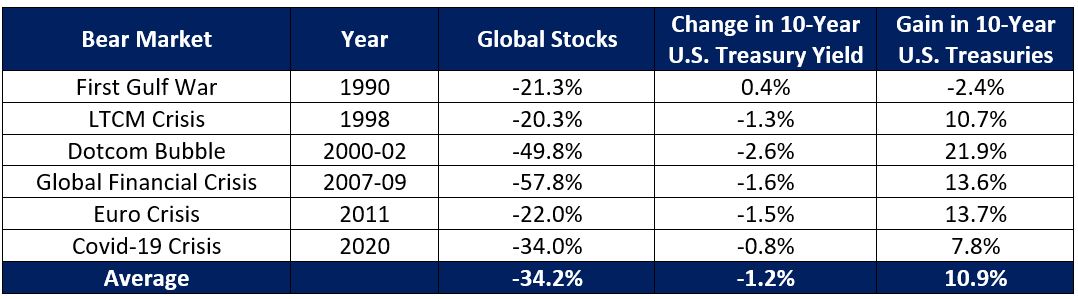
As the following table illustrates, in five of the six equity bear markets before that of 2022, bonds provided investors with much needed gains, thereby mitigating the overall damage to their portfolios.
During the tech wreck of the early 2000s, a balanced portfolio that was 60% weighted in the S&P 500 and 40% weighted in 7–10-year U.S. Treasuries declined 16.41%, as compared to a fall of 42.46% for the all-stock portfolio. In the global financial crisis (GFC) of 2007-2009, the balanced portfolio lost 23.92% vs. a loss of 45.76% in equities.
The ZIRP Era and the Erosion of Bond Powers
During the GFC, central banks entered hyper-stimulus mode to stave off a collapse of the global financial system and avoid a worldwide depression. ZIRP (zero interest rate policy) stances became the norm for monetary authorities around the world, with rates remaining at historically low levels for the next 14 years.
Bonds eventually became a victim of their own success. Although stimulative policies were successful in making the great recession less severe than would have otherwise been the case, they also robbed bonds of their two key attributes. Firstly, high-quality bonds ceased to offer reasonable yields. Secondly, ultra low rates also limited the ability of bonds to provide capital gains during times of equity market turmoil, thereby hindering their diversification value.
In 2016, PIMCO Co-Founder and “Bond King” Bill Gross commented that to repeat the bond market’s 7.5% annualized return over the past 40 years, yields would have to drop to negative 17%: the math just didn’t work!
A Clear Warning Sign
As the saying goes, “Hindsight is 20/20.” It is easy to understand what should have been done after an event has already happened, even if it was not obvious at the time. However, market behaviour during the Covid crash offered a clear warning that all was not well in bond land.
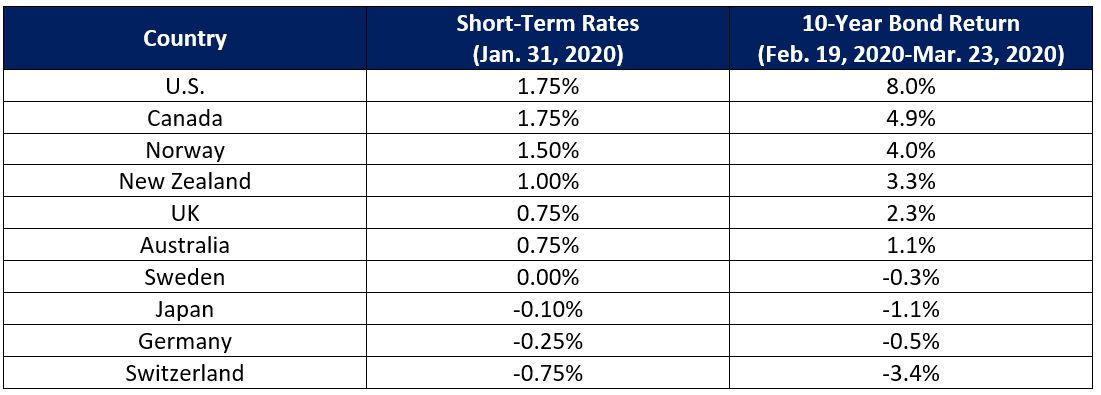
The following table compares countries by their pre-pandemic short-term rates and the returns of their 10-year government bonds during the subsequent bear market.
There is a near perfect relationship across countries in terms of where their short-term rates stood prior to the pandemic and the subsequent return of their 10-Year bonds.
In the countries that initially had relatively high short-term rates, such as the U.S. Canada, and Norway, 10-year bonds produced substantial gains and mitigated the damage caused by the vicious decline in stocks.
In countries that started with rates that were neither relatively high nor low, such as the UK and Australia, 10-year bonds provided some, albeit lower amounts of protection.
Lastly, in countries which started with the lowest rates, such as Sweden, Japan, Germany, and Switzerland, not only did government bonds fail to mitigate stock losses but actually declined.
Given the strong correlation between where pre-Covid rates stood in different countries and the subsequent ability of their bond markets to offset stock market losses, it was clear that there was little, if any, gas left in the tank in the post-Covid world of zero rates, leaving investors largely unprotected.
From Hedge to Texas Hedge
Post-Covid, not only did ultra-low rates obliterate the insurance value of bond holdings, but the unprecedented amounts of monetary and fiscal stimulus that had been injected into the global economy left bonds particularly vulnerable to capital losses. Against this backdrop, when the rubber of stimulus hit the road of inflation in early 2022, central banks were forced to raise rates at a clip not seen since the Volcker era of the 1980s, resulting in painful declines in bond prices. Continue Reading…
Diversification remains one of the most powerful portfolio construction tools available to investors—a principle first introduced by Harry Markowitz in the 1950s, who famously coined the phrase, “diversification is the only free lunch in investing.”1
At its core, diversification aims to maximize return for a given level of risk. This concept is the foundation behind BMO’s Asset Allocation ETFs, designed to provide investors with a globally diversified portfolio through a single, low-cost ETF. To deliver even greater value, BMO has recently reduced the management fee for some of its most popular Asset Allocation ETFs to just 0.15%.
The most important Decision
Asset allocation is widely recognized as the most critical determinant of long-term portfolio performance. The landmark research by Brinson, Hood, and Beebower (1986) revealed that 90% of return variability can be attributed to the mix of asset classes within a portfolio: not market timing or individual security selection.
For investors seeking a disciplined, strategic asset allocation[i] ETF to meet a growth objective, BMO All Equity ETF (Ticker: ZEQT) is a compelling choice. With an asset mix of 100% equities and 0% fixed income, ZEQT provides global equity exposure for long-term growth, while maintaining its target asset mix with built-in rebalancing.
Target Asset Allocations
Source: BMO Global Asset Management, as of May 30, 2025
Rethinking Global Diversification
Many global funds today are heavily concentrated in U.S. equities: given that a global benchmark, the MSCI World Index, allocates approximately 70% to the U.S. ZEQT offers a more balanced global allocation, reducing reliance on U.S. markets to 47%. Notably, ZEQT includes a 28% allocation to Canadian equities, appealing to investors looking to “buy Canada” amid geopolitical concerns such as trade tensions or tariff threats.
BMO Global Asset Management, as of April 30, 2025. The asset allocation is subject to change without notice.
What’s inside: Key portfolio ingredients
The core building blocks of ZEQT are among the largest and most cost-effective ETFs in Canada. tracking well known indices like S&P and MSCI, to provide broad exposure to international markets:
BMO MSCI Emerging Markets ETF – Ticker: ZEM (0.25% mgmt. fee): Adds growth potential from emerging market equities including India and Taiwan.BMO Global Asset Management, as of April 30, 2025. Investors only pay the mgmt fee at the ETF level of 0.15%, not the underlying ETF mgmt fees of 0.20 and 0.25%.
To enhance U.S. market cap diversification and achieve more potential growth, ZEQT includes:
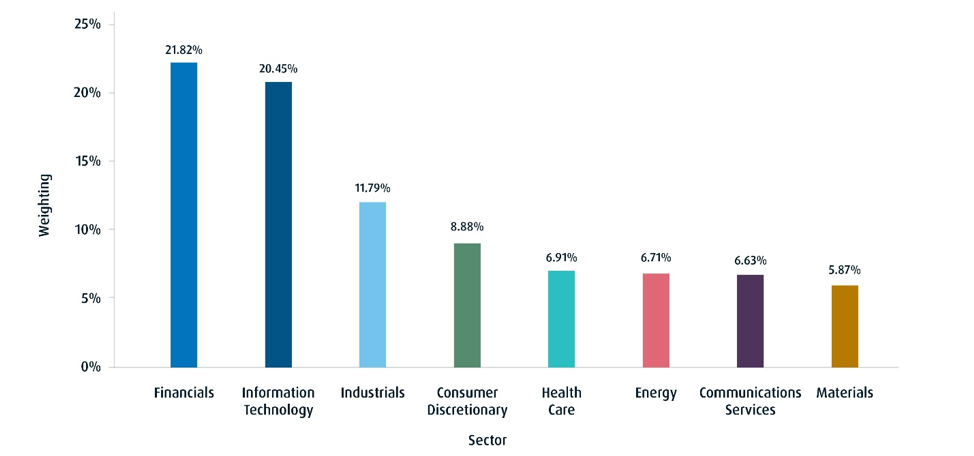
These ETFs apply a profitability screen, targeting higher-quality mid- and small-cap companies in the U.S. ZEQT also spans all major sectors, helping reduce risk as different sectors rotate in and out of favour through economic cycles.
Source: BMO Global Asset Management. The sector allocations are subject to change without notice. ZEQT sector allocation, as of June 2, 2025.
Bottom Line
For advisors who focus on delivering holistic wealth management — integrating tax, insurance, and estate planning — ZEQT offers a simple, scalable core portfolio solution for their practice. It allows advisors to efficiently manage client assets without sacrificing diversification, transparency, or costs.
And for self-directed investors, ZEQT does all the heavy lifting. With global exposure, automatic rebalancing, and all-in-one simplicity, it truly represents a “set it and forget it” investment that is built for the long run.
Again, as of June 9, ZEQT alongside BMO’s three other most popular asset allocation ETFs, management fees have been cut by three basis points to 0.15%: amongst the lowest in Canada.
* Effective after market close on June 6, 2025.
Footnotes
1 UBS, Diversification is the logical solution to an unpredictable future. January 10, 2025
Bloomberg, as of May 31, 2025. Inception date for ZEQT = January 24, 2022.
Definitions
[1] Strategic Asset Allocation: a portfolio strategy where target allocations are set for various asset classes and then the portfolio is rebalanced periodically. The portfolio is rebalanced to the original allocations when they deviate significantly from the initial settings due to differing returns from the various assets.
Sheldon Quan King is Senior Product Manager for BMO Global Asset Management. Sheldon has over 10+ years of industry experience and has spent the last 9 years growing BMO Global Asset Management’s suite of Mutual Funds and ETFs. Previously, on the ETF Institutional and Service team Sheldon and has also been a guest speaker at Canadian Universities delivering ETF education to students. His primary focus now is ETF product marketing at BMO ETFs by engaging stock exchanges, capital markets desks, index providers, and portfolio managers to grow BMO’s existing suite and and launch new ETFs. Sheldon graduated with a Bachelors Degree in Psychology from York University, and is a CFA Level 3 candidate.
Disclaimers:
This article is for informational or educational purposes only and does not provide investment advice or recommendations.
All investments involve risk. The value of an ETF can go down as well as up and you could lose money. The risk of an ETF is rated based on the volatility of the ETF’s returns using the standardized risk classification methodology mandated by the Canadian Securities Administrators. Historical volatility doesn’t tell you how volatile an ETF will be in the future. An ETF with a risk rating of “low” can still lose money. For more information about the risk rating and specific risks that can affect an ETF’s returns, see the BMO ETFs’ simplified prospectus. BMO Global Asset Management is a brand name under which BMO Asset Management Inc. and BMO Investments Inc. operate.
Index returns do not reflect transactions costs or the deduction of other fees and expenses and it is not possible to invest directly in an Index. Past performance is not indicative of future results.
ZEA and ZEM or securities referred to herein are not sponsored, endorsed or promoted by MSCI Inc. (“MSCI”), and MSCI bears no liability with respect to ZEA or ZEM or securities or any index on which ZEA or ZEM or securities are based. The prospectus of the BMO ETFs contains a more detailed description of the limited relationship MSCI has with BMO Asset Management Inc. and any related BMO ETFs.
An S&P, Dow Jones, Standard & Poor or S&P index (the "Index"): the Index is a product of S&P Dow Jones Indices LLC or its affiliates ("SPDJI"), and has been licensed for use by the Manager. S&P®, S&P 500®, US 500, The 500, iBoxx®, iTraxx® and CDX® are trademarks of S&P Global, Inc. or its affiliates ("S&P") and Dow Jones® is a registered trademark of Dow Jones Trademark Holdings LLC ("Dow Jones"), and these trademarks have been licensed for use by SPDJI and sublicensed for certain purposes by the Manager. ZSP, ZMID and ZSML are not sponsored, endorsed, sold or promoted by SPDJI, Dow Jones, S&P, their respective affiliates, and none of such parties make any representation regarding the advisability of investing in such product(s) nor do they have any liability for any errors, omissions, or interruptions of the Index.
Commissions, management fees and expenses all may be associated with investments in exchange traded funds. Please read the ETF Facts or simplified prospectus of the BMO ETFs before investing. The indicated rates of return are the historical annual compounded total returns including changes in unit value and reinvestment of all dividends or distributions and do not take into account sales, redemption, distribution or optional charges or income taxes payable by any unitholder that would have reduced returns. Exchange traded funds are not guaranteed, their values change frequently and past performance may not be repeated.
For a summary of the risks of an investment in the BMO ETFs, please see the specific risks set out in the BMO ETF’s prospectus. BMO ETFs trade like stocks, fluctuate in market value and may trade at a discount to their net asset value, which may increase the risk of loss. Distributions are not guaranteed and are subject to change and/or elimination.
BMO ETFs are managed by BMO Asset Management Inc., which is an investment fund manager and a portfolio manager, and a separate legal entity from Bank of Montreal.
This material is for information purposes only. The information contained herein is not, and should not be construed as investment, tax or legal advice to any party. Particular investments and/or trading strategies should be evaluated and professional advice should be obtained with respect to any circumstance.
The viewpoints expressed by the author represents their assessment of the markets at the time of publication. Those views are subject to change without notice at any time.
Any statement that necessarily depends on future events may be a forward-looking statement. Forward-looking statements are not guarantees of performance. They involve risks, uncertainties and assumptions. Although such statements are based on assumptions that are believed to be reasonable, there can be no assurance that actual results will not differ materially from expectations. Investors are cautioned not to rely unduly on any forward-looking statements. In connection with any forward-looking statements, investors should carefully consider the areas of risk described in the most recent prospectus.
“BMO (M-bar roundel symbol)” is a registered trademark of Bank of Montreal, used under licence.
Discover practical strategies for achieving Financial Independence beyond the confines of a traditional job.
This article presents expert-backed advice on creating multiple income streams and aligning work with personal goals. Learn how to leverage your skills, build value-based income, and take concrete steps towards your vision of financial freedom.
Leverage Your Skills for Side Income
Transform Evenings into Venture Capital
Build Value-based Income Streams
Adopt a Side Hustle Mindset
Future-Proof your Professional Value
Align Work with your Core Purpose
Build a Financial Foundation first
Get Specific about your Goals
Cut Expenses to Create Options
Leverage your Skills for Side Income
In today’s evolving job market, many professionals find themselves tethered to traditional 9-to-5 roles: secure, yes, but often creatively or financially stifling. The desire for financial freedom is not just about escaping the office; it’s about reclaiming time, purpose, and the ability to design life on your own terms. We’ve worked with countless individuals who once felt exactly this way: stuck, uncertain, but ready for a change.
If you’re feeling trapped in a conventional job, the most important first step is to acknowledge that your desire for more isn’t selfish: it’s strategic. Financial freedom isn’t just about money; it’s about choices. And that journey starts by understanding your own value in the marketplace.
Step 1: Audit Your Skills and Strengths
Take stock of what you’re naturally good at and how those skills can translate into high-demand, high-autonomy industries. Digital skills like coding, copywriting, digital marketing, or consulting are especially valuable in today’s freelance and remote economy. Ask yourself: If I had to solve someone’s problem for a fee: what could I offer today?
Step 2: Start a Low-Risk Side Income Stream
This doesn’t mean quitting your job immediately. Start small: freelancing on Upwork, tutoring online, offering resume reviews, or starting a blog or YouTube channel around a niche you know well. Build proof of concept without jeopardizing your current income.
Step 3: Invest in a Career Coach or Mentor
Working with a coach can help you shortcut the confusion. We help clients identify the right path forward based on their lifestyle goals, not just job titles. Our structured guidance has helped people launch side businesses, shift into more flexible roles, or double their income by making strategic pivots.
According to a 2024 report by LinkedIn Workforce Insights, over 60% of professionals under 40 are actively seeking roles that offer greater flexibility and autonomy. Additionally, Harvard Business Review found that professionals who pursue “career portfolios” — multiple income streams from various skill-based services — report 43% higher job satisfaction and 31% faster income growth than peers in static roles.
Feeling stuck isn’t the end of your story: it’s a signal. A signal that you’re ready for change. We believe that financial freedom isn’t just for the lucky few—it’s for anyone willing to make bold, informed moves. — Miriam Groom, CEO, Mindful Career inc., Mindful Career Coaching
Transform Evenings into Venture Capital
If you’re feeling stuck in a traditional job and craving more financial freedom, you’re not alone: and you’re not broken. That restless feeling? It’s your internal compass telling you that what you’re doing no longer aligns with where you want to go. My advice? Don’t silence it: study it.
The most powerful first step I ever took was treating my evenings and weekends like venture capital. Instead of doom-scrolling or complaining about my 9-to-5, I built skills that made me valuable outside of it. I didn’t quit blindly. I audited my strengths, explored high-leverage models like consulting and digital products, and tested small bets until one clicked. It was less about passion and more about leverage: where can I help people, solve problems, and get paid well for it?
If you’re after financial freedom, don’t chase quick wins. Chase agency. Build something that compounds. Start by learning one monetizable skill: something you can offer tomorrow. Package it, test it, refine it. You don’t need to be loud online or have a business plan that wins awards. You need to take the first step: and then the next.
What I’ve learned from growing multiple businesses and coaching founders is this: freedom doesn’t arrive fully formed. It’s built in the margins before it becomes the main thing. So if you’re reading this wondering if it’s too late or too risky: it’s not. Your current job might pay the bills, but it doesn’t have to define your ceiling. — John Mac, Serial Entrepreneur, UNIT
Build Value-based Income Streams
If you feel stuck in a traditional job, it’s because your income is locked to your hours. Financial freedom begins when you earn based on value, not time. The fastest path is building a side income that proves you’re worth more than your salary. That means selling a skill — marketing, coding, design, sales strategy — directly to people who need results, not resumes.
I replaced my paycheck by packaging my experience into targeted offers. One client became two. Two became four. The process wasn’t complicated. I identified a problem, built a simple solution, and sold it. The first $1,000 didn’t change my life. It changed my mindset. From there, scaling was execution, not hope.
Most people stall because they’re waiting for the perfect idea or ideal conditions. Neither exists. Start by solving one problem for one customer. Build income that’s not tied to your boss. Cut costs, track results, and reinvest profits. Don’t romanticize the idea of freedom. Make it measurable. Give yourself a deadline to match and then exceed your job income.
You’re not trapped. You’re unproven. The solution isn’t to quit. The solution is to validate your value outside the structure you’ve been conditioned to depend on. You move forward the moment you stop waiting. — Steven Mitts, Entrepreneurial Coach, Steven Mitts
Adopt a Side Hustle Mindset
Traditional jobs are great for many reasons, but I completely understand. I was stuck in a normal or traditional 9-5 job, and the only thing I was dreaming about was freedom. This feeling is more common than you might think, so anyone who is experiencing it, you are not alone. The best advice I can offer is to change your mindset, more specifically, to adopt a side hustle mindset.
Think about what you currently have in your job: stability, which hopefully provides a decent income. This is a huge asset. Use this stability to your advantage; don’t think of it as a cage, but rather as your investment stream to financial freedom. Then, make a list of the skills you have, things that you like (passions) that could be monetized, or if you’ve noticed a problem that many people experience and you may have the solution, it could be your golden ticket.
Once you have your idea, don’t quit your day job. Dedicate a small but consistent chunk of your time each week to your new adventure (5 hours to start with will do). When it comes to the steps I’d recommend you take, there is only one: validate your idea. Do your research; you don’t want to waste countless hours on something that is already thriving. Once validated, begin your journey. Draw up a business plan, get a name (register it), open a bank account (do not use your personal one), then start. Take that first bold step. It is incredibly exciting, and it can induce a whole heap of fear, but you will never know if you don’t take it.
My encouragement is this: every great entrepreneur started with a tiny step. No one jumps into success; it is built from the ground up. — Aiden Higgins, Senior Editor and Writer, The Broke Backpacker
Future-Proof your Professional Value
Honestly, the biggest shift for professionals feeling trapped isn’t just leaving a traditional role: it’s strategically future-proofing their value. Research shows 65% of workers who feel ‘stuck’ actually suffer from skill obsolescence, yet those who dedicate just 5 hours weekly to learning in-demand capabilities like automation fluency or data-driven decision-making see a 47% faster transition to higher-paying, flexible roles.
Start by auditing daily tasks for automation potential: this reveals immediate efficiency gains and highlights valuable skills to develop. Platforms offering certified, applied learning in operational tech turn that insight into tangible leverage. That frustration? It’s actually a compass pointing toward untapped potential.
Financial freedom isn’t about escaping the grind; it’s about equipping yourself to command the work that matters. Every expert was once someone who decided their growth couldn’t wait for permission. — Anupa Rongala, CEO, Invensis Technologies
Align Work with your Core Purpose
First, define your freedom.
I’ve sat across from many successful people who feel completely trapped by their traditional jobs. My advice is always to stop focusing on the financial spreadsheet and start with a psychological one. The feeling of being “stuck” is rarely about money alone; true freedom comes from aligning your work with your “why.” Continue Reading…


 Posted By

 Canada’s largest mutual funds are offered by Canada’s largest bank – Royal Bank of Canada. When I first looked at the RBC Select Funds, including the RBC Select Balanced Portfolio I suggested they were ‘not so bad.’ But over time the fees and poor portfolio management continue to take their toll.