
General

Franklin Templeton Canada unveils suite of low-cost passive Regional and Country ETFs

On the heels of BMO’s entry into the low-cost asset allocation ETF space (see Hub blog here), one of the world’s largest active money managers has unveiled a suite of low-cost passively managed regional and country ETFs for the Canadian market.

Franklin Templeton Investments Canada today announced the expansion of its Franklin LibertyShares ETF offerings with its first suite of passive ETFs. (Franklin LibertyShares originally entered Canada in 2017 with four actively managed funds branded as Franklin LibertyShares).

The new passive funds gives investors exposure to a specific region or country at rock-bottom fees (below 10 basis points). It says (and I agree) that the management fees for these new Canada, United States, Japan and Europe (excluding U.K.) passive ETFs are amongst the lowest in the industry, ranging between 5 to 9 bps.

The company says these include the first Japan passive ETF and Europe (excluding U.K.) passive ETF available on a Canadian exchange. The ETFs are market-cap weighted.

In a press release, Franklin Templeton Investments Canada president and CEO Duane Green said: “With market-moving events like trade tensions and Brexit, investors and their advisors as well as institutional investors are looking to precisely act upon specific country and regional market views … These new passive ETFs provide Canadian investors with individual country and regional exposure options … at a very low cost.”

Here are the new ETFs and their ticker symbols:

Franklin FTSE Canada All Cap Index ETF (FLCD) invests primarily in equity securities of Canadian issuers, seeking to replicate the performance of FTSE Canada All Cap Domestic Index. The management fee is 5 bps.

Franklin FTSE U.S. Index ETF (FLAM) invests primarily in equity securities of mid- and large-capitalization U.S. issuers, seeking to replicate the performance of FTSE USA Index. Management fee is 7 bps.

Franklin FTSE Japan Index ETF(FLJA) invests directly or indirectly, primarily in equity securities of mid- and large-capitalization Japanese issuers, seeking to replicate the performance of FTSE Japan Index. Fee 9 bps.

Franklin FTSE Europe ex U.K. IndexETF(FLUR) invests primarily in equity securities of mid- and large-capitalization issuers in developed markets in Europe excluding the United Kingdom, seeking to replicate the performance of FTSE Developed Europe ex U.K. Index. Fee 9 bps. Continue Reading…

How to make the most of your HELOC

By Sean Cooper

Special to the Financial Independence Hub

A HELOC, short for “home equity line of credit,” is a revolving line of credit secured by your home’s equity. HELOCs have a reputation for being a convenient, flexible and low-cost way of accessing credit. A HELOC can be a great way to borrow money cheaply (it sure beats using your credit card!), as long as you do it responsibly.

Using your HELOC responsibly means using it for something that is likely to increase your net worth and having a plan to pay back the money you borrow. (It can be tempting to make interest-only payments, but you’ll literally find yourself no further ahead.) To address this, most lenders have recently introduced stricter qualification rules for HELOCs. You’re required to pass the mortgage stress test (2% + your HELOC rate), in addition to some lenders making you qualify based on your HELOC limit rather than your current outstanding balance.

The amount that you can borrow by way of a HELOC has also decreased over the years. With a HELOC today, you can access up to 65% of your home’s appraised value. Note that your mortgage balance and HELOC together can’t be more than 80% of your home’s appraised value.

Now that you have a better understanding of HELOCs, let’s take a look at a couple ways to make the most of your HELOC.

Home Renovations

A popular use of HELOCs is home renovations. But before undertaking a major home renovation, it’s important to ask yourself why you’re doing the renovation. Continue Reading…

BMO keeps it simple with its One-ticket Asset Allocation ETF portfolios

Last week we witnessed another entry into the Canadian Asset Allocation One Ticket Portfolio Solutions.

Welcome BMO.

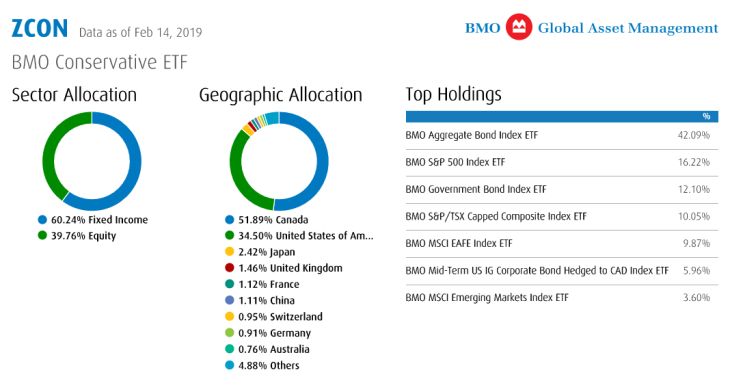
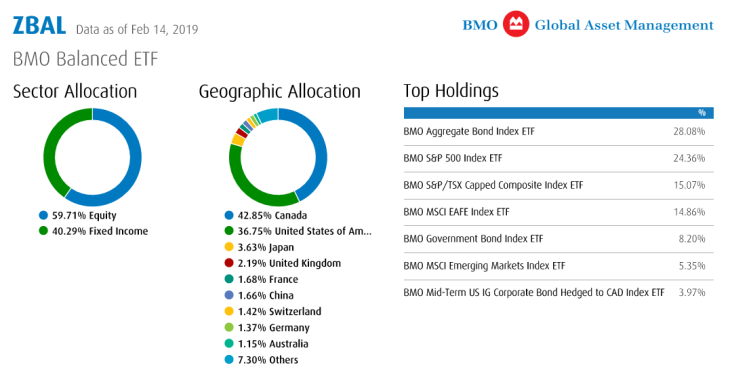
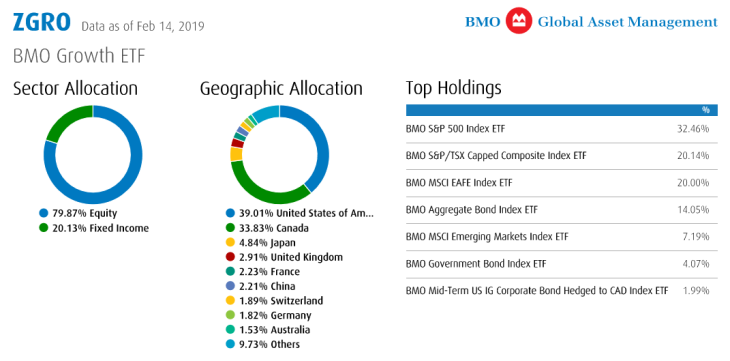
On Friday February 15th BMO launched three asset allocation portfolios by way of the Conservative ZCON, the Balanced ZBAL and the Growth ZGRO.

Here is the overview from the Fact Sheets:

Wonderfully simple or plain vanilla?

Take your pick. These are certainly plain vanilla, they’re not even Lemon Raspberry White Chocolate. But they’re still wonderful.

I am certainly surprised that BMO Global Asset Management kept the portfolios so clean and simple. As you may remember from my review of the BMO SmartFolio. the Robo Portfolios are actively managed. That is to say there is active asset allocation with respect to the core and smart beta ETFs. From my BMO SmartFolio review …

The portfolios will be rebalanced every 2 to 6 months. And back to that human touch, the management team with also make adjustments to that asset mix based on market conditions. They may be more active in periods of market turmoil compared to the current market conditions where we are mostly cruising to the upside for Canadian, US and International stocks. Continue Reading…

Volatility arrived in 2018 but the ETF Exodus didn’t

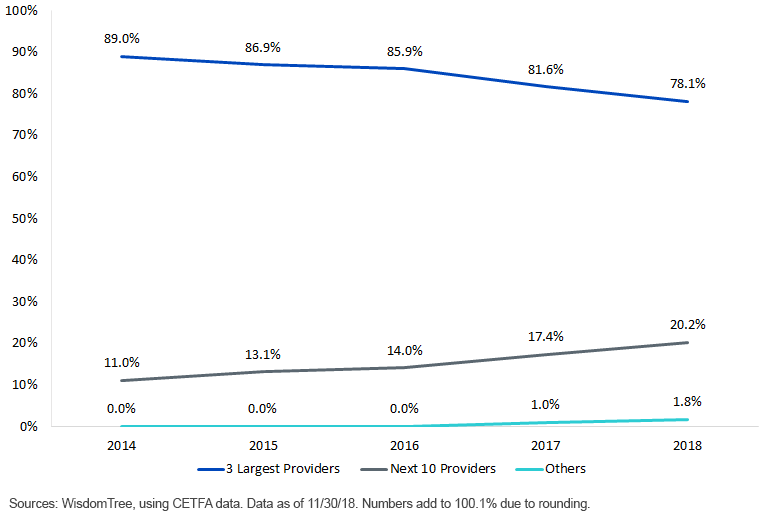
Figure 1: Market Share, Canadian ETFs

By Jeff Weniger, WisdomTree Investments

Special to the Financial Independence Hub

 Money managers had a rough year in 2018. The S&P/TSX Composite Index was off 8.8%, while the MSCI World Index of global equities was down 0.1% in Canadian dollar terms. About the only bright spot was the S&P 500 Index, which was down 4.4% in USD but up 4.1% for Canadians because of U.S. dollar strength. But these tepid figures mask the freefall’s extent; many markets met the bear market definition — declining more than 20% — inside the confines of Q4.

Figure 1 above grabbed attention in our 2019 Canadian ETF Industry & Market Outlook. Many didn’t realize how much market share the smaller players have gobbled up recently.

No doubt, the biggest ETF providers are doing just fine. In fact, we imagine most of the 33 Canadian ETF companies in our corner of the asset management industry must be downright giddy. Many are hitting the sweet spot where track records are becoming seasoned, brand recognition is solidifying and product users are now proselytizing for them.

Grasping at straws

“Active” mutual fund managers have for years been tossing around a prediction that needs to be checked at the door.  To paraphrase them: Wait until we see a downturn in stocks. That’s when everyone is going to dump their ETFs and come back to active mutual funds.

Be careful what you wish for; we think the exact opposite.

The stock market peaked in September, but the exodus from ETFs and into mutual funds never materialized. As an industry, our collective AUM is ever so slightly off its peaks, but that’s because of market losses, not outflows. Continue Reading…

For the love of Money

By Heather Compton

Special to the Financial Independence Hub

I have invested a lot of my lifetime learning, living, teaching and writing about healthy practises around money.  When a young friend recently asked for some guidance on making peace with money, I wanted to fall back on those well learned strategies.

There are many practises that will bring some ease into your financial life. Living within your means, paying yourself first, getting your financial house in order: but you must lean into your own wisdom to bring peace.  It’s an evolutionary, lifelong journey for all of us and I am moved by the struggles we all have with money and the false powers we grant it.

What we buy, what we invest in, what we purchase for others and what we choose to finance or contribute to can bring us peace or its polar opposite.  What if we had a change of heart or a shift in worldview? A change of heart brings about a change of circumstance:  that’s transformation. Changing our worldview means changing what you believe is true – do big houses, fancy cars, expensive wardrobes and larger paycheques really spell success, acceptance, power or freedom?  Ask your authentic self that question.

The Heart test

We are all vulnerable to ambitions that disregard the balance and wisdom of our intuitive hearts. What if every spending decision had to pass through your heart before you pulled out your wallet?  Would you spend differently?

When we use our resources in ways that truly meet our authentic and universal needs for connection, integrity, joy, inspiration, physical well-being, meaning and choice, we find a path to peace.  That’s when money is in service to us and not the other way around. Money is an admirable servant but a terrible boss.

Lining up money’s flow with our authentic self and using it as a direct expression of our values and our vision is simple but it’s not easy.  It requires daily discipline to follow the practises that are the gateway to peace. Continue Reading…