Inflation

Inflation

Inflation and the new ways of diversification


Photo Credit: CCL Private Capital Ltd.”

By Duane Ledgister, vice president, Connor Clark & Lunn Private Capital

Special to the Financial Independence Hub

Inflation has moved to its highest level in decades, with higher prices resulting from strong economic growth led by pent-up demand for goods and record levels of government spending.

At the same time, strong demand is leading to supply shortages. When we look at the components of inflation, we see recent price increases are largest in industries hurt the most during the pandemic, such as energy. These industries are cyclical and are pulling inflation readings higher as prices recover after a period of decline.

Higher prices in the short term are expected to be tempered as supply adjusts and demand returns to more normal levels, and while policy actions such as higher spending and larger debt levels have increased short-term inflation, the same forces are deflationary long-term. This is because more money goes to paying down debt as opposed to future investment. The caveat is that higher debt levels encourage policymakers to allow inflation to move higher than it has been in recent cycles. Accordingly, inflation will be higher but not at the disruptive levels we saw in the 70s and 80s.

Impact of inflation on your investment allocation

Now is a good time to consider its effect on different asset classes that make up a portfolio. Real diversification is much more involved today than you would have been told before.

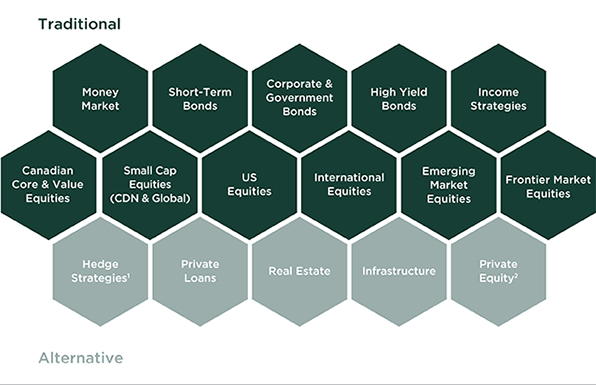
Stocks can generally do well in a period of moderate inflation, whereas fixed income is hurt the most. Alternative asset classes — which most investors have little exposure to, and should begin evaluating — also have some natural protection from inflation.

Equities

Moderate inflation is a double-edged sword for stocks: increasing corporate cash flows while decreasing the real value of investment returns. Companies with high valuations tend to underperform as their valuations are based on future earnings growth long into the future. In a period of higher inflation, these future earnings are now worth less today. Companies with lower valuations, called value stocks, do better in a period of above-average inflation. Strategically it makes sense to hold both growth and value styles within your equity allocation.

Fixed Income

The bond allocation of a portfolio is the one that is hardest hit by inflation, because most bond coupon payments do not increase with inflation, and bond yields tend to rise when inflation is moving higher. The result is both a temporary decline in the price of bonds and lower long-term real return. The negative effects of rising inflation and yields can be managed by holding short-term bonds and higher coupon bonds. The former is less sensitive to changes in inflation and yields. This protects capital when inflation is rising. The latter have more income to offset price declines.

Having a view of the economic backdrop and managing a bond portfolio’s sensitivity to changes in yields and inflation is important to delivering risk-adjusted returns, particularly true when inflation is on the rise.

Alternatives

This is where real diversification can pay off. The alternative asset classes in a portfolio are attractive since they generate strong levels of income relative to traditional equities and bonds. They also tend to be the least sensitive to risks in the broader economy, including inflation. Private market investments (real estate, infrastructure, and private loans) should have natural inflation stabilizers. For real estate, rental income tends to rise with inflation and infrastructure contracts may have ongoing inflation adjustments. Finally, private loans income rises as yields and inflation move higher. Continue Reading…

Ukraine invasion underlines investors’ need for super diversification

It’s scary times for everyone, investors included. As this site focuses on Financial Independence, I’ll try in this blog to direct readers to some useful sources of financial advice.

We’ll start with MoneySense, since in my role as Investing Editor at Large, I’m on top of much of the investing content there.

First, I’d point to Allan Small’s article that appeared over the weekend: The Meaning of market swings and why you should care. Allan recaps current trends in rising inflation and rising interest rates, noting that geopolitical uncertainties can create buying opportunities on certain stocks:

“The key is to make sure your portfolio is diversified. It’s the best — and cheapest — strategy to protect your portfolio in any environment. Balance it with different sectors of the economy.”

Second, Dale Robert’s weekly market wrap for MoneySense always has plenty of good insights into up-to-the-minute market action. His February 27th instalment of Making Sense of the Markets is particularly instructive. Hub readers will be familiar with Dale’s own site, Cutthecrapinvesting, as we regularly republish Dale’s blogs here on the Hub (with his kind permission, of course!).

Here’s Dale’s recent blog on the Ukraine situation. Here’s an excerpt:

“Even a few weeks ago it was easy to predict what would help investors make their portfolios more battle-hardened. Gold and energy certainly rose to the unfortunate occasion.”

Ever since Covid hit, Dale has been furnishing sound investment ideas, often ahead of the rest of the financial blogosphere. For example, he was one of the earliest to sound the alarm that Covid would be a serious problem for investors. He was also early in recommending energy plays like Eric Nuttall’s Nine Point Energy Fund (NNRG) and inflation-fighting recommendations like the Purpose Real Assets ETF (PRA.) That’s one reason why we included Dale as a panelist in MoneySense’s yearly ETF All-Stars feature: the 2022 edition will be out this spring, albeit under the direction of a new writer, Bryan Borzykowski.

No one ever made a dime panicking

How am I responding to the financial aspect of this crisis? Well, as Mad Money’s Jim Cramer often reminds readers in such times, “No one ever made a dime panicking.” Just yesterday, The Successful Investor publisher Patrick McKeough reminded Hub readers that short-term investment decisions all too often sabotage long term returns.

Patrick has been hugely consistent over the years with the following three-fold guidelines, which are as relevant during this Ukraine crisis as in they are in sunnier times:

1.) Invest mainly in well-established, dividend-paying companies;

2.) Spread your money out across most if not all of the five main economic sectors (Manufacturing & Industry; Resources & Commodities; Consumer; Finance; and Utilities);

3.) Downplay or avoid stocks in the broker/media limelight.

In his Inner Circle Advice bulletin issued after Tuesday’s market rout, McKeough titled one section “Putin goes for broke” while urging investors to stay the course if they adhere to the three points above:”In the past third of a century, Russia has gone from dictatorship to fledgling democracy and back to dictatorship. If his Ukraine venture goes awry, it could be the end of the Putin era and the start of a new try at western-style government for Russia.

“Meanwhile, we advise sticking with your portfolio if your investments are in tune with our Successful Investor directives. Now, though, is a good time to re-emphasize that recent IPOs tend to be a poor investment choice, on average. But that’s especially so in a market situation like this one, in which volatility is likely to be above average for some time.”

Some other newsletters to which I subscribe recapped historical market action in advance and during prior outbreaks of war and invasions; generally they found that investors who “bought the invasion” eventually did well.

On the other hand, in an article in the Globe & Mail this Monday, veteran commentator Gordon Pape suggested it wouldn’t hurt to raise cash where you have significant capital gains: while they’re still gains. You can find the article, albeit paywalled, by clicking on this highlighted headline: Investors should take these steps to protect their portfolios from  the Russia-Ukraine conflict.  Pape also warned, as have many pundits, that if Russia does get away with its Ukraine invasion, it may embolden China to make a similar move on Taiwan.  Continue Reading…

Dividend Stocks: Completing the Income Puzzle

Franklin Templeton, iStock

By Les Stelmach and Ryan Crowther

Franklin Bissett Investment Management

(Sponsor Content)

It’s no secret that yields on fixed income investments have been in a prolonged slump for decades, challenging both individual investors to meet their income needs and institutional investors like pension funds and insurance companies to deliver on their obligations to retirees.

While some investors have moved further out the fixed income risk spectrum in pursuit of higher yields, others are diversifying their income sources by adding to their investments in shares of dividend-paying companies.

Dividends are playing catch-up

Despite recovering economic conditions, dividend-paying stocks lagged the overall market in 2021. Given continued uncertainties directly and indirectly related to the COVID-19 pandemic, dividend growth in general reflected some conservatism. Many factors influencing earnings growth in 2021 were sector-specific. Some industries continued to deal with subdued demand compared to pre-pandemic levels, while in other cases, regulators prohibited dividend increases at the onset of the pandemic.

Lately, however, dividend payers’ shares have performed well for several reasons:

  • Despite rising inflation, supply-chain pressures and labour shortages, corporate fundamentals have generally remained supportive as revenues, earnings and profit margins have continued to perform well.
  • Valuations for many dividend stocks are firmly anchored to those fundamentals, insulating them somewhat from market concerns over valuations in a higher-rate environment.
  • In addition to many companies initiating, restoring or raising their dividend payouts, the share prices of many dividend-paying stocks benefited from market momentum in a “best of both worlds” environment.
  • Market sentiment has shifted in response to signals from both the U.S. Federal Reserve and the Bank of Canada indicating a faster pace of interest rate increases in combination with quantitative tightening.

Dividends likely to grow

The average earnings per share growth for the Canadian S&P/TSX Composite and the U.S. S&P 500 Indices spiked last year. Dividend increases were broad-based throughout the year. Barring any major economic setbacks, we expect continued steady dividend growth from companies across many sectors. Average cash as a percentage of total assets held by constituents of the S&P/TSX Composite Index is at levels not seen in more than 20 years: another positive development for dividend growth.

In Canada, we are finding certain sectors particularly attractive:

Financials: Banks are an example of dividend growth held back by regulators from the pandemic’s onset. In 2021, even though  earnings grew, dividends were temporarily constrained; however, this restriction was lifted last November. Most recently, we have seen the Canadian banks increase dividends between 10% and 25%, but we believe there could be room for further increases. Banks retain excess capital, and at the very least, we believe the group will resume their annual pattern of increases from this point. In our view, Canadian banks are on very solid footing and offer some of the most attractive valuations.

Commodity-related: Commodity prices are high as economic activity resumes from pandemic lows, which is positive for the energy and materials sectors, and by extension, industrials. We have seen a remarkable recovery in oil prices since the precipitous drop in the spring of 2020 when the global economy shut down in response to the spread of COVID-19. At that time, a number of energy stocks had their dividends cut as the depth and duration of the economic downturn were unknown.

Since then, the oil and gas sector has staged a dramatic comeback, with higher prices boosting cash flows. Along with the recovery of prices, we also have seen a significant pick-up in dividends. Companies are employing various dividend strategies. Some prefer methodical increases to the base dividend level at a rate sustainable under a range of commodity price scenarios; others are considering variable dividends or periodic special dividend payments on top of the base dividend level. We believe boards and management teams are exercising a certain degree of caution to avoid being vulnerable if oil or gas prices experience a sharp decline in the future.

Real estate: In certain property categories (primarily retail), real estate investment trusts (REITs) had to absorb higher vacancies and deferred rent payments from tenants as stores were temporarily closed due to pandemic restrictions. These stresses often manifested as flat cash distribution profiles or, in some cases, temporary reductions in distributions. Although it’s too early to be certain of a return to historical norms across all property classes, we are seeing encouraging signs in rents and occupancy, and we note some REITs are again raising distributions.

Utilities and telecoms have maintained their dividends throughout the pandemic and we expect their dividend growth trajectories will be in line with historical experience.

Risks and opportunities

Consistent and growing dividends are characteristic of higher-quality, established companies that by definition tend to sit comparatively lower on the equity risk spectrum. It’s important to remember that like any stock, they are subject to equity market levels of volatility; but stable to growing dividends can reduce part of that risk as investors continue to receive income distributions even in a volatile market. In a rising market environment, investors could benefit both from the dividend yield and a higher stock price. Continue Reading…

Retired Money: Do Inflation-linked Bonds make sense in an era of rising interest rates?

My latest MoneySense Retired Money column, which has just been published, can be found by clicking on the highlighted headline here: Do inflation-linked bonds make sense in an era of rising interest rates?

The topic is one that until mid 2021 received relatively scant attention: Inflation-linked Bonds and/or ETFs that own them. In Canada, these are called Real Return Bonds (RRBs) while their equivalent in the United States are called Treasury Inflation Protected Securities (TIPS). There are ETFs trading both in Canada and the US that let users own baskets of these securities.

Of course, inflation didn’t seem to be a huge issue for investors until around the summer of 2021 and then the fall, when suddenly the headlines were full of ominous new levels of inflation not seen in years or decades.

These days, traditional non-inflation bonds, or “nominal” bonds famously pay very little in interest, and net returns net of high inflation can easily end up being negative. The idea with RRBs or TIPS is that If inflation ticks above certain levels, such bonds or ETFs holding them  tack on extra interest payments roughly commensurate with the rise in the official inflation rate.

Inflation plus Rising Interest Rates

But the column addresses the question of what if the longer-term bonds held in these funds inflict capital losses when interest rates spike at the same time? That’s the problem with some Canadian RRB ETFs that hold too much in long- or mid-term bonds, and most of them do. 2021 was not a good year for funds like the iShares Canadian Real Return Bond Index ETF (XRB) or the BMO Real Return Bond Index ETF (ZRR), which lost almost 5% in the first nine months of 2021, but ended the year slightly positive.

This is less of a problem if you hold RRBs directly: Real Return Bonds issued by Ottawa have long maturities, ranging from five years out to 30 and even 40 years out. I use to own some of these directly, listed as Government of Canada Real Return Bonds, maturing in December 2021 .When I tried to find a new series at RBC Direct Investing, none seemed to be available online. I discovered you can buy newer issues by calling the discount brokerage’s bond desk. The column describes one maturing in 2026 [which I ultimately purchased, although it is now slightly under water] and a second in 2031.

US TIPS ETFs hedged to Canadian dollar

But if you want to diversify through funds, minimize interest rate risk and get exposure to both RRBs and TIPs, there’s a lot more choice with US-traded TIPS ETFs like the Vanguard Short-term TIPS ETF [VTIP], which hold mostly short-term bond maturing in under five years. Continue Reading…

Risk Management: A Four-Letter Word?

By Noah Solomon

Special to the Financial Independence Hub

Since the global financial crisis of 2008, markets have for the most part been a one-way train. Even the precipitous decline of the Covid-crash of early 2020 was erased so quickly that several months later it seemed like little more than a bad dream.

In such a favourable and long-lasting environment, risk management has increasingly become regarded as a four-letter word. Any attempt to mitigate risk and protect investors from large losses has been a money losing proposition. It has been a drag on returns and has done little to reduce volatility. Simply stated, risk management isn’t of much use when there has been no risk to manage.

Defining a Bubble: Like Catching Water in a Net

There is no universally accepted definition of a bubble. Identifying one is part art and part science and can only be done with certainty in hindsight once a bubble has become a matter of record.

Parabolic gains in markets in and of themselves may or may not signal a bubble. Similarly, situations where valuations stand significantly higher than their long-term historical averages cannot be conclusively classified as bubbles.

Further complicating matters, bubbles tend to be accompanied (if not caused) by a broad-based mindset among investors, which by definition is difficult, if not impossible to measure or define.

Behavioral Characteristics of Bubbles: Zero Fear & Speculative Frenzy

One of the most common and powerful characteristics of bubbles is a widespread belief that stocks can only go up. Aided and abetted by historical precedent, many investors have become emboldened by growing faith in a perpetual Fed “put,” whereby the central bank will move aggressively to support (and even reverse) any significant decline in markets.

Relatedly, this complacency has led to a surge in speculative madness during which a growing number of investors have piled into riskier assets, causing parabolic gains. One does not have to look far to see several signs of such behaviour, including:

  • Meme stock madness: GameStop and AMC, two companies in declining industries which respectively rocketed up 120x and 38x from their post-pandemic lows to their 2021 highs.
  • Crypto craziness: Dogecoin, which was originally conceived as a parody, went up nearly 300x to a market cap of $90 billion, spurred by tweets from Elon Musk.
  • Electric vehicle ecstasy: Hertz’s stock surged by simply announcing that it would purchase a fleet of Teslas. Similarly, Avis tripled in a day based on the mere suggestion that it might follow suit!

The Daunting and Consistent Math of Bubbles: It’s A Long Way Down

In the world of statistics, a 2 sigma event refers to something that occurs only 5% of the time. Using this framework, a market that is 2 sigmas above its long-term trend can be considered to be in bubble territory (or at the very least quite frothy). Using the same logic, a market that stands at 2 sigmas below its long-term trajectory can be thought of as mouth-wateringly cheap (or at least as somewhat of a bargain).

Founded in 1977, Boston-based Grantham Mayo Van Otterloo (GMO) is an investment management firm with roughly $75 billion in assets under management. It is well-known for its strong track record of asset allocation. The firm successfully identified and navigated both the tech bubble of the late 1990s and the real estate/financial bubble of 2006-7.

GMO analyzed the available data over financial history across all asset classes and identified more than 300 2 sigma observations. In developed equity markets, every single one of these observations over the past 100 years has fully deflated with prices falling back to their long-term trends. This pattern strongly suggests that:

  1. The higher markets go, the lower their expected future returns.
  2. The higher markets go, the longer and greater pain investors will have to endure to get back to trend.

Importantly, if you think that the recent decline in stock prices presents a golden opportunity to scoop up cheap assets, the fact that the S&P 500 currently stands about 40% above its long-term trend should be cause for sober second thought. This prospective downside is corroborated by Warren Buffett’s favourite valuation gauge, otherwise known as the Buffett Indicator, which is the ratio of the total value of the U.S. stock market to GDP. The indicator currently stands at 193%, which is approximately 50% above its historical average.

Make Mine a Triple

Using the 2 sigma definition of a bubble, in early 2021 it looked as if we might have a standard bubble. However, as the year progressed, the 2 sigma deviation progressed into an even rarer 3 sigma anomaly, which comes with an associated increase in potential pain.

Adding to concerns, real estate assets have arguably joined the bubble-party in stocks. Houses in the U.S. stand at the highest multiple of family incomes ever: even ahead of levels that prevailed prior to the housing bubble of 2006-2007. Alarmingly, this lofty multiple is lower than the corresponding level in other countries (Australia, the UK, China, and our very own Canada). Continue Reading…