Tag Archives: debt

Crossing two thresholds: ETFs and negative-yielding debt

ETF word on the green enter keyboard image with hi-res rendered artwork that could be used for any graphic design.

A couple of interesting round-number thresholds in the finance world were crossed recently and we thought it worth pointing out!

1.) Canadian Exchange Traded Fund (ETF) aggregate assets under management reach $100 billion in May:

ETFs in Canada continue to grow, offering investors an increasing variety of low cost and transparent investment options.  According to Atul Tiwari, head of Vanguard Canada writing for the Findependence Hub, the increasing importance of ETFs in Canada can be attributed to 4 trends (our comments in italics):

  • The rise of indexingCanada is still way behind the US in terms of adoption of low cost passive investment options but things are changing.
  • Increased competitionThe number of ETFs and number of ETF providers has grown significantly over the last 8 years.
  • Greater transparency and awareness of investment feesindividual investors can now assemble a low-cost globally diversified portfolio for 1/5th of one per cent or lower.
  • Fee-based versus commission based productsunbiased fee-based advisory services tend to favour lower cost, more transparent investment products like ETFs.

2.) Global sovereign debt trading with negative yields surpasses $10 trillion globally:

Yes, negative yield means that if you invest in a bond and hold it to maturity you will end up with less than your initial investment – not a very attractive proposition for investors.  While central banks continue to try to spur risk taking, investment and economic growth by lowering rates, investors continue to thwart these efforts by demanding even more sovereign debt. Interestingly, the result is that near-term returns for government bonds have been positive as interest rates have continued to come down.

With interest rates so close to or below zero, bond prices are very sensitive to rate changes.  The resulting near-term positive absolute return is offsetting the prospect for negative yield longer term.  Even some corporate bond issues are being traded at a negative yield.  We are breaking new ground that hasn’t yet been well hypothesized by academics or tested by industry practitioners.  While this situation is unlikely to go on forever, it’s very difficult to try to guess what will happen next (or when rate increases may happen) and in the US there is new uncertainty over when the US Federal Reserve will resume its indicated rate increases.

The ETF milestone is a positive indication that things are getting better for Canadian investors in terms of fees and transparency.  The negative yield milestone reminds us that investors still sometimes have to make choices in the face of extreme uncertainty.  Perhaps the best we can do is use some of those low-cost ETFs to create diversified portfolios to dampen the impact of uncertainty wherever it shows up.

graham-bodelGraham Bodel is the founder and director of a new fee-only financial planning and portfolio management firm based in Vancouver, BC., Chalten Fee-Only Advisors Ltd. This blog is republished with permission: the original ran on June 7th on Bodel’s blog here.

 

Confessions of a Rewards Credit Card Addict

A credit card with the name The Rewards Card and a present shown on it illustrating the benefits, refunds and rebates you can earn by using a membership accountIt was all about practicality when I applied for my first rewards credit card and started using it to earn free groceries.
After a while I “graduated” to a cash-back credit card, which paid a higher percentage back on grocery and gas spending.I liked the simplicity of funnelling my spending onto one no-fee cash back credit card and getting a little something back for my effort.My attitude changed a few years later when I started doing research into travel rewards credit cards and other premium cards that came with loads of benefits along with an annual fee.What I found was that some credit cards offered better perks in certain spending categories, but not in others. I decided I could maximize my rewards credit card points by using one card for groceries, another one for gas, one for dining and entertainment, and yet another for everything else, including travel.Finding the best rewards credit cardSo I applied for many credit cards over the next three years. The type of cards that found their way into my wallet typically came with big perks; sign-up or welcome bonus points worth hundreds of dollars in cash or travel, annual fees waived in the first year, and the ability to earn more points at partner retailers when you used your card.I guess you could say I got greedy. I was addicted to finding the best rewards credit card and racking up rewards.Most cards wouldn’t last a year in my wallet before I ditched them and moved on to the next round of tempting offers. The rewards cycle went something like this: apply for a credit card, cash in on the bonus offers, cancel the card within 12 months (before the annual fee kicked-in), and Bob’s your uncle.

I eventually realized what a dangerous game I was playing and ultimately came to my senses. Dangerous because I applied for so many credit cards, and had access to so much credit, that my credit score took a major nose-dive (shameful for a personal finance blogger).

Besides, it was a royal pain balancing my budget every month with spending on multiple cards – each one with a different due date. Enough was enough.

This time I’d go back to funnelling all of my spending onto one card. But which one? I thought about the cards that had staying power in my wallet, the ones I held onto for longer than a year.

What did they all have in common? High earning rates in lots of spending categories, not just one or two. Flexibility when it comes to redeeming points, including the ability to book travel with any provider and use your points to cover fees and taxes. Outside of the box incentives help, too, like free checked bags, priority boarding, or a complimentary airport lounge pass for you and a guest.

That may sound like I’m being picky but Canadians are a rewards savvy bunch and many are also looking to get more from the credit cards they carry. According to a recent TD survey, cardholders want and expect greater choice and flexibility for what their reward program offers, as well as new and creative ways to earn and redeem points.

Sound familiar?

The same TD survey said many Canadians own more than one credit card, with nearly nine in ten (89 per cent) owning a least one card for an average of 1.9 credit cards each.

This humble blogger thinks Canadians are leaving money (rewards) on the table by not finding one program that meets their needs and then sticking to it.

Here’s the thing: funnelling all of your spending onto one rewards credit card is the best way to earn points quickly and maximize the rewards potential of that program.

Final thoughts

In today’s competitive travel rewards landscape, it shouldn’t be hard to find a rewards program that let’s you have your cake and eat it too.

But, as the TD survey says, with such a wide variety of rewards programs available, and so many ways to collect and redeem points, make sure you understand how the earning and redemption mechanics of the card work in order to get the maximum benefit from it.

My advice is to dig into your budget and understand where you spend your money (and how much you spend each month). Only then can you determine which credit card rewards program best matches your spending.

RobbEngenIn addition to running the Boomer & Echo website, Robb Engen is a fee-only financial planner. This article originally ran on his site and is republished here with his permission. The post was originally created in partnership with TD. All thoughts and opinions are Mr. Engen’s.


Review: How NOT to Move Back in with Your Parents

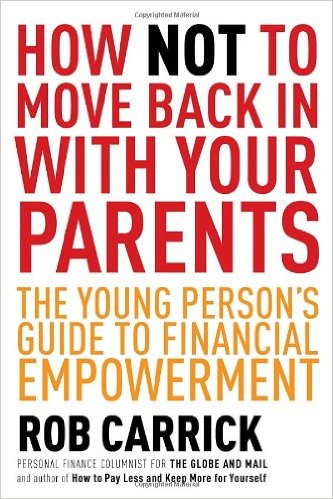
51UopHxeZ+L._SX331_BO1,204,203,200_You’re a millennial. You’ve recently graduated from university and are beginning your career. You aren’t making quite as much as you’d hoped for, and as it turns out, rent is crushingly expensive.

Okay, you’ll just put off moving out for six months, save some money, live at home. Everyone’s doing it these days. You’re sure that before you know it you’ll be on track to success, living it up in homeowner-ville, sitting pretty. You’re not quite sure exactly how you’ll get to homeowner-ville, but it can’t be that hard, right?

If any of this sounds plausible, I would seriously consider reading this wonderful book called How Not to Move Back in With Your Parents – The Young Person’s Guide to Financial Empowerment by Globe and Mail personal finance columnist Rob Carrick. I don’t want to be dramatic and say it will be your new finance bible, but it’s definitely a book you’re going to be referencing time and time again throughout those first few post-graduate years.

Something I really love about this book is that it’s broken down into great detail. Not only that, but it’s organized according to when in life you should be needing the advice.

Covering all the financial bases

Continue Reading…

3 money hacks for Millennials

Rainy day fund as a piggy bank holding money set aside for financial challenges as a 3D illustration of a piggy bank as a glass with water drops or droplets.By Helen Chevreau, Hub Staff

I think it’s safe to say that by our mid-twenties, most of us millennials have received ample financial advice — be it desired or unsolicited. Oftentimes much of it boils down to the same few nuggets of wisdom. We hear those same phrases over and over throughout our childhood and young adulthood so often that sometimes, the value behind them begins to lose its potency.

I know that personally, the phrase “don’t live beyond your means” was a household mantra. If I had a dollar for every time I’d heard that from my dad growing up, I wouldn’t need to be worried about following it! (Editor’s note: see Helen’s bio below).

This week, we’re lucky enough to be working with TD Canada Trust to get to the bottom of what these oft-heard universal personal finance phrases really mean. According to a recent TD survey, the three most received pieces of advice from parents and guardians to millennials have been to live within their means, to save a percentage of each paycheque, and to save for a rainy day.

These are all wonderful pieces of advice, and every millennial should be following them to the best of their ability. However, sometimes these overgeneralized statements ( especially something like “saving for a rainy day”) aren’t helpful to a millennial who has yet to encounter a “rainy day,” and so doesn’t know what to expect from it.

This is where Shirley Malloy, TD’s associate vice president of Everyday Banking comes in. She is here to share a few ‘Moneyhacks’ that will turn these financial ‘truths’ into measurable goals that any millennial (or other financially-inclined individual) can implement.

Nugget #1: Don’t live beyond your means          

Actionable takeaway: Don’t mistake credit for cash.

Continue Reading…

The four Ds to buying your first home

An old wooden house in Dalarna, SwedenBy Sheila O’Hearn, Zoocasa

Special to the Financial Independence Hub

 “If a monkey can be taught to salt away money by sticking it in a sock, so can we.”

That’s what my partner and I told each other the day we decided to start saving for a home. Real estate can be tough, so we started our plan early. In some ways, it was madness. We still had to pay monthly rent and a first baby was on the way. It meant cutting back on activities we enjoyed, little extras and big extras.

But what we had going for us were the four D’s: the dream, the drive, the discipline, and a deadline.

Eventually we hit our target and moved to a small town where houses still cost less than they do in a city. Ours was a modest, century-old farmhouse that would require work, just right for my partner’s creative outlet. It was a cozy fit for our two additional children, but it was home and has been for 28 years.

How a person or couple saves for their first home is not a question of doing it one way, but of having knowledge of the options to make informed choices and a solid plan.

The dream

Continue Reading…