

 Posted By

Prime Minister Mark Carney’s first federal budget was delivered Tuesday afternoon shortly after 4 pm by Minister of Finance and National Revenue Francois-Philippe Champagne.
Go here for full documents and to find downloadable documents for the 405-page Budget. (The above screenshot is not enabled for downloading.)
Below is one of the first releases released by the Department of Finance website. It’s followed with headlines and hyperlinks to the most recent Budget coverage in the Globe & Mail and National Post.
This blog may be revised as new updates arrive from various media sources.
Government of Canada releases Budget 2025: Canada Strong
Canada’s new government puts forward a plan to build, protect, and empower Canada
November 4, 2025 – Ottawa, Ontario – Department of Finance Canada
Canada faces a rapidly changing and increasingly uncertain world. The rules-based international order and the trading system that powered Canada’s prosperity for decades are being reshaped – hurting companies, displacing workers, causing major disruption and upheaval for Canadians.
In the face of global uncertainty, Canada’s new government is focused on what we can control. Budget 2025: Canada Strong is our plan to transform our economy from one that is reliant on a single trade partner, to one that is stronger, more self-sufficient, and more resilient to global shocks. Our plan builds on Canada’s strengths – world-class industries, skilled and talented workers, diverse trade partnerships, and a strong domestic market where Canadians can be our own best customers. We are creating an economy by Canadians, for Canadians.
We are building Canada Strong. This is a plan to build the major infrastructure, homes, and industries that grow our economy and create lasting prosperity. This is a plan that will protect our communities, our borders, and our way of life. This is a plan to empower Canadians with better careers, strong public services, and a more affordable life. We are building a stronger economy, so that Canadians can build their own future.
To do that, Canada’s new government is delivering an investment budget. We are spending less on government operations – and investing more in the workers, businesses, and nation-building infrastructure that will grow our economy. Budget 2025 delivers on the government’s Comprehensive Expenditure Review to modernise government, improve efficiencies, and deliver better results and services for Canadians. It includes a total of $60 billion in savings and revenues over five years, and makes generational investments in housing, infrastructure, defence, productivity and competitiveness. These are the smart, strategic investments that will enable $1 trillion in total investments over the next five years through smarter public spending and stronger capital investment.
Countries across the world are facing global economic challenges – and Canada is no different. Budget 2025 is Canada’s new government’s plan to address these challenges from a position of strength, determination, and action. It is our plan to take control and build the future we want for ourselves, as a people and a country. It is our plan to build Canada Strong.
Quotes
“The global uncertainty we are facing demands bold action to secure Canada’s future. Budget 2025 is an investment budget. We are making generational investments to meet the moment and ensure our country doesn’t just weather this moment but thrives in it. This is our moment to build Canada Strong and our plan is clear – we will build our economy, protect our country, and empower you to get ahead. When we play to our strengths, we can create more for ourselves than can ever be taken away.”
The Honourable François-Philippe Champagne, Minister of Finance and National Revenue
Quick facts
- Canada has the fiscal capacity to meet its ambition:
- Canada has the lowest net debt-to-GDP ratio in the G7 at 13.3 per cent according to the IMF October 2025 Fiscal Monitor. Canada also has one of the lowest deficit-to-GDP ratios in the G7, second only to Japan. This strong fiscal position enables us to respond to global challenges.
- Canada is one of only two G7 economies with a AAA credit rating, making Canada one of the best places to invest in the world.
- Canada has the best deal of any U.S. trading partner, with 85 per cent of our trade tariff-free. While some sectors remain deeply impacted, overall, Canadian exporters benefit from the lowest average U.S. tariff of any country at 5.4 per cent.
- Budget 2025 rests on two fiscal anchors:
- Balancing day-to-day operating spending with revenues by 2028–29, shifting spending toward investments that grow the economy; and
- Maintaining a declining deficit-to-GDP ratio to ensure disciplined fiscal management for future generations.
- In addition to the two fiscal anchors, Budget 2025 enables $1 trillion in total investments over the next five years through smarter public spending and stronger capital investment.
Here are some headlines with hyperlinks in red to the latest Globe & Mail stories on the budget, for those with subscriptions to the paper.
—————-
Federal budget 2025: Ottawa to cut 40,000 public service jobs as part of $60-billion internal savings plan
The big measure is to shrink the size of the public service by 40,000 people over five years in a quest to find some $60-billion in internal savings. The core public service reached a peak of 367,772 employees in 2024 before falling to 357,965 this year, the Treasury Board says.
This budget is a Trump survival plan. Here are the highlights
The Deficit
The article says that for the 2025-26 fiscal year, the deficit will be about $78.3-billion, in line with several estimates from the private sector in recent weeks: “The deficit will edge lower over the projection horizon, reaching $56.6-billion in 2029-30.”
The Debt
And the federal debt? For the current fiscal year, “the debt-to-GDP ratio will amount to 42.4 per cent, rising slightly over the next two years, before heading back down to 43.1 per cent in 2029-30.”
Trade
Recall that Ottawa last month said it hoped to double non-U.S. exports over the next decade, taking annual exports to $600-billion. The budget proposes $5-billion over seven years to create the Trade Diversification Corridors Fund, which “will consider investments in key projects in the Great Lakes-St. Lawrence Region, at ports in northeastern Quebec like enhancing the Port of Saguenay’s capacity to build a second wharf, rail lines in Alberta, port and rail infrastructure on the West Coast, and more,” according to the budget.
It also proposes $1-billion over four years to create the Arctic Infrastructure Fund, “which will invest in major transportation projects in the North with dual-use applications for civilian and military use,” such as airports and all-season roads.
Federal budget 2025: Carney earmarks $89.7-billion in new spending to counter U.S. protectionism
Net new spending over five years will reach $89.7-billion. The Budget proposes a a “productivity super deduction”, described as “a set of tax incentives covering all new capital investment to allow businesses to write off a larger share of the costs right away.”
The Globe says the deduction is “part of a package of other tax measures to entice Canadian and international businesses to massively boost their spending on infrastructure projects linked to natural resource development, artificial intelligence, scientific research and energy conservation equipment.” It quotes Mr. Champagne as saying “This budget will unleash $1-trillion in total investments over the next five years. That would boost average wages by $3,000 per year … It would add $15-billion to federal revenues that can support health care, lower your taxes and pay down Canada’s debt.”
—————
Over at the National Post, the headline in Wednesday’s paper says it all:
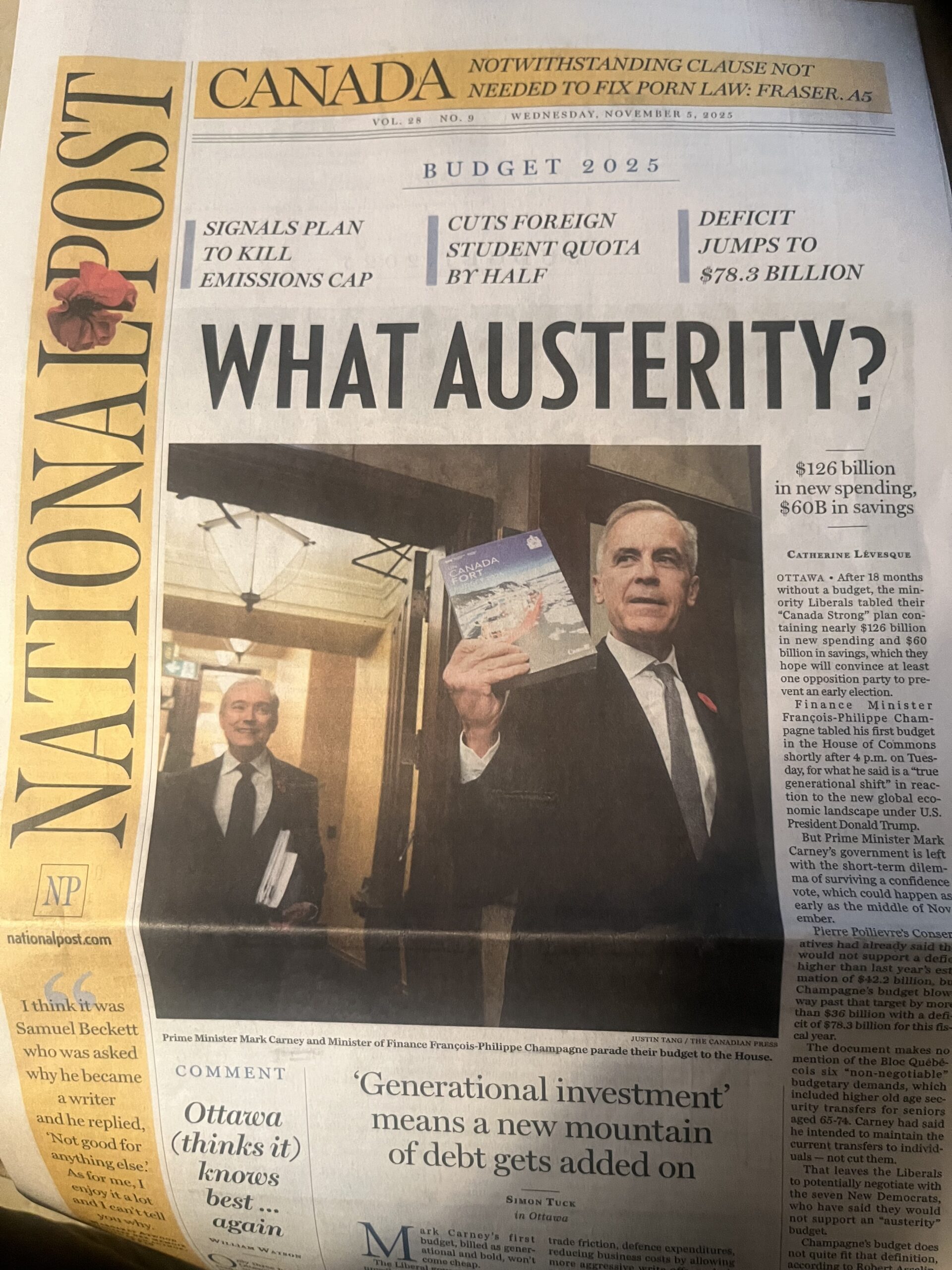
With nearly $80B in red ink, Carney racks up largest ever non-pandemic deficit in federal budget
For those who don’t subscribe, it says a “weakened” Canadian economy will produce gross domestic product (GDP) growth of just over 1 per cent this calendar year and next, compared to 2 per cent forecast in last year’s Fall Economic Statement. It says the new economic landscape means a cut of $7 billion a year in federal revenue, compared to the figures provided in last year’s economic statement and “the addition of new clouds to a fiscal situation that was already dark.”
Golombek says there were no further changes to individual tax rates for 2025, but “the budget did introduce a new top-up tax credit, which aims to fix a problem associated with the recent reduction in the lowest bracket as it relates to the value of non-refundable tax credits.”
He mentions the Home accessibility tax credit (HATC) and notes the cancellation of the Canadian Entrepreneurs’ incentive, the Underused Housing Tax and the luxury tax on boats and airplanes.
He says there were no changes to the annual RRIF withdrawal minimums, despite hopes they might be cut by as much as 25%. “Experts say that the RRIF rules haven’t kept up with recent demographic and economic trends.”
Golombek has an excellent more extensive analysis in his CIBC Budget 2025 report, which he posted on his X account (@JamieGolombek). In addition to those mentioned in his shorter FP column, he describes the Personal Support Workers Tax Credit, Flow-through shares, 21-year rule trust planning, bare trust reporting, immediate expensive for manufacturing and processing buildings, and automatic federal benefits for lower-income taxpayers.
———
What Budget 2025 includes for everyday Canadians
Despite the big-ticket “investments” the article points out that there are also “plans to review ATM fees … funding for the summer jobs program, and a potential bid to join Eurovision.’” In short, “the federal government’s 2025 budget does include some measures that could be of interest to everyday Canadians.”
Here are some of other measures CTV highlights:
Streamlining access to Canada Disability Benefit
Government will review ATM and bank fees
No cuts to Trudeau-era social programs
Adjustments to medical cannabis benefit
Spending aimed at boosting youth employment
Federal budget 2025: Eight ways the budget affects your wallet, from vacant homes to student loans
They include:
A temporary top-up to non-refundable tax credits
A one-off boost to the Canada Disability Benefit
A temporary tax credit for personal support workers
Curbs on student financial assistance
Elimination of the Underused Housing Tax
End the luxury tax on fancy planes and boats
Faster access to money deposited by cheque
Automatic tax filing for lower-income Canadians
Little specifics on Seniors
Finally, according to the Canadian Association of Retired Persons (CARP), it told Zoomer Classical Radio 96.3 that there were no cuts (or boosts for that matter) to programs like Old Age Security (which some feared). And as Golombek noted above, there was no clarification of a temporary reduction in minimum RRIF withdrawals that had been anticipated as a short-term measure during this time of economic insecurity.
This blog may be updated over the course of Wednesday.
