

 Posted By
By Stephen Dover, CFA, Franklin Templeton Institute
(Sponsor Blog)
Executive Summary
Introduction
Global Investment Outlook: 2026 and Beyond was built around three cyclical themes — broadening, steepening, and weakening — and three longer-term forces shaping investor portfolios: intelligence, private markets and big government.
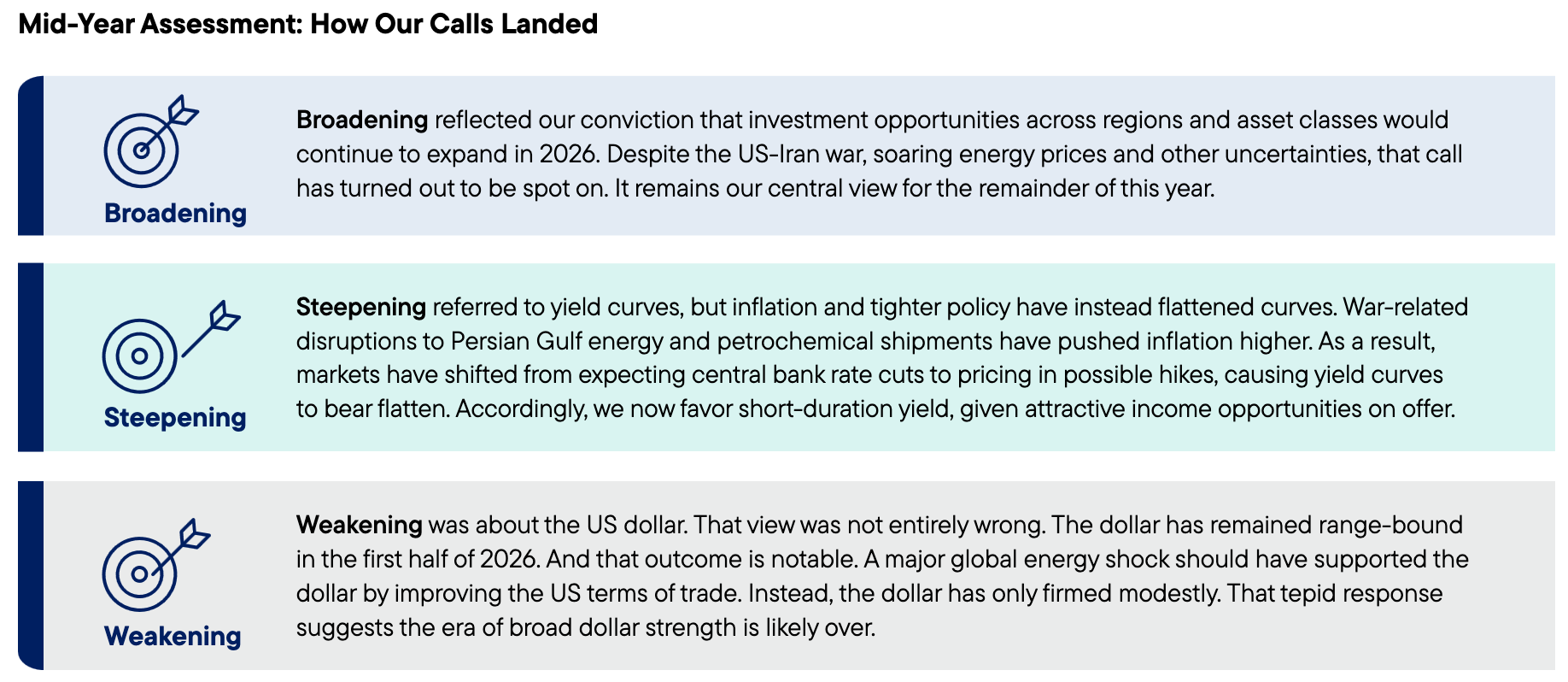
Midway through 2026, we think that framework still provides a useful starting point, but the balance of risks has changed. Broadening remains firmly intact, supported by resilient economic growth, strong earnings and improving opportunities across regions and asset classes. But steepening of yield curves has given way to higher-for-longer yields, reflecting higher inflation and tighter monetary policies. Higher yields, however, also offer improved income opportunities in shorter-duration holdings, including US high yield and select emerging markets.
Meanwhile, the US dollar has firmed and is likely to remain rangebound rather than weak over the remainder of 2026. Most importantly, the world did not break. Despite war, tariffs, inflation, tighter policy and geopolitical fragmentation, the global economy and financial markets have held together better than many expected. This update therefore reframes the outlook around a single organizing idea: resilience: both the resilience already evident in economies and markets, and the resilience investors may need to build into portfolios for the remainder of the year.
A more Resilient Outlook (or Resilience in Markets and Portfolios)
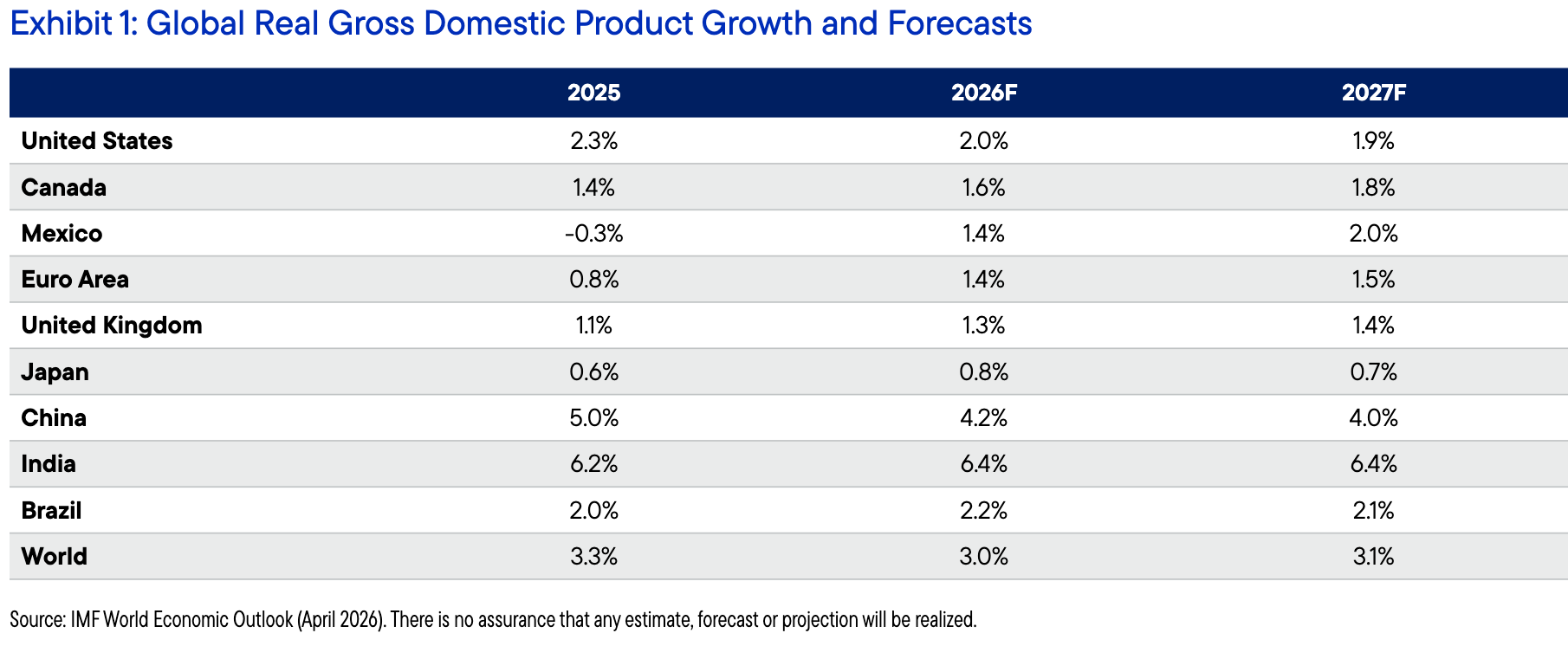
This year, the global economy has demonstrated remarkable resilience in the face of numerous challenges, including geopolitical tensions, trade disputes, fiscal pressures, rising inflation and a sharp re-pricing of central bank policy responses.
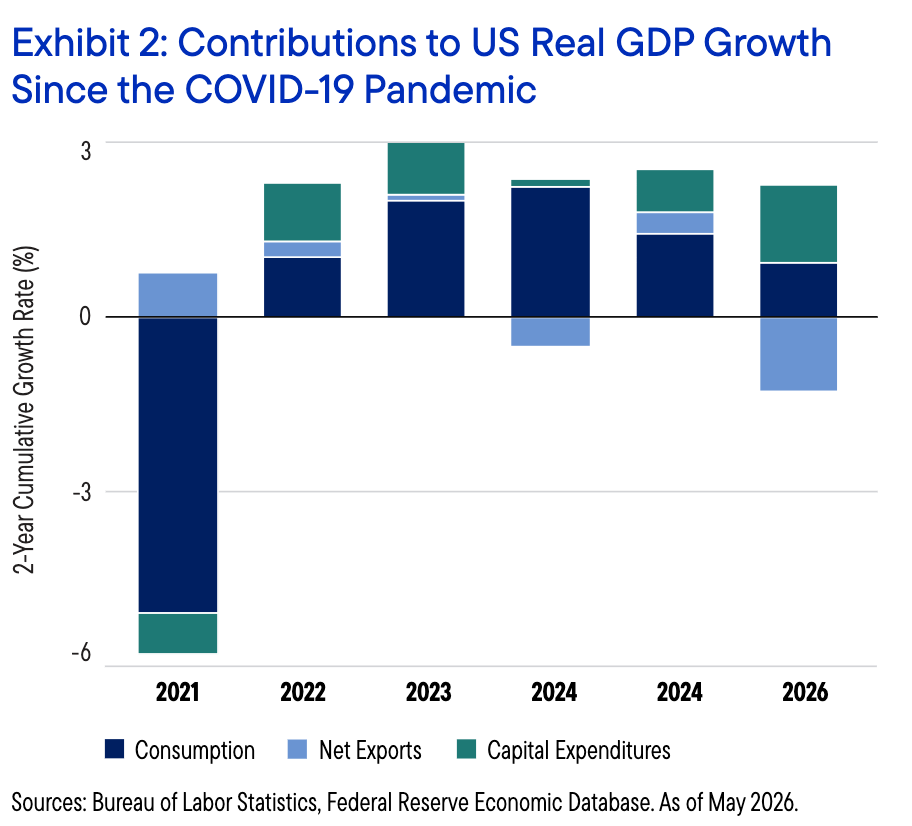
Globally, wealth effects and favorable financial conditions have also supported consumption and capital expenditures.
Notably, trade has held up better than many feared following the introduction of high US tariffs in 2025. Global commerce has continued to expand, with important contributions from services.
China’s economy has also demonstrated notable resilience in 2026 despite ongoing challenges from a weak property sector, geopolitical tensions and trade frictions with the United States. The diversification of China’s growth drivers has been a key factor. Strong investment in advanced manufacturing, technology, renewable energy, electric vehicles, batteries and AI has helped offset weakness in real estate. These sectors have benefited from both government support as well as from strong domestic and international demand.
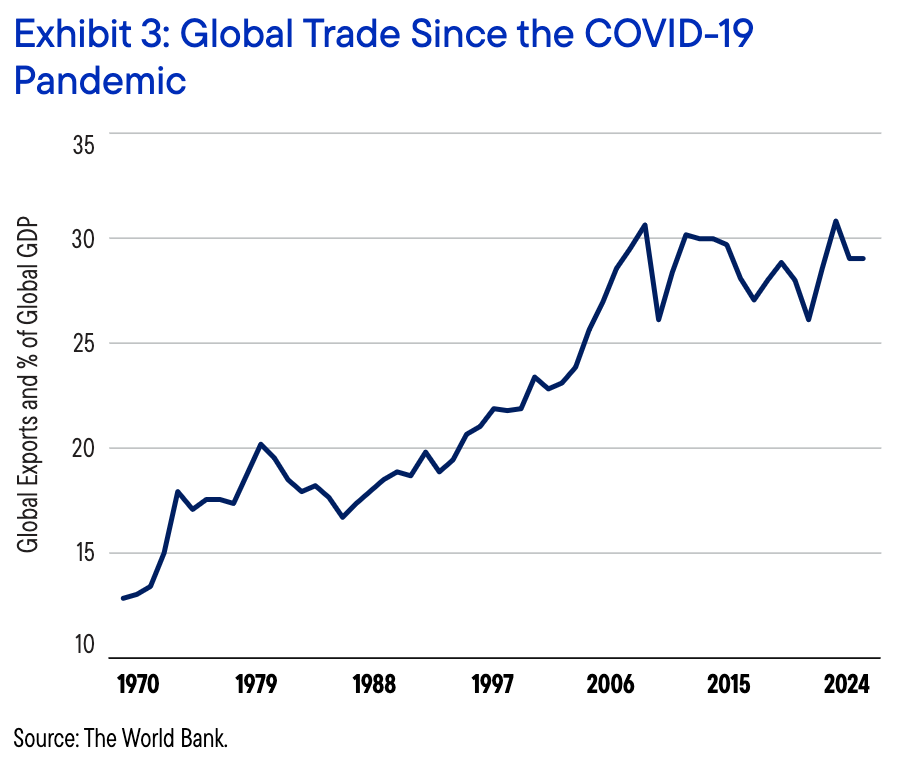
China’s exports have also remained more robust than many expected. Chinese firms have adapted to changing trade patterns by expanding into emerging markets, strengthening supply chains and increasing exports of higher-value-added products. As a result, China has maintained a significant role in global manufacturing and trade despite rising protectionist pressures.
Meanwhile, China’s fiscal and monetary policies have remained accommodative, helping to sustain investment and economic activity without generating significant inflationary pressures.
Finally, other emerging economies have been a bright spot in the world economy. They have benefited from investor confidence following a decade of fiscal and monetary policy orthodoxy, contributing to lower risk premiums, stable capital accounts and favorable investment backdrops.
Emerging economies outside China have also adapted quickly to shifting global trade patterns, while disciplined capital investment has helped lift profitability and support more sustainable growth
Global Equity Resilience
Global equity markets have proven resilient in 2026, ecovering quickly from the initial shock of the US-Iran war and returning close to cyclical or all-time highs. This section explains why we remain constructive on equities for the second half of the year, highlighting a number of positives. Earnings growth remains strong, valuations are not stretched, market leadership is broadening beyond large-cap technology stocks, and emerging markets offer attractive opportunities amid improving profitability and persistent investor underexposure.
Strong earnings growth supports our constructive equity outlook. S&P 500 earnings per share are expected to rise about 15% this year (see Exhibit 4). Even with the S&P 500 Index up nearly 7% in the first half of 2026, its forward price- to-earnings ratio has declined, suggesting that earnings growth — not multiple expansion — has driven much of the market’s advance.
In other words, investors have remained disciplined despite higher geopolitical risk, and to us the US
equity market does not appear stretched.
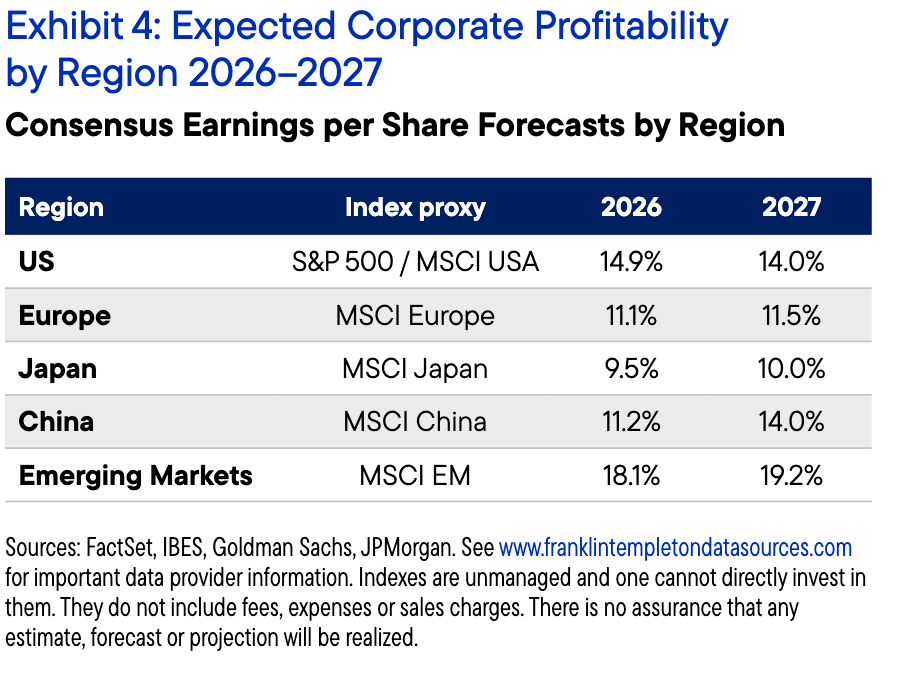
We expect market leadership to continue broadening beyond large-cap technology stocks in the second half of 2026. Improving earnings make US small- and mid-cap equities, emerging markets and Japan more attractive. Year-to-date returns also suggest investors are increasingly rewarding companies with stronger earnings. The Russell 2000 Value Index, for example, has led major subindexes with a nearly 17% gain, supported by earnings growth of more than 40%.1
The pattern is similar outside the United States. The MSCI Emerging Markets Index has gained nearly 20% year-to-date, supported by earnings growth up to nearly 40% in 2026 and 2027. Yet valuations remain attractive. While the S&P 500 Index trades at roughly 21 times forward earnings, the MSCI Emerging Markets Index trades at about 13 times forward earnings and currently offers a dividend yield close to 3%.2
Many global investors remain underexposed to emerging markets after years of relative underperformance. We believe that under-allocation creates a potential tailwind for emerging market equities; even a modest shift in capital flows could meaningfully support returns.
In short, we remain positive on global equities for the remainder of 2026. Rising earnings should support
opportunities across a wider range of markets, especially in areas that have been overlooked in recent years. In the second half of the year, we favor US small- and mid-cap stocks, value stocks and financials, while maintaining core exposure to AI-related themes where leading companies continue to benefit from large-scale investment and technology adoption. Globally, our top equity opportunity remains emerging markets.
Global Fixed Income Opportunities
(This section and the balance of the Investment Outlook can be accessed by downloading the complete document linked below at the bottom of Stephen’s bio)
 Stephen Dover is Chief Market Strategist and Head of the Franklin Templeton Institute. Stephen leverages the knowledge of the firm’s autonomous investment teams to provide global capital market and long-term investment insights internally and to clients. The Franklin Templeton Institute harnesses the depth and breadth of the firm’s global investment expertise and extensive in-house research capabilities to deliver unique investment insights to clients. Mr. Dover is a member of Franklin Resources’ executive committee, a small group of the company’s top leaders responsible for shaping the firm’s overall strategy.
Prior to his current role, Mr. Dover served as Executive Vice President, Head of Equities for Franklin Templeton, leading the firm’s equity investment teams. He has also served as Chief Investment Officer of the firm’s Emerging Markets Equity group and local asset management teams. Previously, Mr. Dover was a founder and chief investment officer of Bradesco Templeton Asset Management (BTAM), a joint venture between Franklin Templeton and Banco Bradesco in Sao Paulo, Brazil.
Prior to joining Franklin Templeton in 1997, Mr. Dover was a portfolio manager with Vanguard where he co-managed an equity income strategy. He also worked for Towers Perrin Consulting (now Willis Towers Watson) in New York, London and San Francisco.
Over the course of his investment industry career, Mr. Dover has lived in China, Europe, Brazil and the United States. Mr. Dover holds a B.A., with honors, from Lewis and Clark College and an M.B.A. in finance from The Wharton School of the University of Pennsylvania. He is a Chartered Financial Analyst (CFA) charterholder. Mr. Dover is on the Board of Trustees of Lewis and Clark College and Law School.
This blog is an excerpt from Franklin Templeton’s recently released mid-year Investment Outlook, The World Didn’t Break.
IMPORTANT LEGAL INFORMATION
This material is intended to be of general interest only and should not be construed as individual investment advice or a recommendation or solicitation
to buy, sell or hold any security or to adopt any investment strategy. It does not constitute legal or tax advice. This material may not be reproduced,
distributed or published without prior written permission from Franklin Templeton.
The views expressed are those of the investment manager and the comments, opinions and analyses are rendered as at publication date and may
change without notice. The underlying assumptions and these views are subject to change based on market and other conditions and may differ from
other portfolio managers or of the firm as a whole. The information provided in this material is not intended as a complete analysis of every material fact
regarding any country, region or market. There is no assurance that any prediction, projection or forecast on the economy, stock market, bond market
or the economic trends of the markets will be realized. The value of investments and the income from them can go down as well as up and you may not
get back the full amount that you invested. Past performance is not necessarily indicative nor a guarantee of future performance. All
investments involve risks, including possible loss of principal.
Any research and analysis contained in this material has been procured by Franklin Templeton for its own purposes and may be acted upon in that
connection and, as such, is provided to you incidentally. Data from third party sources may have been used in the preparation of this material and
Franklin Templeton ("FT") has not independently verified, validated or audited such data. Although information has been obtained from sources that
Franklin Templeton believes to be reliable, no guarantee can be given as to its accuracy and such information may be incomplete or condensed and
may be subject to change at any time without notice. The mention of any individual securities should neither constitute nor be construed as a
recommendation to purchase, hold or sell any securities, and the information provided regarding such individual securities (if any) is not a sufficient
basis upon which to make an investment decision. FT accepts no liability whatsoever for any loss arising from use of this information and reliance upon
the comments, opinions and analyses in the material is at the sole discretion of the user.
Franklin Templeton has environmental, social and governance (ESG) capabilities; however, not all strategies or products for a strategy consider “ESG”
as part of their investment process.
Products, services and information may not be available in all jurisdictions and are offered outside the U.S. by other FT affiliates and/or their distributors
as local laws and regulation permits. Please consult your own financial professional or Franklin Templeton institutional contact for further information on
availability of products and services in your jurisdiction.
Canada: Issued by Franklin Templeton Investments Corp., 200 King Street West, Suite 1400 Toronto, ON, M5H3T4, Fax: (416) 364-1163, (800) 387-0830,
www.franklintempleton.ca.
