

 Posted By
 Evidence over emotion. Process over prediction. Better decisions over better guesses.
By Steve Lowrie, CFA
Special to Financial Independence Hub
Welcome to Before You Decide, a series about the decisions that shape our financial lives. Each article explores a common financial question through the lens of evidence, behavioural finance, and more than three decades of working with Canadian families. The goal is not to predict the future, but to make better financial decisions with the information available today.
A financial decision can be sensible and still produce a disappointing result. It can also be poorly considered and make money. That is what makes investing so difficult.
Most of us naturally judge our decisions by their outcomes. If an investment rises, we assume the decision was good. If it falls, we assume somebody made a mistake. Behavioural economists have a name for this tendency. They call it outcome bias.
Outcome bias is our tendency to judge the quality of a decision by the result it produced rather than by the quality of the reasoning that led to it. The problem is that luck sits between a decision and its outcome, which means a good result does not always prove that the original decision was sound.
Every important financial decision should therefore be judged twice. The first judgment should take place when the decision is made, based on the quality of the reasoning and the information reasonably available at the time. The second should take place much later, after the outcome is known.
Most investors only perform the second evaluation, and that is where many costly mistakes begin.
Every investor eventually faces two different questions: Did my investment work, and was it a good decision? Those questions may sound similar, but they are not the same.
Why is outcome bias especially relevant today?
A relatively small group of technology and artificial intelligence related companies has recently produced outsized returns. Investors who concentrated their portfolios in some of these companies have been rewarded handsomely, while investors holding broadly diversified global portfolios may be wondering whether diversification has become an expensive form of caution.
We have seen this movie before.
During the technology and telecommunications boom of the late 1990s, a relatively small group of companies dominated both market returns and investor attention. The technologies were real, and many of the companies were genuinely innovative. That did not mean every investment made sense or every price was justified.
The same distinction matters today. Artificial Intelligence (AI) may profoundly change the economy without making every AI-related investment a good decision at current prices.
For a Canadian investor, a concentrated position in AI-related stocks may also involve several overlapping risks. It can amount to a concentrated commitment to one sector, one country, one currency, and often a relatively small number of companies. Those risks may continue to be rewarded for years, but they remain risks nonetheless.
The important question is not simply whether the investment works. It is whether the decision itself was well reasoned, whether the risks were understood, and whether the position made sense within the investor’s broader financial plan.
What are the four possible outcomes of a financial decision?
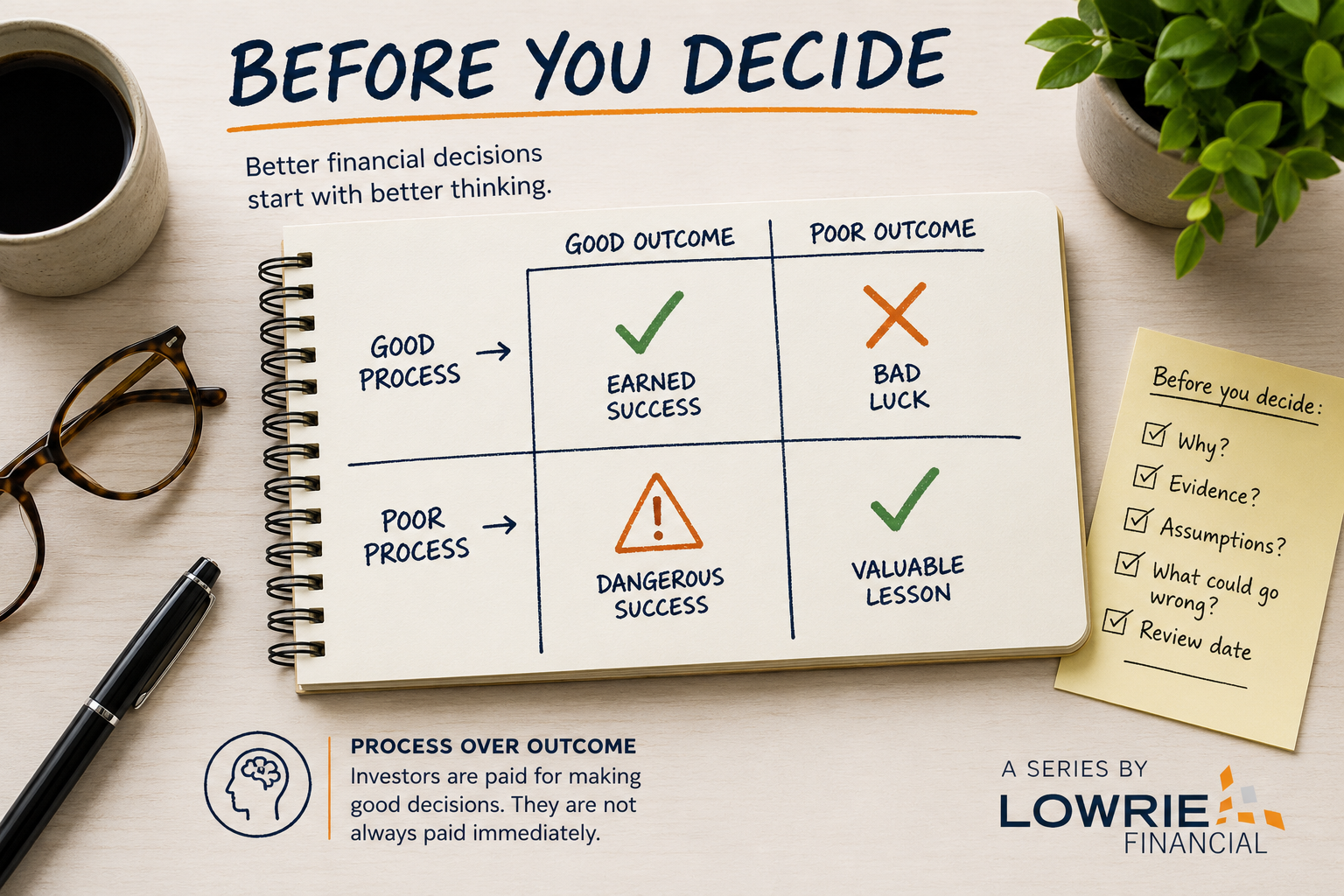
Every financial decision eventually falls into one of four categories:
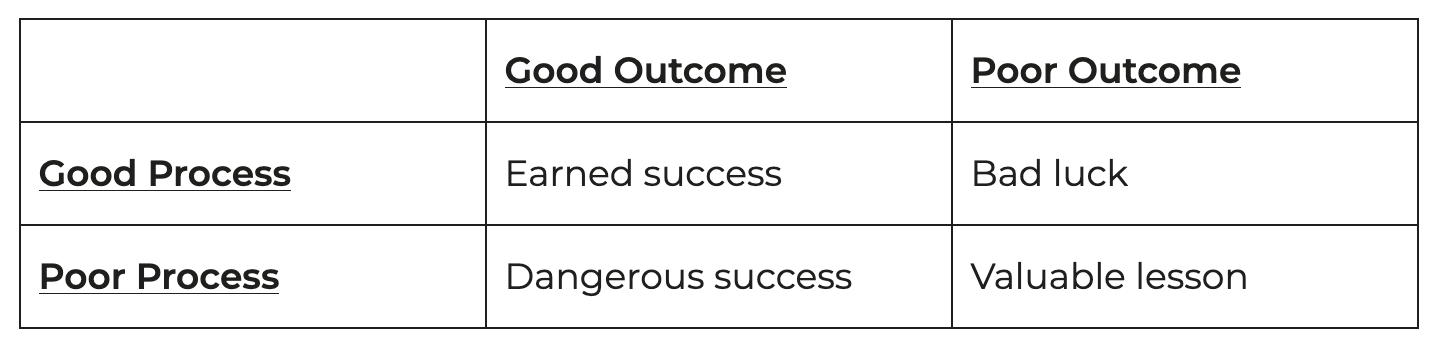
A good process combined with a good outcome is what every investor hopes for. You followed a sensible process, understood the risks, and received a favourable result.
A good process followed by a disappointing outcome is more difficult to accept, but it does not necessarily mean the process failed. Good decisions improve the odds, they do not guarantee a particular result.
A poor process followed by a poor outcome is painful, although at least the mistake is visible. Something in the original reasoning can be examined, understood, and improved.
The most dangerous combination is a poor process followed by a good outcome. In that situation, the result appears to validate the decision, confidence grows, and the same choice may be repeated with more conviction and more money behind it. Nothing in the outcome forces the investor to question the original reasoning.
This is outcome bias at its most expensive. A temporary success becomes a lasting lesson for entirely the wrong reason.
Why do investors judge decisions by their outcomes?
Looking at the result is easy. Examining the decision is much harder.
By the time most people make an important financial choice, they have usually considered taxes, investment products, market forecasts, retirement planning, family needs, and competing advice. Mental fatigue encourages shortcuts, and recent performance becomes one of the easiest shortcuts available.
If the investment made money, it must have been a good decision. That conclusion feels natural, but it is not reliable.
I explored this idea in an earlier article about choice overload and decision fatigue. One of the best-known studies in behavioural economics found that shoppers presented with twenty-four varieties of jam were much less likely to make a purchase than shoppers offered only six. More choice attracted more attention, but it produced fewer decisions.
Investors face far more than twenty-four choices. Individual companies, sectors, countries, currencies, investment styles, economic forecasts, and an endless stream of financial commentary compete for our attention every day. When the menu becomes overwhelming, we naturally look for an easier way to judge our decisions, and recent returns become that shortcut.
There is another problem. We examine our losses far more carefully than our successes. When an investment disappoints, we search for mistakes. When it performs exceptionally well, we rarely ask how much of the result may simply have been good fortune.
Success seldom asks us to defend our thinking, which is one reason poor decisions with good outcomes can survive for so long.
How can you tell the difference between skill and luck?
One useful test is to ask whether a skilled participant can deliberately produce a poor result.
In an activity dominated by skill, that is usually possible. A strong chess player can lose a game on purpose because the relationship between skill and outcome is direct enough to control.
Now think about a concentrated stock portfolio over a single year. Could you reliably make it lose money? Probably not. Unexpected news, changing interest rates, investor enthusiasm, government policy, and countless other factors could move the investment in either direction.
That does not mean skill has no place in investing. Skill appears in building a diversified portfolio, managing risk, controlling costs, minimizing taxes, and staying disciplined when markets become emotional. It also appears in knowing what can be controlled and refusing to pretend that everything else can be predicted.
One year’s return therefore tells us far less about skill than most of us would like to believe.
Why is one investment result not enough to judge a decision?
A single investment outcome contains a great deal of noise, while a pattern across many decisions tells us much more.
Researchers at The Wharton School at the University of Pennsylvania studied what happened when a large employer simplified the investment choices in its workplace retirement plan. Participants generally traded less, paid lower investment costs, and held more appropriate portfolios. The researchers estimated that lower costs alone could leave the average participant approximately US$9,400 better off over twenty years.
The participants did not become better investors because they learned to predict markets. They became better investors because the decision-making environment improved.
That distinction matters because better financial outcomes often come from better decision-making processes rather than better predictions.
What does outcome bias look like in real life?
Several years ago, I had a client who decided, against my advice, to sell a diversified investment portfolio and make a concentrated commitment to residential investment real estate in Toronto.
The decision did not happen in isolation. Another advisor was enthusiastically promoting recent real estate returns and presenting the strategy as an opportunity that should not be missed. Like many investment stories built on recent success, it appealed to a powerful fear of missing out.
I certainly had concerns. Residential real estate prices had risen dramatically, valuations looked stretched, and the risks appeared far greater than many investors appreciated. I believed that prices would eventually flatten or decline, although I did not know when that would happen. Nobody did.
My concern was never based on the belief that I could predict the market. My concern was with the decision itself. The client was abandoning a globally diversified investment strategy in favour of a concentrated commitment to one asset class, in one city, exposed to one narrow set of economic conditions.
Timing, of course, matters to the outcome. Had this same decision been made in 2010 or 2011, before 12 years of outsized returns, it might have produced an outstanding financial result. Even then, I would have viewed it as a poor decision-making process that happened to be rewarded.
Instead, the decision was made in 2022.
Four years later, we all know the ending of the story. Toronto residential real estate has lost a significant portion of its value, while the diversified portfolio that had been sold has appreciated substantially.
I do not tell this story as an “I told you so.” Nobody knew exactly how either investment would perform. The point is that the quality of the original decision never changed. Only the outcome did.
Had the investment performed exceptionally well, the concentration risk, the lack of diversification, and the weak decision-making process would still have been there. A favourable outcome would simply have made them easier to overlook.
Before you decide: What habit can improve financial decisions?
One simple habit can make financial decisions easier to evaluate honestly.
Before making an important decision, write down your reasoning while you still have the benefit of uncertainty. Explain why you are making the decision, what evidence supports it, what assumptions you are relying on, and what would eventually cause you to conclude that the reasoning was wrong.
Then put those notes away.
Months or years later, return to what you wrote before reviewing the investment return. Begin by judging the quality of your thinking and whether the original assumptions were reasonable. Only after that should you consider the outcome.
This simple practice makes it much harder to rewrite history after the fact. It also creates a record of what you actually believed before hindsight made the result appear obvious.
In the articles ahead, I will continue exploring the financial decisions that matter most, the questions clients have raised over the years, and what the evidence tells us about making better choices. The topics will change, but the underlying principle will remain the same.
Remember:
Investors are paid for making good decisions. They are not always paid immediately.
Before making your next important financial decision, write down why you are making it. Your future self may learn more from that explanation than from the outcome itself.
Frequently asked questions
What is outcome bias?
Outcome bias is the tendency to judge the quality of a decision by its result rather than by the quality of the reasoning that produced it. In investing, it can cause people to abandon sound strategies after temporary losses and repeat poor strategies that happened to produce favourable returns.
Can a good financial decision lose money?
Yes. Sound reasoning improves your odds across many decisions, but it does not guarantee the outcome of any single investment.
How can I tell skill from luck?
Ask whether someone with little or no investment skill could reasonably have achieved the same result. If the answer is yes, be careful about attributing the outcome to skill alone.
Does this mean I should never change course?
No. You should change course when your goals change, when new evidence emerges, or when your original reasoning is no longer valid. You should not change course simply because another investment has recently performed better.
Should investment returns matter?
Yes, but they need context. Returns should be evaluated over appropriate periods, relative to the risks taken, and in light of the purpose the money was meant to serve.
 Steve Lowrie is a Portfolio Manager with Aligned Capital Partners Inc. (“ACPI”). The opinions expressed are those of the author and not necessarily those of ACPI. This material is provided for general information, and the opinions expressed and information provided herein are subject to change without notice. Every effort has been made to compile this material from reliable sources; however, no warranty can be made as to its accuracy or completeness. Before acting on the information presented, please seek professional financial advice based on your personal circumstances. ACPI is a full-service investment dealer and a member of the Canadian Investor Protection Fund (“CIPF”) and the Canadian Investment Regulatory Organization (“CIRO”). Investment services are provided through ACPI or Lowrie Investments, an approved trade name of ACPI. Only investment-related products and services are offered through ACPI/Lowrie Investments and are covered by the CIPF. This article originally ran on Steve’s blog on July 31, 2026 and is republished on Findependence Hub with permission.