

 Posted By
By Noah Solomon,
Special to Financial Independence Hub
It’s been a long
A long time comin’, but I know
A change gon’ come
Oh yes, it will
- A Change Is Gonna Come, by Sam Cooke
Skate where the Puck is Going, not where it’s Been
Nicknamed “the Great One,” Wayne Gretzky has been called the best hockey player ever. Despite Gretzky’s unimpressive size and strength, his intelligence, stamina, and reading of the game were unrivaled. Gretzky himself credited much of his success to advice he received from his father as a young boy, which was to “skate where the puck’s going, not where it’s been.”
As is the case with the Great One, superior investment results stem in large part from anticipating future developments rather than simply positioning portfolios based on the past or current environment. To be clear, I am not referring to market timing, nor am I referring to predicting earnings, economic growth, inflation, or interest rates over the next quarter or year. As stated in past newsletters, such endeavours are highly unlikely to result in outperformance.
Rather, I am referring to significant changes in the investment landscape that (1) will likely persist for the next several years and (2) present both the risk of significant underperformance and the opportunity for material outperformance, depending on how one’s portfolio is positioned.
The most Powerful Force in Markets
Reversion to the mean is perhaps the most powerful force in markets: periods of higher-than-normal returns have been followed by periods of subpar returns, and vice versa. The postwar expansion and steady market gains of the late 1940s and 1950s were followed by stagflation and choppy, flat returns in the 1960s and 1970s. In similar fashion, the great bull run of the 1980s and 1990s ushered in the lost decade of the 2000s, when stocks delivered negative-to-flat returns.
This pattern is not coincidental but rather is firmly rooted in behavioural economics. For as long as modern markets have existed, people have overreacted, both in good times and bad. Following several years of strong economic and earnings growth, investors have repeatedly become overconfident that the proverbial party will continue indefinitely, causing stock prices to rise at a faster pace than earnings and multiples to reach unsustainable levels. At the other end of the spectrum, during periods of recession when earnings either decelerate or contract, widespread despondency morphs into predictions of eternal darkness with no possibility of improvement, resulting in lower than reasonable earnings expectations, multiple contraction, and fire sale asset prices.
The longer and stronger the expansion, the more irrationally exuberant people become, and the longer and darker the recession, the more illogically pessimism gets entrenched. Ironically, the most optimistic extrapolations reach a crescendo when they are least likely to be realized, and the most pessimistic ones become most widespread when they should be least so. The exact anatomy and causes of different booms and busts change from cycle to cycle, but the overall picture has remained tragically consistent. Plus ça change, plus c’est la même chose.
Markets have NOT been Normal
Investors today have grown accustomed to well-above-average returns. However, as the following table demonstrates, the past ten years have been highly anomalous from a historical standpoint.
Equity Market Returns: A Longer-term Perspective
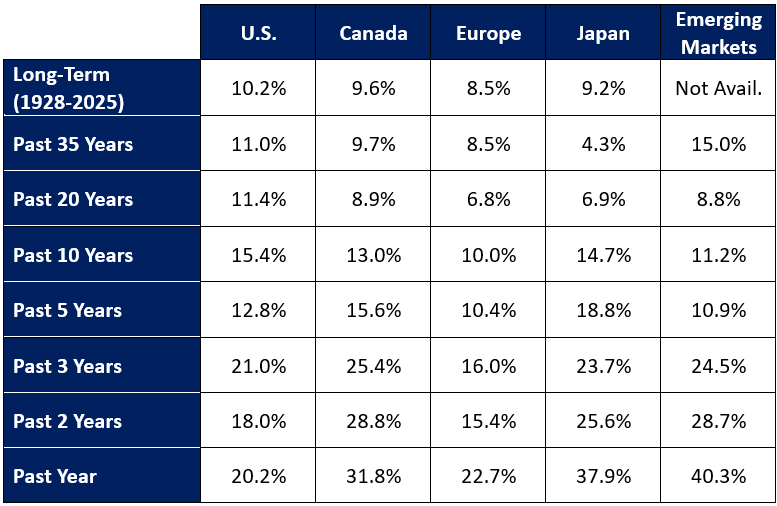
Notwithstanding the daunting historical pattern of mean reversion, the post-global-financial-crisis environment has been highly supportive of equities. Increased globalization, moderate inflation, and low interest rates supported strong earnings growth and expanding valuation multiples, which in turn spurred above-average returns.
In contrast, today’s landscape is marred by trade frictions, stubborn inflation, ballooning sovereign debt levels, and rising interest rates. Importantly, these structural headwinds for earnings growth stand in sharp contrast to today’s elevated valuations, with U.S., Canadian, and European indexes all standing in the top fifth of their historical valuation ranges.
I have no idea whether markets will rise or fall over the near-to-medium term, let alone exactly when or by how much. However, given the historically inverse relationship between starting valuations and forward, ten-year returns, I am confident that average returns over the next ten years will likely be lower than long-term averages, and perhaps meaningfully so. History seems primed to repeat itself, if not rhyme.
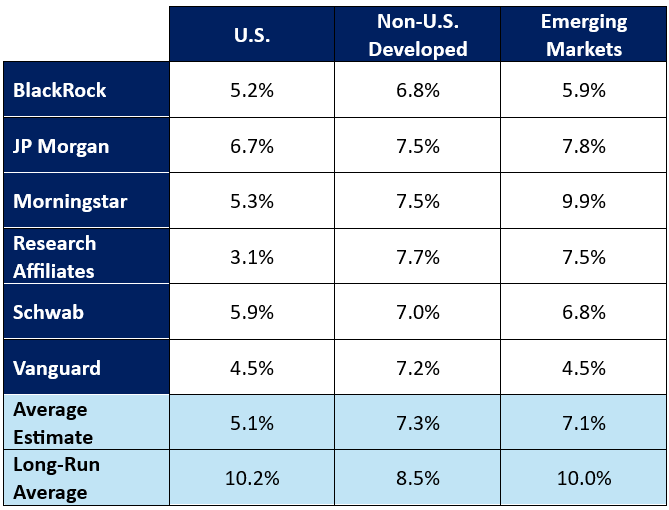
Estimating returns requires sophisticated assumptions, and methodologies used to do so vary across asset managers. Yet, despite these differences, a common theme emerges: most asset managers forecast low future equity returns.
Annualized Equity Return Forecasts: Next 10 Years
What REALLY drives the Bus
It goes without saying that a portfolio’s individual stock holdings and sector weights are important determinants of its return. However, there is more than meets the eye with respect to performance attribution.
A portfolio’s factor exposures refer to its relative weighting towards stocks with certain characteristics, such as low volatility (overweight lower vs. higher volatility companies), dividend yield (overweight dividend-payers vs. non-dividend-payers), value (overweight value vs. growth shares), and size (overweight small vs. large cap. firms). Importantly, several studies have shown that between 55% and 80% of a manager’s out- or under-performance can be attributed to their factor exposures, while only the remaining 20%-45% is typically attributable to the company-specific traits.
As Returns Fade, Style matters most
Whether a manager’s factor exposures result in out- or under-performance is highly dependent on the investment environment. Portfolios that are overweight lower-volatility and/or dividend-paying stocks have historically tended to underperform when benchmark indexes have delivered above-average returns. However, when index returns have been anywhere from below average to negative, these attributes have tended to add significant value. Specifically, during the bottom third of past ten-year rolling return periods from 1926 – 2024, such portfolios have on average outperformed by an annualized rate of 4.9% (61.3% over ten years).
The Key to Capital Growth in a Lower-return World
Index portfolios have delivered well-above-average returns over the past ten years. Against this backdrop, the additional return from non-index portfolios has often been of little, if any, benefit, even for the best managers. In contrast, index returns over the next decade are likely to prove underwhelmingly below average, regardless of country or region.
Lower returns aren’t the end of the world, nor are they reason to stuff your money under a mattress. However, it does necessitate rethinking your approach. Like the Great One, investors should go where the proverbial puck is going.
In an era of below-average returns, Outcome’s algorithmic approach to investing in dividend-paying, low-volatility stocks, both in Canada and internationally, is primed to deliver meaningful outperformance when it will be most needed.
 Noah Solomon is Chief Investment Officer for Outcome Metric Asset Management Limited Partnership. From 2008 to 2016, Noah was CEO and CIO of GenFund Management Inc. (formerly Genuity Fund Management), where he designed and managed data-driven, statistically-based equity funds.
Between 2002 and 2008, Noah was a proprietary trader in the equities division of Goldman Sachs, where he deployed the firm’s capital in several quantitatively-driven investment strategies. Prior to joining Goldman, Noah worked at Citibank and Lehman Brothers. Noah holds an MBA from the Wharton School of Business at the University of Pennsylvania, where he graduated as a Palmer Scholar (top 5% of graduating class). He also holds a BA from McGill University (magna cum laude).
Noah is frequently featured in the media including a regular column in the Financial Post and appearances on BNN. This blog originally appeared in the August 2026 Outcome newsletter and is republished on Findependence Hub with permission.
