

 Posted By
 Most Canadian investors know they need to shelter investments from taxes as much as possible but these can be taxed differently depending on which account holds them. Professionals call this Asset Location. Here’s how to optimally place them in the most tax-efficient vehicles.
By Curtis Travis
Special to Financial Independence Hub
Most Canadian investors learn the first rule quickly enough: shelter it. Fill the registered accounts before a dollar goes into a plain taxable one. It is the single most valuable habit in Canadian investing, and if you read this site you have almost certainly done it.
Almost nobody does the second step.
Here it is: the same investment is taxed differently depending on which account holds it. Not the same investment in a different year, or bought at a different price: the identical holding, on the identical day, taxed differently because of the drawer it sits in. Professionals call this Asset Location. It costs nothing but a few minutes of thought, and getting it backwards can quietly cost you thousands over a couple of decades.
Three facts drive the whole thing.
The first is that the dividend tax credit — the break that makes eligible Canadian dividends so gentle in a taxable account — is lost inside a registered account. A TFSA or an RRSP isn’t paying tax in the first place, so the credit has nothing to offset. It simply evaporates.
The second is that American dividends arrive with tax already taken off the top. The United States withholds 15% under the Canada/U.S. treaty. In a taxable account you can generally claim that back as a foreign tax credit. In an RRSP the treaty exempts it entirely. And in a TFSA, an FHSA or an RESP it is gone for good: the treaty doesn’t recognise those accounts, and there is no tax return on which to recover it.
The third is that interest is taxed as ordinary income, the harshest treatment there is. It has the most to gain from any shelter at all.
Line those up and a rough map falls out. Not a clever one: the kind a CPA will refine but not overturn.
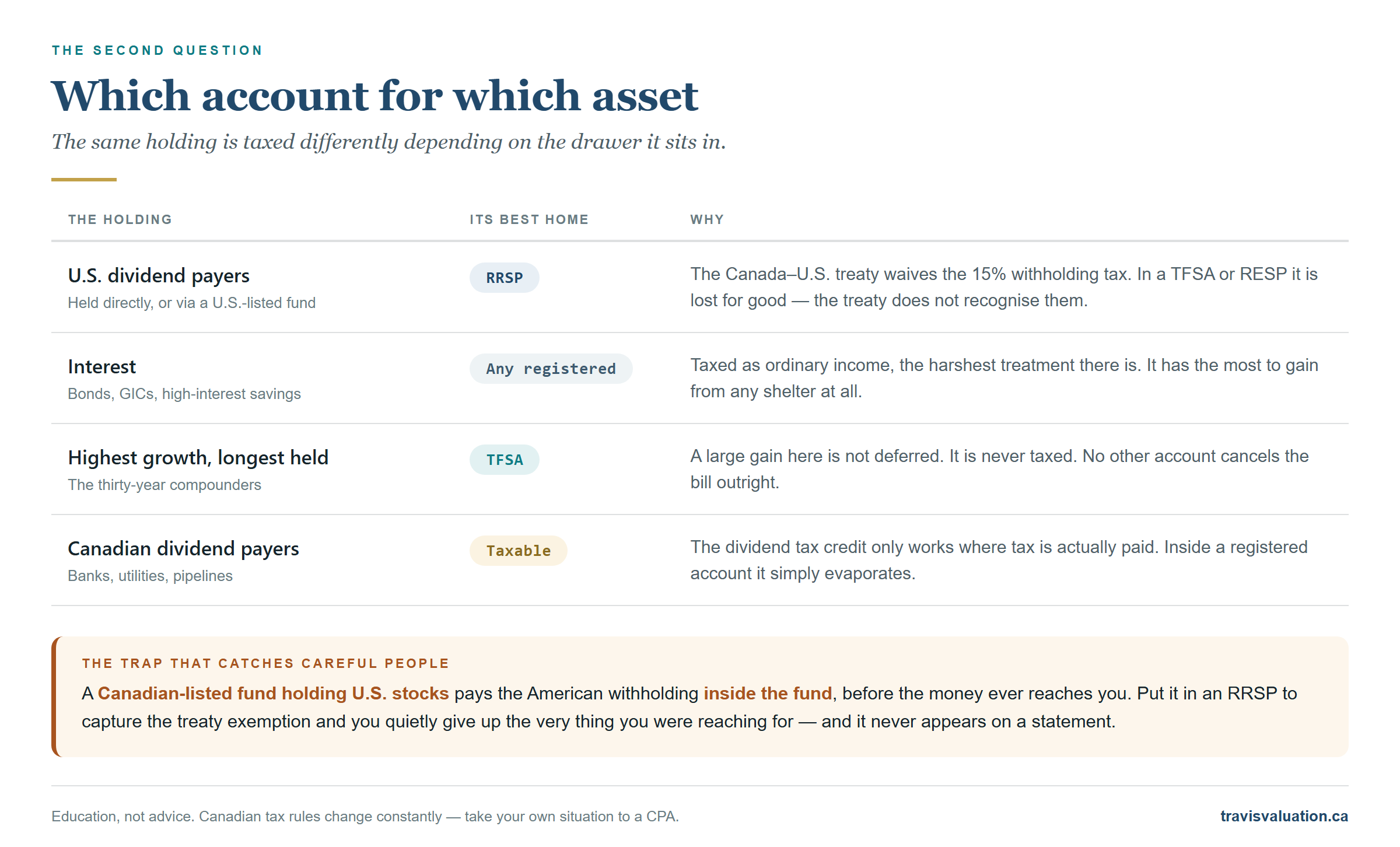 American dividend payers belong in the RRSP, where the withholding disappears. Interest-bearing holdings belong in a registered account too, because they are punished worst outside one. Canadian dividend payers are the natural residents of a taxable account, where the credit actually does its work; so when registered room is tight and something has to sit outside, the Canadian banks and utilities are, for most people, the last things that need sheltering. And your highest-growth, longest-held positions belong in the TFSA, where a large gain is not merely deferred but never taxed at all.
That last one is worth sitting with. A TFSA doesn’t defer the tax on a thirty-year compounder. It cancels it.
Now the part that catches careful people.
The RRSP exemption on American dividends only applies when you hold the American shares, or an American-listed fund, directly. A Canadian-listed fund that owns American stocks pays the withholding inside the fund, before the money ever reaches you. In a taxable account that is survivable: the fund passes the tax through on your slip and the credit is still yours. In an RRSP it is simply lost, and you will never see it on a statement.
This surprises people who did everything else right. They bought a Canadian-listed U.S. equity fund, put it in the RRSP because that is where American exposure is supposed to go, and quietly gave up the treaty benefit they were trying to capture.
Where good intentions get expensive
Two more pieces of fine print, because this is where good intentions get expensive.
The RRSP is a deferral, not an exemption. Everything that comes out comes out as ordinary income: capital gains and dividends included. A gain that would have been taxed at the favourable capital-gains rate in a taxable account is taxed in full when it leaves an RRSP. The deduction you took going in is what pays for that. And by the end of the year you turn 71 the account must be wound up, for most people into a RRIF, which from the following year pays you out on a schedule whether you want the money or not.
The TFSA has three habits worth knowing. Room you withdraw comes back: but not until the following January, so a withdrawal and a re-deposit in the same calendar year can quietly push you over your limit. The penalty is a tax of 1% per month on the excess, which is not a rounding error. And a TFSA is for investing: the tax agency has taken the position, and the courts have backed it, that an account run like a day-trading business can have its gains taxed as business income, tax-free wrapper or not. Buy well and sit still and you will never meet that rule.
Retirees should be aware of OAS clawback
One caveat for anyone near or in retirement. I said Canadian dividend payers are the natural residents of a taxable account. That holds while you are working. Once Old Age Security enters the picture it gets more delicate, because the paper “gross-up” on eligible dividends counts as income for the clawback: so a dividend that is gentle on your tax bill can still be rough on your OAS. If you have registered room to spare, shelter them anyway. Tax-free still beats tax-reduced.
None of this is a loophole. It is the deliberate design of a system that, in its own dry way, pays you to be patient. You owe capital-gains tax only when you sell, which means holding lets the entire pre-tax sum keep compounding: an interest-free loan from the government that grows the longer you sit still. Churn the portfolio and you trigger that tax again and again, interrupting the compounding you were relying on.
I spent the early part of my career as an appraiser, where the job was never to guess a number but to defend one: three approaches to value, reconciled, with the reasoning written down and my signature at the bottom. The habit that survived into investing is the same one that applies here: the arithmetic is rarely the hard part. Knowing which rule applies to the case in front of you is.
So before your next contribution, ask the second question. Not just what should I buy: but which account should I buy it in.
And then take it to someone who knows your situation. This is education, not advice. I am a retired appraiser and an investor, not your accountant and not your tax lawyer, and Canadian tax rules change constantly: which is exactly why everything above is written as durable principles rather than this year’s numbers. A CPA will charge you less than one badly located holding will.
 Curtis Travis is a retired AACI appraiser who spent his early career putting defensible values on real property, and now applies the same discipline to shares. He writes a free weekly valuation of one North American stock at travisvaluation.ca, and is the author of The Modern Value Investor, out this autumn.
