

 Posted By
As those who follow me on social media may already know, financial guru David Chilton interviewed me on his popular The Wealthy Barber podcast, which dropped Tuesday on YouTube.com. You can find the full 39-minute clip here: try 1.5x speed if you’re pressed for time!
David is a good interviewer and got me to confess a few things I might not have coughed up otherwise. Mostly, we chatted about personal finance in Canada, retirement and retirement planning and — a particular concern for David — the plight of young Canadians priced out of the Canadian real estate market. This included a discussion of our own family’s situation and how the “Bank of Mum and Dad” may be enlisted to supplement down payments scraped up by some combination of TFSAs, the RRSP Home Buyers Plan and the new First Home Savings Accounts (FHSAs) that David is quite enthusiastic abøut.
Naturally we talked about Retirement. David himself is retiring at the end of this year soon after he turns 65, so he will have “beaten” me to Full Retirement by roughly eight years. I wrote about his looming Retirement recently in my MoneySense Retired Money column, which was also flagged here on Findependence Hub.
A Who’s Who of Canadian Personal Finance
 I was David’s 71st interview on the podcast since he launched it two years ago: he says he plans to keep it going at least until the end of this year. As I comment in the interview, his many guests constitute a veritable “Who’s who” of Canadian personal finance, with a handful of Americans thrown in.
Glad to be part of it and to join such luminaries as Ben Felix, Preet Banerjee, Rob Carrick, Fred Vettese and many more. As David notes, a lot of his guests are younger newer voices known as “Finfluencers,” a group I also wrote about in Retired Money earlier this summer.
We also discuss other more “seasoned” financial commentators, including Bruce Cohen, Ellen Roseman, Jim Daw, Mike Grenby and other pioneers of the genre. Some of those veterans’ names came up in another Retired Money interview I did after Rob Carrick retired a year ago from his full-time job at the Globe & Mail.
The financial novels spawned by The Wealthy Barber
With an estimated 4- to 5- million copies of his books sold worldwide, it’s no surprize that Chilton’s pseudo-fiction financial format spawned many imitators. I fondly recall Jim Daw (retired from the Toronto Star) cracking a joke about the many financial novel knockoffs inspired by The Wealthy Barber. Rather than a “branch” of personal finance literature, Jim quipped in his review of my own Findependence Day that this specialized field consituted merely a “twig” of the genre.
While much of the interview was perforce about investing and retirement, good interviewer that he is David manages to coax some confessions about my own lifestyle and choices. For example, I tackled headon the fact that the title of my own similarly titled The Wealthy Boomer was not initially conceived as a ripoff of Chilton’s far more commercially successful The Wealthy Barber: that title was just a description of the possible demographic target for the book’s publisher.
We also talked about 12 Good Years, the blog that blogger Fritz Gilbert originally ran on his Retirement Manifesto blog. That article make she case that new or aspiring retirees should strive to make the best of the years between ages 60 and 72, whether for strenuous travel or demanding hobbies, physically or mentally.
Like me, David is enthuiastic about the merits of the traditional employer-sponsored Defined Benefit pension plan. We also discuss the government alternatives like CPP and OAS, as well as annuities proferred by life insurance companies.
My typical semi-retired Work Day
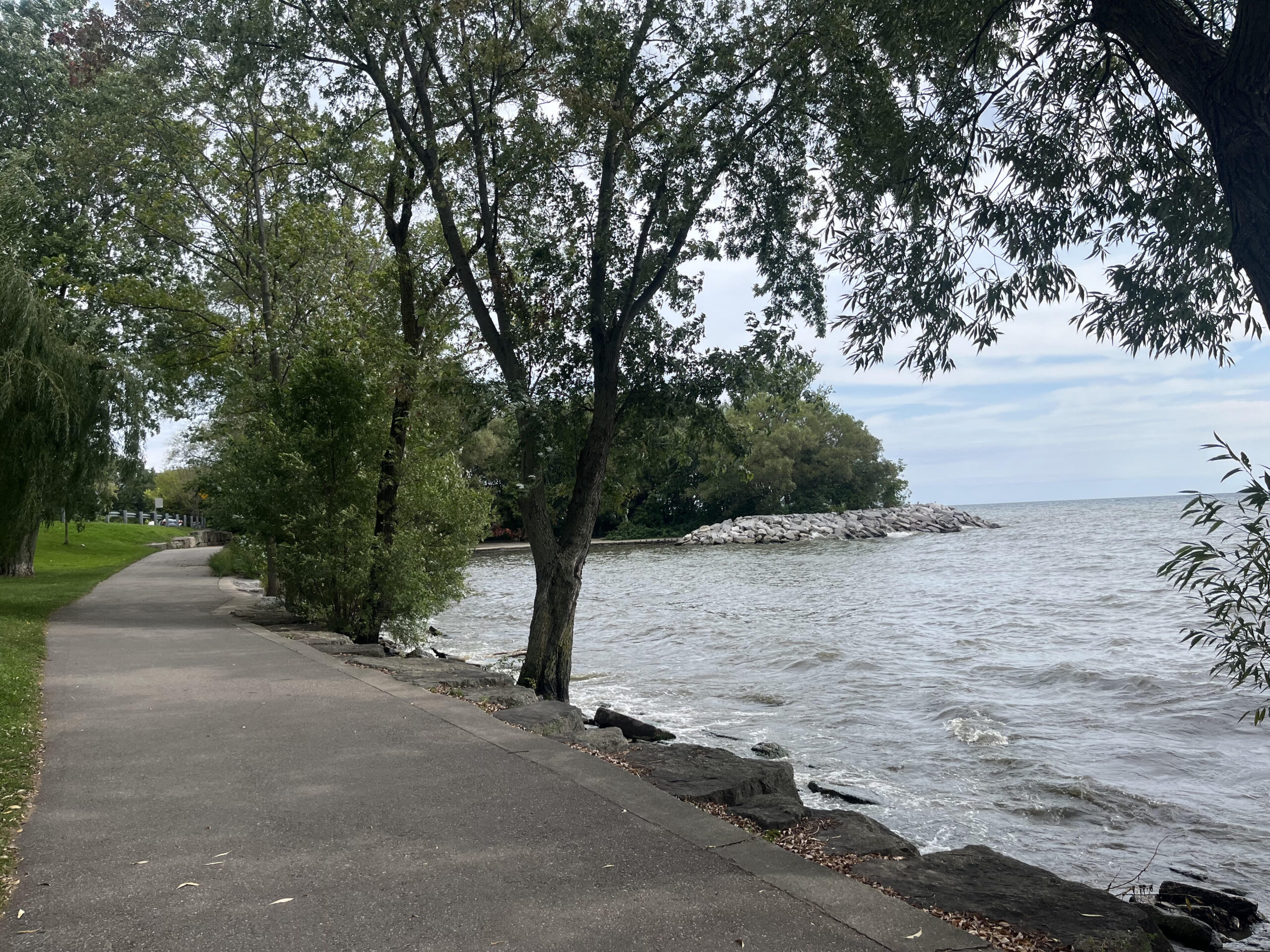
Pressed on what my typical semi-retired work day looks like, I described my own current semi-retirement at age 73 and my typical Monday to Friday.
While ostensibly 6-hour days, I estimate only half those hours are what I’d call billable or invoiceable; the rest may be reading the newspapers, engaging in social media and some combo of exercise; typically going to the gym or walking along Lake Ontario while listening to a podcast or audio book. My gruelling almost-daily “commute” along the lake is shown in the photo on the left, taken just yesterday.
We also discussed oldtimer’s hockey, and the odd bit of volunteering, which consumes much more of my wife Ruth’s time. Her name comes up in the podcast as David once treated us to a dinner in Edmonton on one of his speaking gigs; we discuss what makes an enduring marriage. Other topics included A.I. and how we feel about Canada going foreword: both of us are fairly optimistic about the latter.
Since I pressed David in the MoneySense article about whether his own looming Retirement was “full” or “semi” in the spirit of “turnabout is fair play,” he asked me when I plan to “fully” retire myself. My honest answer was that I’ll probably continue as long as readers of the website and of my MoneySense column are interested in what I have to say, and as long as the corporate advertising that supports those efforts hang in.
