

 Posted By
As you’d expect after the last few weeks of big news and stock market volatility surrounding the A.I. trade (Nvidia scandal and Anthropic IPO in particular), the main focus of Franklin Templeton’s 2027 Investment Outlook was to “broaden U.S. equities beyond a narrow AI-led market.” The annual event was held at Ritz-Carlton Hotel in Toronto on Tuesday.
Of course, even as the event was taking place, the U.S. stock market was again deflating, as it was as I wrote this up Wednesday morning. Even so, a glance at some of the slides shown should give some comfort to longer-term investors who believe in proper diversification and portfolio construction.
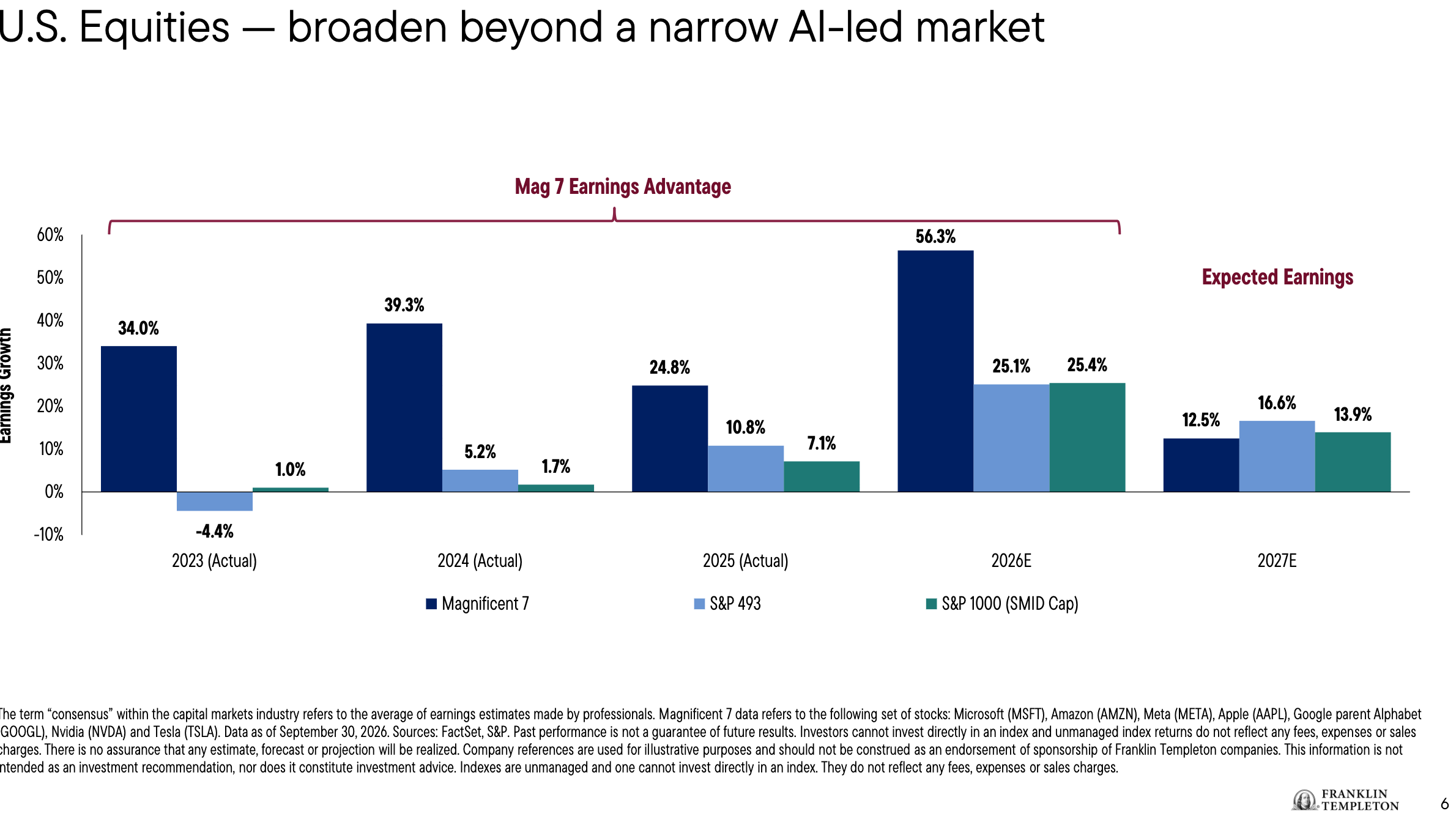
The above slide was presented by Michael Greenberg, CFA, Head of Americas Portfolio Management for Franklin Templeton Investment Solutions. And the one below shows just how much US stocks make up in global indexes, and how much of that exposure comes from the Mag 7 tech stocks (aka AI hyperscalers).
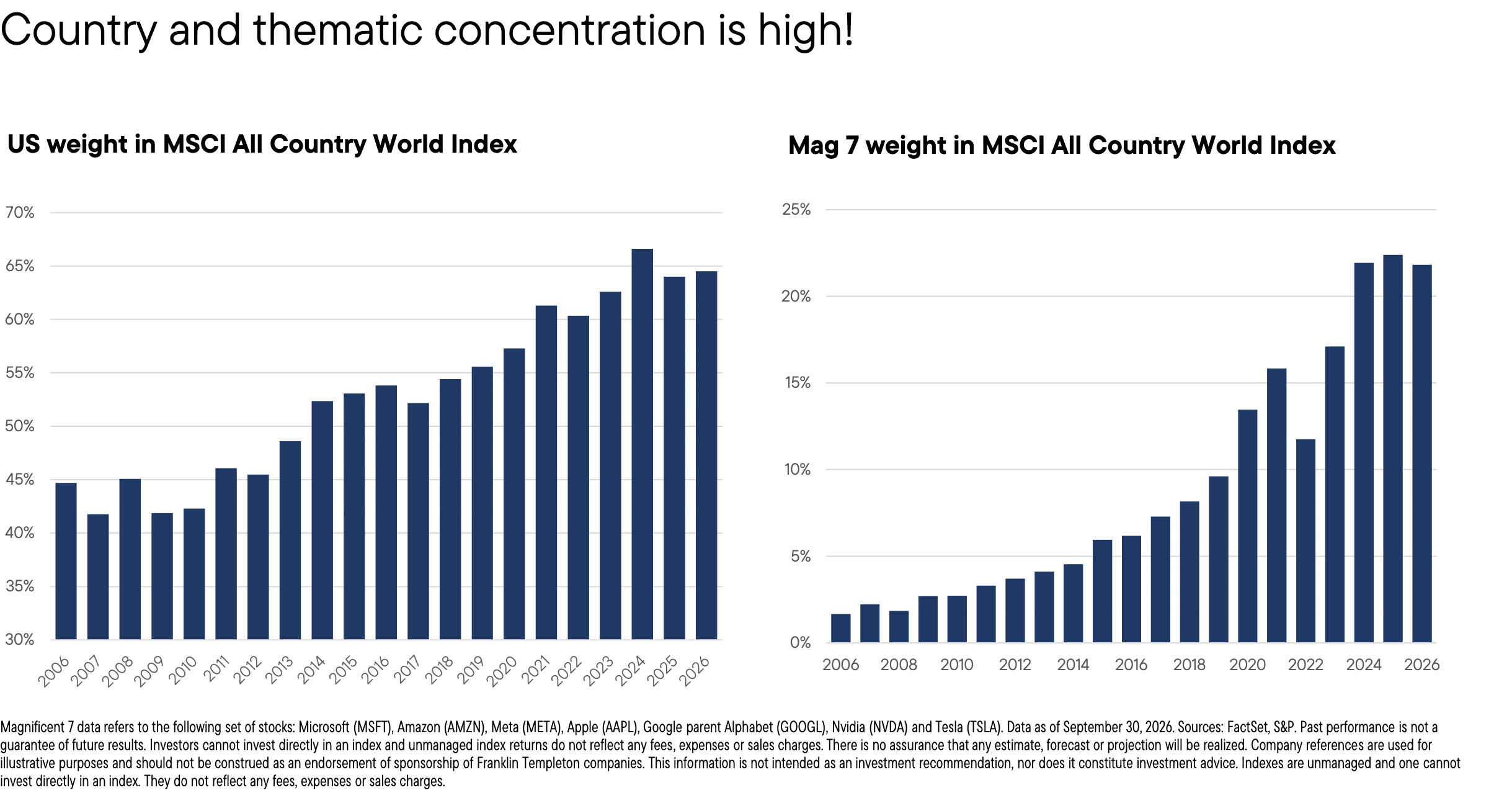

Clearly if the tech and AI trade go south, as it seems to be doing the last two weeks, then those overexposed to the US Mag 7 and/or the AI infrastructure trade may suffer large losses. Those can be mitigated by traditional broad diversification that employs proper asset allocation and portfolio construction.
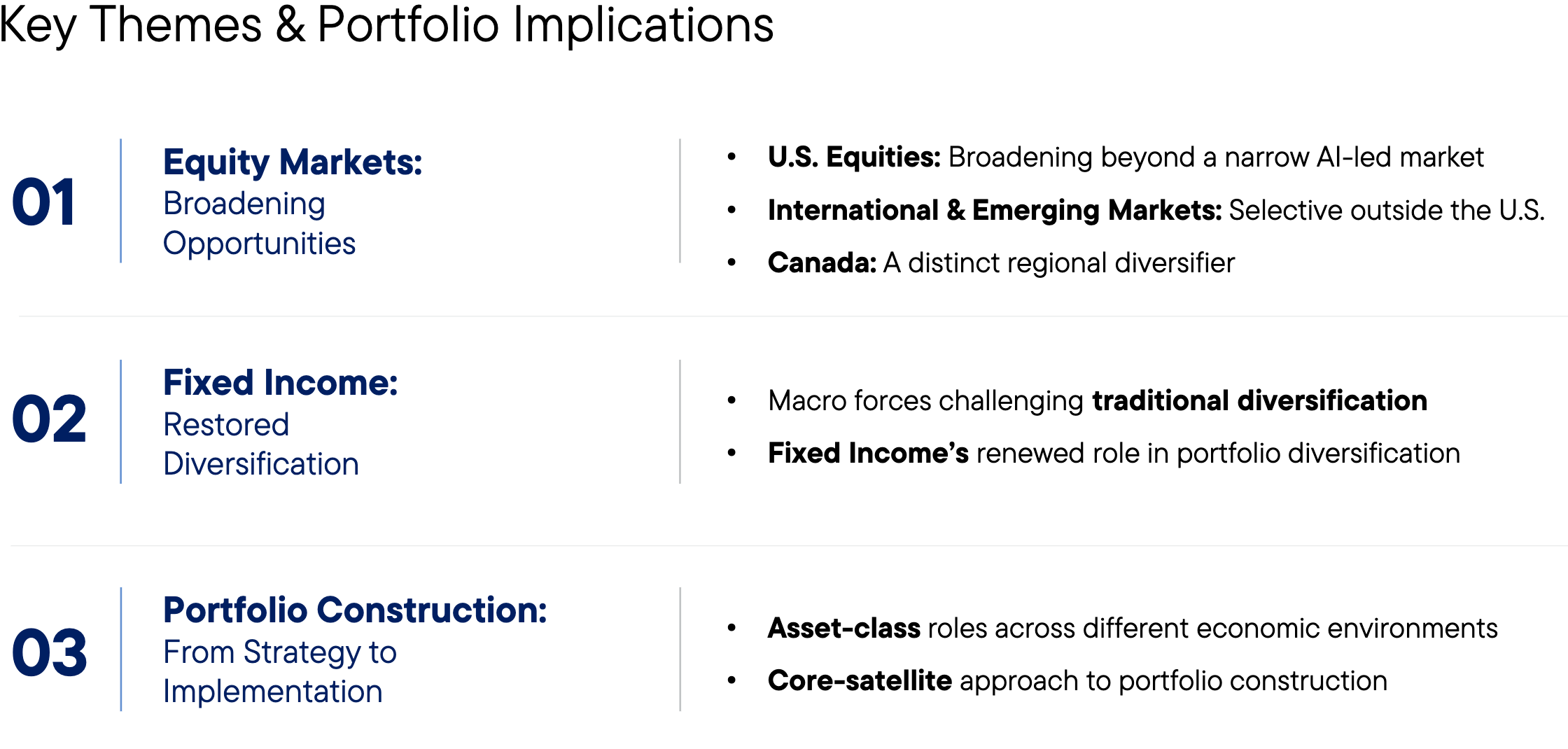
To that end, Greenberg focused on three key themes and portfolio implications for retail and institutional investors. As shown below investors heavy in U.S. stocks need to broaden beyond the narrow AI-led market as well as diversifying into international and emerging markets as well as Canada. Second, investors need to “restore diversification” in their Fixed Income holdings and continue to use a Core-Satellite approach to portfolio construction.
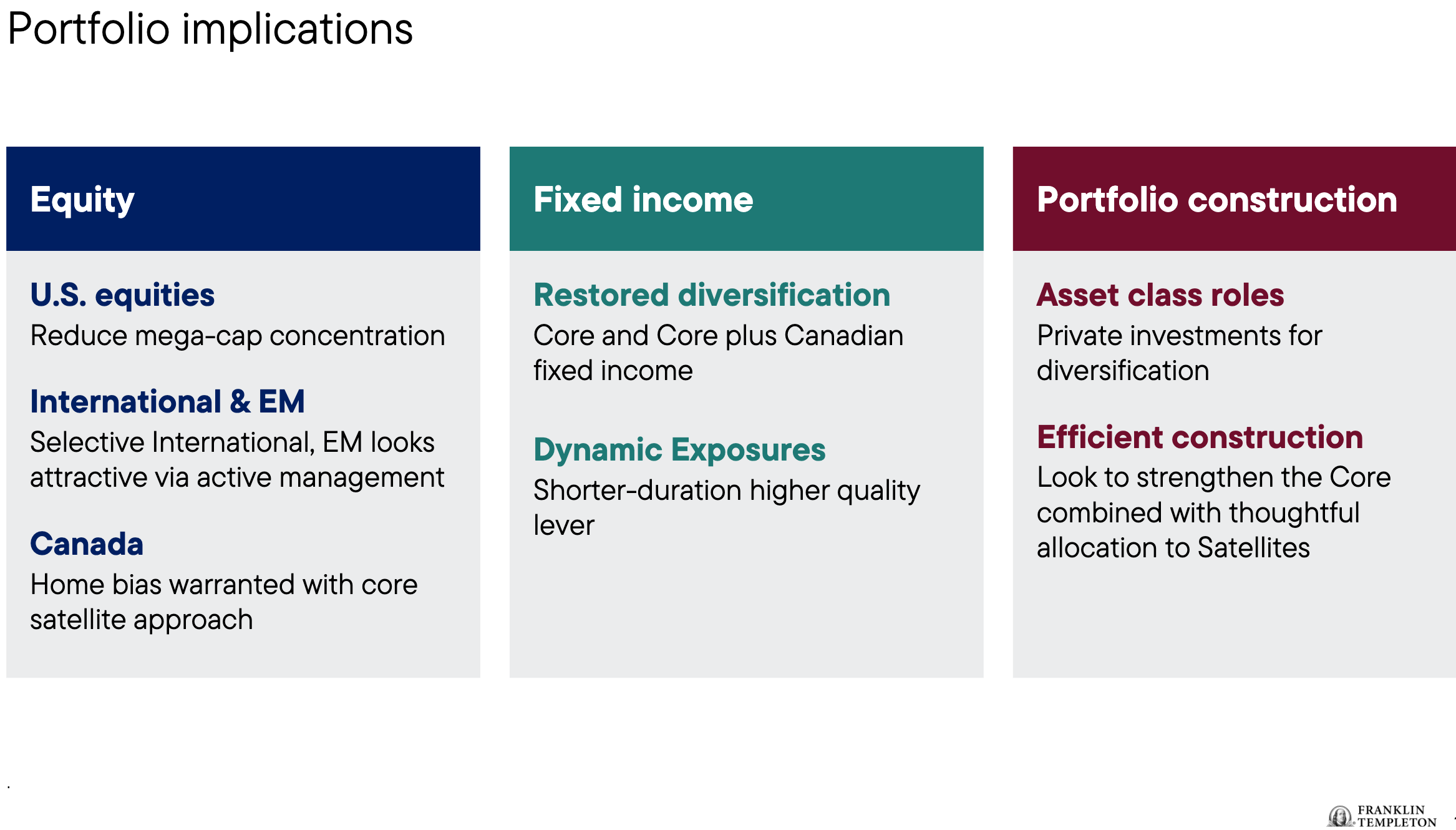
Greenberg showed a slide labelling Canada as “a distinct regional diversifier.” Canada is strong in Natural Resources, including Energy, LNG and Critical Minerals; it has strong fundamentals, including “relatively favorable debt dynamics and capacity to back infrastructure projects.” Plus the Carney administration is making efforts to diversify economically with new global trade alliances and new policy initatives like the Canada Strong Fund and the Investment Mega Deduction.
Greenberg said the Macro landscape “requires a rethink of traditional diversification” as inflation and higher government deficits portend higher inflation and interest rate volatility. By combining complementary asset classes, more resilient portfolios can be constructed: “A core satellite approach can help balance cost, risk and return potential in a portfolio.”
AI Capex boom seen continuing
Jeff Schulze, CFA, Head Investment Strategist for Franklin Templeton Institute, told the audience in the day’s opening presentation that the “AI Capex cycle is alive and well and the labor market won’t be as affected by AI as some think.” At the same event a year ago he talking about broadening US equities beyond the Magnificent Seven, and said Tuesday that that will continue into 2027. And diversifying beyond US stocks by going global “will continue to pay dividends in portfolio construction.”
He made these three points about the U.S. economic outlook:
• The AI capex boom is likely to continue with current spending within the range seen during prior technological innovation cycles.
• Higher energy prices and rising interest rates pose a risk to the US economy, although reduced energy intensity and moves to term out debt (when rates were lower) should dampen the impact.
• The overall signal from the US Recession Dashboard remains firmly in green “expansion” territory.
And he made these three points about the U.S. market outlook:
• The market’s rally has continued through the first nine months of 2026, putting the S&P 500 on pace to deliver its fourth consecutive year of double-digit returns.
• The rally continues to be supported by strong fundamentals with earnings driving the upside this year, while valuations have de-rated.
• Market leadership has fluctuated over the past few years, reinforcing the benefits of a diversified approach to equity exposure across style, capitalization and geography.
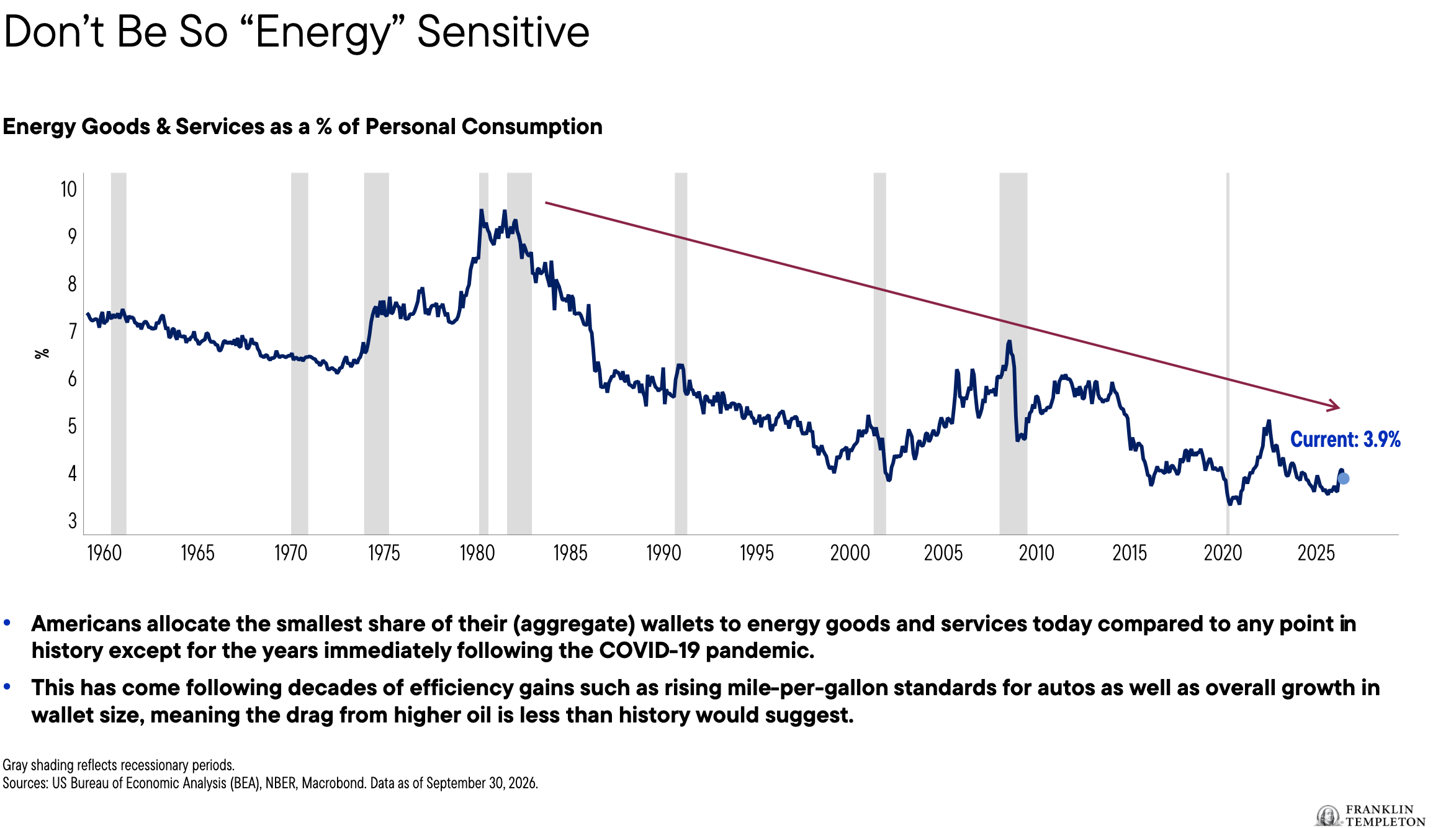
The American consumer is not tapped out, he said, and “borrowing capacity could act as a potential buffer to support consumption should the consumer come under additional strain.” And as the slide below illustrates, Americans spend less on energy goods and services today than in the past, excepting the years of the Covid pandemic:
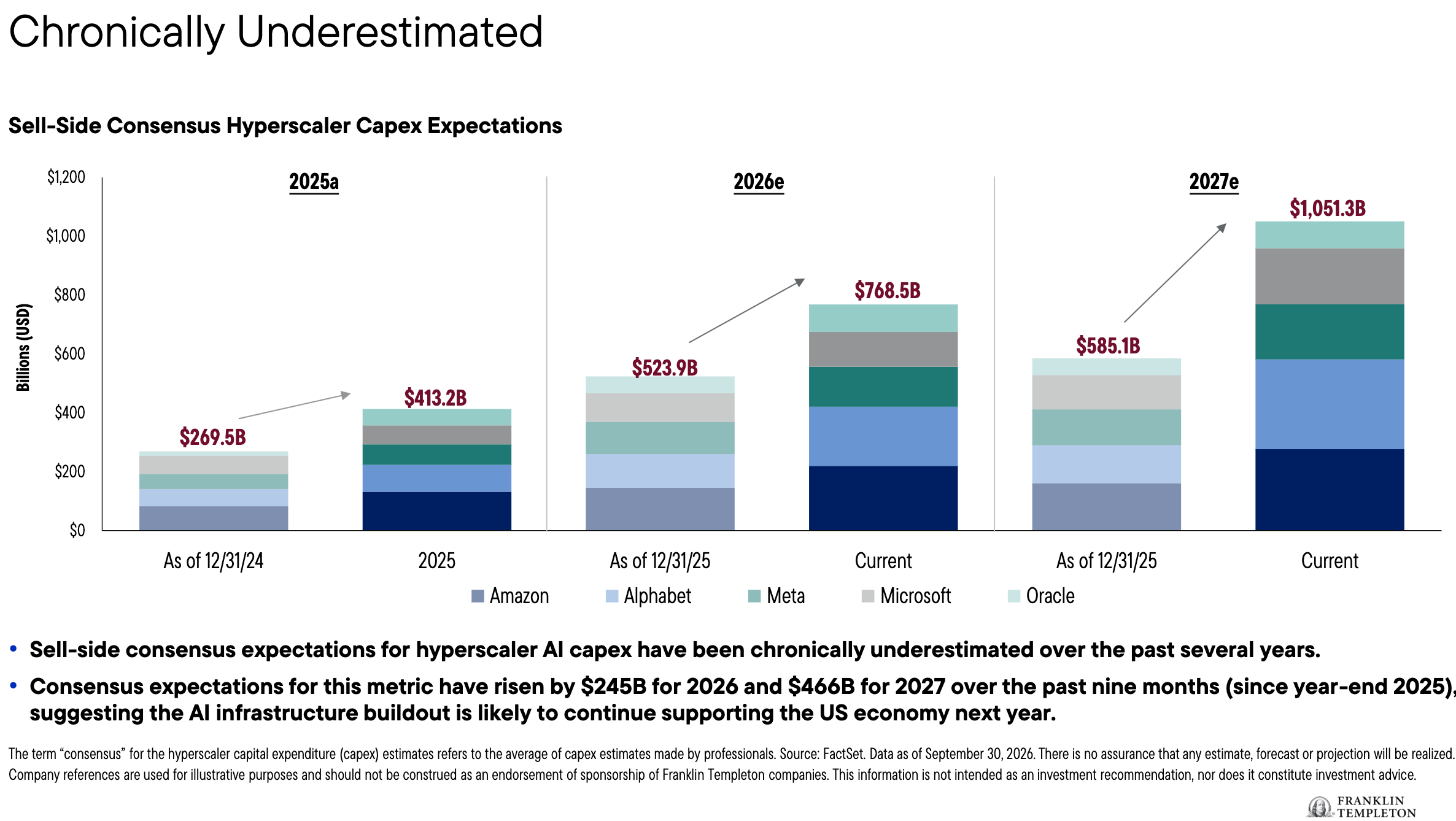
Schulze is also optimistic about the prospects for the AI buildout in the next few years in terms of hyperscaler AI capital expenditures. As the slide below says, this suggests “the AI infrastructure buildout is likely to continue supporting the U.S. economy next year.”
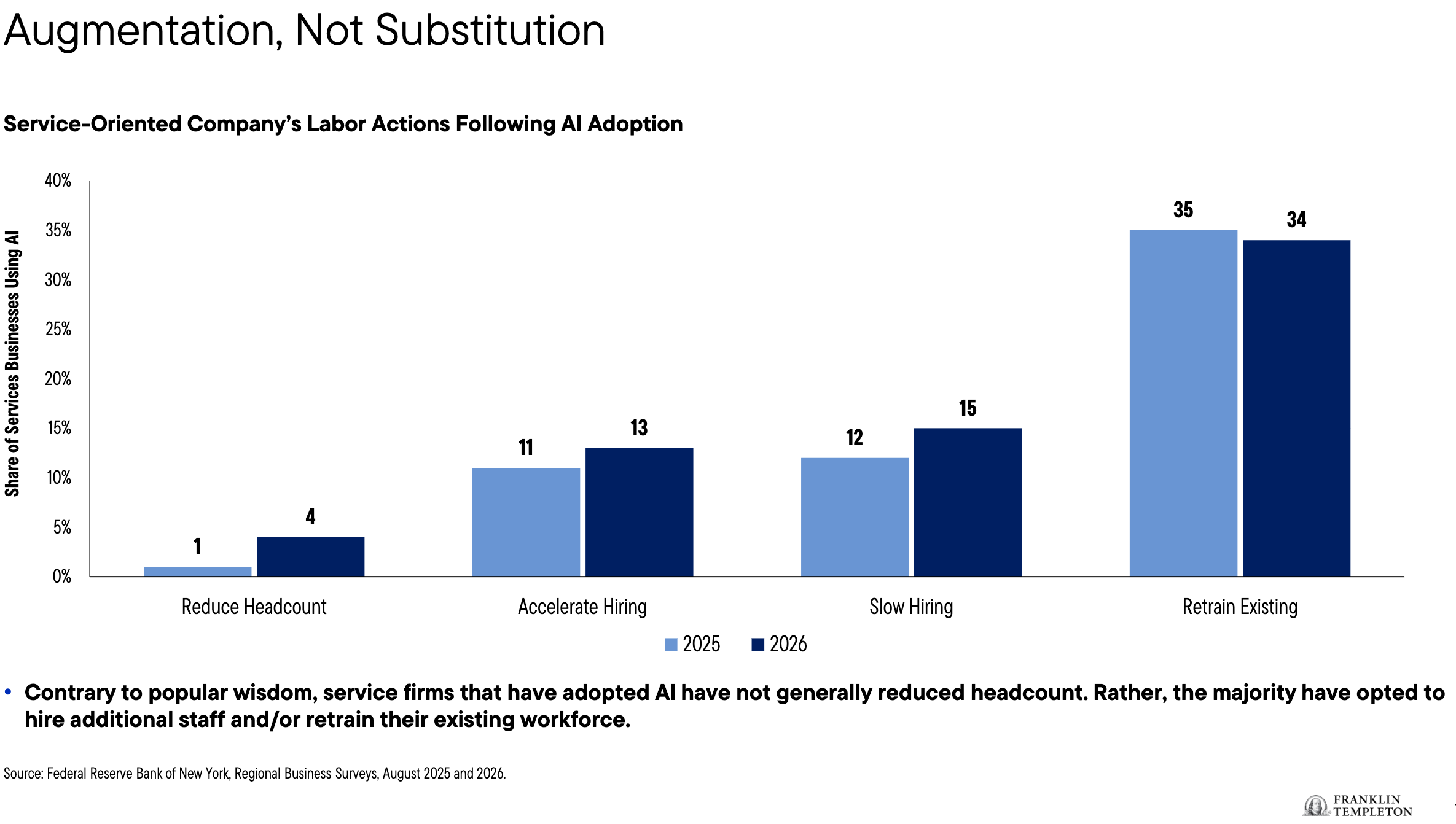
Critically, Schultze sees AI adoption as “augmenting” workplaces, not supplanting existing workers:
Eurasia’s view of impact on Canada of U.S. policies
Closing the day was keynote speaker Maziar Minovi, CEO of the Eurasia Group, which is a leading advisory firm on political risk. He started by warning he had no good news: “Our view for some time has been that we are in the early stages of geopolitical recession.” This he attributed to decline of American hegemony that prevailed for several decades after World War II.

The last 10 to 15 years has seen a change in what he termed the “world architecture” formerly led by the US. Developments with the World Bank, the G7, IMG and NATO, the admittance of China to the World Trade Organization has redeuzed the aggregate size of the US and its allies to half of what it weas 20 years ago, while China and Emerging Markets have risen, Minovi said: it’s “a very different world.” The result is that the middle and closer classes are being left behind in advanced economies, a situation exacerbated by the shift to social media dominating consumer news.
He said he is constantly asked about what is happening in the United States and when it will stop. “It won’t stop,” is his usual reply.
And Canada was one of the biggest beneficiaries of a globalized world protected by American security, and “nurtured by the stability the architecture provided. There’s no way I can say Canada won’t be impacted.” It will be, seeing as 70% of Canada’s exports go to the United States. “Like any other country, Canada is negatively impacted by the world we’re in: probably more so since Canada benefited the most.” The U.S. under Donald Trump has been the main source of uncertainly the last two years. Some believe that we have reached “Peak Trump” on US foreign policy since the Democrats swept the mid-terms and this may have been extended to US domestic policy. That “doesn’t mean the U.S. won’t be the source of uncertainty till the rest of Trump’s term but for peak levels like the Apriil 2025 Liberation Day tariffs or last spring’s unprecededented attack of Israel/US on Iran, “that level of uncertainty is behind us.”
Minova offered 3 scenarios on the Iran war and resulting price of Brent crude oil. He sees a 30% chance of further escalation, in which case Brent will be priced between US$100 and $120. He sees a 60% chance of a standoff, which would mean prices of US$80 to $100. And the odds of a limited deal he placed at just 10%, in which case Brent would be priced between US$60 and $80.
“A violent standoff is the reality until the end of Trump’s term, despite more oil coming onstream.” The biggest impact of this is on Europe and Asia. Oil exporters likie Canada are in a “better position.” Ironically, “the source of all this uncertainty — the United States — will be among the least impacted because it is now the world’s largest oil and gas producer so benefits from higher prices.”