

 Posted By
 By Erin Allen, CIM, BMO ETFs
(Sponsor Blog)
For the most part, when searching for a passive index ETF, you’ll typically encounter products that are weighted by market capitalization. In a market-cap-weighted ETF, a company’s size (calculated by multiplying its share price by the number of outstanding shares) determines how much influence it holds within the index1.
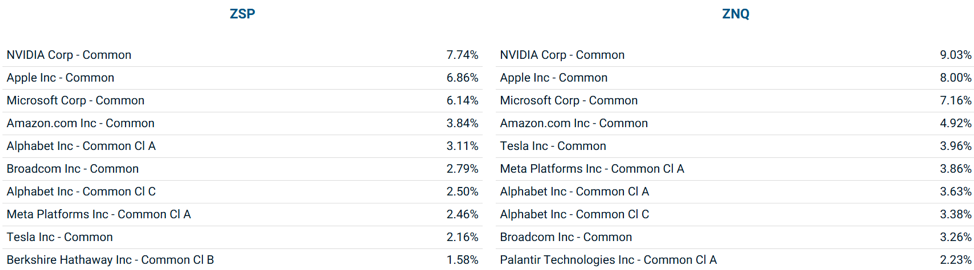
You can see this clearly in widely held U.S. equity ETFs. Take BMO S&P 500 Index ETF (ZSP) as an example. After accounting for the top 10 holdings, the remaining 490 companies make up about 59.49% of the portfolio. That means the top 10 stocks alone represent roughly 40.51% of the ETF’s total weight2.
The concentration becomes even more pronounced in indices like the Nasdaq 100 or the BMO NASDAQ 100 Equity Index ETF (ZNQ) which already has a reputation for heavy exposure to technology companies. In that case, the remaining 90 stocks together account for only 48.58% of the index, while the top 10 holdings make up over half of the entire portfolio3.
Chart 1 Compares top holdings of ZSP – BMO S&P 500 Index ETF to ZNQ – BMO NASDAQ 100 Equity Index ETF
Source: BMO Global Asset Management as of January 30, 20264
Supporters of market-cap weighting say it allows winners to keep running. As a company grows and becomes more valuable, it naturally takes up more space in the index. Over long periods, this approach has benefited from the success of dominant firms that continue to compound.
At the same time, that same feature can make some investors uncomfortable. In the context of 2026, buying a broad market ETF can effectively mean committing a large share of your capital to a relatively small group of mega-cap stocks that are trading at expensive valuations.
Fortunately, the choice is not limited to market-cap weighting or sitting in cash. Equal-weight strategies offer a different way to construct an ETF. Instead of assigning weight based on size, equal-weight ETFs give each constituent the same allocation, regardless of how large or small the company is.
Understanding how these two approaches differ, along with their respective advantages and limitations, is key to choosing the structure that best fits your goals.
How Equal-Weight ETFs work
To see how equal weighting works in practice, it helps to look at a concrete example. Rather than staying in the U.S. market, consider the Canadian utilities sector and compare two different index construction methods applied to the same group of stocks.
A common benchmark is the S&P/TSX Capped Utilities Index. This index tracks 14 Canadian utility companies and weights them by market capitalization, subject to a 25% cap on any single holding.
As of January 31, 2026 the four largest holdings dominated the portfolio. Fortis accounted for 23.35% of the index. Brookfield Infrastructure Partners made up 14.47%. Emera represented 12.61%, and Hydro One came in at 10.84%. Together, those four companies made up more than 60% of the entire index.
Utilities are often viewed as defensive businesses with sensitivity to interest rates and stable cash flows. But instead of making a sector-wide allocation, most of the portfolio’s risk and return ends up tied to a small handful of companies.
An equal-weight approach produces a very different result. The Solactive Equal Weight Canadian Utilities Index holds a similar group of utility stocks, but each company is given the same weight at each rebalance. With 13 holdings, BMO Equal Weight Utilities Index ETF (ZUT)5 allocates roughly 7.7% to each stock, regardless of company size5.
The practical effect is a more balanced exposure across the sector. Smaller or mid-sized utilities receive the same attention as the largest incumbents, and portfolio outcomes are less dependent on the performance of one or two dominant names.
Equal-Weighting for U.S. Stocks
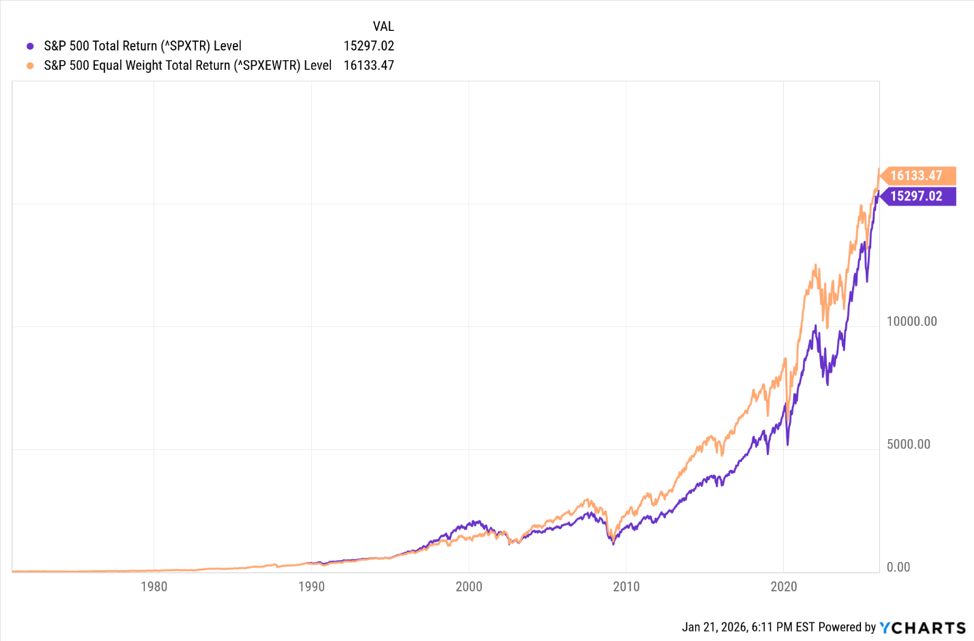
Equal weighting is not limited to Canadian sector ETFs. Entire equity markets can be constructed this way, including the U.S. market. There is a long history of data comparing the S&P 500 Total Return Index with its equal-weight counterpart – the S&P 500 Equal Weight Total Return Index .
Chart 2: Comparing the S&P 500 Total Return Index vs the S&P 500 Equal Weight Total Return Index.
Source: YCharts, as of January 21, 20266 Index returns do not reflect transactions costs or the deduction of other fees and expenses and it is not possible to invest directly in an Index. Past performance is not indicative of future results
Over time, both versions have gone through periods of outperformance and underperformance relative to each other. But from the start of the available data through today, the equal-weight version has delivered higher cumulative returns.
That outperformance tends to show up during periods when smaller and mid-sized stocks outperform large caps.
On the downside, they are also less exposed to drawdowns driven by a small group of very large stocks at the top of the index. However, equal weighting does not have to mean owning a modified version of the S&P 500. Canadian investors also have access to broader U.S. market solutions.
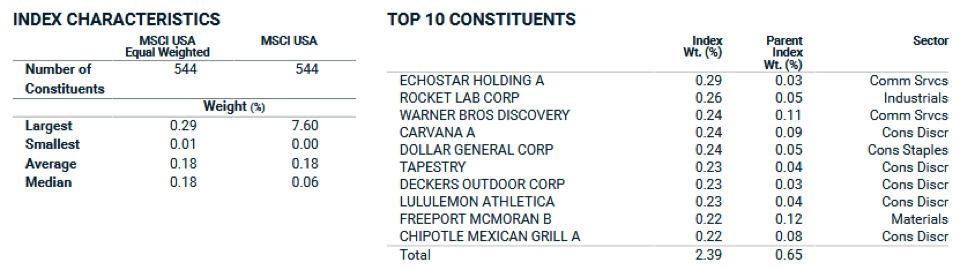
One example is the BMO MSCI USA Equal Weight Index ETF – ZEQL. This ETF tracks an index that includes the same companies as the MSCI USA Index, but weights them equally rather than by market capitalization. At each quarterly rebalance, every stock is reset to the same allocation. The practical effect, generally speaking, results in higher yield and lower valuations.
Chart 3: MSCI USA Equal Weighted Index (USD) Index Performance and Fundamentals

Source: MSCI as of December 31, 2025 7 Index returns do not reflect transactions costs or the deduction of other fees and expenses and it is not possible to invest directly in an Index. Past performance is not indicative of future results.
Between rebalances, some companies will outperform and grow to larger weights, while others will lag. At the next rebalance, winners are trimmed back and laggards are topped up. This enforces a systematic buy-low and sell-high discipline across the entire U.S. market without relying on active stock selection.
Chart 4: MSCI USA Equal Weighted Index (USD) Index Characteristics and Top 10 Constituents
Source: MSCI as of December 31, 2025 8
Currency exposure is another consideration. BMO MSCI USA Equal Weight Index ETF (ZEQL) is unhedged by default, meaning movements between the U.S. and Canadian dollar affect returns alongside stock performance. Investors who want to reduce currency effects can use the currency-hedged version under ZEQL.F – BMO MSCI USA Equal Weight Index ETF (Hedged Units). Those with U.S. dollars available can also access the U.S. dollar-denominated share class, ZEQL.U – BMO MSCI USA Equal Weight Index ETF (USD Units).
The management fee for all is 0.05%, which is competitive with market-cap-weighted U.S. equity ETFs. For investors concerned about concentration in mega-cap stocks, equal-weight U.S. equity ETFs like ZEQL offer a practical alternative that reshapes exposure without abandoning broad market indexing.
Start your Journey toward a Diversified Portfolio
If you’re thinking about investing in U.S. stocks, equal-weight ETFs like the ZEQL – BMO MSCI USA Equal Weight Index ETF offer a straightforward way to spread your investments and reduce risk from putting too much in just a few large companies. With low fees, simple currency options, and regular rebalancing to help you buy low and sell high, ZEQL makes it easy to keep your portfolio balanced and your long-term goals in focus.
It’s important to know your choices when it comes to ETFs. Equal-weight ETFs give each company the same importance, helping you avoid heavy concentration in big names. Market-cap-weighted ETFs, on the other hand, follow the overall market and give more weight to the largest companies. By understanding how these options work, you can choose the ETF that fits your needs and build a stronger, more resilient portfolio for the future.
Browse BMO’s complete range of ETFs and choose the options that best match your investor profile and financial objectives at bmoetfs.com.
 Erin Allen, CIM, is Director, Online Distribution for BMO ETFs. Erinhas been a part of the BMO ETFs team driving growth since the beginning, joining BMO Global Asset Management in 2010 and working her way through a variety of roles gaining experience in both sales and product development. For the past 5+ years, Ms. Allen has been working closely with capital markets desks, index providers, and portfolio managers to bring new ETFs to market. More recently, she is committed to helping empower investors to feel confident in their investment choices through ETF education. Ms. Allen hosts the weekly ETF Market Insights broadcast, delivering ETF education to DIY investors in a clear and concise manner. She has an honors degree from Laurier University and a CIM designation.
Sources:
1 Understanding Capitalization-Weighted Indexes: Definition and Calculation
2 All ZSP – BMO S&P 500 Index ETF holdings as of January 30th, 2026 https://www.bmogam.com/ca-en/products/exchange-traded-fund/bmo-sp-500-index-etf-zsp/
3 All ZNQ – BMO NASDAQ 100 Equity Index ETF holdings as of January 30th, 2026 https://www.bmogam.com/ca-en/products/exchange-traded-fund/bmo-nasdaq-100-equity-index-etf-znq/
4 https://tools.bmogam.com/en/etf/Comparator#symbols=XTSE:ZSP,XTSE:ZNQ
5 All ZUT – BMO Equal Weight Utilities Index ETF holdings as of January 30th, 2026 https://www.bmogam.com/ca-en/products/exchange-traded-fund/bmo-equal-weight-utilities-index-etf-zut/
6 YCharts, as of January 21, 2026
7 https://www.msci.com/documents/10199/255599/msci-usa-equal-weighted-index-net-usd.pdf Div Yid: Dividend yield is a ratio that demonstrates a company’s annual dividends relative to its shares’ market price. P/E: The price-to-earnings (P/E) ratio compares a company’s share price with its earnings per share (EPS). Analysts and investors use this to determine the relative value of a company’s shares in side-by-side comparisons. P/E Fwd: A stock valuation metric that compares a company’s share price to it’s projected future earnings. P/BV: The Price to Book Value ratio is a financial metric that compares a company’s market value to its book value.
8 https://www.msci.com/documents/10199/255599/msci-usa-equal-weighted-index-net-usd.pdf
Performance returns as of January 30, 2026.
| Fund name | YTD | 1 mo | 3 mo | 6 mo | 1 Y | 2 Y | 3 Y | 5 Y | 10 Y | Since Inception | Inception date |
| ZSP – BMO S&P 500 Index ETF
|
0.61% | 0.61% | -1.28% | 8.10% | 8.73% | 21.70% | 21.67% | 16.08% | 14.84% | 17.46% | Nov 14, 2012 |
| ZNQ – BMO NASDAQ 100 Equity Index ETF
|
0.39% | 0.39% | -4.02% | 8.26% | 11.73% | 23.24% | 29.68% | 16.40% | — | 21.26% | Feb 12, 2019 |
| ZUT – BMO Equal Weight Utilities Index ETF
|
.54% | 2.54% | -3.18% | 6.29% | 26.50% | 18.90% | 8.48% | 3.89% | 9.75% | 7.99% | Jan 19, 2010 |
| ZEQL – BMO MSCI USA Equal Weight Index ETF | Not available for funds under 1 year | Feb 4, 2026 | |||||||||
| ZEQL.F – BMO MSCI USA Equal Weight Index ETF (Hedged Units). | Not available for funds under 1 year | Feb 4, 2026 | |||||||||
| ZEQL.U – BMO MSCI USA Equal Weight Index ETF (USD Units) | Not available for funds under 1 year | Feb 4, 2026 | |||||||||
Past Performance is not indicative of future results.
DISCLAIMER
This article is intended for informational purposes only. The viewpoints expressed by the author represent their assessment of the markets at the time of publication. Those views are subject to change without notice at any time. The information provided herein does not constitute a solicitation of an offer to buy, or an offer to sell securities nor should the information be relied upon as investment, tax, or legal advice to any party.

Particular investments and/or trading strategies should be evaluated relative to the individual’s investment objectives and professional advice should be obtained with respect to any circumstance. Past performance is no guarantee of future results. Any statement that necessarily depends on future events may be a forward-looking statement.

Forward-looking statements are not guarantees of performance. They involve risks, uncertainties and assumptions. Although such statements are based on assumptions that are believed to be reasonable, there can be no assurance that actual results will not differ materially from expectations.

Investors are cautioned not to rely unduly on any forward-looking statements. In connection with any forward-looking statements, investors should carefully consider the areas of risk described in the most recent prospectus. Index returns do not reflect transactions costs or the deduction of other fees and expenses and it is not possible to invest directly in an Index. Past performance is not indicative of future results. Commissions, management fees and expenses all may be associated with investments in exchange-traded funds.

Please read the ETF Facts or prospectus of the BMO ETFs before investing. The indicated rates of return are the historical annual compounded total returns including changes in unit value and reinvestment of all dividends or distributions and do not take into account sales, redemption, distribution or optional charges or income taxes payable by any unitholder that would have reduced returns.

Exchange-traded funds are not guaranteed, their values change frequently and past performance may not be repeated. For a summary of the risks of an investment in the BMO ETFs, please see the specific risks set out in the BMO ETF’s prospectus. BMO ETFs trade like stocks, fluctuate in market value and may trade at a discount to their net asset value, which may increase the risk of loss.

Distributions are not guaranteed and are subject to change and/or elimination.

BMO ETFs are managed by BMO Asset Management Inc., an investment fund manager, a portfolio manager, and a separate legal entity from Bank of Montreal. BMO Global Asset Management is a brand name under which BMO Asset Management Inc. and BMO Investments Inc. operate. “BMO (M-bar roundel symbol)” is a registered trademark of Bank of Montreal, used under licence.

Third Party Links and Content

This article may contain links to other sites that BMO Global Asset Management does not own or operate. Also, links to sites that BMO Global Asset Management owns or operates may be featured on third-party websites on which we advertise, or in instances that we have not endorsed. Links to other websites or references to products, services or publications other than those of BMO Global Asset Management on this article do not imply the endorsement or approval of such websites, products, services or publication by BMO Global Asset Management.

We do not manage, and we are not responsible for, the digital marketing and cookie practices of third parties. The linked websites have separate and independent privacy statements, notices and terms of use, which we recommend you read carefully. Any content from or links to a third-party website are not reviewed or endorsed by us. You use any external websites or third-party content at your own risk. Accordingly, we disclaim any responsibility for them.
