Emotions play a very big part in how we live our lives and have an impact on the decisions we make every day: including how and when we each choose to invest for our future.
As financial markets move up and down, investors’ emotions follow suit. Emotions and behavioural biases play a role in people’s investment decisions, and often, emotionally-driven investing can leave them with poor returns in the long run. Add a volatile market to the mix and it can make it even harder to reach important investment goals.
Financial advisors know that staying invested during market downturns makes sense. While this recommendation is typically passed on to clients, panic sets in and some clients insist on selling to avoid a loss, despite sound logic and statistics. We all need to be taking a closer look at people’s behaviours and biases and finding ways to counteract them, for the benefit of our investors.
A new Behavioural Economics program for Canadian advisors
With that in mind, Manulife Investment Management wants to help change the investment game for our clients. Through a new partnership with BEworks, a behavioural consulting firm and research institute,we launched a Canadian Behavioural Economics (BE) program to help advisors understand and manage human emotions in volatile markets. The program will be rolled out to advisors over the course of this year with more to come in 2020.
With the help of Dr. David R. Lewis at BEworks, our advisors have access to:
• Scientific-led research and actionable tools to help them and their clients understand the biases in investment decision making Continue Reading…
Saving can be one of the most time-consuming methods of acquiring personal wealth, but if you choose the right account for the right goal, you can make the most out of this lengthy process.
The best way to make your money work over time is by choosing the best savings account based on what you’re saving for.
Picking the best savings account in Canada can maximize your interest return and (in some cases) minimize the amount of taxes you’ll end up having to pay.
While this might seem obvious, it’s a crucial step in the financial planning process. By finding the best savings accounts based on what you’re saving for, you’ll be able to achieve your financial goals much more quickly.
The other side of the coin shows that not choosing the right account can cause roadblocks down the line and sometimes cost you money in early withdrawal fees and taxes.
For example, if your aim is saving on a down payment for your first house, but you have all of your money wrapped up in, let’s say, GICs, you won’t be able to withdraw funds early without a penalty.
But that’s not to say that savings accounts are only propped up for massive investments like homes or your retirement.
Saving up for a car, your wedding, or even a trip can have significant benefits on your interest return, but only if you pick the best savings accounts for your financial goals.
Base choice of Savings Account on what you’re saving for
If you’re unsure what it is you need to save for, consider these two questions before making any firm decisions:
What is my financial situation like right now?
Will I need to access the money I’m investing soon?
Here are a few suggestions why a TFSA, RRSP, and HISA are best suited for your short-term and long-term goals, whatever they may be.
Tax-Free Savings Account (TFSA)
A Tax-Free Savings Account (TFSA) isn’t exactly a savings account. Think of TFSAs as tax shelters. You can put cash, mutual funds, stocks, bonds, or GICs in a TFSA and shelter them from taxes, as long as you remain under your yearly TFSA contribution limit [currently $6,000.]
The contribution limit on your TFSAs depends on how much you contribute each year and the yearly contribution limit allotted by the Canadian Revenue Agency (CRA).
If you exceed your yearly TFSA contribution limit by $2,000, you will not be able to deduct the exceeded amount. Contributions that exceed the $2,000 threshold are subject to a 1% fee for every month the amount remains in your RRSPs.
A Registered Retirement Savings Plan (RRSP) might seem like a savings account exclusively for retirement planning. However, it’s also one of the best savings accounts for saving for your first home.
An RRSP is somewhat similar to a TFSA. Both shelter your contributions from tax: so long as you remain below your yearly contribution limit. Unlike a TFSA, however, an RRSP does not allow you to withdraw money tax-free. Continue Reading…
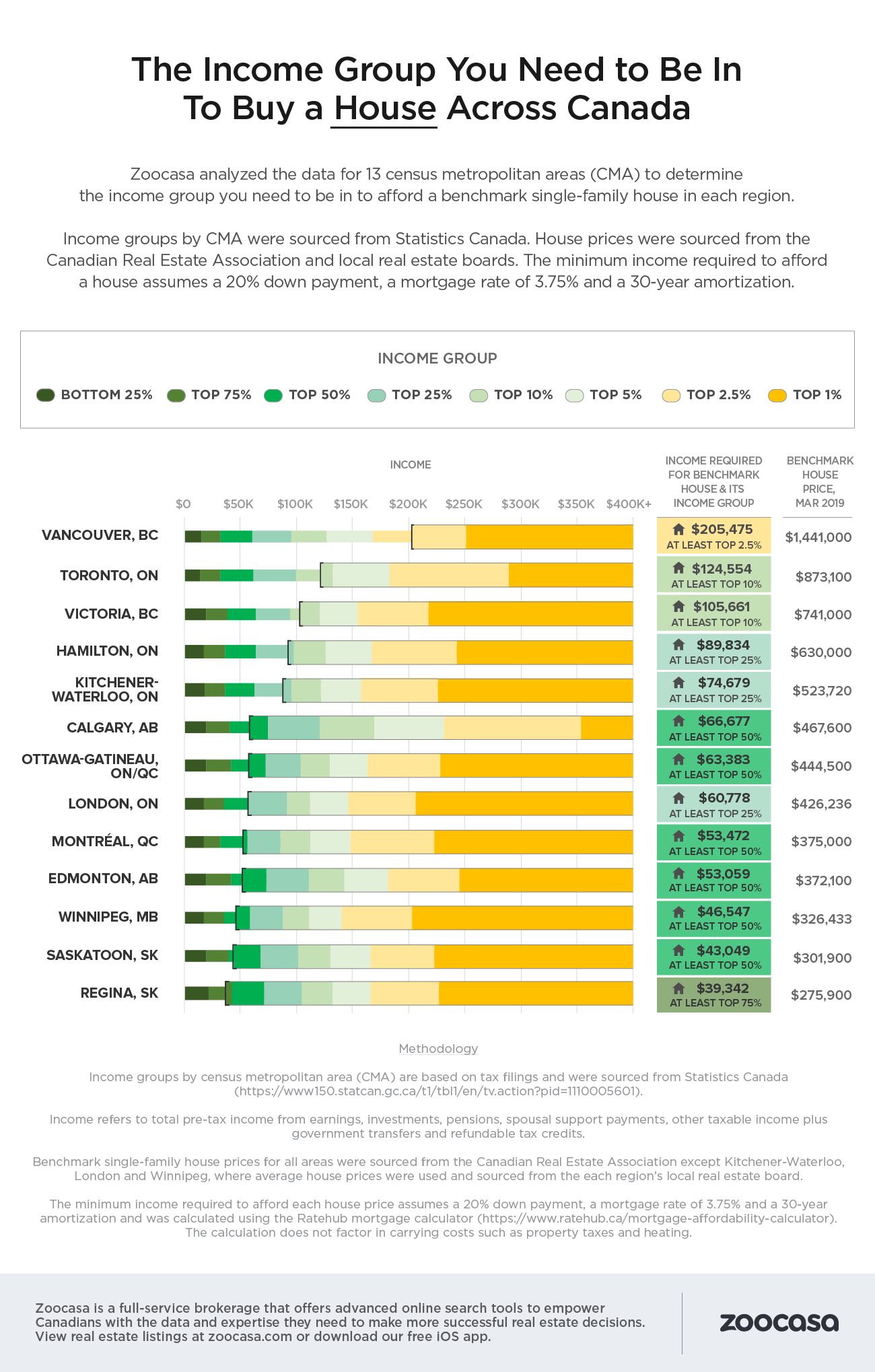
It’s no secret that in order to purchase a house in Toronto or Vancouver, you’ll need to have considerable financial assets; however, a new study from Zoocasa reveals just how elite income earners need to be in order to afford the benchmark single-family home in these cities.
According to the data, which is based on benchmark home prices sourced from the Canadian Real Estate Association as well as income tax filings from Statistics Canada, a Torontonian buyer must be within the top 10% of earners to afford a house priced at $873,100, while only Vancouverites within the top 2.5% could do so for a home priced at $1,441,000.
The numbers also show that prices for entry-level housing, such as condos, remain out of reach for many; buyers must be within the top 25% of income earners to afford the benchmark unit, which costs $656,900 in Vancouver and $522,300 in Toronto, respectively.
Affordability is greater in Southern Ontario, Prairies
However, the study also highlights the comparative affordability in other cities; several of the secondary markets in Ontario, as well as in the Prairie provinces, are much more accessible in terms of housing prices.
For example, those interested in markets within proximity of the GTA, such as Waterloo real estate, need only be within the top 50% to purchase a condo priced at $320,857, though houses are still only in reach for those within the top 25%, at a benchmark of $523,720.
London is also a reasonable alternative for first-time buyers; those looking to purchase a house priced at $426,236 must be within the top 25%, though condos for sale in London are accessible to the top 50%, at $307,359.
You’re probably familiar with mutual funds. Most people have encountered them at some point: either through their banks and financial advisors, or their friends complaining about the fees.
ETFs are a newer investment, which people tend to associate with lower fees and broad diversification.
“So, what is the difference between a mutual fund and an ETF?”
Mutual funds are bundles of stocks and bonds that are managed for you by a bank or investment firm. Traditionally, they’re taking a hands-on approach to try to beat the market.
With actively managed mutual funds, you have managers who are trading a lot to take advantage of opportunities. However, this active trading comes at a cost, which usually translates into higher fees.
Most ETFs, or Exchange-Traded Funds, tend to take a different approach. They were primarily set up to track an index of investments (eg. The S&P 500 is an index of 500 publicly-listed US stocks and an ETF could track it. But you could have track indexes of tech stocks, energy investments, real estate investments, etc).
With most ETFs, portfolio managers are trying to reproduce the holdings and performance of an index. They give investors diversified exposure to an index at a low cost.
With those kinds of funds, managers don’t need to rebalance as often. That could mean lower costs for them. In turn, they can charge lower fees for the client.
“Which one is a better financial fit for me?”
Based on the above description, you might be wondering, “Why should I take a hands-off approach and match indexes, when I can take a hands-on approach and try to beat them?” Continue Reading…
We gasped a few weeks back when DWS Group launched an environmental, social and governance (ESG) ETF that raised nearly US$1 billion from a Finnish insurance company.
Two doors down, the US$1 trillion Norwegian sovereign wealth fund made its own announcement: it has enough North Sea oil exposure, so it’s slashing its energy portfolio. The Scandinavians aren’t talking; they’re acting.
Norway’s oil wealth comes from “upstream” extraction, so that’s the focus of the divestiture campaign. It’s not a wholesale energy liquidation just yet. Integrated oils like Chevron are still fair game because they have downstream refining and can thus offer diversification. Nevertheless, Norway is sending a clear message.
The trailblazing fund is a force to be reckoned with, controlling 1% of global listed equities. When it bobs, you weave.
There are two takes here: the idealistic one and the realistic one.
1.) Idealistic: A progressive northern European country is leading the way on a megatrend, just as it did with state-provided health care, parental workplace benefits and gender roles (and if we stretch to the Netherlands, drug decriminalization and bicycling).
2.) Realistic: A society whose fortunes are levered to the oil price is diversifying concentration risk under the guise of ESG.
Take note, Canada.
This nation is the portrait of cognitive dissonance. Justin Trudeau was supposed to be this era’s incarnation of the Summer of Love, with a warm Canadian kiss on the Paris Agreement for greenhouse emissions. Puzzling, then, the prospect of a Trans Mountain pipeline expansion.
Meanwhile, having Big Oil reach Big Tobacco pariah status can happen faster than you can google “University Divestment 1980s Apartheid.” I’ll give you the Coles Notes: apartheid died once institutional investors started cutting ties.
If you don’t think Canadian oil interests are petrified of the New Left’s answer to Trump — e.g., American congresswoman Alexandria Ocasio-Cortez — visit Suncor’s website. You wouldn’t know it was in the oil sands business, because you can’t get past all the sustainability, climate change and photos of sunshine. That’s when it dawns on you: this is like Altria urging smoking cessation. Catch even a fraction of the so-called Green New Deal and one-fifth of the S&P/TSX 60 is in a real pickle.
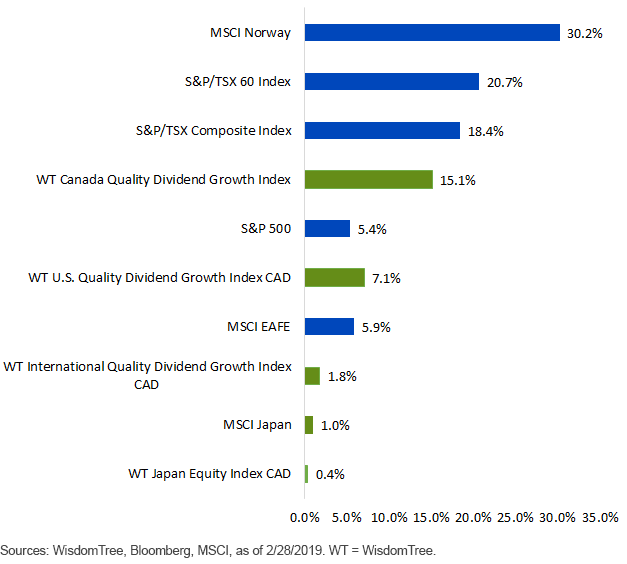
As Oslo goes, so goes Ottawa? Norway’s sector trap is particularly acute, so it forges the path (figure 1). Canadian asset allocators, get your compass: Norway is drawing the map.
Figure 1: Index Energy Weight
Jeff Weniger, CFA serves as Asset Allocation Strategist at WisdomTree. Jeff has a background in fundamental, economic and behavioral analysis for strategic and tactical asset allocation. Prior to joining WisdomTree, he was Director, Senior Strategist with BMO from 2006 to 2017, serving on the Asset Allocation Committee and co-managing the firm’s ETF model portfolios. Jeff has a B.S. in Finance from the University of Florida and an MBA from Notre Dame. He is a CFA charter holder and an active member of the CFA Society of Chicago and the CFA Institute since 2006. He has appeared in various financial publications such as Barron’s and the Wall Street Journal and makes regular appearances on Canada’s Business News Network (BNN) and Wharton Business Radio.
Important Risks Related to this Article
Commissions, management fees and expenses all may be associated with investing in WisdomTree ETFs. Please read the relevant prospectus before investing. WisdomTree ETFs are not guaranteed, their values change frequently and past performance may not be repeated. Past performance is not indicative of future results. This material contains the opinions of the author, which are subject to change, and should not to be considered or interpreted as a recommendation to participate in any particular trading strategy, or deemed to be an offer or sale of any investment product and it should not be relied on as such. There is no guarantee that any strategies discussed will work under all market conditions. This material represents an assessment of the market environment at a specific time and is not intended to be a forecast of future events or a guarantee of future results. This material should not be relied upon as research or investment advice regarding any security in particular. The user of this information assumes the entire risk of any use made of the information provided herein. Neither WisdomTree nor its affiliates provide tax or legal advice. Investors seeking tax or legal advice should consult their tax or legal advisor. Unless expressly stated otherwise the opinions, interpretations or findings expressed herein do not necessarily represent the views of WisdomTree or any of its affiliates.


 Posted By