


All posts by Financial Independence Hub

October home sales stronger as buyers beat Mortgage deadline: CREA

By Penelope Graham, Zoocasa

Special to the Financial Independence Hub

October ushered in slightly stronger home sales across the nation leading to tighter buyer conditions, but losses in Canada’s largest markets continue to “overwhelmingly” drag the average well below last year’s activity levels, reports the Canadian Real Estate Association (CREA).

Sales remain weak Year over Year

According to CREA’s October report, overall sales rose 0.9 per cent month over month, but remain 4.3 per cent under 2016’s number. Compared to peak activity experienced in March, sales are down an even steeper 11 per cent. It was the seventh month in a row that sales have underperformed on an annual basis. And, with the majority of the downturn experienced in the Greater Toronto Area and surrounding Golden Horseshoe markets, it’s clear detached houses, townhomes, and condos in Hamilton and Toronto are proving less of a draw.

However, fewer homes listed for sale in October made the market more seller-friendly, down 0.8 per cent over the month. This could indicate the flood of Toronto real estate listings that followed the Ontario Fair Housing Plan may be subsiding, as well as typical seasonal factors: fewer people want to deal with selling their home as the holiday season approaches.

Buyers rush to beat Mortgage Rule deadline

The slight improvement could also be due to new mortgage qualification rules, which will make it tougher for all borrowers of new mortgages — regardless of their down payment size — to qualify, and will reduce the amount of home they can afford. CREA President Andrew Peck says that as the changes will take effect in January, buyers now are rushing to get into the market in order to avoid the new requirements.

“Newly introduced mortgage regulations mean that starting January 1st, all home buyers applying for a new mortgage will need to pass a stress test to qualify for mortgage financing,” he stated. “This will likely influence some home buyers to purchase before the stress test comes into effect, especially in Canada’s pricier housing markets.”

CREA’s Chief Economist Gregory Klump agrees, saying short-term improvement may be temporary.

“National sales momentum is positive heading toward year-end. It remains to be seen whether than momentum can continue once the recently announced stress test takes effect beginning on New Year’s Day,” he stated. “The stress test is designed to curtain growth in mortgage debt. If it works as intended, Canadian economic growth may slow by more than currently expected.”

Home prices continue to rise across Canada

Real estate continues to get more expensive throughout Canada, with the national average price rising 5 per cent to $506,000, and the national MLS Home Price Index benchmark up 9.7 per cent year over year. However, the pace of price growth appears to be slowing: that’s the smallest increase seen since March 2016. Not factoring in Toronto and Vancouver, the average price would be $383,000 – $120,000 lower.

Toronto: following Vancouver’s footsteps?
Continue Reading…

Don’t shun Bonds merely because of fear of rising Rates

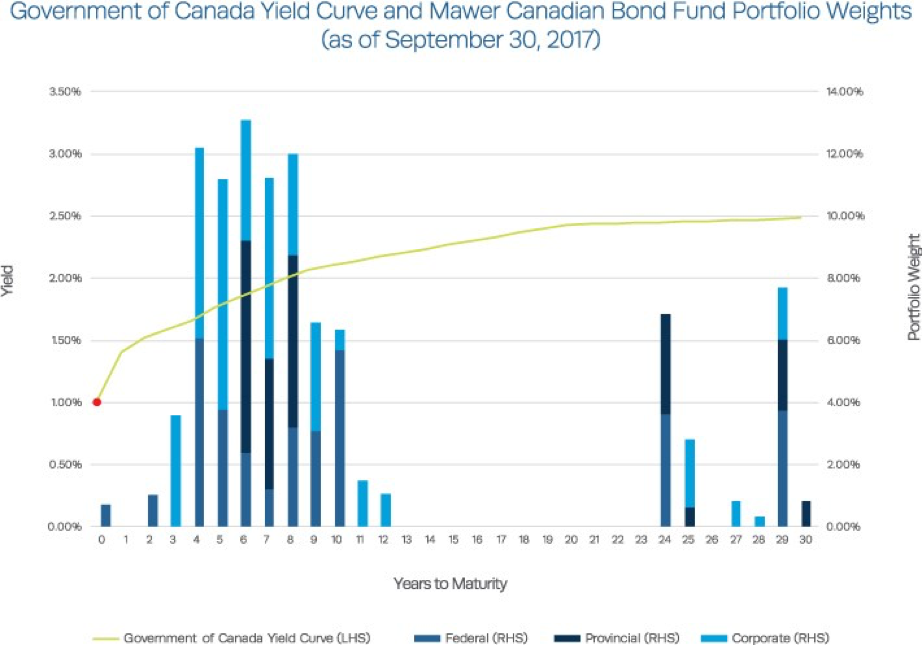
Sources: Bloomberg and FactSet

By James Redpath and Curtis Elkington

Special to the Financial Independence Hub

Conversations about increasing interest rates and their impact on bond investments have recently spiked in Canada. Since bonds are traditionally viewed as an investment that provides a steady stream of income while acting as a safety net within an overall balanced portfolio, an environment of rising interest rates understandably causes unease: it can decrease the price of bonds and therefore can negatively impact performance.

While we share the same concern, we also think some of the prevailing discussions oversimplify the relationship between interest rates and bonds and require a bit more context. We may want to think twice about knee-jerk shunning of the asset class.

Right off the bat, what should be kept in mind is that the interest rate most commonly referred to in media articles is the overnight interest rate, which we will refer to here as simply ‘interest rate’. For anything longer than the overnight rate, we will use ‘yield’ and/or ‘yield curve’.

While the Bank of Canada controls the overnight interest rate (represented by the red dot in the graph above) and has some influence on the short end of the yield curve, medium to long-term yields are a different story. Medium and long-term yields tend to be driven by long-term factors outside the Bank of Canada’s direct control, such as potential economic growth and inflation dynamics, supply and demand, and global influences.

Thus, pinning too much importance and conversation onto that red dot doesn’t provide a holistic picture since the Fund has a diverse maturity structure and exposure to multiple sectors: all of which can have different influences on performance. While shifts higher in the yield curve over the short-run will likely negatively impact a bond portfolio, over a longer time horizon, the effects might be surprisingly positive.

In long run, rising yields are a positive

Why? Although it may seem counter-intuitive, if you have a long-term time horizon, an increase in bond yields is usually more beneficial than if yields remained lower as the performance of a bond fund is influenced by the level and slope of the yield curve over time. Another important factor is the pace yields rise relative to the time it takes to recover lost performance. While there could be short-term pain, maintaining a long-term horizon allows an investor to reinvest at a higher yield, which over time typically outweighs the negative short-term impact. Simply put, the higher yields are, the higher the income an investor receives when cash flows are re-invested.

Continue Reading…

Financial planning should be a Parallel, not Serial, process

By Darren Coleman

Special to the Financial Independence Hub

In a serial circuit when one light bulb goes out, all the lights go out. Each light is wired to the next and all of them have to work for each one to work. In a parallel circuit all the lights are wired together but independently from each other, so when one light goes out, the other lights still stay on.

This concept is important and comes into play in my book ‘RECALCULATING – Find Financial Success and Never Feel Lost Again’. The book applies the analogy of driving to investing and financial planning. (See earlier Hub blog on the book).

I have spent almost a quarter of a century counseling clients about their money and assets, and often see people who believe their financial planning should look like a serial circuit. They think they must achieve one goal before moving on to the next. They have constructed an order or sequence that must be strictly followed for them to feel comfortable about achieving their plan.

This is the view Marvin and Jesse had when I met them. A successful, professional couple, they had young children and a list of goals. No. 1 on the list was that they wanted to be mortgage-free by age 45. They also wanted their kids to go to a private school, and vacations every year with the family. In addition, they wanted a comfortable retirement by their late fifties. They had great jobs, were disciplined savers, and figured they should be able to achieve all these goals. But they didn’t know how to put all the pieces together and make it happen.

I reviewed the situation to gain an understanding of their current state, and discovered that almost all their uncommitted cash flow went to pay down the mortgage. There were only token amounts being saved for their children’s education, family vacations, and retirement plans.

A couple that used serial financial planning

When I asked about this, they said paying down the mortgage as quickly as possible was the central assumption – the core pillar – of their financial planning. In short, this couple looked at all their desired destinations as if they were part of a serial circuit. Once they had paid off the mortgage, they would move on to the other plans.

I told them they could do this, but achieving that milestone of being mortgage-free by age 45 meant they could not put their children in private school, take annual holidays with the family, or make tax-advantaged contributions to their retirement plans. So, while they could be mortgage-free at an early age, they would not accomplish their other goals. And, of course, they couldn’t get the time back.

None of us can.

Shift to financial planning in parallel

I showed them that changing the picture from a serial circuit to a parallel circuit might be the answer. Continue Reading…

Debunking myths about Smart Beta and ETFs

By Jeff Weniger, CFA , WisdomTree Investments

Special to the Financial Independence Hub

This is part one of a four-part blog series addressing the attacks on smart beta and ETFs. Today we address the supposed academic consensus that the only recourse for investors frustrated with active management is to turn to market capitalization-weighted index funds.

“That’s the way it’s ‘always’ been done”

In much of our research we lay out our case that much of the impetus for trillions of dollars to continue tracking market capitalization-weighted indexes appears to be little more than “that’s the way it’s ‘always’ been done.”

In this blog series, we’ll address the most common lines of attack against smart beta and ETFs.

For clarity, our discussion of smart beta will refer to this excerpt from the Financial Times:

Smart beta strategies attempt to deliver a better risk and return trade-off than conventional market cap weighted indices by using alternative weighting schemes based on measures such as volatility or dividends.1

The truth is that the “active management versus passive market cap-weighted indexing” argument is a classic false dilemma. Continue Reading…

How Group Annuities can help employers protect Defined Benefit pensions

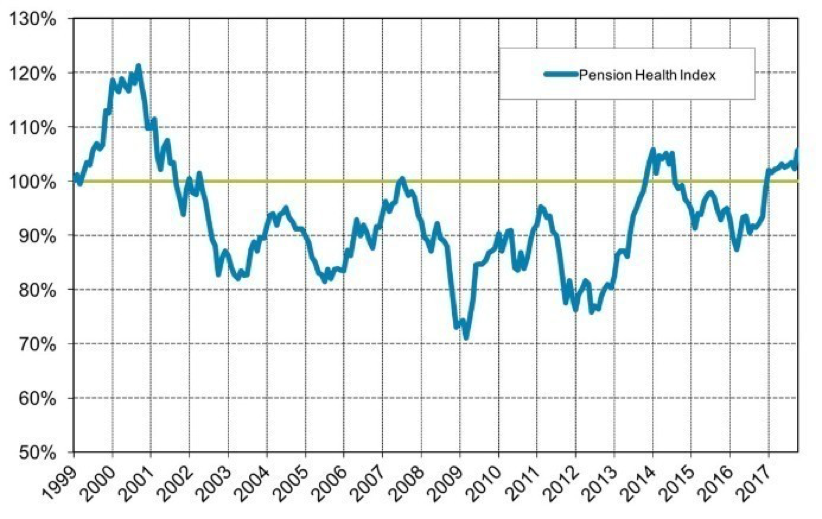
Source: Mercer Pension Health Index published October 2, 2017

By Brent Simmons, Sun Life Financial

Special to the Financial Independence Hub

Recently, employees and retirees of Sears were stunned to learn they may not receive all of their defined benefit (DB) pension when it declared bankruptcy. They learned their pension plan was underfunded and the company had requested that it be allowed to stop making the contributions required by Ontario laws. The plight of Sears employees and retirees has left many Canadians wondering if their DB pension plan is healthy and if their DB pension is safe.

The pension challenge

With a DB pension plan, a company promises their employees a pension for life and is responsible for paying the pension: whatever the cost ends up being. The problem is that low interest rates and choppy equity markets have made the funding level of many pension plans look like a roller roaster ride. This can be seen in the chart at the top of this blog.

Another challenge facing pension plans is that Canadians are living longer, meaning that pensions need to be paid for a longer time. A common rule of thumb is that one year of additional life expectancy at age 65 can increase the cost of the pension plan by 3% to 4%.

In a tough economy, the need to contribute to a pension plan can often come at a time when a company’s core business is also facing financial difficulties. If a company becomes bankrupt, then the company likely won’t be able to pay the contributions owed to the pension plan and employees may indeed face a shortfall in its pensions.

How Group Annuities protect their employees’ pensions 

The good news is that a growing number of Canadian companies are taking steps to protect their employees’ pensions. They are buying group annuities to transfer the financial risk of their pension plans to insurance companies, which are subject to strict regulations and must have funds on hand at all times to pay promised pensions. With a group annuity, an insurer assumes responsibility for providing the pensions to a company’s retirees in exchange for a fee, and the retirees continue to receive their promised pension.

Continue Reading…