Dodge costly financial forecasting pitfalls that derail your Financial Independence plans. Canadian retirees need these proven strategies now.
By Dan Coconate
Special to Financial Independence Hub
Planning for Financial Independence requires careful financial forecasting, but many Canadians approaching or already in their golden years make costly errors that jeopardize their financial security.
Understanding common mistakes to avoid in long-term financial forecasts helps protect your hard-earned wealth and maintain the lifestyle you’ve worked decades to achieve.
Ignoring Inflation’s Compounding Impact
Many retirees don’t realize how much inflation can reduce their buying power over time. For example, with just a 2% annual inflation rate, $100,000 today will only be worth about $67,000 in 20 years. In Canada, this is even more concerning as healthcare and housing costs are rising faster than average inflation.
Quick Tips:
Factor 2-4% annual inflation into all projections
Account for healthcare inflation potentially outpacing general rates
Consider variable inflation rates across different expense categories
Overlooking Healthcare Cost Escalation
Provincial health coverage doesn’t eliminate all medical expenses. Dental work, prescription drugs, vision care, and long-term care facilities often involve major costs that many forecasts overlook. These expenses tend to increase with age, potentially leading to budget shortfalls just when you’re least able to return to work, making financial planning essential.
Underestimating Longevity Risk
Life expectancy in Canada continues to rise, with many individuals now living well into their 90s and beyond. This shows the importance of careful financial planning, especially since early retirement may not be sufficient if you live 30 or more years without employment income.
Women, in particular, face unique longevity challenges, often outliving their male partners and needing to manage finances independently for extended periods. Planning is essential to ensure financial stability throughout these longer retirement years.
Using Static Return Assumptions
Market volatility creates sequence-of-returns risk, where poor early performance devastates long-term outcomes despite average returns meeting projections.
A portfolio losing 20% in year one of Financial Independence faces dramatically different outcomes than one gaining 20% initially, even with identical long-term averages.
Managing Market Volatility
Consider dollar-cost averaging withdrawals and maintaining 2-3 years of expenses in conservative investments to weather market downturns without selling equities at depressed prices. Continue Reading…
Flexibility without stock-picking: Sector ETFs offer diversified access to industries like tech, health care, and energy, without the need to select individual companies.
Diversification and precision: Broad ETFs provide market-wide exposure, while sector ETFs let you overweight specific industries based on your market view.
Tactical or strategic: Use sector ETFs for short-term tactical calls or long-term structural tilts (e.g., overweighting defensive sectors for cash flow).
Image courtesy BMO ETFs
By Michelle Allen, BMO ETFs
(Sponsor Blog)
There are many strategies investors can use in their portfolios. One of the most popular strategies is making tactical tilts with sector ETFs.
Sector ETFs – like the new BMO SPDR Select Sector Index range – allow investors to focus on the parts of the market they believe will outperform, such as health care, financials, technology, or industrials.
These ETFs make it simple to increase exposure when certain sectors are expected to perform strongly or dial it back to buffer portfolios when economic conditions change, and are available in both unhedged1 and hedged-to-CAD2 versions.
In this article, we explore how sector behaviours shift across different economic environments, and how tactical tilts using sector ETFs can help investors pursue outperformance.
What is tactical investing?
Tactical investing refers to the process of adjusting portfolio allocations in response to market conditions or economic signals.
While a long-term investor might stick to a static asset allocation, tactical investors“tilt” or increase their exposure toward sectors or asset classes that they believe are poised to outperform over shorter time frames.
Sector ETFs are ideal tools for tactical investing. They allow investors to quickly and easily overweight specific sectors without the need to pick individual stocks. At the same time, they can also be used to create more balanced portfolios as they can be used to diversify portfolios that are concentrated in certain industries.
Sector performance can change dramatically each year
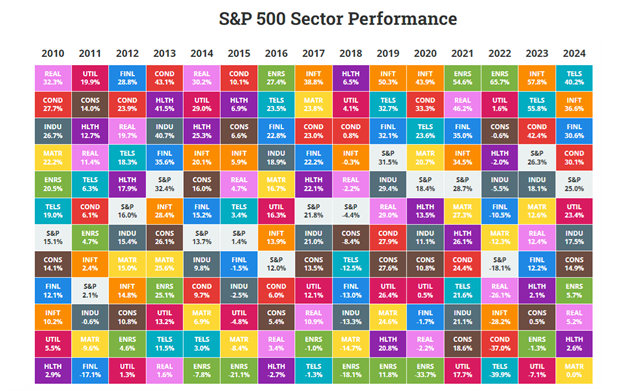
Sector performance often mirrors the dynamics seen across different asset classes and individual stocks: the top performers tend to change from year to year as shown in the table below3.
Over the past five years, we’ve seen sectors like information technology, consumer discretionary, and communication services lead the market in 2020 and 2021, only to become some of the worst performers in 2022. That year saw a massive rotation into energy, a sector that had significantly lagged in 2020.
Chart 1 – S&P 500 Sector Performance
Table 1 – S&P 500 Average Sector Returns
Source: Novel Investor (as at March 31, 2025)
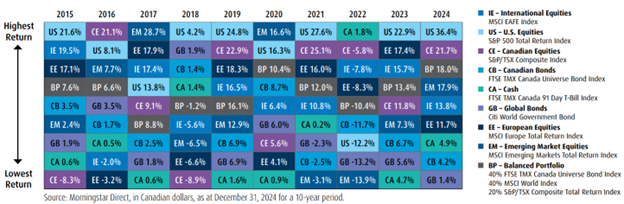
Chart 2 – Asset Class Returns
Index and sector returns do not reflect transactions costs or the deduction of other fees and expenses and it is not possible to invest directly in an Index. Past performance is not indicative of future results.
What drives these rotations? One of the key concepts is the economic cycle, which typically moves through four broad phases:
Recession: A period of economic contraction marked by falling gross domestic product and weak demand.
Recovery: Growth begins to rebound as consumer and business confidence, and spending, return.
Expansion: Economic activity strengthens, employment rises, and output reaches new highs.
Slowdown: Growth decelerates, signaling a potential shift back toward recession.
S&P 500 sector performance during phases
Understanding how sectors behave during different phases of the economic cycle is key to making informed tactical tilts. Here’s a snapshot of average S&P 500 sector performance across the four main stages of the U.S. business cycle (based on historical data from 1960-2019)4: Continue Reading…
John De Goey, a financial advisor and portfolio manager with Designed Securities, and long-time commentator on the financial services industry, was a keynote speaker at The Money Show recently held at the Metro Toronto Convention Centre.
Author of the book ‘Bullshift – How optimism bias threatens your finances’ (Dundurn Press, Toronto, 2023) and host of the popular podcast Make Better Wealth Decisions, De Goey delivered a presentation called Bullshift and Misguided Beliefs.
‘Bullshift,’ the term De Goey has coined, refers to his view about how the financial services industry makes people feel bullish in order to do the industry’s bidding. To make his point, he noted full-page ads appearing in such publications as The Globe and Mail; one of them ran under the headline ‘Be bullish.’
As for misguided beliefs, De Goey says there is ample evidence that Canadian mutual fund registrants believe things which are patently untrue. To illustrate the latter, he referred to Brandolini’s Law.
Alberto Brandolini was an Italian programmer who developed the term in 2013 and his rule goes like this: The amount of energy required to refute BS is an order of magnitude bigger than what was needed to produce it in the first place. Or, put another way, it compares the considerable effort needed to debunk misinformation to the relative ease in creating that misinformation.
American writer and humourist Mark Twain had a take on this at a much earlier time, and De Goey cited that. Said Twain: “It’s easier to fool people than to convince them that they have been fooled.” The point beyond all this, said De Goey, is that people must unlearn what they think they already know. No easy task.
His presentation at The Money Show covered a number of topics including:
The difference between misinformation (an honest mistake) and disinformation (saying something that is deliberately false), and how to unlearn the latter and think for yourself.
How behavioural economics and social psychology affect your investing decisions.
How the industry uses motivated reasoning and tribalism as opposed to critical thinking and evidence.
Why 90% of our financial decisions are based on emotions, not logical thinking.
Why governments and financial advisors like optimism over realism.
De Goey, always a student of history, observed that the market is 30% more expensive now than it was in 1929 just before the stock-market crash that led to the Great Depression. He mentioned the Smoot-Hawley tariffs of 1930 and their catastrophic impact on the U.S. economy, not to mention worldwide economy, and compared this to today’s on-and-off tariffs coming out of the Trump White House. He also noted recent credit downgrades and their effect on the U.S., and, of course, the very real pain of the tariffs which he believes will be much worse in the fourth quarter of 2025. What’s more, De Goey says this will be accompanied by higher inflation.
Bear market looming?
De Goey said the current bull market is “taking its final bow” and the bear market is “waiting in the wings.” In fact, he warned that gains made over the past six years could be entirely wiped out in the next four years if the historical regression to the mean for CAPE occurs. For those who are retired or nearing retirement, this would be devastating news indeed.
One of De Goey’s pet peeves – ‘optimism bias’ – refers to a) people thinking the good times will continue despite blatant warning signs, and b) the very human sentiment that bad things happen but only to other people. Not true, says De Goey. The trouble, he says, is that optimism can sometimes put you in trouble.
Normally, a presentation about money, economics and investing doesn’t get into wisdom imparted by such luminaries as Mark Twain, but De Goey didn’t stop there. He also took a page from Carl Sagan, notably, his 1997 book ‘The Demon-Haunted World. Said Sagan: “If we’ve been bamboozled long enough, we tend to reject any evidence of the bamboozle. We’re no longer interested in finding out the truth. The bamboozle has captured us. It’s simply too painful to acknowledge, even to ourselves, that we’ve been taken. Once you give a charlatan power over you, you almost never get it back.” Continue Reading…
By Dale Roberts, CutTheCrap Investing, Retirement Club
Special to Financial Independence Hub
The following is a special to Findependence Hub. This post is derived from a newsletter from Retirement Club for Canadians, re-shaped and enhanced for this audience.
Retirees typically face the greatest risk in the first few years of retirement. A severe market correction or bout of inflation can permanently impair retirement plans. In fact, the risk for retirees starts several years before the retirement start date, they’re already in the retirement risk zone.
Norm suggested …
“Planning for retirement is tricky at the best of times because it is beset by uncertainties both known and unknowable. High valuations are one of the known problems but that doesn’t make them easy to deal with.”
While a severe market correction early in retirement is a great risk for retirees who will rely extensively on balanced or growth-oriented portfolios, a longer period of low returns can also create risk. The U.S. stock market is trading at worrying levels based on a variety of value factors.
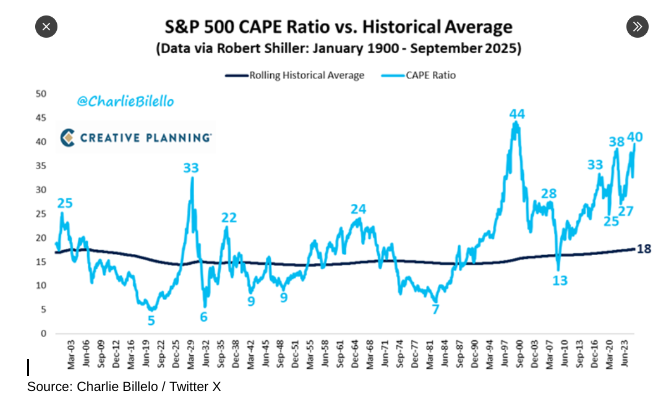
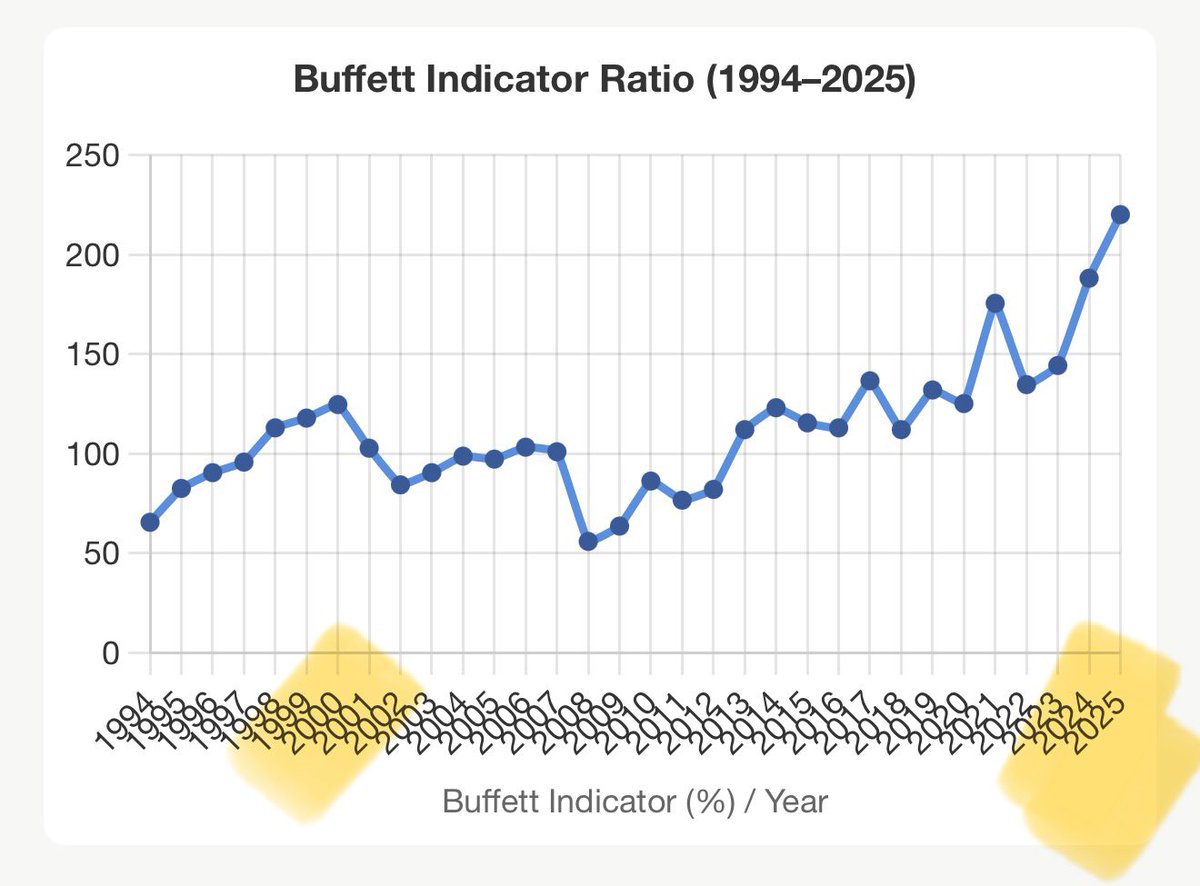
Norm demonstrated that the S&P 500 Index is trading at a cyclically adjusted price-to-earnings ratio near 39, which is approaching the 44 level that we saw in late 1999 as we approached the dot com crash.
Source: Charlie Billelo / Twitter X
The price-to-sales ratio is approaching its 1999 high.
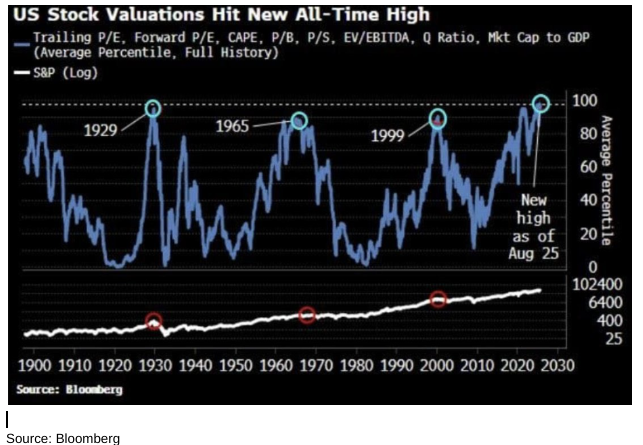
This ‘everything metric’ says we have the most expensive U.S. market – EVER!
We certainly can’t just step aside and wait for the next recession. Valuation metrics provide no market-timing opportunity. Nothing provides any market timing opportunity. Valuation tends to be a poor near-term market predictor, but it can ‘predict’ the potential returns over the next several years to decade. The data suggest returns for U.S. stocks could be very low in the range of 1-4% annual or even negative in real dollar (inflation-adjusted) returns.
And keep in mind that Canadian stocks (after a very healthy run) are expensive as well. After their big run-up this year, Canadian stocks now trade for nearly 29 times their average inflation-adjusted earnings of the past decade, according to Citigroup, the historical average is 16, TSX returns over the next several years might be challenged as well.
So, there is a risk of a major correction inspired by the lofty levels. And low returns in the first decade can put a strain on the spending plans. Continue Reading…
I’d gladly lose me to find you
I’d gladly give up all I have
To find you, I’d suffer anything and be glad
I’ll pay any price just to get you
I’d work all my life, and I wi
To win you, I’d stand naked, stoned and stabbed
I call that a bargain
The best I ever had
Bargain, by The Who
By Noah Solomon
Special to Financial Independence Hub
Many investors could be forgiven for believing that U.S. stocks are a superior investment to their non-US counterparts. Since the global financial crisis, U.S. stocks have not merely outperformed those of other countries: they have trounced them. Over the past fifteen years, the S&P 500 outpaced other developed market equities by a cumulative 150%.
Notwithstanding this astounding outperformance, successful investing necessitates looking ahead. To assess the likelihood that U.S. stocks will continue to outperform, it is important to (1) analyze the drivers of their past outperformance, and (2) determine the future sustainability of these drivers.
Not as Exceptional as you might think
Over the past decade, U.S. companies have delivered stronger earnings growth than those in other countries. However, given the degree to which their share prices have outperformed, the magnitude of their excess earnings growth is far less than one might suspect. Over the past ten years, American company earnings have outpaced those of foreign companies by a meagre 3.8% on a cumulative basis. Moreover, this excess growth was concentrated in the first part of the decade, with U.S. companies growing their earnings at the same clip as their non-U.S. peers from 2020-2024.
Not only has U.S. earnings growth been undifferentiated over the past five years, but it has achieved this mediocrity due to the stellar growth of a small handful of mega-cap tech stocks. Between 2020-2024, the magnificent six (Tesla was not in the index at the end of 2019), which collectively represent a 32% weight in the S&P 500 Index, grew their earnings at an extraordinary, annualized pace of over 20%. Given that the aggregate U.S. earnings growth, which was bolstered by a handful of mega-cap growth companies, has been undifferentiated, it follows that most U.S. companies have been subpar vs. the rest of the world from a fundamental perspective.
Despite relatively weak earnings growth from a global perspective, the non-magnificent 68% of S&P 500 companies nonetheless trade at a significant premium to their non-U.S. peers. Going forward, unless these companies can produce greater earnings growth than those in other regions, their relatively elevated valuations are not fundamentally justified. Moreover, there are several reasons to suspect that that U.S. companies will fail to grow their earnings faster than those in other regions.
Firstly, the U.S. administration’s imposition of tariffs on its trading partners will inevitably raise costs for American companies and reduce the global competitiveness of goods produced in the U.S. Even in rare instances where U.S. companies are successful in passing through these increased costs to their customers, their profits will nonetheless suffer from lower volumes. In addition, recent developments in U.S. immigration policies will reduce the supply of labour, which will hinder economic growth. Lastly, continued policy uncertainty is likely to engender a “wait and see” mode among CEOs, thereby leading to lower levels of investment.
The Magnificence is Evolving
Even if the non-magnificent majority of U.S. stocks fail to deliver the superior earnings growth that is required to justify their relatively high valuations, there is always a possibility that the magnificent minority could save the day by delivering earnings that exceed expectations. At an aggregate valuation of 30 times forward earnings, magnificence does not come cheap. However, if these companies can continue growing their earnings at their historic pace, their valuations are sufficiently reasonable to allow for strong gains in their stock prices. Conversely, if their growth reverts to less magnificent levels, the ensuing capital losses could be substantial.
One of the key drivers of the magnificent Six’s success has been their ability to grow their earnings at a breakneck pace with far smaller amounts of investment than what has been required of past behemoths. However, they have been aggressively ramping up investment in response to the current AI gold rush. While it is possible that these investments will produce strong returns, the fact remains that the low investment/high growth dynamic which has been a key element of the magnificent six’s magnificence may be a thing of the past.
Have I got a Deal for You
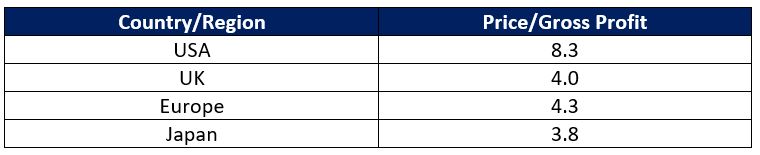
Given that U.S. companies have experienced similar earnings growth as their global peers, it follows that the former’s outperformance has been driven primarily by greater multiple expansion, which has resulted in U.S. P/E ratios that currently stand in the 90th percentile of their historical range. Relatedly, the earnings yield on U.S. stocks is close to an all-time low relative to Treasury yields. In contrast, international stocks are currently valued at a historically large discount to their U.S. counterparts.
Price/Gross Profit by Region
Admittedly, it is possible for valuations to become even more stretched in the short term, and timing markets perfectly is an exercise in futility. However, history strongly suggests that higher valuations foreshadow below average returns over the medium-to-long term. Moreover, in the absence of any compelling argument that future profit growth of U.S. vs. non-U.S. companies will be meaningfully different, the latter appear to be a relative bargain. Continue Reading…


 Posted By
  By Dan Coconate