Trading ETFs can work just as well in facilitating dumb moves as it does with smart moves.
Most investors would agree when we say that Exchange Traded Funds or ETFs started out as the most benign investment innovation that has come along in our lifetimes.
The problem is that ETFs work just as well in facilitating dumb moves as smart ones. And there are all sorts of dumb moves that ETFs can facilitate.
In fact, if you get an urge to invest in oil stocks, or gold stocks, or Swedish stocks, or windpower stocks, or any of hundreds of other stock groups and themes, you can act on that urge without doing any messy and time-consuming research on individual stocks—research that may give you pause and keep you from investing.
Manage your portfolio successfully into retirement
A University of Guelph report predicts Canadians will spend an additional $345 on groceries this year. However, there are ways to help offset the rising costs using certain types of credit cards.
Food is getting more expensive and the weak Canadian dollar hasn’t helped. The report notes that for every cent the dollar drops over a short period of time, fruits and vegetables are likely to rise by more than 1%. Unfortunately, more than 80% of all fruit and vegetables are imported.
Going out for dinner is also expected to cost more this year. Food prices in restaurants are forecast to rise between 1.5% and 3.5% in 2016.
Sensible Investing TV has posted part 9 of its How to Win the Loser’s Game series of videos, which you can view by clicking here. This 9-minute segment is the second-last episode of the ten-part series.
You can also find it here at Findependence.TV, where all the earlier episodes, plus those of FWB TV, are housed.
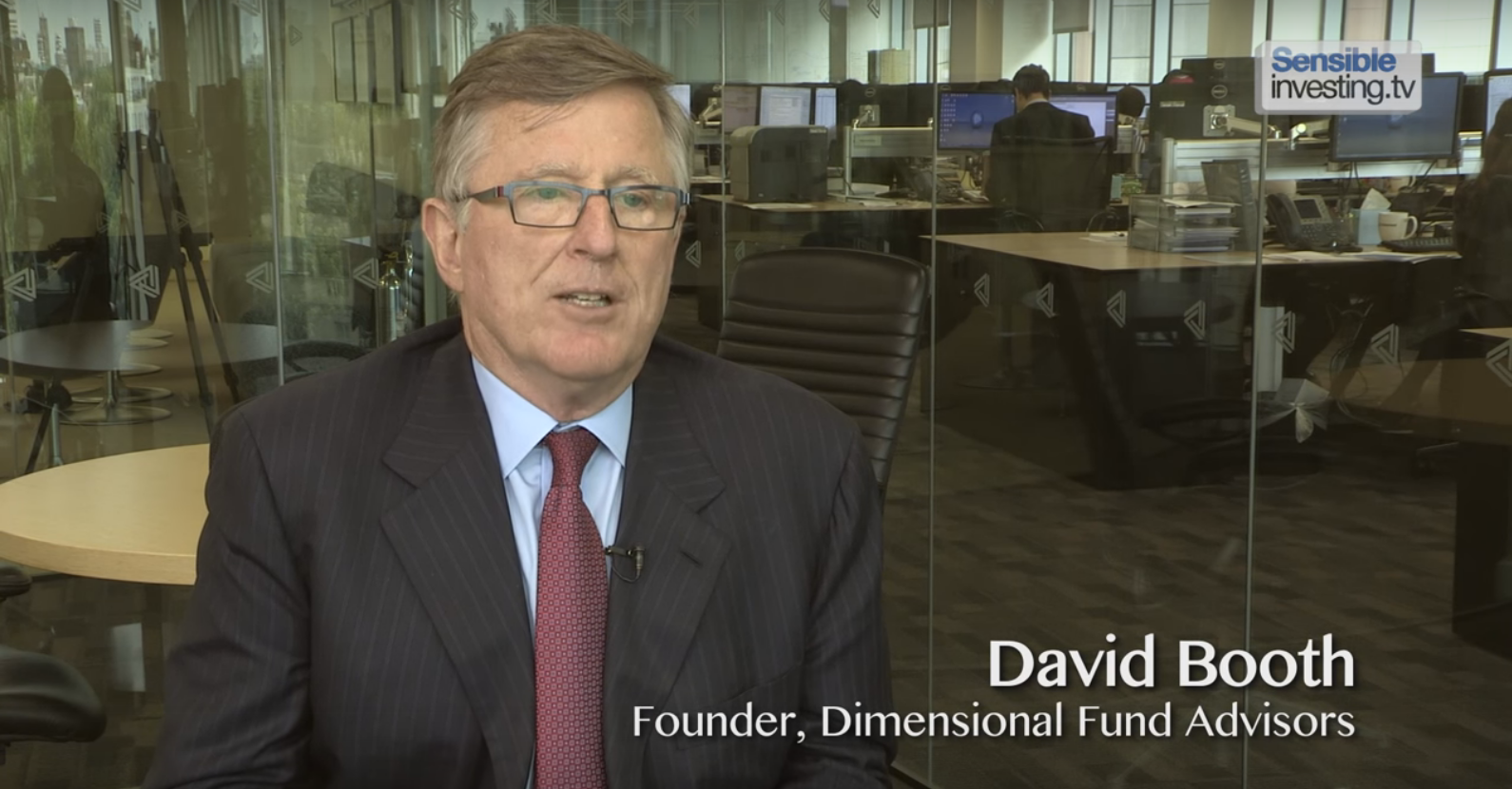
David Booth, co-founder of Dimensional Fund Advisors (pictured), says this:
“One of the big difficulties is getting people to stay the course when results are disappointing. It should come as no surprise to people that markets go up and they go down. When they go down, there’s a tendency for people to go, ‘Gosh, Are we on the edge of an abyss? Will things really get bad from here?’
In 2008-2009, it was difficult to get people to stay the course. My heart goes out to these people that were invested in equities, lost half their money then got out and missed the rebound. It may take quite a while for them to get back even again.”
We need to stay the course, and this video shows why …. the culprits will be familiar to many investors: buying low and selling high, panicking at the worst possible time, listening to media noise. There’s also a good segment featuring Vanguard founder John Bogle and the long-term returns that come from dividend yield and earnings growth, as opposed to speculation. Continue Reading…
Over the years I’ve summarized many financial strategies for your successful retirement. Today I delve into shaping key “lifestyle” factors for your retirement happiness.
Definition of lifestyle is a very individual combination of activities. There is no one-size-fits-all scenario.
For example, try to diminish your work life gradually, say over two to five years. A series of short sabbaticals is another way to sample your new lifestyle.
Your retirement road map is a very personalized and unique process. Where there is a spouse, both should be involved in the planning.
Developing 5-year road maps within the money comfort works for many,
such as activities for age “60 to 64,” “65 to 69” and so on.
It doesn’t matter how experienced you are with investing. We make lots of mistakes. Always have and always will. Investing is probably one of those disciplines where you literally have to “pay” your dues to make progress. It is an extremely humbling activity. It’s closest comparable in my mind is golf.
In the almost 20 years that I’ve been investing, I’ve made lots of mistakes. Some I’ve learned from and minimize and some I’m still a work in progress.
1.) Lack of commitment to the cause (Passive and Active Management)
One of the first questions I ask every potential coaching candidate is how much time they are willing to learn and practice investing. The answer determines the type of learning program that I will develop for them. If they are willing to make the time to learn about the intricacies of investing in individual stocks, I will develop a more comprehensive program.
If you can’t be bothered with learning about all the elements of investing, but just want to obtain enough knowledge to passively get exposure to stocks via index funds or ETFs then the program will be different. Either way, whether you are investing actively or passively, you need to dedicate a certain amount of time to learn and engage in the investing process. Engagement can mean doing the analysis or research, reviewing financial plans, tracking performance.
In the book, The Millionaire Next Door, one of the common traits of wealthy investors is that they have always have a good handle of their finances. On average, these investors dedicate some time each month to review their portfolios. The more engaged in the process, the more opportunities you will have to be aware of your behaviours, actions, and opportunities around you and the less intimidating the activity will be. Investing for many people is viewed as a chore and not at the top of the priority list. This needs to change.
2.) Lack of an ideology of how to create wealth
There’s a great school of thought that everyone needs to have some kind of financial plan that will map out how their savings will grow over the course of their life. It often contains lots of charts, graphs, and projections of their financial position at various life milestones. It’s always useful to have a bit of a window into the possibilities of the future. The problem with financial plans is they become immediately outdated when the ink dries.
Circumstances in our life and in the external environment will make that financial plan redundant pretty fast. Furthermore, even when a financial plan is created it is often adjusted and tweaked to reflect changes, which often do more harm to the portfolio. What is more important before engaging on the journey is to have some fundamentals and first principles of how wealth is created and more importantly staying true to those principles and ideology. We live in a capitalist society and often we use the term loosely without understanding what it means.
Our goal as investors is to allocate our savings to ideas, people, and organization that have demonstrated it is capable of managing the scarce capital it has been entrusted to generate additional wealth. When we buy and sell stocks, we often frame our decisions without any thought to evaluating these qualities. Most of the time we invest on hope and a prayer that it will all work out. A better approach is developing some core principles of how you plan to invest and the qualities or criteria of an ideal investment opportunity. Conversely we also need to develop an ideology on when we will exit an investment. How much return do we need to obtain? What is the most we are willing to lose on an investment? When you develop your ideology, it then becomes about consistent execution and minimizing the tweaking of your ideology.
An ideology will stick with you thick and thin. An investment plan may not necessarily. If you believe in passive investing and holding a few Exchange Traded Funds and rebalancing periodically, then stick to that strategy and don’t stray away from it. If your ideology is to buy high quality companies at discounted prices, then stay true to that strategy and avoid the temptations to tweak it. Having an investing ideology and implementing it faithfully and consistently is a trait many successful investors adopt and is more powerful than any financial plan.
3.) Not aware of their own or other people’s cognitive biases
I’ve written in the last while about how the greatest impediment for investors in making successful investment decisions is our behavioral biases that we are constantly fighting on a daily basis. While I spend a good part of my time teaching and coaching people on the mechanics of analyzing investments, I find over the years, I have been spending more time coaching people on becoming more aware of the emotional and behavioral side of investing. Ultimately I believe strongly that our ability to manage the emotions and biases will determine our financial success. At the same time, having an understanding of the psychology of how other investors behave can yield meaningful opportunities to leverage and become successful.
4.) Desire to be on the winning team
One of our core human traits is a need to be part of something, whether that is a peer or social group or family. By being associated with a group, we feel a certain level of security, comfort, and safety. As humans we are constantly searching for groups to associate with and more specifically, groups that are perceived to be cool, hip, current, and share ideas and beliefs that are similar to ours. We’re all prone to want to be on the winning team. Unfortunately, chasing winners and following what the herd is doing can often lead to poor returns.
5.) High fees are a drag on returns … to a point
A mantra that is often chanted by financial wonks and other financial illuminati is to always be mindful of the fees and transaction that are being incurred. Keeping fees and costs low can lead to long term savings and preservation of capital which is very true. At the same time making investment decisions solely based on the costs of products can limiting.
Remember the reason why we invest is to take money. Keeping costs low preserves capital which is fine to a point. The reality is that we will need to spend money to make money. Investing by keeping costs low is equivalent of a company trying to increase profits through cost cutting. It works in the short term, but at some point the company needs to demonstrate it can sell its products and services at a price point that makes it profitable. At the end of the day, no one is going to parade you through the streets because your ETF has an Management Expense Ratio of 0.05%. They will parade you because the investments in that ETF were profitable and generated a significant amount of money.
6.) Reaching for yield
A common strategy you will hear involves investing in dividend paying stocks. The premise is that companies that pay dividends that are continuously increasing are less risky than other investments. Unfortunately that premise lures people into a false sense of security as it implies that stocks are less risky, which is completely false. Stocks are among the riskiest assets and whether it pays a dividend is inconsequential. Any stock can still fall to zero. So getting a 3 per cent yield may seem appetizing, however if the stock falls 20 per cent will you feel any solace or comfort?
7.) Deviation from the plan via tinkering
We spend enough time, energy, and money putting together wonderfully written financial plans that we hope will lead us to the promise land. The reality is over time we will subtly nudge and tweak the plan. We’ll hear about a new product that promises higher returns at a lower cost and will convince us that the new product will be complement the portfolio. A nudge here, a poke here and the next thing you know it that wonderful pristine financial plan you and your adviser developed looks nowhere anything like you started off with and chances are it is so fragmented that implementing it will be even harder. That plan will then gather dust. Successful investors develop an investment ideology and plan and stay very loyal to it in its implementation. Ideally, a financial adviser should be there to prevent you from getting in the way, however, advisers can be prone to enable the tinkering as new opportunities to churn for commission present itself.
8.) Inability to control losses and turn the page
When we make investment decisions, we put a great deal of energy in identifying investments that hope will grow in value. We will do all the due diligence and analysis to ensure and convince ourselves that the investment will be successful. After all that there is still no guarantee that it will pan out. We will all definitely make decisions that will lose us money. When we get into that situation, we will be more likely to exhibit Loss Aversion behaviour and put more money into the investment. The key note is that if an investment falls 20 per cent, you need to make 25 per cent to get the investment back to break-even. If the investment falls 50 per cent, you need to make 100 per cent.
As your losses get larger, the ability to recoup becomes extremely difficult. This is why it is very important when you make an investment decision to establish a minimum gain you are striving for, you should also establish how much you are comfortable losing. By controlling the loss, you are preserving your savings and not subjecting putting more money at risk in an investment. The old throwing good money after bad analogy applies here. The reality is to be a successful investor, you will run into instances where some of your investments just won’t work out. When it doesn’t, we cannot get too emotional about it. We have to think like a goalie who just gave up a goal through the legs or a cornerback who just got burned for a touchdown. We need to turn the page very fast and not let the loss linger. The more we let it linger, the more it can cloud our judgement for future investment decisions.
9.) Back to the Future: Equating past performance with future potential. The future is always uncertain
A behaviour we are all predisposed to involves extrapolating current events to the future. If our investment portfolio generated a return of 10 per cent, we will internally convince ourselves that we will continue to generate a similar return well into the future. This recency bias can really cloud our expectations because the reality is there is no way you can predict what returns you will generate in the future. It’s futile. Don’t even go there.
The best you can do to leverage history is take a much larger data set. If we go back over 150 years, on average stock prices rise 6 to 8 per cent annually. If you’re anywhere near that range on a regular basis that it is pretty extraordinary. Another reality is that we all will have down years, especially after what we think is a good year, so it is always better to temper expectations, especially after a solid year of performance because the stock market has a funny way of bringing your feet back to the ground.
10.) A bad case of the Short Term’isms
As our society and pace of life continues to speed up, our decision making framework is also getting shorter and shorter. Investing involves making decisions on allocating money to assets we think are going to generate superior returns over a long period of time, which traditionally has been 3 to 5 years. Unfortunately the time frame appears to be getting shorter and shorter. Wall Street and Bay Street are so incredibly short term focussed on their expectations.
They are seeking immediate gratification constantly. Decisions and companies are valued on a quarterly basis and this pressure to meet quarterly profit estimate has forced companies to take a more short term approach to how they allocate and invest shareholder capital. Sometimes the pressure is so large that companies will resort to outright manipulation of numbers to meet analyst expectations. Investing has slowly been evolving into trading and gambling. Taking a short term view of investing decisions can make you susceptible to extreme swings in the stock market and can trigger emotions that may force you to prematurely make decisions that will further impair your portfolio.
11.) Not allowing compounding to work for you
One of the great gifts of the universe is the magic of compounding. When you take a number and roll it over and over that number can rise very fast over a long period of time. Bringing this into investing, the simple act of reinvesting the dividends, interest income, and capital gains generated by your investments consistently over the long term can take your portfolio to whole new level. I myself have been guilty of not leveraging this enough especially in my younger years. The beauty of compounding is that doesn’t require an intense level of saving, but instead requiring a large segment of time and strict adherence to an investment ideology (See #2).
12.) Understanding where the messages are coming from and the agenda behind them
Investors have a gold mine of information resources at their fingertips thanks to the disruption of the internet and 24-hour news cycles. The problem with having a mountain of information and data points to consume as it gets pretty easy to overlook the sources of the information. A lot of times there is an agenda behind them. Money managers don’t go on CNBC to give recommendations and prognostications because they have nothing better to do. They go on because they have a company and business to promote. I have done the same. Analyst reports can often be skewed or sanitized depending on if the bank has a relationship with the company. Blogs posts can be sponsored to project certain selling points of an investment product. Even though information resources have exponentially increased, it is even more important now to understand where the information is coming from, the players behind it and what are their agendas for putting out the content. Investors are having difficulty filtering out the noise and it can have an adverse impact on their portfolios.
13) You and your behaviours are your own worst enemy
At the end of the day, the biggest road that is preventing us from becoming better investors is not the banks, or financial advisers or the Government or BNN or CNBC or Maple Leaf Sports and Entertainment nor is it a lack of financial literacy. It is us. It is the stuff between our ears and how it makes us behave and reacts and perceives the actions, events, and behaviours that will drive our investment proficiency.
A lot of what I do as an investment coach revolves around improving people’s behaviours to avoid or at the very least manage these mistakes. When I started coaching, I spent more time on teaching people the mechanics of investing (i.e. reading/analyzing financial statements, interpreting economic activity, valuing companies). As my practice has evolved, I find myself spending more time working people to develop and manage their behaviours towards money and investing. I spend more time instilling a level of commitment and discipline in people and taking a longer term, strategic view when framing their investment decisions. I feel very strongly that these elements are the secret sauce that can push people over the top.
Aman Raina, MBA is an Investment Coach and founder of Sage Investors, an independent practice specializing in investment coaching and portfolio analysis services. This blog was originally published on his web site and is reproduced here with permission.


 Posted By
  By Patrick McKeough, TSINetwork.ca