Here’s my latest MoneySense blog, which it titled Is your advisor retirement ready? It came out of a conference I attended in Niagara Falls last week: the National Elder Planning Issues Conference. I had delivered the keynote address on why Longevity changes everything — a theme you’ll often see in the Hub’s Longevity & Aging section — but also sat in on a couple of sessions on which this blog is based. As you’ll see it’s also quite relevant to our Decumulation & Downsizing section.
For archival and one-stop shopping purposes, here’s the blog below, with a few photos and subheadings added: Continue Reading…
Wednesday’s Financial Post ran the 5th instalment of the 7-part series I’ve been writing on The Eternal Truths of Personal Finance.
I originally headlined this one with a title that’s long been familiar to personal finance writers and investors: Be an owner, not a loaner, which is to say emphasize stocks over bonds. The headline in the print edition today (FP5) reads Eternal Truth No. 5: Embrace Risk, pay less tax.
When I posted this blog, there was no online version available, so I took the liberty of posting my original draft, which may vary from the edited version in the paper. Here’s the link to the first in the series, and nearby should be links to at least instalments two to five. Continue Reading…
Saturday featured Eternal Truth #4: Buy a Home and Pay if Off as Soon as Possible. At least that was my original headline: you can find it online under the title Eternal Truth #4: Don’t be a Renter.
In my book, Findependence Day, this truth is expressed as “The foundation of financial independence is a paid-for home.”
Of course, in cities like Vancouver, Toronto, San Francisco and several other California cities, critics of sky-high housing prices continue to argue that renting and putting the difference in the stock market may make more sense. In Friday’s Financial Post, just this argument was made in no uncertain terms: You’d have to be crazy to buy real estate.
I’m not sure I’d be buying at these prices today but am glad we bought a starter home in 1988. It didn’t stop us from building a healthy stock portfolio as well: I don’t see home ownership and investing as mutually exclusive propositions. Continue Reading…
Are the Baby Boomers part of the Ageless Generation?
Many of us seem to act as if that were the case but there’s little doubt most of us feel younger than we appear. To me, the poster child for this ageless generation is Jane Fonda, whose famous workout videos appear to have held her in good stead in her personal twilight career.
(Technically, since she was born in 1937, Jane Fonda is not a post-war baby boomer but her spirit certainly seems to epitomize the zeitgeist of the generation that came soon after her).
If you get Netflix check out the recently released series Grace & Frankie, where Fonda plays a 70-year old recent divorcee: even though she herself is actually 77! Equally vibrant are her aging costars: Lilly Tomlin, Martin Sheen and Sam Waterston (best known as the prosecutor on Law & Order). Tomlin is 75 and the two male co-stars are 74.
Medical advances will transform the global economy
Amazon.com
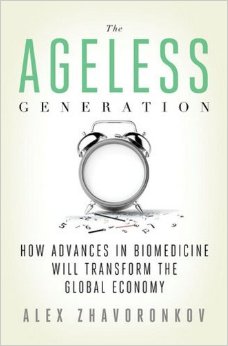
The Ageless Generationalso happens to be the title of a recent (2013) book by Dr. Alex Zhavornonkov, director of the Biogerontology Research Foundation and founder of the International Aging Research Portfolio. It’s one of about a dozen books I read in recent months in preparation for a talk on Longevity that I gave on Monday to the National Elder Planning Issues Conference in Niagara Falls.
The book’s subtitle summarizes the gist of it: How advances in biomedicine will transform the global economy. Since the focus is on the United States, it will come as no surprise that Zhavornonkov believes breakthroughs in extending Longevity can only make a shaky Social Security and Medicare system that much more fragile in the United States, and by extension their equivalent programs in other advanced nations.


 Posted By