 As my article in the print edition of Monday’s Financial Post goes into in some depth, the recently released DALBAR study on North American robo-advisers highlights several challenges the pioneering industry faces with new customers, or in poaching them from the established wealth management industry.
See the headline Service ‘gaps’ in robo advice: Dalbar study (page FP1). You can find the online version here under the headline ‘Robos are getting a pass’: Study points to gaps in automated investment advice.
Many older and wealthier clients may get “poached” from the traditional wealth management industry, whether retail mutual funds, banks, investment counsellors, full-service brokerage or other segments. Of course, in some cases, robo-advisers are landing “new” money from young people who may never have invested before. Millennials are a big focus of some robo-advisers (such as Toronto-based Wealthsimple).
Last Tuesday, the Hub ran a blog outlining the major points issued in the Dalbar press release, and we also published reaction from three Canadian robos: JustWealth, NestWealth.com, Wealthbar and the aforementioned Wealthsimple. See Becoming a Robo-Advisor Client may be challenging, Dalbar finds.
The 126-page study — which not all robo-advisers have seen — contains plenty of information that couldn’t be summarized in the FP piece. It begins by noting that these services are “one of the fastest growing segments in the wealth management space” and that they have “managed to capture significant share of wallet from the established wealth management providers in … a short period of time.” The report mentions that Wealthsimple has grown to $500 million in assets from a standing start in 2014.
The report has a relatively small sample size: 45 mystery shoppers (15 US, 30 in Canada) were asked to sign up to various Robos. Almost half of them were in their 30s. To assess risk, Dalbar directed these mystery shoppers “to ask for high returns in a short time period to test risk response mechanisms.”
Below, I present some more highlights that have not yet been covered:
Robo firms covered in the Dalbar report
First, the report looked at five American robo-advisers and ten Canadian ones (interesting that there weren’t more US ones!)
The US firms were Betterment, Charles Schwab, Future Advisor, TradeKing Advisors and Vanguard. (interesting that the oft-cited Wealthfront is not in: Dalbar told me it was based on what clients chose.)
The Canadian firms were (in the order Dalbar listed them): BMO SmartFolio, Invisor, JustWealth, Modern Advisor, NestWealth, Questrade Portfolio IQ, RoboAdvisor Plus, Smart Money Capital, Wealthbar and Wealthsimple.
Why clients chose particular services
Asked why clients chose a particular service, 100% of Betterment clients cited convenience while 100% of Vanguard clients cited reputation. WealthSimple clients cited equally (25% each) advertising, convenience, executive team and reputation. Interestingly, 75% of BMO clients cited its bank affiliation, and 25% its reputation. Invisor was a 3-way split between advertisements, executive team and product selection. JustWealth was an even 4-way split between advertisements, reputation, convenience and — this is interesting — being the “first to return my initial contact.” The latter point also accounted for 25% for NestWealth, Wealthbar and Modern Advisor. For NestWealth, the other three reasons, all an equal 25%, were convenience, platform offered and reputation. For Questrade Portfolio IQ it was 67% convenience and 33% reputation.
Reasons for Choosing vary with Client income levels
The report broke clients down into three clients with annual incomes that I’ll call low, medium and high: $60,000 to $75,000, $75,000 to $100,000 and $100,000 to $150,000 or more.
For the low-income clients, Convenience was most often cited, 30% of the time, followed by Platform Offered (26%) and Reputation (17%) and Pricing (9%).
For the middle-income clients, Reputation was most important, at 38%, followed by First to Return Initial Contact at 19%, executive team at 13%, and equal 6% allotments for Advertisements, Bank Affiliation, Convenience, Platform offered and Pricing.
For high-income clients, Reputation was most important in 33% of cases, followed by even 17% allotments to advertisements, bank affiliation, convenience and executive team. Remember these are small sample sizes, but none of the high-income clients even cited pricing, platform offered , product selection, or First to Return Initial Contact.
Motivations for trying a Robo-Adviser
Curiosity seemed to be a major driver for wanting to check out a robo service in the first place, Dalbar found, followed by lower fees and convenience. Not surprisingly, lower costs dominated for the high-income group, 83% citing it, followed by 17% time saving. For the middle-income group, 44% just cited the desire to try new technology; this was also cited by 30% of the low-income group. The two lower-income groups were also influenced by the fact robo-services let you start investing with relatively small amounts of money.
Cross-border differences in account opening times
Time to open an account varied from five to more than 30 minutes in Canada. Canadian users needed up to six times more time to open than their US counterparts. 75% of US robo users needed just 10 or 15 minutes to open an account, while 70% of Canadian robo users needed 15 to 60 minutes. Most Canadian users felt it took “too long” to open an account and US robos were perceived as being much easier to work with than their Canadian counterparts.
Dalbar singled out NestWealth as being most consistent, with most clients able to complete a risk assessment questionnaire in 15 to 30 minutes. US robo firms were faster but mostly because the questionnaires were shorter.
Aman Raina’s robo-experience
Continue Reading…


 Posted By
 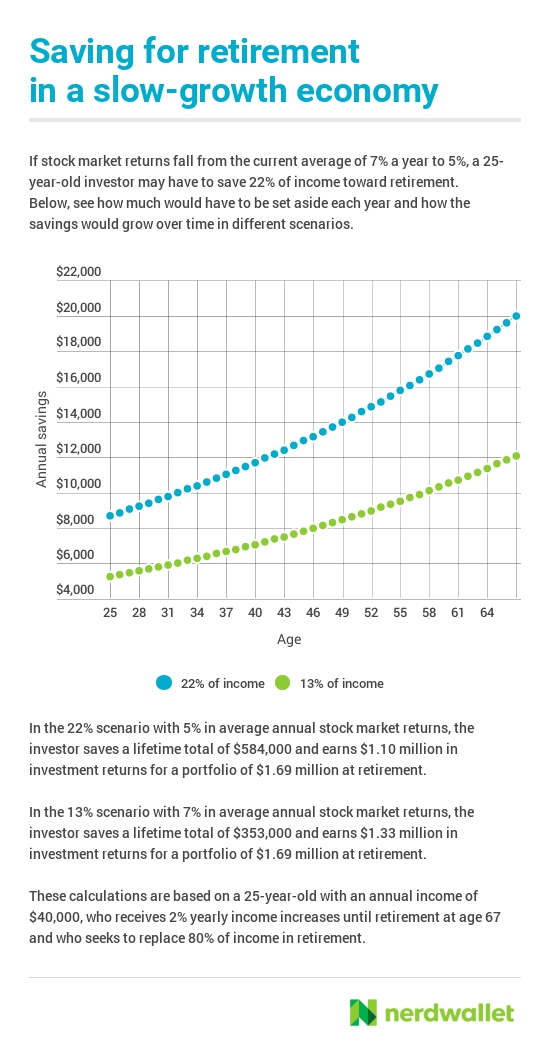 As my Financial Post blog today recaps, a new study being released today by the San Francisco-based personal finance site NerdWallet warns that just to retire by age 70, today’s millennials would have to save a whopping 22% of yearly income. Click on the highlighted text for the FP piece: Millennials may have less time on their side, U.S. retirement study shows.