Hub Blogs contains fresh contributions written by Financial Independence Hub staff or contributors that have not appeared elsewhere first, or have been modified or customized for the Hub by the original blogger. In contrast, Top Blogs shows links to the best external financial blogs around the world.
The devastating coronavirus pandemic has flipped every aspect of life on its head and caused great uncertainty, especially when it comes to higher education in North America.
In Canada, for example, higher education institutions can’t appear to get on the same page, as some colleges will be fully online, some will be a mix between in-person and virtual classes, and some just aren’t sure what they are going to do yet.
Then there are some colleges, like Brock University, that are implementing mandatory mask policies, while others like St. Francis Xavier University are requiring all students to sign a liability waiver by August 1 to protect the school against any loss or injury related to COVID-19.
In the United States, the situation is no different, and many students and parents have no idea what colleges are going to do come the Fall. Some institutions, like Yale and the California State University system, are gearing up for another virtual semester, while others like Rice plan to reopen with social distancing regulations in place.
Harvard released a confusing plan that will bring back 40% of students next semester, while the rest will take online classes, and all will somehow pay the exact same price.
LendEDU, a personal finance website, recently published a survey that highlighted how this uncertainty surrounding higher education in North America could change the college landscape for good.
Many students considering Online College or a Gap Year during Pandemic
LendEDU’s report surveyed 1,000 respondents that were either current college students from the graduating class of 2021 or later or graduated high school seniors from the class of 2020.
The results showed that many college students are considering nontraditional alternatives to college in light of the coronavirus pandemic.
For example, 41% of undecided high school seniors are considering enrolling in online college for the Fall semester, while another 28% are not sure if they would do that yet, and 31% will not.
Another 43% of undecided high school seniors are thinking about just taking a gap year next year, while 28% are not sure either way, and 29% are not considering that. Continue Reading…
MoneySense.ca; Photo created by senivpetro – www.freepik.com
My latest MoneySense Retired Money column looks at that perpetually useful guideline known as the 4% Rule. Click on the highlighted headline to access the full article online: Is the 4% Rule Obsolete?
As originally postulated by CFP and author William Bengen, that’s the Rule of Thumb that retirees can safely withdraw 4% of the value of their portfolio each year without fear of running out of money in retirement, with adjustments for inflation.
But does the Rule still hold when interest rates are approaching zero? Personally I still find it useful, even though I mentally take it down to 3% to adjust for my personal pessimism about rates and optimism that I will live a long healthy life. The column polls several experts, some of whom still find it a useful starting point, while others believe several adjustments may be necessary.
Fee-only planner Robb Engen, the blogger behind Boomer & Echo, is “not a fan of the 4% rule.” For one, he says Canadians are forced to withdraw increasingly higher amounts once we convert our RRSPs into RRIFs so the 4% Rule is “not particularly useful either … We’re also living longer, and there’s a movement to want to retire earlier. So shouldn’t that mean a safe withdrawal rate of much less than 4%?”
It’s best to be flexible. It may be intuitively obvious but if your portfolio is way down, you should withdraw less than 4% a year. If and when it recovers, you can make up for it by taking out more than 4%. “This might still average 4% over the long term but you are going to give your portfolio a much higher likelihood of being sustainable.”
Still, some experts are still enthusiastic about the rule. On his site earlier this year, republished here on the Hub, Robb Engen cited U.S. financial planning expert Michael Kitces, who believes there’s a highly probable chance retirees using the 4% rule over 30 years will end up with even more money than they started with, and a very low chance they’ll spend their entire nest egg.
Retirees may need to consider more aggressive asset allocation
Other advisors think retirees need to get more comfortable with risk and tilt their portfolios a little more in favor of equities. Adrian Mastracci, fiduciary portfolio manager with Vancouver-based Lycos Asset Management Inc., views 4% as “likely the safe upper limit for many of today’s portfolios.” Like me, he sees 3% as offering more flexibility for an uncertain future. Continue Reading…
For a real estate deal, Title insurance plays an essential purpose: it covers sellers and investors from financial damages arising from errors or conflicts not detected before the property was sold.
If a purchaser and seller sign a sales contract for a house, the buyers appoint the title officer to conduct a research of any liabilities, duties, disputes or disagreements which are to be settled before the home is transferred from one party to the other in the local jurisdiction’s land records.
But consumers can opt to purchase title insurance from a renowned insurer as an extra measure of security.
What is a Title Insurance policy?
A title insurance policy protects you from title issues such as a poorly registered act, an overdue contractor’s lien, or an unwanted successor. After the title examiner researches, divorce decrees, court rulings, and other public documents, title insurance policy shall be provided to ensure that there are no title disputes.
The title insurance of the lender is mandatory if you fund your home with a hypothec and covers the interest of the ender for your lending life. The strategy for a lender is related to the amount of the loan (not the buying price). Furthermore, the title insurance policy of an investor covers your property for as long as you own it, and the purchase price is the basis.
How much does it cost?
When buying a lender’s and the policy of the owner together, the overall cost of title insurance policy is around 0.5 per cent to 1 per cent of the purchase price. According to December 2019, the amount of fees applies to the premium from $1,372,50 to $2,745 [US$] for a medium-priced home of $274,500. The larger your size, the more likely you will be to pay for title assurance, although tariff insurance costs differ by region.
In respect of a refinancing loan, the cost of the title policy of a new lender is closer to 0.5% of the balance. You do not need to purchase another if you refinance the title policy of an owner when buying your home, as long as your own coverage is in place.
Factors affecting the cost
In general, title insurance plans, unlike many other specific insurance plans (such as car insurance, life insurance, and household insurance), require a single, one-time payment at or before the closing date of a settlement. If the insurer agrees to break payments into more manageable monthly installments, recurring payments for the title policy are very unusual.
Insurance charges are typically classified into two general categories: premiums and service charges. The cost of title insurance may be further divided within each group, depending on the quantity and form of work needed to complete the program.
Premiums
To some degree, the maximum premium paid on a standard title insurance policy depends on the valuation of the underlying asset. However, since most of the costs cover pre-transfer research – title quest, testing, and cure of defects – property value is not the priority. Continue Reading…
Prior to the pandemic, the financial health of Canadians was of great concern to the Bank of Canada, who often cited the record level of household debt as a serious threat to our economy. In 2019, the average Canadian household was carrying $1.76 in debt for every $1.00 of disposable income.
Other statistics related to the financial health of the average working Canadian were just as alarming: 52% were living pay-cheque to pay-cheque, 44% say it would be difficult to meet financial obligations if their pay was late, 40% were overwhelmed by their level of debt, and 48% were losing sleep because of financial worries.
We all know now that the COVID-19 Pandemic of 2020 is the gravest economic and financial shock anyone could have imagined. With no time to prepare, millions of Canadians and countless businesses are facing extreme financial stress and a global economic recession has taken hold. Now, more than ever, Canadians must focus on their financial health.
We need to think of health as a three-legged stool
Our overall health is connected on three levels: physical health, mental health, and our financial health. Financial challenges and difficulties are experienced by individuals across all income levels and age groups. Financial stress is the most obvious symptom and proves that financial health is strongly linked to our mental health.
Poor financial health can lead to more serious mental health issues such as anxiety and depression and can also negatively impact our physical health, from fatigue, poor nutrition, to substance abuse and dangerous conditions like high-blood pressure and heart disease.
A state of being in good financial health is when an individual:
has control over their day-to-day, month-to-month expenses,
has the capacity to absorb a financial shock,
is on track to meet financial goals – short, medium and long term, and
has the financial ability to make choices that allow them to enjoy life and seize opportunity.
Just like our physical and mental health, we need to put in the time, effort and commitment, and apply proven strategies, to maintain and improve our financial health. The Financial Health Network has created a measure of financial health called the FinHealth Score™. An individual’s score is based on four financial behaviours: how you Spend, Save, Borrow and Plan for the unexpected and your future. Your overall score will change with your circumstances and ranges on a spectrum from financially healthy to financially coping to financially vulnerable. Continue Reading…
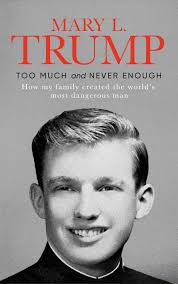
There seems to be no end to the number of books devoted to America’s flawed president but certainly the two dominant ones this summer have been John Bolton’s The Room Where it Happened and now Mary Trump’s Too Much and Never Enough.
Bolton’s book topped the New York Times best-seller list last time I looked but I expect it will be knocked off shortly by Mary Trump’s intimate portrait of her uncle’s early days, and how his character and outlook has never really changed. Mary Trump’s book sold 950,000 copies within days of its release and should be nicely past a million by the time you read this.
I have copies of both books but confess to having given up on Bolton’s long snoozer once Mary’s much shorter and more entertaining book came out. Mary’s is just over 250 pages. Both books have been extensively reviewed since their release and of course the White House’s attempt to block publication of them and muzzle their authors only ended up backfiring and turning both books into bestsellers.
In Bolton’s case, I found the numerous reviews sufficient to get the gist of what he was saying: the book is just too pedantic and self-serving to tolerate unfiltered.
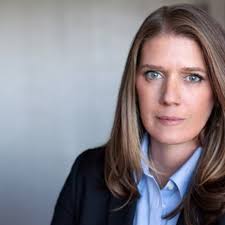
Mary’s book, on the other hand, is a compelling fast read, as you’d expect a book would be when written by someone actually in the Trump family. If indeed she believes Uncle Donnie is the world’s most dangerous man, then she’s a brave lady, as she demonstrated last Friday evening on CNN, when she ably rebutted Trump’s belated attempts on Twitter to discredit her.
I think most readers can safely disregard White House flack Kayleigh McEnany’s blanket dismissal of the book as “a pack of lies,” given that she also confessed at the same time she hadn’t read the book.
Perhaps Mary focuses too much on the early days of her father (Fred Junior) and his early death by alcoholism, largely caused by some abominable treatment by his younger brother (Donald) and their father, Fred Senior. But an understanding of this relationship is crucial to the book’s thesis, given that Mary notes near the end that “Vladimir Putin, Kim Jong-un, and Mitch McConnell, all … bear more than a passing psychological resemblance to Fred.”
I found the book more compelling the further you get into it. The last few chapters are especially insightful and pretty damning, judging by the extent to which I underlined it. Below are a few examples:
Protected from his many failures
Author Mary Trump
The last full Chapter (14, A Civil Servant in Public Housing) starts with an idea I’ve not seen discussed elsewhere, as Mary sees parallel “through lines” from the House where the Trump family was raised to Trump Tower to the West Wing; and from Trump Management to the Trump Organization to the Oval Office. The first reveals a progression of controlled environments that took care of Donald’s material needs, while the second constituted “a series of sinecures in which the work was done by others and Donald never needed to acquire expertise in order to attain or retain power …. All of this has protected Donald from his own failures while allowing him to believe himself a success.”
Also intriguing is the interpretation that — far from Donald taking advantage of others, which he certainly did — “there was a line of people willing to take advantage of him.” This started with the New York tabloid press in the 1980s, which “discovered that Donald couldn’t distinguish between mockery and flattery and used his shamelessness to sell papers.”
By 2004, Donald’s finances were “a mess,” Mary writes, at which time his “empire” consisted of “increasingly desperate branding opportunities such as Trump Steaks, Trump Vodka, and Trump University.” And this made him an easy target for Mark Burnett, who saved his career by convincing Trump to be the star of the reality TV show, The Apprentice, where he played the part of the successful businessman he wasn’t in reality.
She also recounts the many times his father bailed him out, including at least one of his failing casinos (It seems the House always wins, unless Donald Trump owns it). As she notes:
“Nobody has failed upward as consistently and spectacularly as the ostensible leader of the shrinking free world.”
In short, Mary concludes, her uncle “was neither self-made nor a good dealmaker … His real skills (self-aggrandizement, lying, and sleight of hand) were interpreted as strengths unique to his brand of success.”
Mary’s credentials as a psychologist also make her observations relevant, such as this shocking sentence:
“Donald today is much as he was at three years old: incapable of growing, learning, or evolving, unable to regulate his emotions, moderate his responses, or take in and synthesize information.”
The stress of distracting from his vast ignorance
While his fundamental nature hasn’t changed, he has experienced more stress since taking on the presidency. However, she explains: Continue Reading…


 Posted By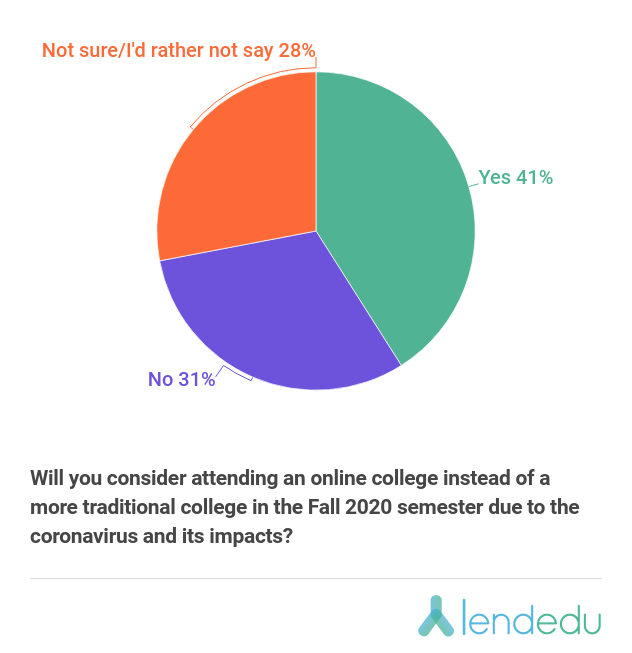
 Posted By