Hub Blogs contains fresh contributions written by Financial Independence Hub staff or contributors that have not appeared elsewhere first, or have been modified or customized for the Hub by the original blogger. In contrast, Top Blogs shows links to the best external financial blogs around the world.
If you’re like most people, you have a phobia about phishing. In fact, as we found in a recent Interac survey, almost one quarter of Canadians have clicked on a link that resulted in a phishing scam.
It’s no wonder Canadians are more likely to be worried about payment fraud scams such as phishing and skimming than they are about having their homes broken into or their cars stolen. Fortunately, just as you can take steps to protect your home and car, there are things you can do to protect yourself from online scams, too.
Beware Phishing trips
Phishing is a scam where fraudsters try to get your personal or financial information – such as passwords or card numbers – by masquerading as a trusted person or business, usually through email, text or an instant message, but also sometimes by phone. Continue Reading…
The 2018 Federal Budget confirms that the Government will move forward with the implementation of the December 13, 2017 proposals regarding the splitting of income by private company owners and their family members. The Budget, however, proposes two additional key measures regarding the taxation of passive investment income earned by a Private Corporation, a topic that was aggressively targeted by the July 2017 consultation paper on tax planning strategies involving private corporations.
The first measure focuses on limiting the access to the small business tax rate to private corporations earning a significant amount of passive income.[1] Currently, the small business deduction limit allows for $500,000 of active business income to be taxed at a preferential small business tax rate. This $500,000 limit begins to be ground down once the taxable capital of an associated group of companies reaches $10,000,000; it is completely eliminated once the taxable capital of the group is $15,000,000.
Budget introduced new reduction mechanism on passive investment income
The Budget’s proposal introduces a new reduction mechanism, which will work in tandem with the aforementioned existing business limit reduction, based on the passive investment income earned by a private corporation and its associated group. Specifically, once a corporation and its associated members earn $50,000 of passive investment income in a given year, the small business deduction limit begins to be ground down, on a straight line basis, until the passive investment income reaches $150,000. At this point, the small business deduction limit would be ground down to nil. The new reduction will apply to taxation years that begin after 2018.
The second measure aims at correcting an unintended tax advantage currently enjoyed by some private corporations when paying out eligible dividends to their shareholders in situations where the refundable tax pool (aka refundable dividend tax on hand “RDTOH”) was generated from investment income that would need to be paid out as a non-eligible dividend. The Budget is creating a new account, called the eligible RDTOH account, which will include the tax paid on eligible portfolio dividends.
Otherwise, tax paid on investment income or on non-eligible portfolio investments will be included in the non-eligible RDTOH account. The ordering rule will dictate that a private corporation, in payment of non-eligible dividends, will first have to access the refundable tax in the non-eligible RDTOH pool before it can tap into the eligible RDTOH pool. A payment of eligible dividends will only entitle the corporation to dividend refund to the extent of its eligible RDTOH pool. These new measures will also come into play after 2018.[2]Continue Reading…
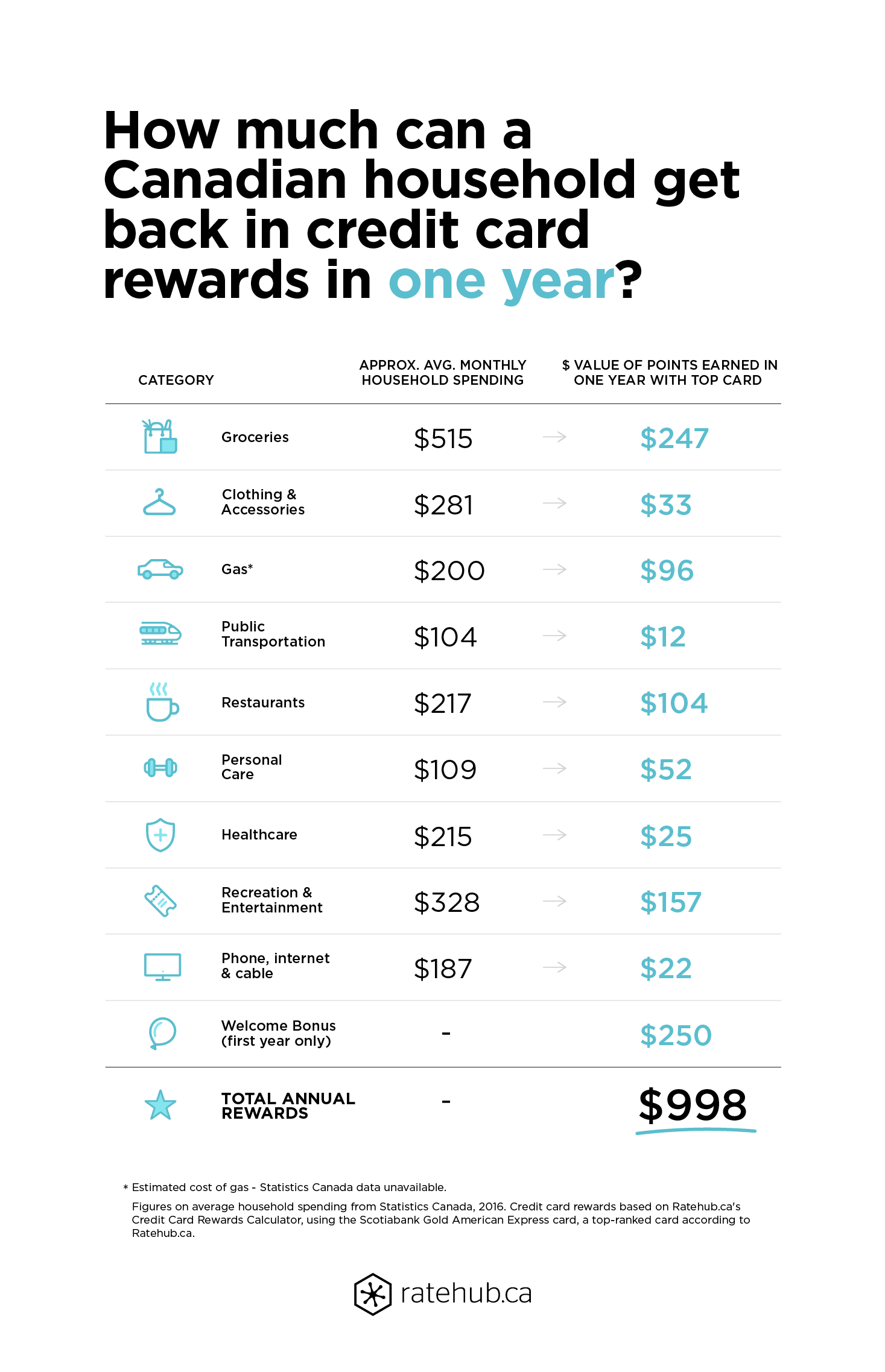
A whopping 86 per cent of Canadians say one of their top reasons when choosing a new credit card is earning rewards points or cash back, this according to a recent survey done by Ratehub.ca. 42% of those surveyed said they’ve never searched or compared credit cards to ensure they’re getting the maximum return.
Based on spending averages from Statistics Canada, that means Canadians could be giving up almost $1,000 rewards by not using one of the best credit cards available.
How is that possible? Well, when you look at some of the best credit cards in Canada, they offer up to 5% in cash back or rewards for certain categories. In addition, many cards offer a big sign-up bonus that could be worth anywhere from $250 to $500, so it’s not hard to see how some people are missing out.
Choosing a new credit card
With 29 per cent of those surveyed saying that the card they use most has been in their wallet for more than 10 years and another 50 per cent saying they would never pay an annual fee, perhaps it’s psychology that’s holding them back from making a change?
While Bill Morneau’ s second federal budget can be described as a punt, this third foray can best be described as a “fart in the wind;” however, given that this is a Justin Trudeau government, the term “pixie dust” seems far more appropriate.
The Budget included two major tax measures, one relatively substantial and the other curative. The latter was a tweaking of the rules surrounding Refundable Dividend Tax on Hand (RDTOH) , dividing the pools into eligible and ineligible pools, thus corresponding with their according dividend. The more substantive measure was to introduce a measure that reduces the ability of a corporation (or its related entities) to claim the Small Business Deduction where “substantial” income has been earned of invested after tax profits.
The new rule would see a company’s SBD eroded by 5 dollars for each 1 dollar of passive income earned in excess of $50,000 each year. If the company earns $150,000 per year in passive income it loses the entire SBD and is subject to General Rate taxation, effectively 26%. The government claims that this will affect about 3% of businesses. In the cases where the full SBD is lost the company will end up paying about $55,000 in additional corporate tax. The same company would also be paying out eligible dividends, which will be taxed at lower personal rates by the shareholder.
Finance’s pragmatic policy wonks prevailed with the Small Business Deduction
I actually think that the more pragmatic policy wonks in the Department of Finance prevailed with regard to this measure. The SBD was introduced to provide a tax incentive for small businesses to save and invest and by this process graduate to a medium sized or growing business. The problem of course is that tax planners have for decades sought to freeze the status of a small business in place. This can still be achieved by paying out shareholder bonuses, but given confiscatory personal rates in most of the provinces it is likely that trusted advisors will still the ability of a corporation to defer taxation and recommend that earnings continue to be retained. The approach the government has taken is a more comprehensive approach to total corporate earnings. It explicitly says to business owners and incorporated professionals that you can use your corporation as a retirement vehicle, or rainy day fund but you will be taxed as a more mature business.
There are of course planning measures that can be taken to avoid this new measure. Permanent life insurance remains the last game in town with regard to significant tax deferral possibilities. Given that the Department of Finance engaged in meaningful consultation in fashioning the substantive update of the “exempt test” rules in 2016 that no wholesale assault on life insurance is in the offing.
Instead, I think the Department will continue to observe the golden rule — “Pigs get fat and hogs get slaughtered” — in deciding what action is necessary. Like the 10/8 strategy before, there are strategies being implemented today that clearly drift into the aggressive category. The diversion of loan proceeds to a shareholder in an Immediate Finance Arrangement, or the rebating of commissions without their appropriate declaration of status as taxable income come to mind.
Individual Pension Plans only temporary remedy for new rules
Some might also trumpet the use of Individual Pension Plans. IPP’s in the right instance are wonderful planning tools. They are particularly useful for incorporated physicians who cannot plan retirement on the basis of an eventual sale of their professional corporations and who too often suffer from a lack of savings discipline. Continue Reading…
If you lack what finance professor and author Moshe Milevky calls a “real” pension (i.e. an employer-sponsored Defined Benefit plan), then you’re a likely candidate for annuitization or at least partial annuitization of your RRSP and/or RRIF.
My latest MoneySense Retired Money column revisits Fred Vettese’s excellent new book, Retirement Income for Life, and in particular his third “enhancement” suggestion for maximizing retirement income. We formally reviewed Vettese’s book in the MoneySense column before that, and commented on it further here at the Hub.
You can find the new piece drilling down on the partial annuitization enhancement by clicking on the highlighted headline: RRIF or Annuity? How about Both.
One of the main sources in the piece is fee-only planner Rona Birenbaum (pictured above with Fred Vettese), who has some useful videos on YouTube about annuities, including an interview with Vettese about the partial annuitization strategy described in the new MoneySense column. See Is it time for annuities?
Expect an annuity wave from retiring boomers without DB pensions
Certainly you’re going to hear a lot more about annuities as the baby boomers move seriously from Wealth accumulation mode to de-accumulation, aka “decumulation.” Coincidentally both Vettese and I are 1953 babies with April birthdays. In an interview with Fred, he told me he bought some annuities a year ago and that he believes that those who plan to retire at age 65 (and who lack a traditional employer-sponsored Defined Benefit pension) should consider at least partly annualizing at 65, to the tune of roughly 30% of the value of their nest egg (typically in an RRSP or RRIF). That means registered annuities.
Certainly, in light of the 10% “correction” in stocks that occurred in the last few weeks, the possibility of a more severe stock market retrenchment has to be upper most in the minds of soon-to-retire baby boomers. I note in his recent G&M column, Ian McGugan (in his early 60s) confessed he was slowly starting to take some profits from stocks and move them to safer fixed-income investments like GICs. See The Market’s gone mad: Here’s how to protect yourself. See also Graham Bodel’s article earlier this week: Response to an investor who frets the market is going to crash.
Annuities are one way to hedge against market risk, since you’re in effect transferring some of the market risk inherent in an RRSP or a RRIF to the shoulders of the insurance company offering the annuity. That’s one reason in the YouTube video above, Vettese talks about partly annuitizing as soon as you retire, whether that be age 65, or sooner or later than that traditional retirement date.
Financial advisors may not agree with all of Vettese’s five “enhancements.”
The earlier column reviewing the book mentioned that not many of Vettese’s “enhancements” to retirement income may be endorsed by the average commission-compensated financial advisor. Even so, as the Royal Bank argued earlier this year here at the Hub, annuities can help fund a full lifestyle in retirement. It observed that 62% of Canadians aged 55 to 75 are worried they’ll outlive their retirement savings but only 10% use or plan to use an annuity to ensure they’ll have a viable lifestyle in retirement.
Regular Hub contributor Robb Engen — a fee-only financial planner who also runs the Boomer & Echo website — wrote recently (on both sites) that annuities are one way retirees or would-be retirees without traditional DB pensions can Create their own personal pension in retirement.
As I note in the MoneySense column, while I’m certainly approaching the age when partial annuitization may make sense, I’ll probably wait a year or two. But in preparation for that possibility, as well as for the column, I asked Birenbaum to prepare three quotes for a $100,000 registered annuity, starting at ages 65, 70 and 75. As you might expect, the longer you wait to begin receiving payments, the higher the payout, but it’s not such a massive rise that you could rule out early payments if you really needed them to live on.
The mechanics of buying an annuity
And should you be ready to take the step, it’s not all that complicated. In the above case, you would liquidate $100,000 worth of investments in your RRSP so the cash is available to transfer, then complete an annuity purchase application and fill out and submit a T2033 RRSP transfer form. That form is sent to your RRSP administrator, and they transfer the cash to the insurance company without triggering tax. Once all these preliminary steps have been taken, payments begin the month following the annuity purchase.
Oh, and one last step, Birenbaum adds: Start relaxing!


 Posted By
  By Rob Fodor


 Posted By