Hub Blogs contains fresh contributions written by Financial Independence Hub staff or contributors that have not appeared elsewhere first, or have been modified or customized for the Hub by the original blogger. In contrast, Top Blogs shows links to the best external financial blogs around the world.
Side hustles are a great way to develop a side income, and gaining professional certifications can help boost your credibility. You can build off existing education or learn something entirely new.
There may be several certification programs to choose from in your desired industry. Most can be completed online, giving you ample flexibility to gain knowledge no matter where you’re located. The programs often require education, testing and background checks, and certification fees vary.
Discover how to strategically acquire professional certifications that unlock lucrative side-income opportunities.
In-demand Fields and Certifications to consider
Market demand plays a large role in the success of your side hustle and income. Consider these popular industries and certifications you’ll need to obtain:
Accounting and Finance
Manage assets for businesses and individuals. Those interested in accounting and finance should have an eye for detail and an understanding of business operations.
Licensed Certified Public Accountants (CPAs) prepare taxes and audits for individuals and businesses. You will be able to work and earn throughout the calendar year, not only during tax season, and earn an average US $51,000 to $74,000 starting salary.
Are you interested in certifying financial documents for loans? You can become a notary loan signing agent with the National Notary Association (NNA) and Loan Signing System certifications. These two certifications command respect in the industry and set you up for success. Learn about the proper execution of loan signing and how to get more loan signing jobs.
Technology Fields
There are many tech-based gigs to consider for innovators and problem-solvers. With the potential to make US $60 per hour as a cybersecurity professional, technology licenses can lead to lucrative side hustles.
The CompTIA Security+ certification is a great option if you want to get started with cybersecurity or tech support. This globally recognized certification gives you the skills you need to work as an IT support specialist, help desk technician or technical support analyst. You can also consider the Google IT Support Professional Certificate for information technology jobs.
OpenAI, Nvidia and Google are among the top Artificial Intelligence companies in 2025. This booming industry is expected to be worth US$1.33 trillion by 2030, making it an ideal field to get into. Some machine learning programs to consider are the entry-level Azure AI Fundamentals and the advanced Google Professional Machine Learning Engineer program.
Medical and Health
This industry offers a comprehensive range of care and lucrative salaries. Outpatient and administrative positions may provide flexibility and remote opportunities. Those with interpersonal skills may be more suited for the field.
Do you want to get started with telehealth? Become a Certified Professional by the American Heart Association. This side hustle can offer remote flexibility for providers and patients. You can learn how to manage medical records with the Registered Health Information Technician (RHIT) certification or discover medical coding with a Certified Professional Coder (CPC) license.
As the second half of 2025 unfolds, many Canadians are grappling with economic uncertainty. Headlines about slowing growth, persistent inflation, and global trade tensions may have many wondering whether their portfolio is ready for what’s next. While economists debate whether Canada is teetering on the edge of a recession or not, the real concern for investors is ensuring their financial future remains secure. Here are some items to consider to help protect your investments during turbulent times.
Understand the Economic Landscape
Economic indicators suggest Canada’s economy is under strain. The Bank of Canada has maintained elevated interest rates to curb inflation, which — while cooling — remains a concern at around 2.5% in mid-2025. This has slowed consumer spending, impacting sectors like retail and manufacturing. The S&P/TSX Composite Index — heavily weighted toward financials, energy, and materials — has seen volatility, with energy stocks particularly vulnerable due to fluctuating oil prices amid geopolitical tensions. A potential recession could further pressure corporate profits, leading to declines in stock prices, especially in cyclical industries.
Diversify to reduce Risk
Diversification remains the key to maintaining a resilient portfolio. Spreading investments across asset classes — such as stocks, bonds, real estate, and even alternative assets like gold or infrastructure — can cushion against market swings. For instance, while equities may falter in a downturn, government bonds or fixed-income securities often provide stability. Within stocks, consider balancing exposure between cyclical sectors (e.g., consumer discretionary) and defensive ones (e.g., utilities or healthcare). Geographic diversification is also key, as international markets, particularly in the U.S. or emerging economies, can offset domestic weaknesses.
Avoid emotional decisions
Market dips can test even the steadiest investor. Panic-selling during a downturn often locks in losses and derails long-term goals. Historical data shows that markets recover over time. For example, after the 2008 financial crisis, the TSX rebounded significantly within a few years. Staying focused on your investment horizon — whether it’s retirement in 20 years or a home purchase in five — helps avoid knee-jerk reactions. Regular portfolio rebalancing ensures your asset mix aligns with your risk tolerance and objectives.
Leverage professional Advice
If you are feeling uncertain about the current economic environment and how it may impact your portfolio, now is an ideal time to consult an Investment Advisor. A professional can assess whether your portfolio is positioned to weather volatility and aligns with your financial goals. Continue Reading…
Investment properties have long been a cornerstone of wealth creation, offering a tangible asset that can provide both ongoing income and long-term appreciation. For individuals mapping out their financial future, the allure of real estate lies in its potential to generate passive revenue streams, act as a hedge against inflation, and build substantial equity over time. Navigating the world of property investment requires careful consideration of market trends, financing options, and management responsibilities, but the rewards can be significant for those who approach it strategically.
Adobe Stock image
By Dan Coconate
Special to Financial Independence Hub
The financial benefits of owning investment properties are multifaceted, primarily stemming from consistent rental income and the gradual increase in property value.
Rental payments from tenants can cover mortgage obligations, property taxes, and maintenance costs, often leaving a surplus that contributes directly to an investor’s cash flow.
Beyond this regular income, the potential for capital appreciation means the property itself can become a more valuable asset over the years. This combination of steady revenue and growth in underlying value makes investment properties a compelling option for diversifying an investment portfolio and securing a more robust financial footing for the future.
Deciding how to secure financial stability during retirement can feel overwhelming, especially when considering long-term strategies. Among the options, investment properties are worth exploring. Whether investment properties can benefit your financial future depends on many factors, but they can offer distinct advantages when managed wisely. Read on to uncover how real estate investments might support your retirement goals and gain key insights into the potential risks and rewards.
Maintaining steady Income through Rental Returns
By renting out an investment property, you can generate monthly cash flow that supplements your retirement savings. This income could cover living expenses or fund unexpected costs in your retirement, creating a layer of financial security. However, you must account for costs like maintenance, management fees, and property taxes so potential rental income remains profitable.
Building Long-term Equity
Real estate allows you to build equity over time when the value of your property increases. Unlike traditional savings or stock investments, properties provide a tangible asset that grows in value as you pay down your mortgage. Equity represents your ownership stake, which you can leverage for financial needs, reinvestment, or even retirement travel plans. Consider the area’s housing market trends before purchasing, which impact a property’s appreciation potential.
Diversifying Retirement Savings
Concentrating all your savings into one type of investment is risky, particularly as you near retirement. Real estate is like a diversification tool, reducing dependency on market-dependent ventures like stocks or bonds. This balance may shield you from financial losses if another investment market fluctuates. Keep in mind, though, that real estate isn’t immune to market downturns. Confirm that the candidate areas and property types you consider align with your financial goals. Continue Reading…
Investing in companies that sustain and/or increase their dividends through different economic cycles is widely regarded as a prudent investing strategy, as sustainable dividend policies typically serve as a proxy for identifying high-quality businesses.
Companies with a track record of dividend growth often exhibit strong, reliable cash flows, disciplined capital allocation, and a clear commitment to returning value to shareholders. Such an investing approach can provide a steadily rising income stream to help offset inflation and enhance total returns over time.
We are excited to unveil the HAMILTON CHAMPIONS™ ETFs: built for long-term growth from exposure to blue-chip Canadian and U.S. companies with consistent track records of growing dividends (CMVP/SMVP). The suite also includes two Enhanced HAMILTON CHAMPIONS™ ETFs that utilize modest 25% leverage to further enhance long-term growth potential (CWIN/SWIN).
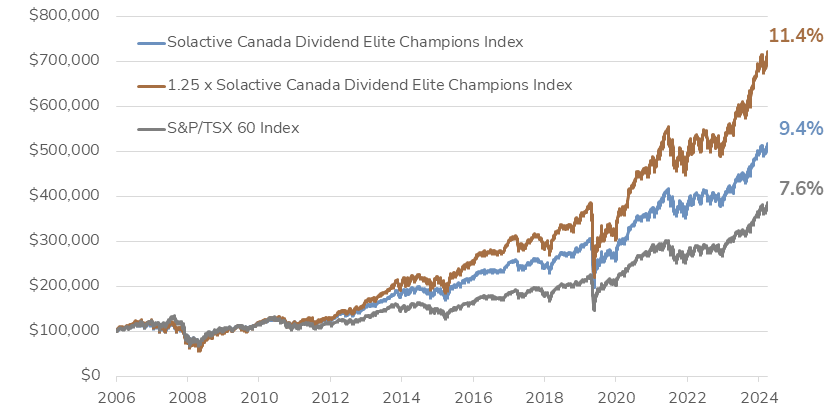
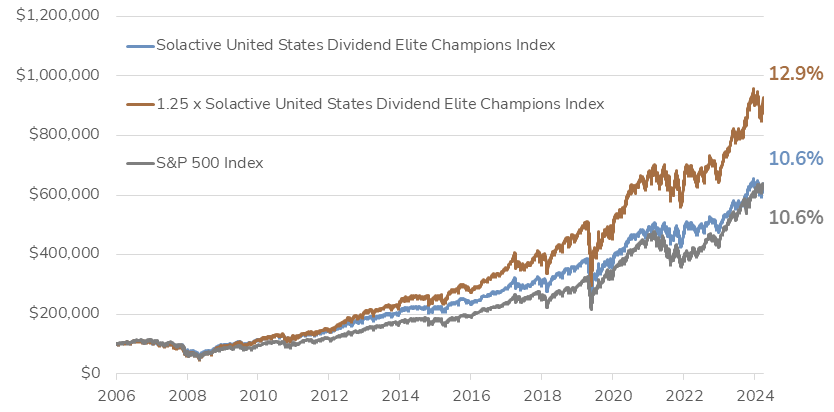
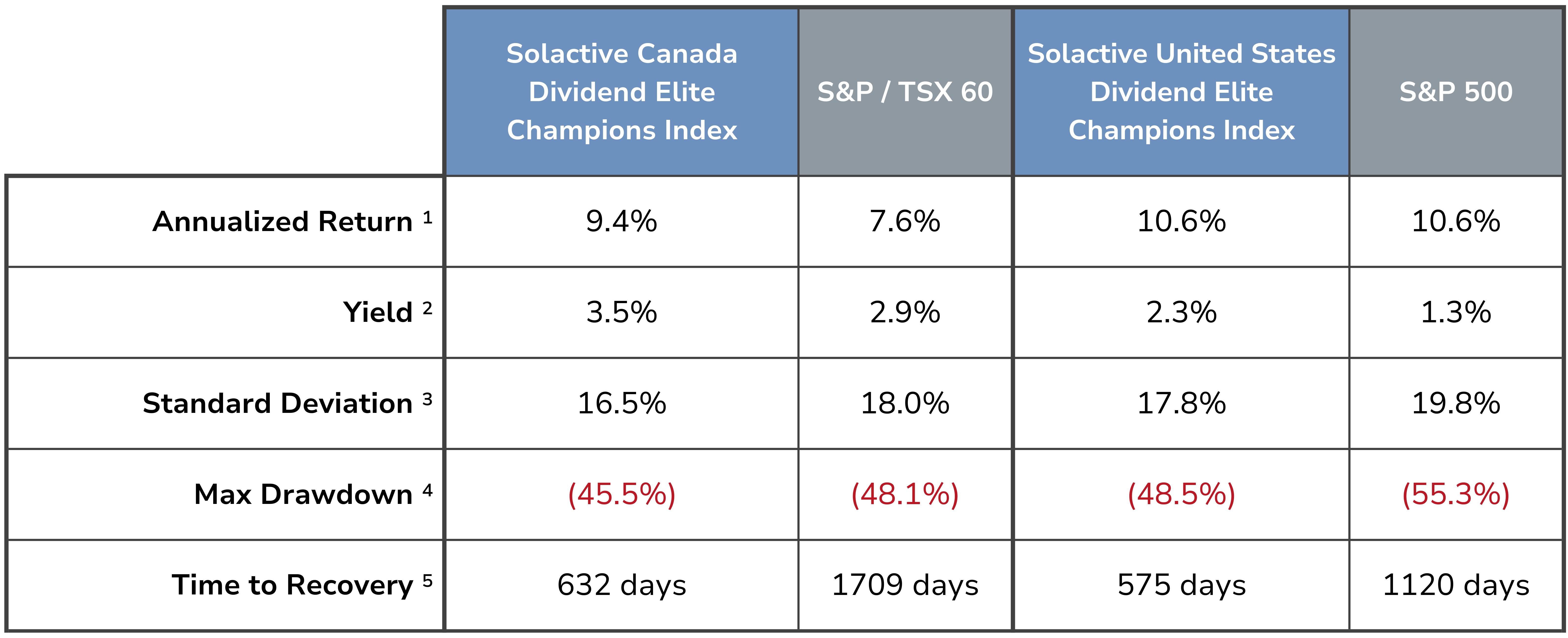
The HAMILTON CHAMPIONS™ ETFs are designed to track the Solactive Dividend Elite Champions Indices[7]. Boththe Canadian and U.S. indices have demonstrated strong performance and low volatility historically relative to the S&P/TSX 60 and the S&P 500, respectively.
Canadian HAMILTON CHAMPIONS™ — Growth of $100K [8],9]
U.S. HAMILTON CHAMPIONS™ — Growth of $100K [8, 10]
The Canada Dividend Champions Index and U.S. Dividend Champions Index are designed to provide equal-weight exposure to blue-chip stocks, listed in their respective countries, with a long history of dividend growth/sustainability. The result is a Canadian and a U.S. index with favourable performance and risk profiles vs. the S&P/TSX 60 and S&P 500, respectively. In addition, both indices have demonstrated (i) lower relative volatility; (ii) lower relative drawdowns; and (iii) faster relative time to recovery.
DISCLAIMER: see footnotes 1-5 below
Proven Winners, Rising Dividends
The Solactive Dividend Elite Champions Indices are focused on delivering diversified portfolios of companies with a long history of increasing dividends. The resulting portfolios have the following important characteristics: Continue Reading…
Discover unconventional paths to Financial Freedom that go beyond traditional advice. This article presents surprising strategies, backed by expert insights, that can transform your approach to wealth-building. From maintaining your lifestyle despite income increases to investing in non-financial assets, these innovative methods offer fresh perspectives on achieving financial success.
Maintain Lifestyle Despite Income Increases
Access High-Value Real Estate Through Syndications
Build Wealth with Niche Websites
Invest in Non-Financial Assets for Growth
Profit from Surplus Business Equipment Sales
Turn Discarded Inventory into Profitable Ventures
Monetize Legal Downtime with Tech Solutions
Transform Teaching into Wealth-Building Opportunity
Generate Passive Income by Renting Unused Space
Leverage Prop Trading Firms for Capital Growth
Maintain Lifestyle despite Income Increases
One unconventional yet effective method I tried to grow wealth and become financially independent is strategically managing lifestyle deflation in alignment with income changes. In simpler words, this means continuing to maintain the same lifestyle and budget even when your income increases, instead of adjusting your expenses alongside it.
I learned to prioritize this in my younger years after seeing people around me struggling to maintain their lifestyles despite rising income. I noticed they were increasing their expenses as their income grew. Most of these expenses were smaller differences that usually go unnoticed but compound to a bigger sum when you see them in total. Examples include subscribing to more services than before, buying more expensive items because they can now afford them, etc. Seeing all this, a thought nagged me often: “What would happen if they saved the raise they got instead of spending it immediately?”
As I learned more about personal finance, budgeting, etc., I started making a conscious effort to maintain the same lifestyle as always even as my salary grew. I funneled the extra sum into various investments instead. Over the years, this habit helped my net worth increase without compromising my quality of life.
Here are some tips I will offer others in this regard:
Automate the transactions into specific accounts: Immediately redirect your extra amount into another savings account for debt repayment and investments. This will help you avoid impulsive spending.
Understand wants vs needs: Take a broader look at your budget, including things you spend on usually. List all the expenses you make and consider which are important and which you can postpone for later since there is no immediate need. Doing this will help you stay focused.
Track net worth monthly: Make sure to track your investments frequently. Seeing your net worth grow will keep you motivated to continue your habit and avoid unnecessary purchases. — Lyle Solomon, Principal Attorney, Oak View Law Group
Access High-value Real Estate through Syndications
One unconventional way I’ve built wealth that surprised me on my journey to Financial Independence is through the strategic use of real estate syndications. While many focus on buying individual properties, I discovered that pooling resources with other investors allowed me to access high-value opportunities I wouldn’t have been able to tackle alone.
This method allows you to invest in larger commercial properties with a group of people, benefiting from economies of scale and shared risks. I first came across this approach through networking with experienced investors and learning about the power of group investment.
My advice to others would be to build a solid understanding of how syndications work and start small with reputable groups. It’s a unique way to scale wealth while minimizing individual risk, and it’s often overlooked compared to traditional property purchases. Collaborating with experienced partners can unlock doors to lucrative projects that wouldn’t be accessible otherwise. — Jonathan Ayala, Licensed Real Estate Salesperson | Founder, Hudson Condos
Build Wealth with Niche Websites
One unconventional way I’ve built wealth that really surprised me was by doubling down on building tiny niche websites. Early in my career, I thought the only path to success was creating huge, authority-style blogs. But after some experimentation, I realized that smaller, hyper-focused sites could generate a steady income without requiring a massive team or overhead.
I stumbled onto this by accident while testing out ideas that didn’t quite fit my main business. A few of these small projects started making a few hundred dollars a month each, and when you scale that up across multiple sites, it becomes something compelling. The magic is in finding a narrow topic where you can be the absolute best resource online, even if it’s something super specific.
For anyone interested, I suggest thinking smaller, not bigger. Find those underserved niches where competition is low, but passion or need is high. Focus on genuinely helpful content, optimize it properly, and be patient. It’s not a get-rich-quick strategy, but it is an incredibly reliable way to build passive income streams.
This approach allowed me to diversify without putting all my eggs in one basket and played a big part in reaching Financial Independence sooner than I expected. — James Parsons, CEO, Content Powered
Invest in Non-Financial Assets for Growth
One unconventional way I built wealth was by keeping a “no-market” year. For twelve months, I chose to remove myself from investing in anything that required speculation, interest, or growth. Instead, I focused on building non-financial assets: time, skill, energy, and relationships. I tracked it like a portfolio: hours of learning, time saved by simplifying routines, days reclaimed from overcommitting, and people I could count on for collaboration. That “quiet compounding” brought in far more than my typical quarterly gains ever did. I walked into the next year with three new paid projects, two solid partners, and almost double the free time.
I discovered it accidentally after turning down a contract that would have pulled me out of integrity. I gave myself permission to step back and see what kind of return I could build without putting money anywhere. I suggest trying this as a 90-day experiment. Track the non-financial gains as seriously as you would your net worth. Value created in learning, trust, and creative space often turns into money later. The catch is, you have to believe it is real before anyone else does. Once you see it, it is hard to go back. — Adam Klein, Certified Integral Coach® and Managing Director, New Ventures West
Profit from Surplus Business Equipment Sales
Purchasing and selling surplus business equipment was much more profitable than previously thought. Initially, it was just a game of turning what companies didn’t want into something useful. But as time went by, I learned what had actual value was an awareness of where the demand was: what buyers were searching for but couldn’t be found easily. That gap became an opportunity.
I became interested in it on a whim when assisting someone with liquidating their lab, and saw its inefficiency. So we built a system around it. My advice? Identify supply chain omissions or inefficiencies in industries that people do not pay much attention to. The more untrendy it sounds, the more opportunities you’ll have if you’re willing to master it inside out. — Joe Reale, CEO, Surplus Solutions
Turn Discarded Inventory into Profitable Ventures
I started buying leftover inventory from failed event suppliers. Half the time they were happy just to offload it for $0.10 on the dollar. I mean, we once picked up $35,000 worth of LED wall panels for $2,800, stacked them in our warehouse, and rented them out per gig for $650 a pop. In under four months, they paid for themselves, and we have since generated over $48,000 in revenue from those same panels. Everyone wants to build wealth from stocks or SaaS. I just bought junk others walked past and turned it into profit. Continue Reading…


 Posted By