Once you achieve Financial Independence, you may choose to leave salaried employment but with decades of vibrant life ahead, it’s too soon to do nothing. The new stage of life between traditional employment and Full Retirement we call Victory Lap, or Victory Lap Retirement (also the title of a new book to be published in August 2016. You can pre-order now at VictoryLapRetirement.com). You may choose to start a business, go back to school or launch an Encore Act or Legacy Career. Perhaps you become a free agent, consultant, freelance writer or to change careers and re-enter the corporate world or government.
As you know, I have frequently expressed concerns about high valuations for stocks. The concern has been expressed vehemently, yet so far, no serious risk has presented itself in terms of market drawdowns.
The narrative of U.S. public markets being risky has not proven to be accurate over the past few years. That said, what was once a minority view is becoming increasingly mainstream, as valuations remain stretched. The adage of ‘markets can remain irrational for longer than you can remain solvent’ has proven to be prescient and problematic for those who raised their cash positions. It has also caused certain commentators (including myself) to feel like Chicken Little. Despite our breathless admonitions, the sky has not fallen: yet.
Reallocate to more reasonably priced Asset Classes
Some people chose to exit public securities, but not capital markets. Private assets where there are likely to be pockets of more realistic valuation, as well as traditional inflation hedges like infrastructure and gold, have all performed relatively well in 2025. Rather than engage in market timing, this approach is more akin to an active reallocation toward being fully invested in asset classes that are more reasonably priced.
The Financial Independence Retire Early (FIRE) community is a very supportive and tight-knit one. Because the community is made up of folks who have different backgrounds and different ages, it’s very diverse (not just Caucasian bros from high tech).
One thing I appreciate from the diverse FIRE community is that there are people ahead of us who are always willing to share their knowledge and help others slightly behind them on the FIRE journey.
Earlier this year, after having been financially independent for a while, Dividend Daddy decided to step away from work to pursue other passions! Since stepping away from work, Dividend Daddy has been travelling around the globe and enjoying life.
I’m happy to have Dividend Daddy joining me today on the latest Early Retirement Q&A.
Q1: Welcome back Dividend Daddy. Congratulations on reaching FIRE and stepping away from full-time employment. Can you tell us a little bit about yourself?
I’m in my late 40s and Canadian. I worked in high pressure roles for my working career and this January, I pulled the plug on full-time work. With return to office mandates clashing with my desire for work location freedom, work was no longer tenable for me so I stepped away. As of July 2025, I’ve been retired for 7 months and travelling a ton.
Tawcan: Amazing stuff!
Q2: You and I utilize hybrid investing, a combination of individual dividend stocks and low-cost ETFs. What made you decide on utilizing hybrid investing in the first place?
Replicating the Canadian stock market is super easy so I buy individual Canadian dividend stocks and get the dividend tax credit for doing so.
Internationally, in the U.S. and world, it’s very hard to do that yourself so buying an index fund like $VTI and an ETF like $XAW just makes sense.
Q3:What made you decide to finally pull the plug and step away from full-time employment? Walk me through your decision process.
It was a mix of mental burnout and circumstances at my job that led to my early retirement. Of course, I had done the “math” several times and early retirement was possible financially for me.
Being financially independent meant that I had the control to decide my future. If work arrangements no longer suited my needs, I could walk away from them. So, that’s what I did.
At this stage, I wanted time freedom more than I did the next pay cheque.
Tawcan: that makes a lot of sense. In some level I’m probably there too.
Q4: Tell me more about your plans for this new chapter of your life.
Right now, it’s all about travel. I’m doing a ton of it and I have to say, it’s great without having the stress of work or a job on your mind.
I’m not travelling with a laptop for the first time in a very long time. Just my smartphone. Being untethered from your job while travelling is so very freeing, mentally and physically. It’s wonderful.
Q5: Prior to stepping away from full-time employment, did you do a lot of soul-searching to determine what you plan to do in early retirement? Why is this an important process for early retirement?
I did do some soul-searching and planning. Nothing rigorous, trusting myself to figure it out. Some planning is important because you suddenly have many more hours in a day and week to fill.
For me, I increased the amount of pickleball I play (when I’m at home), I cycled way more at home and abroad, increased the amount of time I spend at my second home in Mexico (to avoid those nasty Canadian winters), and have been travelling a ton more.
Q6: I know you were considering doing part-time work with your previous employer. Did that ever happen? Why or why not?
I did not end up doing part-time work with my employer. Circumstances changed at my employer and that flexibility was no longer available.
I may end up doing some very limited consulting in the future but that’s not on the table for 2025 or 2026. I do miss aspects of my work.
Q7: Tell me a bit more about your portfolio withdrawal strategy. I believe you plan on withdrawing from non-registered (N) and registered (R), and leaving TFSA (T) untouched for as long as possible? Are you planning to collapse your RRSP early? Or do you envision converting RRSPs to RRIFs at some point?
Not sure completely yet on strategy but I’ve only been early retired for 7 months as of July 2025. I’m definitely spending dividends from my non-registered account with a cash reserve/bucket of $75,000.
I will reinvest most dividends from my RRSP and all of them from my TFSA. I will need to seek professional advice for what to do with my RRSP going forward and whether spending it down is advisable give tax planning purposes.
Q8: Why is it important to “learn” how to spend money and enjoy life a bit more in retirement rather than a “save-save-and-save-some-more” mentality so many FIRE seekers tend to have?
Life is short. This hits you as you approach 50 years old. My parents’ generation is starting to pass on and I know I’m next in line (hopefully a long way off still). Continue Reading…
By Dale Roberts, CutTheCrap Investing, Retirement Club
Special to Financial Independence Hub
A recent Globe & Mail article laid out a retirement and investment challenge? A couple in their mid-fifties had a combined million dollar portfolio. They wondered if they could retire at age 65, while maintaining their annual income. How much would they have to save and invest to allow for that income level in retirement? I read through the comment section of that post. It became apparent that many or most Canadians who are DIY (Do It Yourself) investors are not aware of the free tools available that will allow them to calculate their savings requirement and how to estimate their potential spend rate in retirement. Let’s take a look at how they might create $110,000 in annual income.
Here’s the link (subscription required) to the Globe & Mail article –
Keep in mind that not many details were provided and the SunLife financial planner consulted for the article did not offer up any details on the required savings rate or how they would generate the income. This is the first reader comment you’ll see on the post …
That was the least helpful one of these types of articles that I have seen in a long time. No numbers and very little detail. “Try to save as much as you can in the most tax-efficient way now and for the future”. No mention of CPP amounts, OAS amounts, tax rates, withdrawal strategies, etc . The link to the SunLife infomercial was a low point.
That pretty much nails it. I was curious, so I thought I would take a quick run at it.
Here was the question submitted …
Is a million dollars enough for the two of us, both in our mid-50s, to retire on if we maintain our current lifestyle and work until we are 65? Our household income is currently $150,000. Is there a percentage of income you recommend as an annual savings goal until we reach that retirement age?
How do you calculate your required savings rate?
From the article, it is likely that the couple has a combined $150,000 in annual income before taxes. To make things more interesting and challenging, I’ll crunch some numbers to generate $150,000 in after tax income. I’ll use Ontario for a tax rate and tax treatment.
To estimate the required savings rate I will use testfolio and a simple savings calculator.
Both are free-use calculators that we cover and demonstrate at Retirement Club for Canadians. Check out that link if you want to learn more, or if you’re looking to sign up. We are starting a new group, now.
While you can use a ‘full ‘and very robust retirement calculator such as Optiml or Adviice for estimating the savings needs, you can certainly find your number by way of using a basic savings calculator or investment calculator, such as Portfolio Visualizer and testfolio. I found Optiml very difficult to use.
That said, you will first need to discover the portfolio value required to generate that desired income level.
How much do you need to create $150,000 income?
Canadians will typically generate retirement around these 3 pillars.
Retirement Club
For our scenario, we’ll assume there are no employer pensions in the mix. We will give the couple very generous Canada Pension Plan (CPP) and Old Age Security (OAS) amounts. A Canadian couple can generate over $50,000 of annual income from those government sources. And at age 65, taxes might not start to bite until after the first $54,000. That is a wonderful ‘tax free’ head start. We can call that our pensionable earnings. It is guaranteed income that is inflation-adjusted. Certainly, one can argue that OAS may be at risk due to the costs to the federal balance sheet. We might get some more clues this week when the current government delivers their first budget. That said, most of the calls are for reducing OAS benefits for “wealthy” seniors.
To maximize those government benefits Canadian retirees might look to the RRSP / RRIF meltdown strategy.
With the meltdown strategy we delay CPP and OAS to allow for the much greater payments. The strategy can also allow for greater tax efficiency, and it might allow you to manage any OAS claw back. If we make too much, we can lose all or some of those OAS payments.
Creating $150,000 in annual after-tax income
MayRetire revealed that the couple would need about $2.8 million to $3 million to create $150,000 in annual after tax income. Of course we have to account for inflation when estimating the savings rate and the spending rate in retirement. You can set your Province for tax treatment, of course.
MayRetire is very intuitive and quite easy to use. You enter your investment assets for yourself, or yourself and your spouse (if with spouse) and set your CPP and OAS amounts and start dates, enter any employer pensions, real estate income and any special income. You’ll enter your plan end date, rate of return, inflation rate and desired income. You can adjust your RRSP / RRIF meltdown rate using 5 presets. If you need to tailor your meltdown their is a custom strategy feature.
You press Calculate to run your model.
It is not that difficult to enter portfolio amounts and desired income to quickly get a sense of the portfolio level required. And be sure to click on that Simulate button that will stress test your portfolio model (Monte Carlo simulations). For example, when I tested a $2,000,000 portfolio looking to generate $150,000 of annual income. There was only a 2% success rate. We want to get into the 80% success rate and beyond. The simulations are quite ‘bearish’ according to MayRetire creator Boris Rozinov, so 80% and beyond is a good starting point.
I simply added greater portfolio asset amounts (while somewhat optimizing the RRSP / RRIF meltdown strategy and CPP and OAS dates) until I reached a favourable success rate.
Of course for those new to retirement calculators it will take several hours to even get a basic feel for how the calculator works and how retirement cash flow plans take shape. But it is a wonderful and more than interesting experience. Learning how to optimize and match your cash flow plan to your life plan will take more time, indeed. But it is all more than time well spent for the DIY retiree. It is essential that we run a cash flow calculator. You might ‘find’ hundreds of thousands of dollars of additional retirement income.
At Retirement Club we’re showing members how to use MayRetire and other calculators.
If you’re not up for learning the retirement cash flow ropes you might consider an advice-only planner who is a retirement specialist. You’ll get conflict-free advice from planners who are not attached to any investment products. aka – they are not selling.
Let me know if you want a few names to consider.
The $150,000 retirement income plan
Here’s what the spending plan looked like. Keep in mind this is ‘back of napkin’ initial projections. The cash flow plan will match your life plan and greater financial plan that includes your estate planning. Your longevity projections will factor in. You may decide to spend heavily in the early go-go years, and then decrease spending in the slow-go years. You might need an income boost in the late-stage years. We’d call that a U-shaped spending plan, or you-shaped. You might also have special items that factor in such as a home or cottage sale, business sale, inheritance and more. You will factor that into your retirement cash flow plan. At MayRetire you can enter special items for income and spending. Those special items can be set for a period as well; 15 years for the go-go years, for example, 10 years for the no-go years.
I ran the plan to age 95. When a couple both reach age 65 there is a 30% chance that one of them will live to age 95.
The red and turquoise bars represent the couples RRSP / RRIF accounts, the purple bar is combined TFSA income creation. We see the CPP (Orange) and OAS (Blue) kick in at age 70. The tax rate is above 22%, but will drop to a very low level at age 87 when the TFSA does the heavy lifting, topping up the CPP and OAS amounts.
Here’s how the accounts will ‘spend down’ in retirement. Yes, there is a massive TFSA shown, remaining at age 95. This is the funding ‘math’ when you run returns in linear fashion without market stress. That TFSA could be greatly decreased by a considerable recession and market correction(s). That said, the possible spend rate could also be higher.
Call this a buffer. Remember, your spending plan will be variable due to life events and market returns. And it’s wise to embrace a variable send rate. We might be prepared to spend less if we run into a period of market stress. MayRetire allows you to test that strategy.
Given the massive $3 million portfolio requirement (in inflation adjusted dollars) the required savings rate would be considerable, and likely not doable for a couple with $150,000 gross income. The savings projection was based on balanced to balanced growth portfolio returns of 6%-8%. Given that, let’s move on to creating a more modest after tax income goal – $110,000. That would be closer to what our $150,000 gross income couple takes home.
Longevity Stuff
You’ll find more on longevity in the Purpose Longevity Pension Fund post, and here’s a chart on probabilities of reaching age 90 and longer, from Fred Vettese.
Creating $110,000 retirement income after tax
MayRetire shows that a $1,500,000 portfolio, working in concert with CPP and OAS could deliver $110,000 in after tax income. The retirees each have $600,000 in an RRSP account and $150,000 in a TFSA. Continue Reading…
For those without the subscription like I have, here are the key ways to navigate any stock market bubble that might be forming.
Curious to get your thoughts on what you are thinking about and doing as we head into 2026 …
1.) Cut back on dividend reinvestment plans/DRIPs. In doing so, you are raising your cash/cash equivalents pile. (I have been doing that since 2024.) From the article: “Rather than purchase more shares at these possibly elevated prices, I will accumulate some cash and deploy as opportunities present themselves,” one reader said.”
2.) Trim individual stock holdings. While holding individual stocks can be amazing for income and growth, I know they also expose me to some concentration risks: company or sector risks. So, to avoid that, I can trim individual holdings and simply index invest: instead. From the article: “I have felt a U.S. equity bubble has been forming for over a year now. In January, I decided to sell all my individual U.S. stock holdings and move the funds into my S&P 500 ETF,” one reader said.” (Yup, see link below, what I have done.)
3.) Hold more cash. Aligned to #1, and have done this as well. We’re about 90% equities and 10% cash/cash equivalents entering retirement in spring 2026. I may even increase my cash allocation from here since almost all DRIPs are turned off for cashflow now…
Related to #2:
What approaches are you taking? Other steps? Happy to read and learn more…
Consider “bucketing” to manage withdrawals: Set a portion of your RRIF aside in something with no or very little risk that can be used for withdrawals. That way, the advisor suggests “…if the overall market takes a downturn, clients aren’t forced to sell investments at a loss because they need the cash.”
Consider funding the TFSA with unspent money: “Just because you are taking the money out of a RRIF account doesn’t mean you have to spend it.” Yes, correct. This is why I set up my parents’ RRIF withdrawals, annually, early in the year: so whatever they don’t need to spend from their RRIF each year can go directly to their TFSAs, where money can continue to grow tax-free for any longevity spending or other emergency needs down the line.
Simple concepts that can also apply to RRSP withdrawals too for any early retirees… Continue Reading…
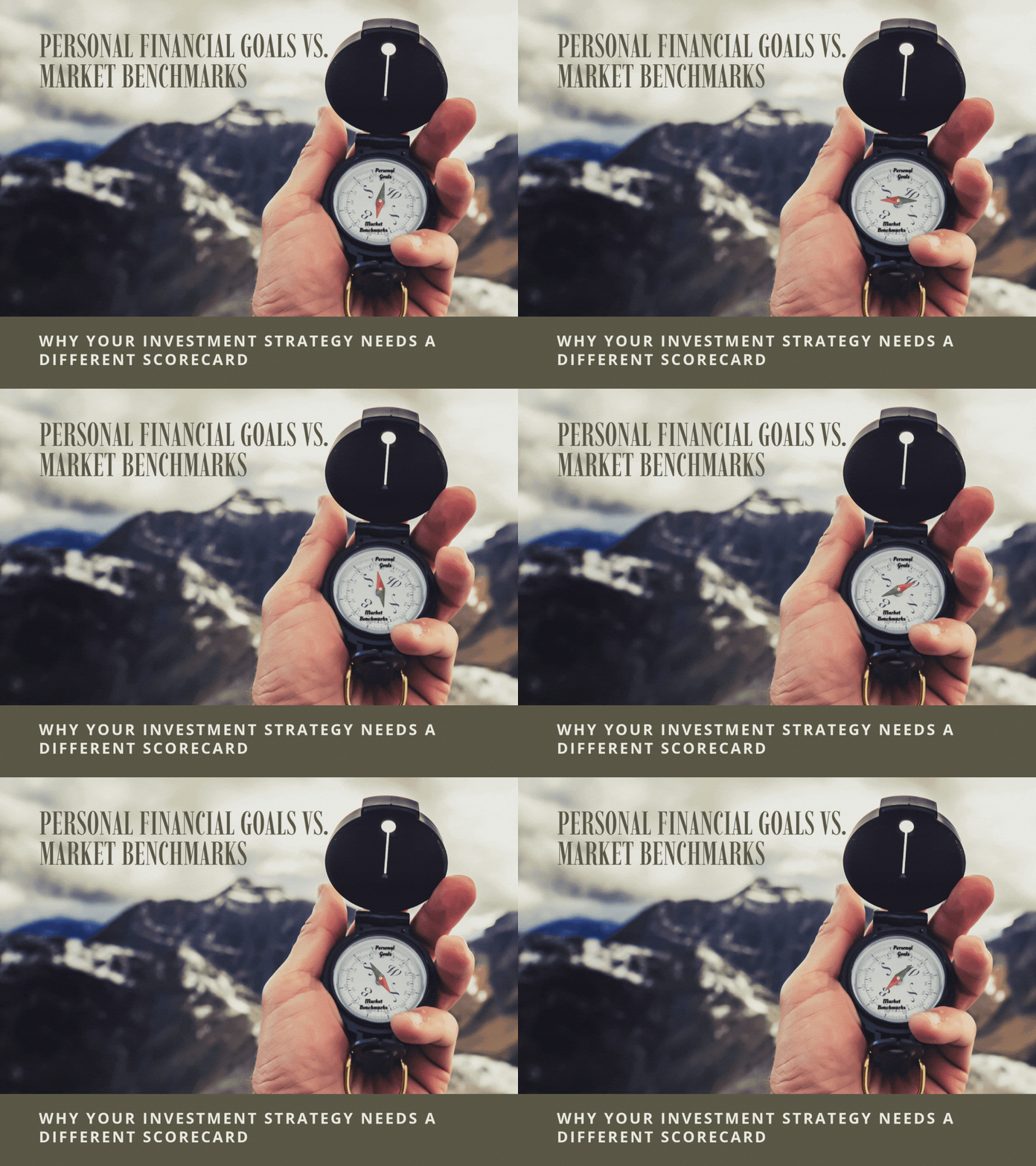
The only investment benchmark that truly matters is whether you’re on track to meet your financial goals
Canva Custom Creation: Lowrie Financial
By Steve Lowrie, CFA
Special to Financial Independence Hub
We all like to know how we’re doing. It’s human nature. Whether it’s checking your golf handicap, your step count, or your investment portfolio, we’re wired to compare.
When it comes to investing, though, comparing can quietly pull you off course.
A client once asked me, “How’s my portfolio doing compared to the market?” It’s a fair question. But the real question is: how do you define the market?
In my experience, that definition changes over time. When one area of the world is outperforming, that’s suddenly what everyone calls “the market.” Over the last decade or so, U.S. stocks have led the way, so many people now define the market as broad U.S. stock indices like the S&P 500, or even narrower ones such as the NASDAQ, which is largely a measure of technology stocks. But in the decade before that, Canadian stocks did significantly better than U.S. stocks, so back then “the market” meant the TSX Index.
So, the idea of “the market” shifts with whatever happens to be doing best lately. That’s a moving target, and it makes for a poor benchmark.
Here’s the truth: unless your goals, timeline, and tolerance for risk are the same as that shifting version of “the market,” the comparison doesn’t tell you very much. In fact, it can distract you from what truly matters.
The Problem with Traditional Investment Benchmarks
Every night, the financial news tells us how some financial market did that day. The TSX was up. The S&P 500 hit a record. Bonds bounced back.
It’s easy to wonder, “Am I keeping up?”
But those numbers have nothing to do with your life. They’re designed to measure markets, not people. They don’t know when you want to retire, how much income you will need, or how much you can save. The list goes on.
When you start judging your progress against those numbers, you’re borrowing someone else’s scoreboard. It might look objective, but it’s not built for your personal situation.
That’s what we call tracking-error regret: the uneasy feeling that your portfolio is “falling behind” when it isn’t mirroring a benchmark or your friend or neighbour’s latest success story. That feeling often leads investors to make changes that feel smart in the moment but work against their long-term goals.
Setting Personal Investment Benchmarks that actually matter
There’s nothing wrong with measuring performance. The key is to measure what matters.
Ask yourself questions like:
Am I on track to retire when I plan to?
Can I fund the life experiences that matter most to me?
Do I have the financial flexibility to enjoy life without worrying about every headline?
If the answer is yes, you’re succeeding. That’s your true benchmark.
Remember, you can beat an index, or outperform a family member, friend, or colleague, but that doesn’t necessarily mean you’ll meet your financial goals.
It’s not about beating an index. It’s about building the life you want and staying on the path that gets you there.
A Road Trip worth taking: Planning your Financial Journey
Imagine you’ve always dreamed of doing a ski road trip through Western Canada. You plan a route from Calgary to Vancouver, hitting some of the best slopes along the way: Banff, Revelstoke, Big White, Whistler.
It’s not the fastest or cheapest way to get from point A to point B. You could fly to Vancouver in a couple of hours for a fraction of the cost.
But that’s not the point, is it?
The goal of your trip isn’t efficiency. It’s the experience itself: the mountain views, the fresh snow, the time with friends.
That’s exactly how a good investment plan works. It’s designed around your goals, not someone else’s shortcut (which, over time, may end up as a long cut). Your journey might look different from someone else’s, but if it takes you where you want to go, it’s the right route.
The Dangers of Portfolio Comparison and Tracking-Error Regret
When you compare your portfolio to an index or to what someone else is doing, you are like the skier who keeps checking flight prices mid-trip. You will always find a cheaper, faster, or flashier option. But constantly changing direction will make it impossible to finish the journey you started.
Comparison is powerful. It plays on our emotions, especially when markets are volatile or when others seem to be “winning.” But most of the time, those comparisons leave us feeling anxious rather than informed.
Any five- or six-year-old can look at two numbers and tell you which one is bigger. In fact, they will tell you that in a second. That is the easy part. The harder part, the adult part in an investing context, is not only spotting the bigger number, but understanding why one number is bigger than another. Continue Reading…


 Posted By