Most of your investing life you and your adviser (if you have one) are focused on wealth accumulation. But, we tend to forget, eventually the whole idea of this long process of delayed gratification is to actually spend this money! That’s decumulation as opposed to wealth accumulation. This stage may also involve downsizing from larger homes to smaller ones or condos, moving to the country or otherwise simplifying your life and jettisoning possessions that may tie you down.
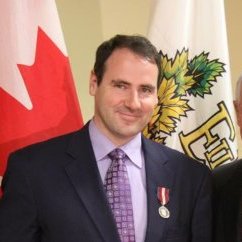
As mentioned in the MoneySense version of the blog, one of the readers highlighted — Oakville-based David Davidson — also sent along a photograph of himself, which we’re running here (on the left).
What this all comes down to, and as I commented on Twitter after the original MoneySense blog was posted, is that “Retirement planning would be so much easier if we just knew the exact date of our death!”
Of course, few of us know that so there’s always going to be a tradeoff between planning for a long life that never materializes; and under-saving and living in the present, only to find yourself running out of money before you run out of life. Personally, I’d rather err on the side of the first possibility but as you can see below, some readers (including David shown above), make the case for the second possibility, or a balance between either extreme. Some on Twitter are in the same camp, including Ryan (@simplemoolah):
“LOL. Since we don’t — Don’t blow it all today. Live in the present & enjoy every moment but also plan for your future.”
Recently I have been doing retirement assessments for several new customers. What amazed me as I spoke with them was how resigned to defeat the clients were. It was like they knew in their guts that they had started saving too little and too late to attain the retirement they wanted.
One answered my question on when do you want to retire by saying “around 120 is the only way I could.”
After the initial meetings I reflected on other circumstances from planning for customers in 2014 and noticed some commonalties.
Age range: 45-55
They own homes with attractive Fair Market Values
Had fairly decent equity positions in homes
Most would carry a mortgage into retirement
All had projected incomes at retirement far less than their desired outcome
Many Canadians, including these clients, have grown up with the belief that home ownership is an important goal. The home represents a significant part of their net worth.
Ah, life was so simple when all we had were Defined Benefit pension plans! I sometimes envy my late father, who only had to invest in GICs (Guaranteed Investment Certificates) to supplement his inflation-indexed Ontario Teachers pension. Just like a salary, that guaranteed pension flowed in like clockwork, including a healthy survivor’s benefit after my father predeceased my mother.
Unfortunately, such pensions do not pass to the next generation and it’s becoming harder to find employers that offer new employees DB plans: even if you’re fortunate enough to be in one, you may be subjected to pressures to switch to a Defined Contribution Plan, putting stock-market risk squarely on the pensioner’s shoulders instead of the employer’s.
Decumulation Issues similar with RRSPs and RRIFs
Since RRSPs behave quite similarly to DC pensions, the issues are almost the same, both on the wealth accumulation side as well as what we call the Decumulation side. (Here at the Hub, we have sections devoted to blogs on either topic).
Unlike DB plans, members of DC plans need some employer-supplied education so as to optimize both the wealth accumulation as well as the ultimate decumulation that is the ultimate raison d’être of any pension. Por says an OECD study found most employer communications programs about DC pensions were rather ineffective in improving the behaviour of the plan members when it came to investing decisions. The average score of such programs was only 10 out of a maximum 100. (a range of 50-60 is considered effective).
Anyone near retirement and without significant income from old-fashioned DB plans well knows the stress of seeing RRSP or RRIF values fluctuate with financial markets. As Por notes, one reason for the disappointing DC scores is this:
Plan members are expected to make complex decisions about an uncertain future … Members are expected to make the same or even more difficult decisions as chief investment officers (CIOs) of large pension funds.
His fifth point is also instructive:
Educators fail to recognize the inherent challenge of overcoming limitations imposed by human nature, such as people’s hard-wired biases and heuristics.
Most DC plans do a good job educating members in the Accumulation years. Por says default options can guide more than 80% of members to a well-diversified efficient portfolio at low costs. But it all breaks down just when the money is needed at retirement:
Unfortunately, much of this support disappears at the decumulation decision— the very point where complexity explodes. Yet 60 cents of every retirement dollar are paid by returns earned after retirement as the direct result of decumulation decisions.
Por delves into behavioural economics, noting that one reason retirees shy away from annuities is that they “discount” the value of the tradeoff involved in converting capital to long-term secure income stream that should last 20 or 30 years.
While Por’s focus is DC plans, remember that the decumulation issues are also quite relevant for those planning for the transition from RRSPs to Registered Retirement Income Funds (RRIFs). But with 9 million Canadians set to retire in the next 15 or 20 years, he’s optimistic that employers and financial institutions will rise to the Decumulation challenge:
Canadian society will produce 1,500 retirees every working day for the next 20 years, and financial institutions have an overriding interest in serving them. As these institutions vie for asset decumulation, competition will result in better financial products and more effective education efforts.
“Alzheimer’s disease – the degenerative brain condition that is not content to simply kill its victims, it must first snuff out their essence.” – Time Magazine, October 31, 2010
By age 85, an individual has a 50% chance of developing Alzheimer’s disease. It’s a matter of a flipping a coin. Chances are if you don’t have Alzheimer’s, you will be caring for someone who does.
The Grim Statistics about Dementia
• The incidence of Alzheimer’s disease is reaching epidemic proportions. Today, 500,000 Canadians have the disease or a related dementia.
• Alzheimer’s disease is considered the second most feared disease of aging.
• While 1: 11 people 65 years of age and older suffer from Alzheimer’s disease, 71,000 Canadians < 65 have the disease.
• It is estimated that one person is diagnosed every five minutes and it is projected that by 2035, 1.1 million Canadians will be living with Alzheimer’ or a related dementia. Continue Reading…
One of the features of the Decumulation years is making limited funds stretch. Below, early retiree and Montreal resident Michael Trani shows his analysis for his decision to lease rather than buy late-model cars for 20- and 30-year periods following his early retirement at age 55. He uses income from an investment to fund the lease, a strategy that lets him drive a new car every four years. He says he’ll never buy outright again.
By Michael Trani,
Special to the Financial Independence Hub
A few months ago, for family-related reasons, I was forced to retire from my job at the relatively young age of 55. Yes, lucky me, I was now living the Freedom 55 dream! I was well aware that in this new phase of my life, my future earning capabilities would be severely restricted. Wishing to provide stability to my financial affairs, I embarked on a mission to essentially fix all the present and future costs I could control.
My first order of business was to develop a low-cost strategy to provide me with a car for the next 20 to 30 years. While employed, I had saved quite a bit of money to purchase and carry out the required maintenance on a new car. However, now that I did not have the safety net of a job, I knew that once this money was spent, it would be gone for good. I certainly would not be able to replace it. I had been buying cars at 10-year intervals, and for my potential future car in 2024, things did not look good.
The solution to my predicament was simple. Why not simply invest the money I had saved in an investment that returned regular, monthly, tax-advantaged income, then use this income to finance a car lease in perpetuity?
With the aid of a spreadsheet, I compared the cost of purchasing a new car for “cash” every ten years with a car lease financed strictly with the monthly distributions of my investment. My comparison looked exclusively at the 20- and 30-year timeframes, as these represent my future driving years. I also factored in the necessary tax treatment for the monthly distributions and the residual value of the investment.
The investment I used to finance my car lease strategy is: Investors Group Allegro Balanced Growth Canada Focus Class –T J DSC. This is a special balanced mutual fund that distributes 7% yearly on a monthly basis. The distributions are treated as a Return of Capital, and when all the capital has been returned (in approximately 15 years) the distributions become capital gains. I am sure that other well-established financial institutions will have similar products available.
In the following table I have summarized the findings of my comparison.
Comparison of car strategies for 20 and 30 years
Car: 2014 Nissan Versa Note
Duration of lease: 48 months
Car strategy
20-yr strategy; cost per month
20-yr strategy; total cost 20 years
30-yr strategy; cost per month
30-yr strategy; total cost 30 years
purchase “cash”
$300.60
$72,144.00
$300.60
$108,216.00
lease strategy
$119.08
$28,579.76
$119.53
$43,030.76
savings of lease over “cash”
$181.52
$43,564.24
$181.07
$65,185.24
Note 1: The lease includes the dealer-offered free scheduled maintenance for the duration of the lease (in this case 48 months) and a $600 winter tire credit ( ufficient to purchase 4 brand-new Michelin X-ICE tires)
Note 2: With the purchase “cash” strategy there is no free scheduled maintenance and no $600 winter tire credit
I was totally blown away by these results. Certainly, I had made assumptions in my calculations, but, nevertheless, it is clear that the leasing strategy considerably reduces the cost of financing new cars, in perpetuity I may add. The cost reduction is not trivial when I can lease a car with only a third of the money required to purchase that same car.
Leasing yields a new car every four years
Sure enough, I followed through on my plan. I implemented my investment strategy and recently leased a Versa Note. Now every four years I will have a new car. I realize that at the end of 20 or 30 years, I certainly will not own a car, but will instead own the units of the Allegro fund, which will continue to generate monthly income. I believe I succeeded in my mission to devise a low-cost strategy to finance my future car requirements. I will never buy a car outright again.
As a side note, while negotiating my car lease, I learned that car dealers are willing to give away quite a bit of goodies for free. I negotiated four years of free scheduled maintenance and four really good, brand-name, winter tires for free as well. What more could I ask for?
The following table I details all my calculations, to permit easy verification.
Fund: Investors Group Allegro Balanced Growth Canada Focus Class – T J DSC
Date: June-27-2014
Unit Value on this date: $10.8492
Monthly Distribution: $0.0616 per unit
To generate $332.50 monthly requires 5,397.7273 units or $58,561.02 to be invested in the Allegro fund (the initial cost)
20-year strategy
Purchase price of a 2014 Versa Note: $19,072.00 cash payment in full, assume value of trade-in cancels the sales tax
Average maintenance cost per year: $1,700.00
Total cost for 10 years: $36,072.00
Total cost of purchasing per month: $300.60
Total cost for 2 cars over 20 years: $72,144.00
Leasing a 2014 Versa Note for: $332.50 per month line 1
Maintenance expense: $0.00 per month, free scheduled maintenance line 2
Insurance for replacement value: $17.51 per month, $840.40 for 48 months line 3
Insurance for end of lease protection: $19.79 per month, $950 for 48 months line 4
For 20 years this will cost: $88,752.00
The actual cost of leasing: $67,513.02 A. the initial cost of the Allegro fund + ((lines 2+3+4) x 240 months)
The capital gains tax: $4,987.50 B. to be paid on the distributions from years 15 to 20
The net cost of leasing for 20 years: $72,500.52 C. defined simply as (A + B)
Residual value of the Allegro fund: $43,920.77 D. value of the Allegro fund after all return of capital has been used up and units theoretically sold
The “true cost” of leasing for 20 years is: $28,579.76 E. defined simply as (C – D)
The “true cost” of leasing per month is: $119.08 F. defined simply as (E / 240 months)
30-year strategy
Purchase price of a 2014 Versa Note: $19,072.00 cash payment in full, assume value of trade-in cancels the sales tax
Average maintenance cost per year: $1,700.00
Total cost for 10 years: $36,072.00
Total cost of purchasing per month: $300.60
Total cost for 3 cars over 30 years: $108,216.00
Leasing a 2014 Versa Note for: $332.50 per month line 1
Maintenance expense: $0.00 per month, free scheduled maintenance line 2
Insurance for replacement value: $17.51 per month, $840.40 for 48 months line 3
Insurance for end of lease protection: $19.79 per month, $950 for 48 months line 4
For 30 years this will cost: $133,128.00
The actual cost of leasing: $71,989.02 A. the initial cost of the Allegro fund + ((lines 2+3+4) x 360 months)
The capital gains tax: $14,962.50 B. to be paid on the distributions from years 15 to 30
The net cost of leasing for 30 years: $86,951.52 C. defined simply as (A + B)
Residual value of the Allegro fund: $43,920.77 D. value of the Allegro fund after all return of capital has been used up and units theoretically sold
The “true cost” of leasing for 30 years is: $43,030.76 E. defined simply as (C – D)
The “true cost” of leasing per month is: $119.53 F. defined simply as (E / 360 months)
Montreal-based Michael Trani can be reached at michael_trani@hotmail.com.