Most of your investing life you and your adviser (if you have one) are focused on wealth accumulation. But, we tend to forget, eventually the whole idea of this long process of delayed gratification is to actually spend this money! That’s decumulation as opposed to wealth accumulation. This stage may also involve downsizing from larger homes to smaller ones or condos, moving to the country or otherwise simplifying your life and jettisoning possessions that may tie you down.
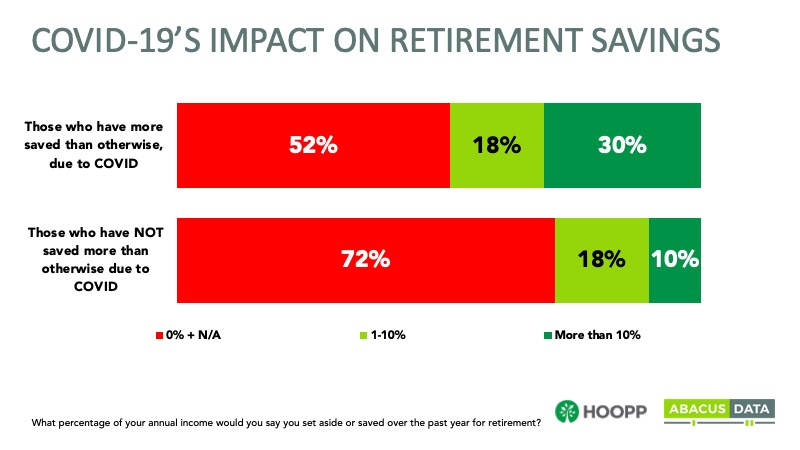
Over the course of the Covid pandemic the past year, almost two thirds of Canadians (63%) did not put aside anything for retirement, up from 58% last year, according to a study being released today.
That’s according to the third annual Canadian Retirement Survey from Healthcare of Ontario Pension Plan (HOOPP) and Abacus Data.
Not surprisingly, the survey also found a widespread belief that better access to workplace pensions is needed to avoid a retirement crisis.
The findings, based on an April 2021 survey of 2,500 Canadians, affirm there is a high level of anxiety about ability to save for retirement. Half (48%) said they are “very concerned” about not having enough money in retirement. That was more than the concern for one’s own physical health (44%), mental health (40%), debt load (31%) and job security (26%). Only the daily cost of living was a greater concern than Retirement.
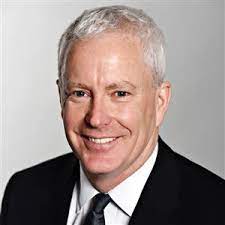
Steven McCormick, hoopp.com
“After more than a year of COVID-19, Canadians remain steadfast in their personal and societal concerns around retirement security,” said Steven McCormick, SVP, Plan Operations, HOOPP in a press release [pictured on right]. “As day-to-day financial pressures mount for some and ease for others, Canadians across the board are acutely aware of the importance, and challenge, of saving for retirement.”
While 46% of Canadians said they saved more money during COVID than they otherwise would have, more than half (52%) set aside nothing for retirement during the past year. Of those who said they saved less than usual, 72% saved nothing for retirement.
McCormick added: “HOOPP is proud to do its part by providing retirement security to healthcare workers, many of whom fall into groups that often don’t have access to pensions, such as women, part-time workers and younger Canadians. For our membership, the impacts of this pandemic will continue to be felt even after we emerge from the immediate crisis; but they can take some comfort in knowing their pension is secure.”
Covid disproportionately hurt finances of younger low-income groups
The COVID-19 pandemic harmed the finances of half of Canadians (52%) and did so disproportionately amongst younger and lower-income groups. Those aged 44 and younger are twice as likely to have had their finances greatly harmed (24%) than those 60+ (11%). Likewise, those earning less than $50,000 are twice as likely to have had their finances greatly harmed (25%) than those earning $100,000+ (12%). Continue Reading…
The topic is last Tuesday’s announcement by Purpose Investments of its new Longevity Pension Fund (LPF). In the column retired actuary Malcolm Hamilton describes LPF as “partly variable annuity, part tontine and part Mutual Fund.”
We described tontines in this MoneySense piece three years ago. Milevsky wasn’t available for comment but his colleague Alexandra Macqueen does offer her insights in the column.
The initial publicity splash as far as I know came early last week with this column from the Globe & Mail’s Rob Carrick, and fellow MoneySense columnist Dale Roberts in his Cutthecrapinvesting blog: Canadian retirees get a massive raise thanks to the Purpose Longevity Fund. Dale kindly granted permission for that to be republished soon after on the Hub. There Roberts described the LPF as a game changer, a moniker the Canadian personal finance blogger community last used to describe Vanguard’s Asset Allocation ETFs. Also at the G&M, Ian McGugan filed Money for life: The pros and cons of the Purpose Longevity Pension Fund, which may be restricted to Globe subscribers.
A mix of variable annuity, tontine, mutual fund and ETFs
So what exactly is this mysterious vehicle? While technically a mutual fund, the underlying investments are in a mix of Purpose ETFs, and the overall mix is not unlike some of the more aggressive Asset Allocation ETFs or indeed Vanguard’s subsequent VRIF: Vanguard Retirement Income Portfolio. The latter “targets” (but like Purpose, does not guarantee) a 4% annual return.
The asset mix is a fairly aggressive 47% stocks, 38% fixed income and 15% alternative investments that include gold and a real assets fund, according to the Purpose brochure. The geographic mix is 25% Canada, 60% United States, 9% international and 6% Emerging Markets.
There are two main classes of fund: an Accumulation Class for those under 65 who are still saving for retirement; and a Decumulation class for those 65 and older. There is a tax-free rollover from Accumulation to Decumulation class.
There are four Decumulation cohorts in three-year spans for those born 1945 to 1947, 1948 to 1950, 1951 to 1953 and 1954 to 1956. Depending on the class of fund (A or F), management fees are either 1.1% or 0.6%. [Advisors may receive trailer commissions.] There will also be a D series for self-directed investors.
Initial distribution rates for purchases made in 2021 range from 5.65% to 6.15% for the youngest cohort, rising to 6.4 to 6.5% for the second youngest, 6.4% to 6.9% for the second oldest, and 6.9% to 7.4% for the oldest cohort.
Note that in the MoneySense column, Malcolm Hamilton provides the following caution about how to interpret those seemingly tantalizing 6% (or so) returns: “The 6.15% target distribution should not be confused with a 6.15% rate of return … The targeted return is approximately 3.5% net of fees. Consequently approximately 50% of the distribution is expected to be return of capital. People should not imagine that they are earning 6.15%; a 3.5% net return is quite attractive in this environment. Of course, there is no guarantee that you will earn the 3.5%.”
Full details of the LPF can be found in the MoneySense column and at the Purpose website.
The Covid pandemic has led to unprecedented government spending with a deficit that has reached record heights.
Sooner or later someone has to pay for this and that usually means the taxpayer. Don’t look now but when you start your tax planning it’s probably best to assume that tax rates are going up in Canada.
However, even before Covid the federal government was talking about increasing the capital gains tax.
Capital gains inclusion rate could go back up to 75%
Currently, only 50% of capital gains are, in fact, taxable but this was not always the case. In fact, from 1990 to 1999 75% of capital gains were subject to tax! It’s logical to assume that tax revenues will be increased through a higher capital gains portion that is taxable, since capital gains are perceived as ‘passive’ income from investments. In theory, this means taxes should be generated by wealthier taxpayers.
Loss of Principal Residence exemption?
Also, the big fear of every Canadian is that government will remove the principal-residency exemption. Currently, taxpayers can sell their primary residence at a gain and not pay any taxes. Many taxpayers rely on the appreciation in value of their homes as their main source of retirement income. The impact of making gains on principal residency taxable would be devastating to many, if not most, Canadians.
Before discussing what to do about all this, let’s make sure we understand what capital gains are, how they are different from your other income, and when these gains become taxable.
So, what exactly is capital gain? In a nutshell it’s the growth in the value of an asset being held for investment purposes, so that asset is not for resale. A long-term holding period would indicate that the gain is capital. Currently, only half of the capital gain is taxable, while most other income is fully taxed.
In most cases the capital gain is subject to tax when the asset is sold, but there are also times when you may have to report capital gains without an actual sale occurring. For example, at the time of death there is the deemed or assumed sale of all assets, with any capital gains included in the tax return of the deceased. This would, of course, affect beneficiaries.
It’s important to note that increases in personal tax rates will also result in you paying more tax on capital gains. This is because the tax rate on capital gains is applied at the same tax rates in Canada as on employment and other income. In addition, reporting a higher overall total income would also result in more tax because a higher income puts you in the top tax bracket.
Defence # 1: Timing
So, now we see that many tax-reducing strategies primarily revolve around two things – 1) timing, and 2) reducing your taxable income. First, let’s look at timing.
If you have higher overall income from various sources in 2021, and expect lower taxable income for 2022, consider disposing of the asset(s) in 2022 wherever possible so the gain attracts a lower marginal tax rate for you.
You can also use time to advantage by deferring the cash outflow – the tax you pay to the government – and disposing the assets early in the year. Your tax bill is due April 30th of the following year, so if you sell the capital asset in January of 2022 you still have 15 months until tax must be paid on that.
Staggering gains over multiple years
Now, let’s assume you have a large capital gain. How can you stagger that gain over several years? One strategy is to defer cash receipts from the sale over multiple years. The Canadian Income Tax Act allows you to spread that gain over five years (and in some cases over ten years), provided you receive proceeds from the sale over a number of years. For example, if you receive 20% of the proceeds in 2021, you only need to include 20% of the gain in your taxable income as it can be spread over five years.
RRSPs and TFSAs
All these strategies are of a short-term nature. If the assets are disposed of in the long term, consider holding them inside your RRSP. You don’t have to declare those assets as income until you make a withdrawal. Likewise, you can use your TFSA so some of the gains are not subject to tax at all. Either way, your tax advisor can help determine if assets can be transferred to your RRSP or TFSA. Continue Reading…
It’s possible that the game has been changed for the better, for Canadian retirees. Purpose Investments has launched a retirement funding mutual fund that is designed to deliver an annual payout at 6.15% annual. That is, the fund would pay out a minimum of 6.15% of your initial total fund value. For every $100,000 that you have invested, you would receive an annual payment $6,150. Introducing the Purpose Longevity® Pension Fund.
The Purpose Longevity Pension Fund offers the pension model, now available to the typical investor. Advisors will also be able to use the fund and will collect a modest trailing commission. For many Canadian retirees it will certainly be a game changer.
Income for life.
One of the greatest fears for retirees is running out of money. And most retirees don’t want to manage their own investments. They want to enjoy life, without financial worry. The Purpose Longevity Pension Fund will allow Canadians to top up their Canada Pension Plan and Old Age Security payments. Retirees may have other private pensions and other assets within the mix. The fund will allow a retiree to pensionize a large percentage of their liquid assets. They approach would remove much of the stock and bond market (volatility) risk.
And more importantly perhaps, it would remove the risk of investors messing up their retirement portfolio (and retirement funding) by way of bad behaviour.
The Purpose fund sits between the Vanguard VRIF ETF retirement funding solution and the traditional annuities. The Vanguard ETF is designed to pay out at a 4% rate of the portfolio value, adjusted each year.
An annual 6.15% payment (at age 65) is a big step up the retirement funding ladder.
When a retiree manages their own investment portfolio they will often use the 4% rule as a benchmark for the level that the portfolio can safely deliver retirement income, including an annual inflation adjustment. On Boomer and Echo I had offered …
Life changes and priorities change when we switch to the retirement or decumulation stage. Retirees just want to get paid.
Purpose Investments Presentation
Canadian retirees are not necessarily well served by the financial institutions in the retirement stage.
Purpose Investments Presentation
The pension model for the masses.
How does a fund pay out at a 6.15% rate (and potentially to increase) while studies show that a balanced or conservative investment mix can only ‘safely’ pay out at a 4%-4.5% level? Once again it follows the model used by pension funds (public and private) around the world.
I asked Som Seif, CEO of Purpose Investments to deliver an explanation.
It is based on what they call Longevity Risk Pooling. The difference between the required return on the fund (net 3.5%) and the income paid to investors (6.15%+) is because when people buy, they get their income, but as some people redeem/pass away earlier, they leave behind in the pool their returns on their invested capital (ie they get their unpaid capital out upon death or redemption). These returns left behind reduce the total return required to provide the income stream for all investors.
Som Seif
It is the pooling of funds by the collective group of investors that will hold the fund, that delivers the secret sauce. There is retirement funding strength in numbers.
This is called Longevity Risk Pooling (or Sharing).
And as per the above quote, the underlying fund holdings only have to deliver at an annual 3.5% rate of return for the Purpose Longevity Pension Fund to deliver on the 6.15% funding level. Here’s ‘the how’ …
If you put in $500,000. After a number of years you receive distributions of $200,000, but then you pass away. Your estate would receive the unpaid capital of $300,000 ($500k-$200k). The return on the invested capital would stay in the pool for the benefit of all of the investors remaining. This return would reduce the overall required return for everyone.
Som Seif
The approach as been back tested.
Morneau Shepell conducted extreme stress testing on the model, which included the use of their economic scenario generator (ESG) that produced over 2,000 different simulations of future paths of economies and financial markets.
Probability of success (i.e. not having to decrease the income payout):
Over a 25 year period: 91%
Over a 35 year period: 86%
Purpose Investments can reduce income levels to ensure that the assets are never depleted and that income payments can continue to unitholders for their lifetime.
Net, net, the payments could move higher or lower. The risk will be managed, while any benefits offered by the markets will be passed along to investors.
The fund series.
There will also be a D-series available for self-directed investors.
The game changers combo offering.
On MoneySense and when we put together the Best ETFs in Canada, we often refer to the one ticket asset allocation ETFs as game changers. For use in the accumulation stage (wealth building) Canadian investors can hold comprehensive all-in-one portfolio ETFs with fees in the range of 0.20%.
And now enter the Purpose Longevity Pension Fund that might turn out to be the next piece in the game changing investment landscape.
Accumulation: one ticket
Decumulation: personal pension mutual fund
I’ll continue to do more research and I’ll add to this post. And I would invite reader questions. What do you want to know about this new offering?
I’ll get you the answers and I’ll add the responses to this post.
Thanks for reading. We’ll see you in the comment section.
Support your portfolio and Cut The Crap Investing.
While I do not accept monies for feature blog posts please click here on the mission and ‘how I might get paid’ disclosures. Affiliate partnerships help me pay the bills for this site. That will allow me to keep this site free of ads and easy to read.
You will also earn a break on fees by way of many of those partnership links.
I use and I’m a big fan of the no fee Tangerine Cash Back Credit Card. We make about $55 per month in cash back on everyday spending.
Make your cash work a lot harder at EQ Bank. RRSP and TFSA account savings rates are at 1.3%.
Kindly use the buttons below to share this post.
Dale
Dale Roberts is the Chief Disruptor at cutthecrapinvesting.com. A former ad guy and investment advisor, Dale now helps Canadians say goodbye to paying some of the highest investment fees in the world. This blog originally appeared on Dale’s site June 1, 2021 and is republished on the Hub with his permission.
Franklin Templeton Investments: Licensed from GettyImages
(Sponsor Content)
While many equity markets have performed well year to date, the last few months have not been as kind to fixed income investors. Last quarter, fixed income markets recorded some of the worst returns in 40 years as central banks and governments worldwide continued to rack up a mountain of debt in ongoing support of the global economy and consumers during the COVID-19 pandemic. But don’t despair; as Franklin Bissett fixed income portfolio manager Darcy Briggs points out in this Q&A, the market still offers value — if you know where to look.
Q: How would you describe the current environment for Canadian fixed income?
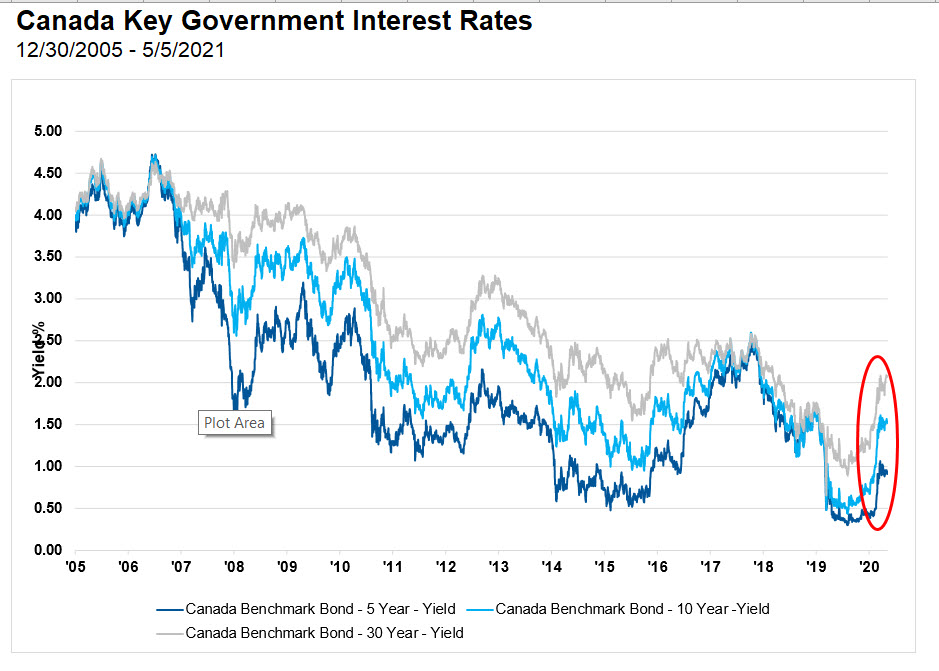
After seeing significant returns in Canadian fixed income last year, we expect more subdued performance in 2021. Given the year’s starting point of very low interest rates and tight credit spreads, we see corporate credit as offering the best risk-adjusted return opportunities in the current environment. As active, total return managers focused on generating income and capital gains, we know bond selection will remain important this year. Small interest rate moves can lead to significantly different outcomes for different fixed income sectors. Uncertainties remain high, and we are seeing a wide range of forecasts on how the balance of 2021 will unfold. Although interest rates have been up as much as 100 basis points so far this year, we think they may have overshot, as happens from time to time. We would not be surprised if they drifted lower later in the year. Realistically, we expect the path ahead to be a little messy.
Source: FactSet, Franklin Templeton
How so?
This recession/quasi-depression was prompted by a dramatic health crisis and the resulting government-mandated shutdown; it was not caused by normal business cycle dynamics. While fiscal and monetary policy have prevented a full-blown financial crisis, those tools have limited ability to solve the current recession. We believe it will end once the pandemic subsides and the economy fully opens, functioning in a more familiar pre-pandemic way. Vaccines are key to the pace of progress. Continue Reading…


 Posted By
  Over the course of the Covid pandemic the past year, almost two thirds of Canadians (63%) did not put aside anything for retirement, up from 58% last year, according to a study being released today.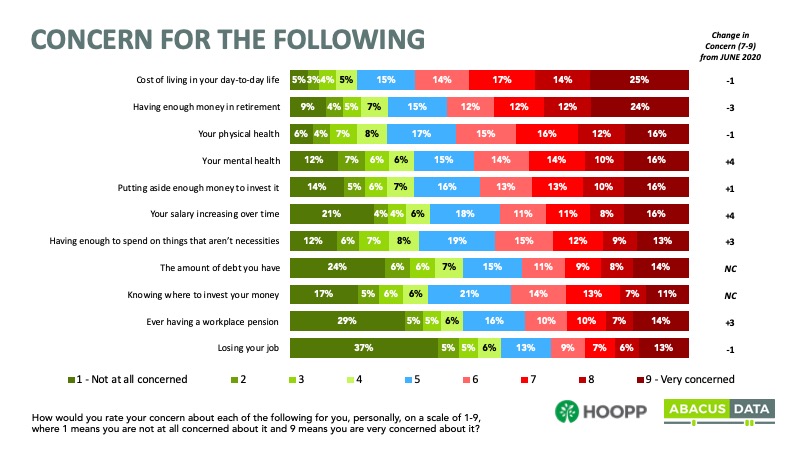
 Posted By