Family Formation & Housing

For young couples starting families, buying their first home and/or other real estate. Covers mortgages, credit cards, interest rates, children’s education savings plans, joint accounts for couples and the like.

Does downsizing to a secondary housing market really save money?


By Penelope Graham, Zoocasa.com

Special to the Financial Independence Hub

Despite the efforts of new rules and regulations, real estate prices continue their upward trajectory across the nation; according to the Canadian Real Estate Association, the HPI Index rose in nine of 13 markets in January by an average of 7.7 per cent, while the average home price increased 2.3 per cent, to $481,500.

However, CREA noted that excluding Canada’s largest housing markets – Toronto and Vancouver – would strip a whopping $107,500 out of the national sale price, with the remaining markets contributing to an average of $374,000.

While it has always been more expensive to live in a main city centre than in a rural market, excessively hot price growth over the last few years has increasingly prompted buyers to explore their options in secondary real estate markets, fuelling the migration to further-flung communities with comparatively affordable housing. And, as new stress-testing mortgage rules designed to squeeze affordability are now in place, this big-city exodus won’t slow any time soon.

Savings offered by secondary Real Estate markets

This trend is perhaps most evident in Ontario’s Greater Golden Horseshoe region, home to the City of Toronto and surrounding markets that stretch as far as Niagara, Peterborough and Windsor. Prices have ballooned in Toronto over the last two years and – while slightly softer following the implementation of the Fair Housing Plan last year – remain firmly out of reach for many prospective home buyers. For perspective, the average sale price in the Greater Toronto Area fell 4.1 per cent to $736,783 in January, yet a buyer earning the city’s median household income of $78,280 would qualify only for a maximum mortgage of about $545,692.

One of the most popular real estate destinations for these displaced buyers is the City of Hamilton, located to the west along the shores of Lake Ontario. At a roughly one-hour’s drive from Toronto’s downtown core, and boasting beautiful natural features in addition to a rapidly-gentrifying downtown, home seekers have been drawn to the Hammer in droves.

However, affordability is clearly their main motivation, as freehold Hamilton real estate can be had for a relative bargain compared to its Toronto counterparts, with the average home costing $549,546 in January. That’s a whopping $734,435 less than the average Toronto detached price of $1,283,981.

Is It worth moving to another city?

Such savings are tempting – but there are considerations all buyers should mull over before booking a long-haul moving truck. Continue Reading…

Federal budget 2018: Just what you’d expect from a Liberal government well into its mandate

The Liberals’ 2018 federal budget that descended on us on Tuesday afternoon is pretty much what you’d expect from the Justin Trudeau administration at this slightly-past-the-midway point of its mandate: lots of spending on things like gender pay equity, parental leave, native rights. Another stab at sin taxes, with a carton of 200 cigarettes going up by $1 and a proposal for excise duties on cannabis if and when marijuana becomes legal in July. A bit of business tax reform scaled down from the measures that so incensed small business last fall. As for balancing Ottawa’s books? Not so much.

The CBC’s web site provides this overview: Liberals spend billions to close gaps for working women, indigenous families. If you want to do straight to the source, click on the Finance Canada site here.

Here’s the Globe & Mail’s overview that went up soon after 4 pm:  Federal budget highlights: 12 things you need to know. In case you’ve met the paywall limit on free views, it reports that the budget is in line with previous estimates from Finance Canada, which means deficits for the “foreseeable future.”  Pay equity legislation is proposed for federal government employees and federal regulated sectors. And $447 million will be spent over 5 years to create a new indigenous Skills and Employment Training Program (replacing the Aboriginal Skills and Employment Training Strategy).  And another $1.4 billion or more over 6 years is proposed for First Nations child and family services.

A National Pharmacare program is being “consulted” on. More detail on passive income and private corporations: companies with more than $150,000 in passive income will no longer be eligible for the small business tax rate, while those with under $50,000 oil passive income will not be affected. In between is a formula. Also more than half a billion will go to Cybersecurity, and $3.8 billion over 5 years will go to “support science.”  And journalism has not been forgotten: the budget proposes $50 million over 5 years to support journalism in “underserved communities.”

At the National Post, this piece looks at 5 ways average Canadians could be impacted by the federal budget. MoneySense‘s Julie Cazzin totes up 15 ways Budget 2015 will impact your wallet. There’s something for everyone, Cazzin writes, but no real showstoppers. Julie also looks at 5 measures that directly impact Canadian families. Another MoneySense writer looks at the implications for small business owners.

Carrick sees 7 changes affecting personal finances

Here’s Rob Carrick’s piece on 7 changes that could affect your finances. Carrick writes in the Globe that Ottawa will be modernizing deposit insurance, replace the Canada Working Income Tax Benefit with the introduction of a Canada Workers Benefit, which raises benefits by up to  $170 a year in 2019 for single parents and couples, while raising the level at which the benefit is phase out from $32,339 to $36,483. The Sears bankruptcy appears to have stimulated consultation on pension security, while as of June 2018 an extra five weeks of parental benefits will be available when parents share parental leave. (Yes, Justin Trudeau’s government wishes to encourage more men to take pat leave!) There is also an expansion of the medical expense tax credit and a move to strengthen the oversight of bank sales practices by the federal Financial Consumer Agency of Canada.

Coyne: Budget has nothing to do with budgeting; Ivison: Liberals show their cunning

Back at the National Post, you can get useful video insights from columnists Andrew Coyne, John Ivison and William Watson here. Coyne’s column is titled Liberals deliver a federal budget that has nothing to do with budgeting, or the economy.  In it, he wryly observes that the Liberals are pandering “to every conceivable Liberal client group and policy cult: environmentalists, seasonal EI recipients, multiculturalism, official language groups, regional development, all the way to the media … And, of course, feminists.”

John Ivison’s column is headlined “In their third federal budget, Trudeau’s Liberals show their cunning.

Finally, for a sober look from the tax and accounting pros at KPMG, read this overview.

My take? How about addressing pension inequity between public and private sectors?, not just gender pay inequity?

Continue Reading…

In wealth transfer, communication is as important as inheritance

By Jim Greenwood, CFP

Special to the Financial Independence Hub

What’s the most difficult thing to talk about with your children? For many of us, discussing plans for our estate is pretty high on the list. Talking about your will and your own passing can be uncomfortable. According to a recent IPC Private Wealth survey of Canadians with at least $500,000 in investable assets, 58 per cent have not talked to their heirs about instructions for their estate, both financial and personal.

Having the inheritance discussion is very important, largely because of the consequences after your passing if you don’t have the talk. Perhaps one child wants to keep the vacation property while the other wants to sell, creating financial discord among siblings. Or there is a dispute about one’s final wishes upon death. The consequences are many and varied, and can be different for each family but equally devastating.

Holding the family meeting

As a financial planner myself, I can tell you that I am very happy to host or attend a family meeting, which should include the executor. It takes the pressure off you. Just let your children know that your advisor recommends having beneficiaries present during part of your estate planning process.

Or say you want to hold a meeting on your own. Beforehand, ask your advisor for coaching on approach and content. You’ll feel a lot more comfortable during the family meeting.

At my firm, we believe there are two main themes to a wealth transfer meeting. The first is about values. Share your views of money and wealth, ask your children what money means to them, and have a discussion. Tell your children what it took to create your wealth. Talk about the idea of a legacy – helping out your children and grandchildren with the hope that your children will do the same. Why discuss these ideas? You want to guide your children to a place where they feel appreciative, not entitled. Where they are trustworthy, not irresponsible.

The second theme is all about your will. Talk about how you’d like your legacy to be managed, and go through the distribution of assets, explaining the reasons for your decisions. This is where you discover if any of your bequests could unintentionally lead to conflicts between children, delays in estate administration, or your will being contested. If any problems arise, you’ll have the opportunity to resolve them — and you’ll be thankful you uncovered the issues now.

Wealth transfer for blended families

If you’re in a blended family, you have an additional layer of estate planning. Take the case of an individual in a second marriage who has children from the first marriage, and needs to provide for both the spouse and children. Continue Reading…

Buying a condo in the GTA on one income? Here’s where It’s possible

By Penelope Graham, Zoocasa

Special to the Financial Independence Hub

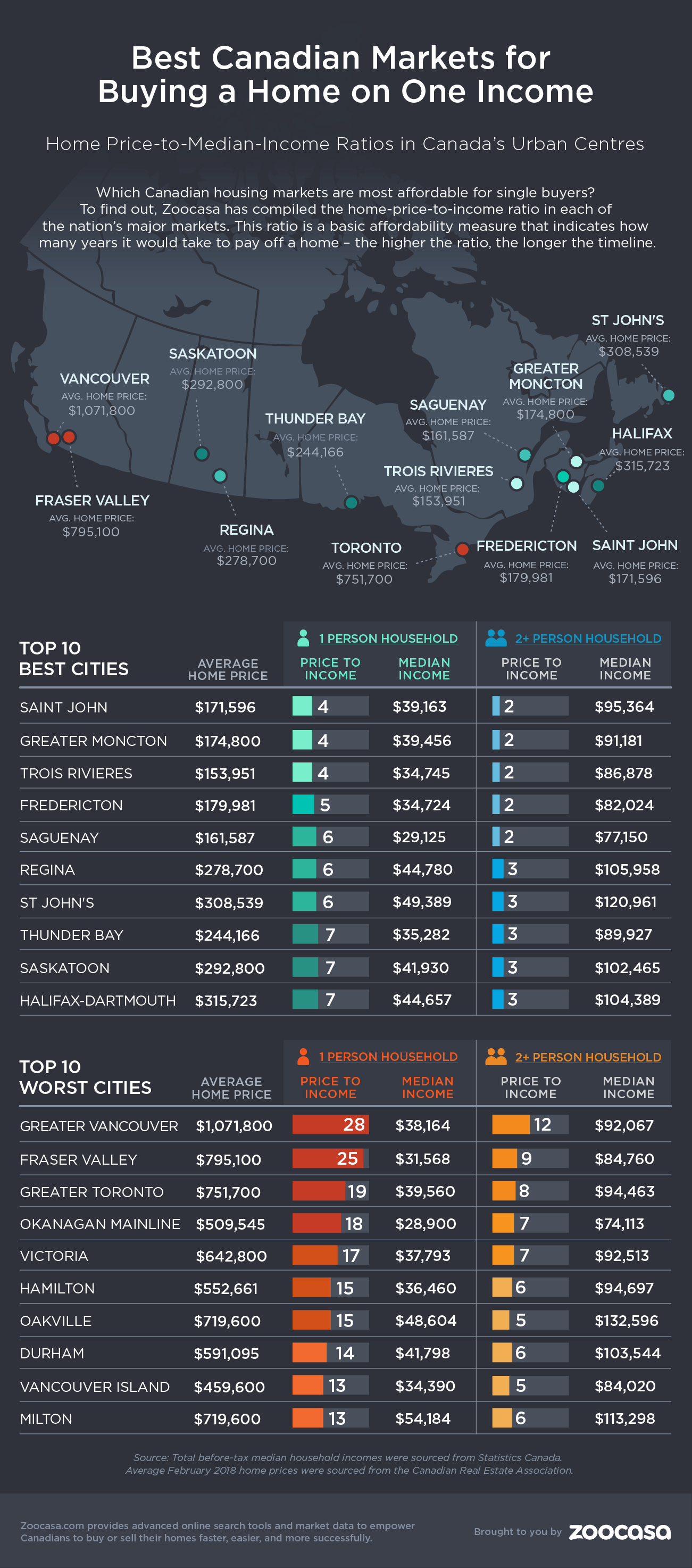
Looking to purchase a home in the Greater Toronto Area on your own? According to new data, the real estate reality for solo buyers is pretty heartbreaking, with most options out of financial reach for those earning the median single-household income in the region.

In fact, owning a condo within a GTA municipality will set a single homeowner back more than double the recommended shelter cost, even in the most affordable markets. With two incomes getting far more home for their buck than one, it’s no wonder buyers are increasingly partnering with family, friends, or even strangers to improve their real estate affordability.

Tough affordability throughout GTA

Check out this infographic to see how affordable condos are for both single and multi-income buyers throughout the GTA.

To find out the extent of housing affordability for single buyers, Zoocasa calculated what’s called the home-price-to-income ratio in 17 of the markets tracked by the Toronto Real Estate Board. Crunching the average January 2018 condo price and median income earned in each municipality determines how many years of total income (as in, one’s entire annual salary) it would take to pay off a condo in that region. The higher the ratio, the tougher the home will be to carry financially.

The ratio recommended by most financial experts for shelter costs is three, but that’s well below what’s possible in the GTA market, the numbers reveal. The data finds that the minimum ratio for a single condo buyer is seven, available in only two markets: Milton and Clarington.

That’s not to say dual-income households have it much easier; coupled-up buyers have only three regions that satisfy the recommended affordability ratio (Milton, Clarington, and Whitby), while another 10 regions hover just above the four-point mark.

City Centre most challenging for all buyers

The toughest place to purchase for all Toronto condo buyers is Toronto central, which sets single buyers back a whopping 16 times their income, and seven times for multi-income buyers. And, while affordability varies throughout the region, it’s steep across the GTA; Mississauga condos command 10 times a single buyers’ income, while Vaughn costs 11 times the median household income.

Penelope Graham is the Managing Editor of Zoocasa.com, a leading real estate resource that uses full brokerage service and online tools to empower Canadians to buy or sell their home faster, easier, and more successfully.


Why you might get more for your home in January

By Penelope Graham, Zoocasa

Special to the Financial Independence Hub

When it comes to nuggets of real estate wisdom, a persistent adage is that one should avoid selling in the winter at all costs:  after all, bad weather, limited sunlight and poor driving conditions don’t inspire shoppers to peruse open houses.

But while it’s a fact that the winter housing market is a slower one — there were 25 per cent fewer sales in the Toronto real estate market in January 2017 compared to the previous May —  having to list your home in the new year doesn’t necessarily mean compromising on your profits.

In fact, due to a few seasonal phenomena, listing your home for sale in January can translate to a higher sales price; here’s why.

Winter buyers are extra motivated

Just as January sellers are likely listing for a reason, early-winter buyers are also likely driven by a sense of urgency. In fact, a small but persistent bump in activity is typically seen in the weeks following New Year’s Day, as buyers who shelved their holiday home purchases jump back into the market.

January also tends to be a busy season for mortgage pre-approvals, especially for organized buyers seeking every advantage in preparation of the spring market. However, once these buyers have confirmed their maximum buying power, they may be tempted to take a preliminary look at what’s available now, including your listing.

“The fact is, if you’ve waited until spring to get a mortgage pre-approval, you’re already late, and there are a few real estate market factors that will work in your favour if you act now,” says Mike Bricknell, a mortgage broker at CanWise Financial.

“It is very beneficial to get your mortgage pre-approval when the housing market is quieter, especially as there have been many recent industry changes that may have affected what you can afford.”

Low supply means higher prices

Continue Reading…