It stands to reason: To make money in the market, you need to sell your holdings for more than you paid. Of course, we’re all familiar with good old buy low, sell high. But despite its simplicity, many investors fall short. Instead, they end up doing just the opposite, or at least leaving returns on the table that could have been theirs to keep.
You can defend against these human foibles by understanding how stock pricing works and using that knowledge to your advantage.
Good News, Bad News, and Market Views
How do you know when a stock or stock fund is priced for buying or selling?
The short answer is, we don’t.
And yet, many investors still let current events dominate their decisions. They sell when they fear bad news means prices are going to fall. Or they buy when good news breaks. They invest in funds that do the same.
While this may seem logical, there’s a problem with it: You’re betting you or your fund manager can place winning trades before markets have already priced in the news.
To be blunt, that’s a losing bet.
You’re betting that you know more about what the price should be at any given point than what the formidable force of the market has already decided. Every so often, you might be right. But the preponderance of the evidence suggests any “wins” are more a matter of luck than skill.
Me and You Against the World
Whenever you try to buy low or sell high, who is the force on the other side of the trading table?
It’s the market.
The market includes millions of individuals, institutions, banks, and brokerages trading hundreds of billions of dollars every moment of every day. It includes highly paid analysts continuously watching every move the markets make. It includes AI-driven engines seeking to get their trades in nanoseconds ahead of everyone else.
And you think you can beat that?
We believe it’s far more reasonable to assume, by the time you’ve heard the news, the collective market has too, and has already priced it in. Continue Reading…
Money management is arguably one of the most stressful things that most of us deal with on a regular basis. It never fails; just as soon as you feel like you’re doing well financially, something comes up — unexpected home repairs, vehicle maintenance, emergency medical bills, holiday gift purchases. Financial worries can sit in the back of your mind and weigh on you day in and day out.
For many, financial stresses are a concern, but not a debilitating one. However, some people develop financial anxiety — a condition where worry, fear, and unease about finances causes those suffering from it to behave differently. Behavior changes can show up in different ways such as extreme frugalness, avoiding finances, excessive overspending, or even physical changes such as high blood pressure.
Fortunately, if you are someone who suffers from financial anxiety, there are steps you can take to help address it and get your life back. The first one is finding some help, the next is gaining control. As you work through the process of dealing with your financial anxiety, you will inevitably learn a lot about yourself and how to manage your money the way you want to.
Finding Help
The root cause of financial anxiety can come from a number of different places. Maybe you have an extreme fear of being in debt because you grew up watching your parents struggle to make ends meet without sinking deeper and deeper into financial ruin. Or perhaps you were never really taught about personal finance management and now everything finance seems daunting. Or maybe you’ve just given up all hope of financial stability and choose not to address the financial concerns you know you should.
Either way, there is help out there and you are not alone. Talking with professionals about financial issues is a great place to start. Numerous different types of therapists can help you identify the root of your financial anxiety and work through the issues surrounding that cause. Likewise, financial advisors can be a great resource for helping you to understand your finances and get them back on track.
Of course, it might give you anxiety just to think about paying for a therapist to help you through your financial stresses.
Don’t worry! There are still options for you. The first might be to start by talking to a trusted friend that you believe manages their money well. Another option is to dive into the multitudes of cheap or free resources that are available online. These include affordable financial help guides or podcasts that dive into all sorts of topics, from how to build a budget you can stick to all the way to how to best invest your money.
Making a Plan
If getting help is the first step, developing a realistic plan is the second step. You might be thinking great, another budget that is bound to fail, but this isn’t necessarily the case. A workable plan can come in a variety of different forms. The right plan for you to address your financial anxiety might be different than what another person needs to feel financially stable.
For example, maybe the right plan for you involves building greater financial literacy by learning some of the terminology and tools available. Perhaps your plan is to read one financial news article a day. Or maybe your plan is to build up a rainy day fund that will ease your concerns about going into debt. Or to focus more on building more meaningful relationships and focus less on having the fanciest home goods.
All of this isn’t to say that a budget isn’t sometimes a great tool. In fact, budgets can be one of the most powerful tools for getting yourself out of debt or achieving a financial goal. The crux is creating a realistic budget that you can actually live with. Cutting out all of your excess expenditures might help you save money, but sooner or later you’ll crack. Smaller changes that you can really stick to are much more valuable over the long run.
Taking Control
The final step is to enact the plan and adjust as needed to make sure you’re doing something that is really making a positive difference. Take time once a month to evaluate where you’re at with your financial anxiety. Are you making progress? Are you achieving your financial and financial mental health goals? Continue Reading…
Recently, I was helping a young person with his first ever RRSP contribution, and this made me think it’s a good time to explain a confusing part of the RRSP rules: contributions in January and February. Reader Chris Reed understands this topic well, and he suggested that an explanation would be useful for the upcoming RRSP season.
Contributions and deductions are separate steps
We tend to think of RRSP contributions and deductions as parts of the same set of steps, but they don’t have to be. For example, if you have RRSP room, you can make a contribution now and take the corresponding tax deduction off your income in some future year.
An important note from Brin in the comment section below: “you have to *report* the contribution when filing your taxes even if you’ve decided not to use the deduction until later. It’s not like charitable donations, where if you’re saving a donation credit for next year you don’t say anything about it this year.”
Most of the time, people take the deductions off their incomes in the same year they made their contributions, but they don’t have to. Waiting to take the deduction can make sense in certain circumstances. For example, suppose you get a $20,000 inheritance in a year when your income is low. You might choose to make an RRSP contribution now, and take the tax deduction in a future year when your marginal tax rate is higher, so that you’ll get a bigger tax refund.
RRSP contribution room is based on the calendar year
Each year you are granted new RRSP contribution room based on your previous year’s tax filing. This amount is equal to 18% of your prior year’s wages (up to a maximum and subject to reductions if you made pension contributions). You can contribute this amount to your RRSP anytime starting January 1. Continue Reading…
Are you a patient investor? Or are you looking at your portfolio multiple times a day, having the itch to sell everything? Despite having done DIY investing for over a decade and making my shares of investment mistakes in the past, I am still learning about investing on a daily basis.
One key lesson I’ve learned is short-termism will hurt your investment. As investors, we need to have patience and a long term view.
What is short-termism?
Per Wikipedia, short-termism is giving priority to immediate profit, quickly executed projects and short-term results, over long term results and far-seeing action.
On the surface, it seems that short-termism is associated with investment strategies like day trading, momentum trading, short selling, and options trading. However, I believe many investors that invest in individual dividend stocks and passive index ETFs often fall into the short-termism trap as well.
How so?
On one hand, it’s about short-term profit taking. On the other hand, it’s about paying too much attention to the short-term share price movement and feeling the need to tweak your investment portfolio. Some common portfolio management questions I’ve seen on Facebook and Twitter are:
“Should I take profits when the stock goes up and re-invest the money later? Give me a reason why I shouldn’t sell and should just hold?”
“I purchased Royal Bank at $110. It’s frustrating seeing the share price going up to $150 and then dropping back down to $125. Should I sell when the stock is at a 52-week high and buy back when the stock price dips?”
“I have a small paper loss on Brookfield Asset Management, I don’t think the company is doing well, should I sell and invest the money elsewhere?”
“I bought some Apple shares recently. Apple had a terrible quarter and I’m down. I’m convinced that Apple is going to crash and burn. Should I sell and run now?”
And the questions go on and on…
Why do we fall into the short-termism trap?
There are many reasons why we fall into the short-termism trap. Some of the common reasons I believe are:
The need to be correct – we as investors want to see our investments increase in value once we make the purchase. When this happens, it means we’re right and made the correct investment decision. If the share price goes down, that must mean we are wrong and are terrible at investing. The need to be correct becomes a burning desire. Nobody wants to be told that they are wrong and be the laughingstock.
The need to be validated – we all have the need to be validated by others but for some reason, this need is even stronger when it comes to investing. We want others to validate that we made the right investment decision so we can feel good inside. The desire to be validated can be like drugs, once someone validates you, you begin to want even more. The need to be validated is a very slippery slope…
Looking for gains right away – It’s exciting to see investment gains. It is even more exuberating to see significant gains in a few days. It’s like going to the casino and winning 1000 times on your bet or winning the lottery. Why wait for five years to see multi-bagger gains when you can get the same type of gains in a week? Long-term investing is for losers!
Ego – for some reason we all believe we are better investors than who we truly are. Believe me, I fall into this trap from time to time. Deep inside, we believe that we can predict how companies will do in the future accurately by looking at past performance and public information.
How to escape the short-termism trap?
So how do we escape the short-termism trap? I think the best method is to understand your short-term, medium-term, and long-term goals. Are you investing for the short-term or are you investing for the long-term? Knowing this will dictate what kind of investments you should buy. Continue Reading…
It goes without saying that 2022 was a less than stellar year for equity investors. The MSCI All Country World Index of stocks fell 18.4%. There was virtually nowhere to hide, with equities in nearly every country and region suffering significant losses. Canadian stocks were somewhat of a standout, with the TSX Composite Index falling only 5.8% for the year.
Looking below the surface, there was an interesting development underlying these broader market movements, with value stocks far outpacing their growth counterparts. Globally, value stocks suffered a loss of 7.5% as compared to a decline of 28.6% in growth stocks. This substantial outperformance was pervasive across countries and regions, including the U.S., Europe, Asia, and emerging markets. In the U.S., 2022’s outperformance of value stocks was the highest since the collapse of the tech bubble in 2000.
These historically outsized numbers have left investors wondering whether value’s outperformance has any legs left and/or whether they should now be tilting their portfolios in favor of a relative rebound in growth stocks. As the following missive demonstrates, value stocks are far more likely than not to continue outperforming.
Context is everything: Value is the “Dog” that finally has its Day
From a contextual perspective, 2022 followed an unprecedented period of value stock underperformance.
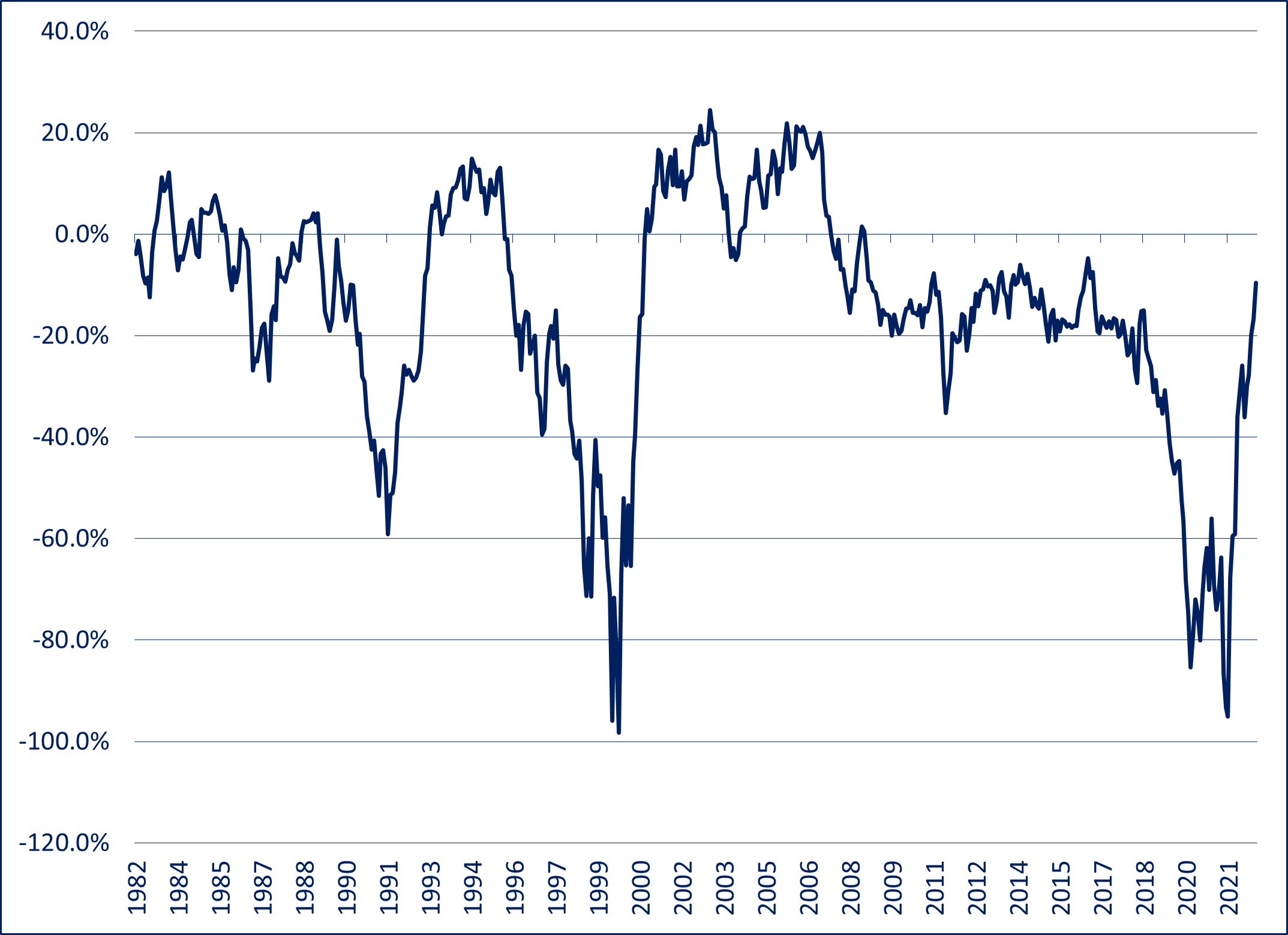
U.S Value vs. U.S. Growth Stocks – Rolling 3 Year Returns: 1982-2022
Although there have been (and will be) times when value stocks underperform their growth counterparts, the sheer scale of value’s underperformance in the several years preceding 2022 is almost without precedent in modern history. The extent of value vs. growth underperformance is matched only by that which occurred during growth stocks’ heyday in the internet bubble of the late 1990s.
Shades of Tech Bubble Insanity
The relative performance of growth vs. value stocks cannot be deemed either rational or irrational without analyzing their relative valuations. To the extent that the phenomenal winning streak of growth vs. value stocks in the runup to 2022 can be justified by commensurately superior earnings growth, it can be construed as rational. On the other hand, if the “rubber” of growth’s outperformance never met the “road” of superior profits, then at the very least you need to consider the possibility that crazy (i.e. greed, hope, etc.) had indeed entered the building.
The extreme valuations reached by many growth companies during the height of the pandemic bring to mind a warning that was issued by a market commentator during the tech bubble of the late 1990s, who stated that the prices of many stocks were “not only discounting the future, but also the hereafter.”
U.S. Value Stocks: Valuation Discount to U.S. Growth Stocks: (1995-2022)
Based on forward PE ratios, at the end of 2021 U.S. value stocks stood at a 56.3% discount to U.S. growth stocks. From a historical perspective, this discount is over double the average discount of 27.9% since 1995 and is matched only by the 56.6% discount near the height of the tech bubble in early 2000. This valuation anomaly was not just a U.S. phenomenon, with global value stocks hitting a 57.5% discount to global growth stocks, more than twice their average discount of 27.6% since 2002 and even larger than that which prevailed in early 2000 at the peak of the tech mania. Continue Reading…


 Posted By