General

3 ways to organize your new business

By Sia Hasan

Special to the Financial Independence Hub

If you have a new business, then it is crucial that you organize it in the right way. Otherwise, you could end up missing out on more productivity.

So ensure that you get the most done possible during the day and increase profits while reducing problems with workflow. Set up your business for massive success by organizing your business better in the following three ways:

SOP (Standard Operating Procedure)

The first thing you need to do when organizing your new business is determine what kind of roles everyone has. There should be specific and unique classifications as to who is responsible for what.

The best way to do this is with SOPs. These are documents that show everyone what is expected of each role. You can have certain protocols as to how to handle consumer service, sales, and more.

The idea of the SOP is that anyone can plug right into your business and know how to perform that role without much hassle. It’s a step by step list of instructions so there is no confusion regarding what needs to be accomplished to deem that particular part of the business a success. Of course, this kind of thing won’t happen overnight!

It is best to sit down and make time to create your own SOPs. You might even read a few books or resources on the subject. This way, you have some guidance. There are a lot of different ways to do it, but you need to choose one that works for you.

For instance, some people find that they prefer to record a video and upload the files online. Then, it acts as a training resource. Others like to write down the procedures and share them in the cloud. Do whatever seems right for your new business.

The right software

We live in a world where software is more important than ever. It is vital that you use the right software tools or you could risk falling behind. Oftentimes, the right software will allow you to get more done, save time, save money, and stay on the cutting edge so you can generate new ideas for even more innovation. Consider the various types of software out there.

For instance, accounting software for nonprofits helps you keep an eye on your transactions. This is crucial for a company. If you lose sight of what you need to be doing for your income or expenses, then it could come back to bite you later. This is true regardless of what kind of business you run.

Another type of software is a great CRM. Being able to communicate with your team and upload information about customers is invaluable. It shaves time off the communication cycle and gives everyone what they need in the cloud.

Sales and Marketing Automation

Long gone are the days where marketers had to sit down and write out a new email, post, or ad by hand. Today, you can use automation software to make these assets in a scalable way. After all, your team can’t be there every second of the day.

You want your team focused on the higher-level aspects, so let them do that. Enable them with marketing software that automates your funnels. It can test your ads right away. Continue Reading…

Is every day a Saturday in Retirement?

Is every day a Saturday in retirement? That’s what behavioural scientists Dan Ariely and Aline Holzwarth claimed in a recent study about retirement income. The premise being that when you’re no longer working 40 hours a week (or more) all of a sudden you have 40 hours a week available to spend money. Every day is like Saturday. Not to mention, many of the things your employer used to pay for, such as coffee, a smart-phone, or gym membership, now falls on you.

The study’s conclusion? Retirees should expect to spend as much as 130 per cent of their preretirement income after they retire. Yikes!

That flies in the face of typical retirement planning advice, which pegs the income replacement rate at around 70 per cent of your preretirement income. A lot of expenses should disappear when you reach retirement age. Hopefully your kids have left home, and your mortgage is paid off. You’ll no longer have payroll deductions for income taxes, CPP, and EI. Say goodbye to the long, soul-crushing commute, along with the expensive business attire.

Because of these reasons (and others) some retirement experts, like Fred Vettese, even champion a much lower retirement income target of 50 per cent of your income.

On the flip side, in this article about money myths, financial advisor Kurt Rosentreter seems to concur with the Ariely / Holzwarth study:

All the old retirement planning textbooks said you could expect to live off less than your working income (e.g. 70 per cent). The reality of what we are seeing in the trenches doing this work everyday is that there are three phases: Age 60 to 70 where we are seeing as high as 110 per cent of pre-retirement spending; age 75 to age 85, where costs can drop to 80 per cent after the first spouse death; and costs in the final phase of age 85 onward that can be lower or higher depending on health care.

This study resonated with me because one of my biggest fears about retirement is that I’ll overspend and completely blow my carefully planned budget.

Overspending is one of the biggest Retirement fears

Why is that a fear?

We do spend more money on the weekend. That’s when we do our shopping, our leisure activities, and when we go out for dinner. Weekends can be expensive!

Continue Reading…

If you have no faith in the future, should you invest?

By Billy Kaderli

Special to the Financial Independence Hub

As many know, I am more than willing to offer financial advice in order to help others to become financially independent (aka “findependent.”) The sooner the better” that’s good for everyone, right?

I met a lady at a recent event that Akaisha and I attended, and in our visiting together I steered the conversation towards finances. Knowing that she lived in Hawaii and seeing that she was probably in her 40s, I falsely assumed she had some knowledge of money and how it works.

I was wrong.

After I shared with her that we retired at the age of 38, I asked what her financial plan for retirement was. She told me that she did not have much faith in the future, therefore she had no plan.

I asked her, “What if you are wrong?”

Her response was “I do not think I am wrong”

The Dollar is going to collapse

I have been hearing of the impending collapse of the Dollar for the last forty years.

First it was going to be replaced with the German Mark, then the Swiss Franc, then the Russian Ruble, Chinese Yuan, and now Bitcoin. Maybe someday they will be right, but so far, betting against the Dollar has been a costly investment.

I like to tell people that the Dollar is the cleanest shirt in the dirty laundry bin. Maybe you have some special inside trading information, but for me, I’ll stick with the U.S. currency.

Various apocalyptic scenarios

Maybe it’s part of being human, but it seems that society creates ominous future scenarios of various sorts to scare the living bejesus out of everyone. Continue Reading…

Poking fun at investing clichés

“You sell when people are greedy and buy when people are fearful.” —Warren Buffett

Do you ever wonder what the gurus are really saying when they speak in clichés? Typically in trying to draw your attention to what is happening in the markets.

Don’t fret. I often find myself wondering just what someone said or meant. I suggest poking a little fun at this topic is a valuable exercise.

As in practically every other part of life, the world of investing is full of clichés. Some are pearls of wisdom to behold.

Hopefully, poking a little fun at these investing clichés helps you better understand ‘guru speak.’

They are found throughout the internet. Let’s uncover some common clichés favoured by the pundits and what the translations really mean.

Guru speak gems
Here is my sampling of “guru speak” gems and corresponding translations that stand out for me:


1.) “It’s different this time”
Some wild and crazy logic is about to be let loose.


2.) “Markets never move in a straight line”

Take the ups and downs in stride.


3.) “You’re catching a falling knife here”

It’s going to get worse before it gets better.


4.) “Greed can be the achilles heel of investors”

Sell when you can, not when you must.


5.) “Markets can stay irrational longer than you can stay solvent”

You had better have some deep pockets.


6.) “All the weak hands are getting shaken out”

I’ve lost a lot of money on this, but I’m still right.


7.) “You have to be defensive here”

I have no idea what is going on in the markets.


8.) “My thesis is still intact”

I am so underwater on this investment, I see the ocean floor.


9.) “Bulls make money, bears make money, pigs get slaughtered”

Take the money and run.


10.) “It’s the start of a new quarter”

Expect new money to flow into the markets to keep things going


11.) “There are big headline risks right now”

Hide your cash under the mattress.


12.) “Buy on rumour, sell on news”

Buy as you hear something may happen, sell when the company confirms it’s happening.


13.) “The markets like it”

I have no clue why stocks are rising.


Hopefully, poking a little fun at these investing clichés helps you better understand “guru speak.” Listen attentively for the next ones.

The messages are typically short and simple. For example, Warren Buffett reminds us how to buy low and sell high.

I’ve only just scratched the surface.

Adrian Mastracci, Discretionary Portfolio Manager, B.E.E., MBA started in the investment and financial advisory profession in 1972. He graduated with the Bachelor of Electrical Engineering from General Motors Institute in 1971, then attended the University of British Columbia, graduating with the MBA in 1972. This blog is republished here with permission from Adrian’s website, where it appeared on May 29, 2018. 

Could you become car-free?

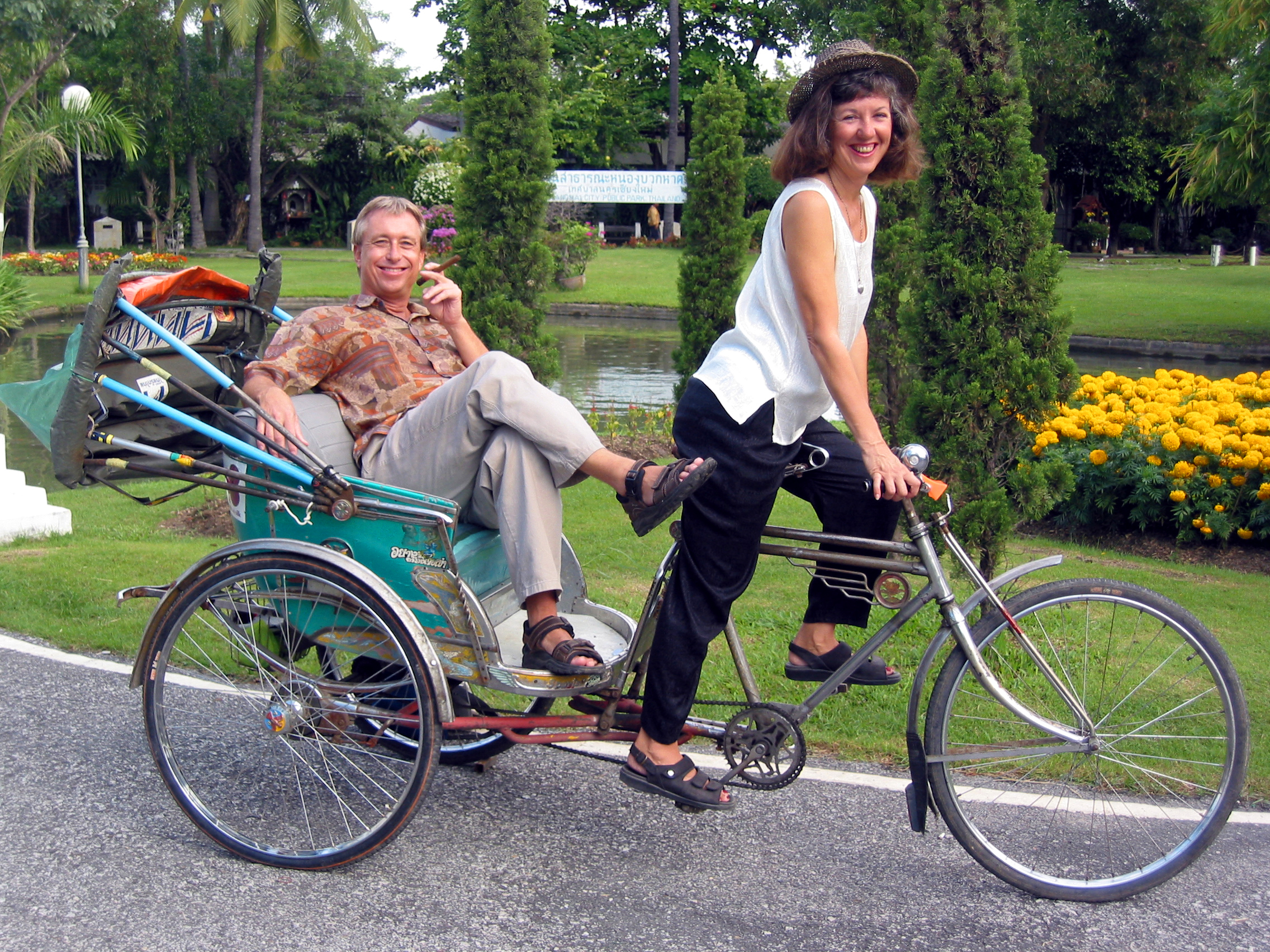
Billy and Akaisha on a Jak-a-Ran in Thailand

By Akaisha Kaderli, RetireEarlyLifestyle.com

Special to the Financial Independence Hub

It wasn’t a decision we took lightly.

In fact, Billy and I discussed the idea of becoming car-free for several years. There were good reasons to do it: no more maintenance and repair costs; no more fees for insurance, license plate renewal, or registration; no more fuel expense; and no more worry about storing the vehicle here in the States when we are traveling overseas for months or years at a time.

But there were also some obvious downsides. We wouldn’t have the freedom to come and go at a whim. And because we live in the American Southwest, where temperatures reach triple digits in the summer, we wondered how we’d manage to get around during the sun season.

Silly idea or feasible plan?

Most people we know couldn’t fathom the idea of giving up their vehicle and saw this new lifestyle choice as a hardship. Americans love their automobiles, and owning one is packaged as part of the American Dream. A look at the automobile and truck commercials today describe how we will be sexier, more popular, physically stronger, and obviously smarter if we purchase their brand of car.

As we’ve described on our Retire Early Lifestyle website, Billy and I live in an active adult community where we are within walking distance to stores, restaurants, and several different entertainment options. Most of what we need is near to us, and we appreciate the slower pace of life with all the rewards it brings. Many of our neighbors use a small scooter, golf cart, or bicycle to get around within a reasonable range. When we need to go somewhere farther, we trade services or pay cash to a neighbor or friend for their time. This is much cheaper than a taxi, more sociable, and we aren’t bogged down with worries about maintaining a vehicle. Both sides appreciate the trade, and our lives are enriched.

After almost two decades of world travel, we realized that the only place where we need to drive is in the States. Elsewhere, we take public transportation or hire a private driver. For the amount of time we live in the States, and for the amount of money that owning our own transport required, we finalized our decision to sell our vehicle.

The year was 2009.

What about you? 

Retirement takes many expressions and even if you could never see yourself as becoming completely free of car ownership, maybe you have toyed with the idea of keeping only one vehicle instead of two.

The following sites may help you with this transition: Continue Reading…