General

The many benefits of ETFs: What’s not to love about them?

The availability of exchange-traded funds (ETFs) is one of the best things to happen to investors in the last twenty years. What’s not to love about ETFs?

Investors can get broad diversification on the cheap with just two or three funds. This simplicity is what tipped the scales for me nearly three years ago when I switched from a portfolio of 25 Canadian dividend stocks to my two-ETF solution (the four-minute portfolio).

But not all Canadian investors are as enamoured as I am with ETFs. While Canadian ETF assets climbed to a record $133.8 billion in assets under management (Canadian ETF Association – Aug 31 2017), the Canadian mutual fund industry claims a whopping $1.41 trillion in assets (Investment Funds Institute of Canada – Aug 31 3017).

That 10:1 ratio needs to change in a hurry, but there are still headwinds facing the average investor.

First of all, mutual funds have been around a lot longer than ETFs and their sales channels are more widely available. In plain language that means any Joe or Jane investor can go to an advisor and choose from a menu of in-house mutual funds, whereas if an investor wanted to build a portfolio of ETFs, his or her advisor might not have the right license to sell them, might not have access to an exchange to trade them, or might simply balk at the idea that a couple of low cost ETFs could outperform an actively managed portfolio of mutual funds.

Many investors are forced to go the do-it-yourself route like I did, learning on the fly from financial blogs, forums, and sometimes even the financial media about the benefits of investing in low cost ETFs.

 Benefits of low-cost ETFs

Despite these challenges, Pat Chiefalo, the new head of iShares Canada, sees a bright future for the ETF industry in Canada as investors seek lower price points and broader exposure to different markets.

“ETFs offer a simpler and cleaner approach to building a diversified portfolio and we see that diversification makes up the vast majority of investment returns,” said Chiefalo.

Indeed, fans of this blog and of the Canadian Couch Potato’s model portfolios will recognize products like iShares Core MSCI All Country World ex Canada Index ETF: also known as XAW. This ETF gives investors one-stop-shop access to U.S., international, and emerging markets — nearly 8,000 holdings in total — for just 22 basis points (0.22% MER).

It’s hard to believe a company can make money charging $22 for every $10,000 invested, but you won’t hear Canadian investors complain. That’s because a similar global mutual fund might cost $220 for every $10,000 invested (there’s that 10:1 ratio again).

How low will ETF costs go? Continue Reading…

5 ways post-secondary students can save money

By Brandon Silbermann

Special to the Financial Independence Hub

When it comes to education, there are important financial lessons to be learned by post-secondary students outside of class.

According to Statistics Canada, there are currently more than two million full and part-time students at Canadian universities and colleges, and for those who leave home to study, a four-year university education could cost as much as $90,000. The road to responsible money management is a lifelong journey and many post-secondary students would benefit from ongoing practice: no matter their financial situation.

As a millennial financial advisor with freedom to provide impartial advice to helps young adults and parents prepare for life on campus, here are my top five tips and tricks to help students save money and put themselves on a solid financial footing throughout the school year.

1.) Look for scholarships and bursaries

There are many different scholarships out there available to students based on factors such as their choice of major, financial need, academic performance and community involvement. Surprisingly, however, many scholarships and bursaries go unclaimed each year. Although it may be time-consuming to find all the options available to you, contacting your school to get a directory is a great start and may be well worth the effort. You can also access Canada.ca’s student financial assistance section to learn what is available to you and how to apply for help to pay for your post-secondary education.

2.) Hone your cooking skills and save big

Buying food at restaurants every day can quickly add up and put a damper on a limited student budget. Shopping at a local market or on student discount days at a grocery store is a smarter route. For example, Zehrs – a Loblaws brand grocery store – offer 10 per cent discounts off students’ groceries on Tuesdays if they present their student cards in Waterloo. You can also order a basket of ugly but delicious produce via second-life.ca or browse through your local grocery store for discounted fruits and vegetables nearing expiry. Certain supermarkets, such as Loblaws, Sobeys or Metro, now offer a range of “imperfect” fresh products at affordable prices.

3.) Pay down highest interest rate debt first

Continue Reading…

Always show up for a free lunch!

By Heather Compton

Special to the Financial Independence Hub

Always show up for a free lunch!

That’s the tongue-in-cheek advice I give all “soon to retire” folks but, frankly, taking advantage of free lunches is key for every investor.

I use the term “free lunches” for all manner of benefits and it’s alarming to me how many people pass them by. Many employers offer employees matching contributions to Retirement Savings accounts that require the employees to pull out their own wallet too.

One major corporation I worked with gave all employees a contribution of 6% of their salary to the Defined Contribution Pension Plan.  The employer would contribute a further 4%, contingent upon the employee also contributing 4%. That’s a great free lunch! A shocking number of employees felt they couldn’t afford to participate:  they said they couldn’t meet all their other financial obligations without that 4% of salary. Actually, by making the 4% RRSP contribution they also earned a tax deduction, so the after-tax, out-of-pocket expense was even less.

Don’t overlook the daily Special

Many companies offer employees the convenience of group savings programs, even where there are no company-funded contributions. That too has value; the investment choices available in these plans often have significantly below market rate MERs (management expense ratios) and no account fees or cost to buy or sell. One company with which I am familiar has a savings plan offering a solid range of investment funds with MERs ranging from a low of 0.10% to a high of 0.58%.

Only a knowledgeable investor, capable of building a low cost ETF (exchange traded fund) portfolio, could match this low-cost option. If the contributions are made to a group RRSP, the employer can also add the convenience of reducing the tax paid at source. Since the contributions and investments are made regularly, often monthly, we can add the benefit of dollar cost averaging to the mix.

What other free lunches are often overlooked?

Continue Reading…

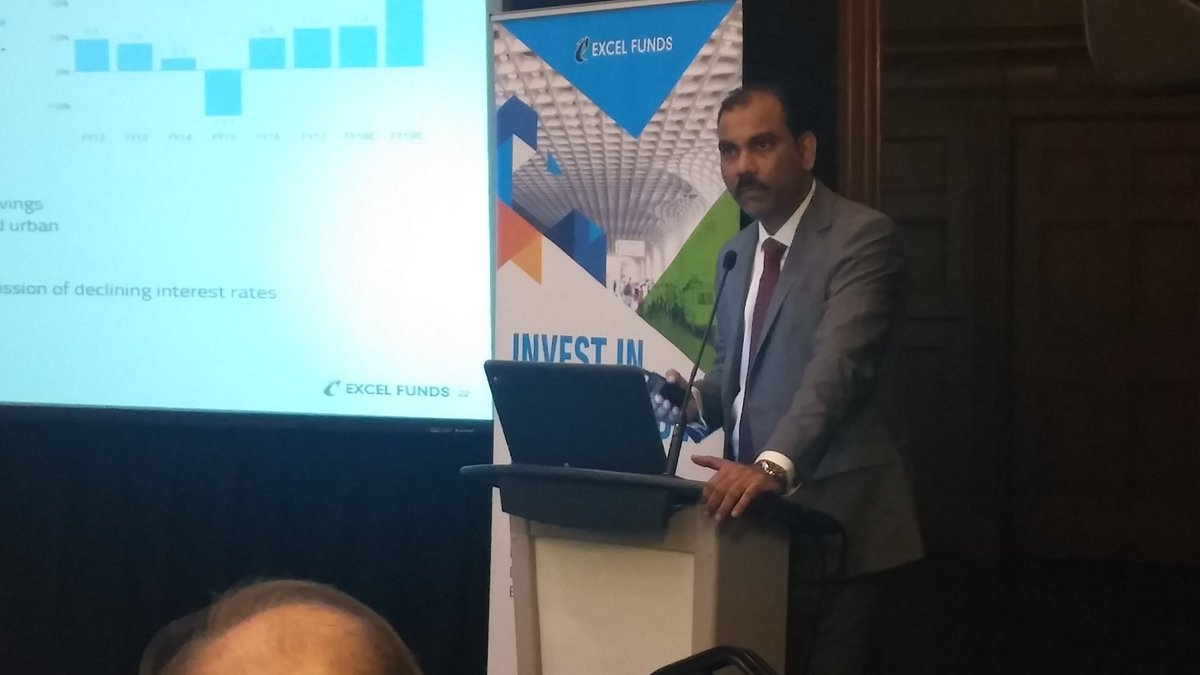
Indian economy poised for sustainable growth: Excel Funds’ Atul Penkar

Atul Penkar at Excel Funds Indian Road Show

(Sponsor Content)

The Indian economy is firing on all cylinders, fueled by policy reforms that are the catalysts for growth in one of the world’s fastest growing economies.

This was the central theme of the message delivered by Atul Penkar, lead sub-advisor of the Excel India Fund at an investor conference held in Toronto on September 19th. Mr Penkar is also the Head of Offshore Equities at Birla Sun Life Asset Management Company Ltd. (BSLAMC) in India.

Titled “Expert Insights into India: The World’s Growth Giant,” the conference was sponsored by Excel Funds Management Inc., in association with BSLAMC, the on-the ground sub-adviser of Excel’s three India-focused funds: Excel India Fund, Excel India Balanced Fund and Excel New Leaders Fund.

Mr. Penkar noted that India’s GDP growth has exceeded long-term projections made by Goldman Sachs and that the country was already close to achieving 2020 growth forecasts five years earlier.[1]

Huge Demographic Dividend 

Continue Reading…

Getting unstuck: How to live the life you want with the money you have

By Sheila Walkington, Money Coaches Canada

Special to the Financial Independence Hub

Money does not buy happiness. You’ve heard that before. Many studies of happiness have shown that relationships, a positive attitude, working towards goals and helping others, are at the core. Even exercise and pet ownership are considered contributing factors. How much money is in your bank account doesn’t even make the list.

On the other hand, constant struggle and worry about money can certainly rob you of happiness. Luckily, whether or not you struggle with money has less to do with how much you have and much more to do with your mindset. That’s why being a Money Coach brings me so much happiness. I have the opportunity to help people stop struggling and gain mastery over their money.

I also have the opportunity to dispel the misconception that money mastery is synonymous with giving up all the fun stuff you enjoy, and thinking only of a distant retirement or being prepared for a “rainy day.” As a Money Coach, I don’t set your priorities; I help you determine what matters most to you. The approach Money Coaches Canada, co-founder Karin Mizgala and I developed in our book Unstuck, is focused on the concepts: Dream, Plan, Live.

We believe that to live the life you want, you need a clear vision of what that life will look like. Once you have a dream, you develop an action plan with steps you can take immediately. In that way, your dream isn’t some far off wish; it becomes an active part of your daily life and you are able to recognize—and celebrate—the progress and victories along the way.

Here are some ideas to get you started living according to your goals.

Use your dreams to set your priorities

What do you really want in your life? More travel? Early retirement? More time with your children? To start a business? Of course, there is no right or wrong answer. It’s your life. Never assume that the life you want is out of your reach. A clear vision of what you want is an amazing source of motivation to make things happen. Because once you have uncovered what you really value, you can take actions that support your dreams becoming reality.

Continue Reading…