

 Posted By
By Stephen Dover, CFA, Franklin Templeton Institute et al
(Sponsor Blog)
This bi-annual outlook survey is designed to give a view across our investment teams. The expectations for 2026 are based on survey results from investment professionals across all asset classes. We also provide our predictions on inflation, recession, asset class performance and more.
Summary
This bi-annual outlook survey is designed to give a view across our investment teams. The Franklin Templeton Institute identifies the median across answers and develops commentary on the year ahead. We surveyed our investment teams across all our asset classes: equity, private equity, fixed income, private debt, real estate, digital assets, hedge funds and secondary private markets.
The goal of the Global Investment Management Survey is to provide the most comprehensive global view on the dimensions that matter most to our clients.
The findings reflect the average of the group. While each of our investment teams are independent and have different outlooks, the survey serves as a starting point in understanding Franklin Templeton’s aggregate views on the economy, equities, fixed income and alternatives.
The survey results outlined in this paper are as of May 2026, and market data as of August 31, 2026.
Exhibit 1: Expectations for 2026 Based on the Franklin Templeton Global Investment Management Survey
Focus on Quality Across All Asset Classes

Source: Franklin Templeton Institute Global Investment Management Survey expectations are for the year 2026 and are as of May 2026. Survey methodology included at the end of the paper. There is no assurance any forecast, projection or estimate will be realized.
Key takeaways
Economic growth accelerating
- Global growth will be slightly better than consensus forecasts.
- We expect core Personal Consumption Expenditure (PCE) to approximate 3.0%–3.5% and will likely remain above central-bank targets.
- Unemployment will rise but remain relatively low in the United States and will end the year around 4.5%.
- The US dollar will remain rangebound and essentially unchanged by the end of 2026.
- We do not expect a recession in 2026.
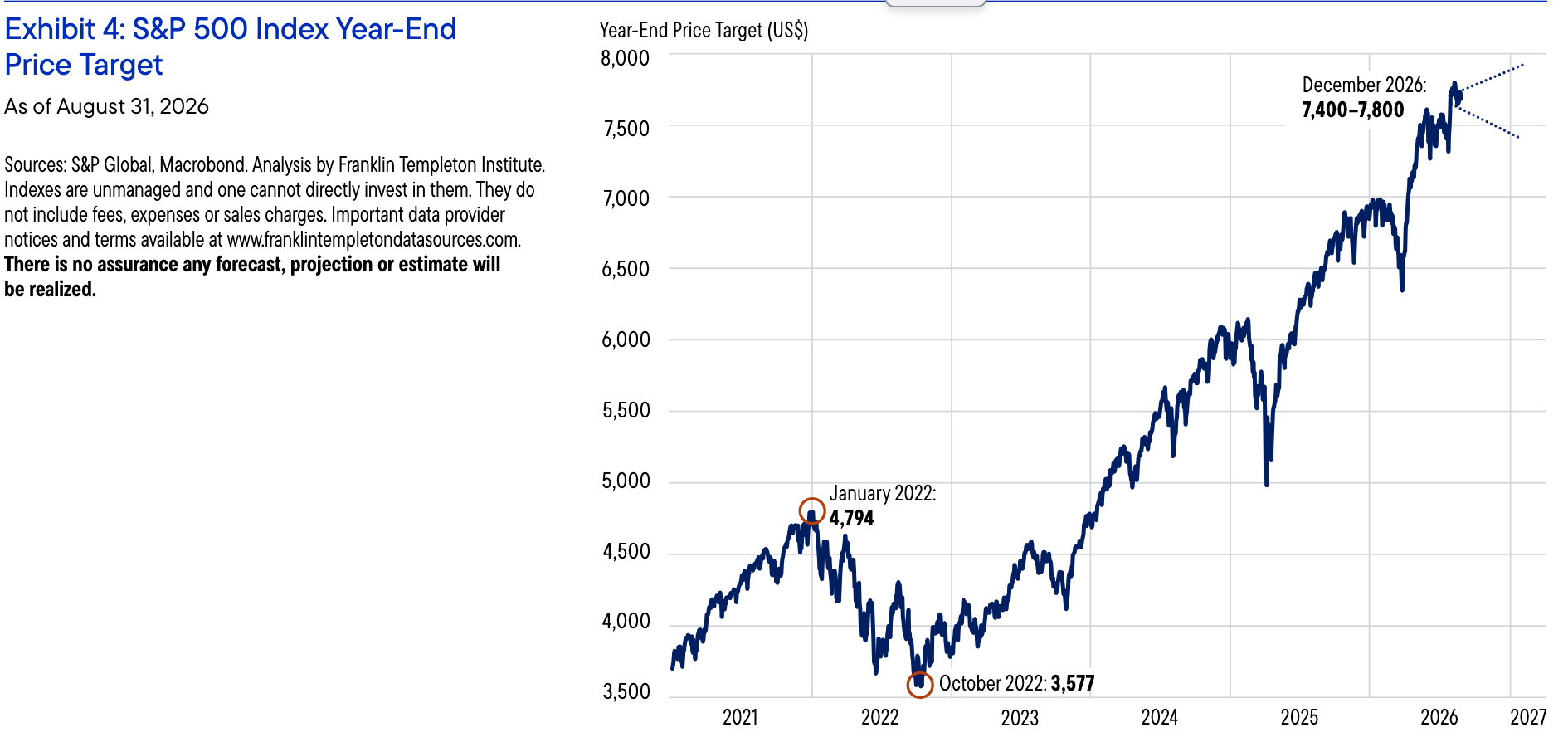
Equities likely to end 2026 at 7400–7800 (S&P 500 Index target)
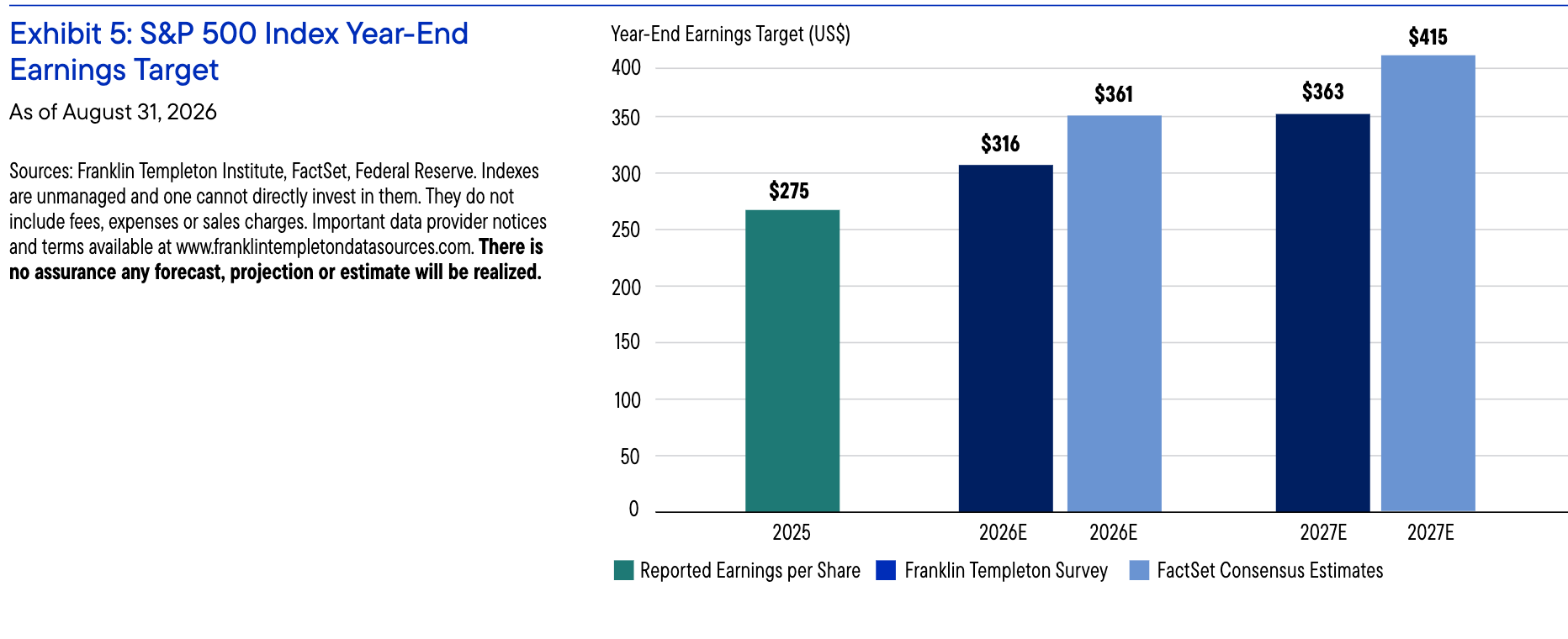
- Earnings will grow 15%+ versus market consensus of 31.5%.
FAVOR
- Broad US stock exposure: we favor large-, mid- and small-cap and a balanced mix of growth and value. We are bullish on emerging markets and Japan.
- Sector focus on technology, industrials and energy.
- Factors to focus on include free-cash-flow yield, return on invested capital and return on equity.
RISKS
- Geopolitics, Federal Reserve (Fed) misstep and earnings below expectations.
Municipal bonds, short duration and corporate credit will benefit from solid fundamentals and elevated yield levels in 2026
FAVOR
- Municipal bonds will continue to be a high-quality, diversifying investment with attractive tax-free yields, as fundamentals remain solid and elevated supply levels continue to be met with strong demand to support valuations.
- Shorter duration fixed income will be in favor during most of 2026 as yields remain elevated and the Fed could be on hold.
- High-yield bonds are attractive. Default rates for high-yield debt could tick slightly higher during the second half of 2026; however, spreads should remain relatively tight in a sector with low interest rate risk and high all-in yields.
RISKS
- Geopolitics and potential missteps by the Fed or other major central banks.
Survey Results Related to Equities
• The S&P 500 Index will end 2026 in the range of 7,400–7,800.
• Earnings are expected to grow more than 15% in the United States, driven in part by strong real US GDP growth of 2.5%.
• We expect earnings growth to broaden out. We favor stocks across the capitalization spectrum and believe both value and growth will generate positive returns.
• We are also bullish on emerging markets and Japan.
• At the factor level, we favor free cash flow yield, return on invested capital and return on equity.
• Sectors that will outperform include technology, industrials and energy.
• Our primary concerns are centered around geopolitics, Fed policy missteps and earnings below expectations
Survey Results Related to Fixed Income
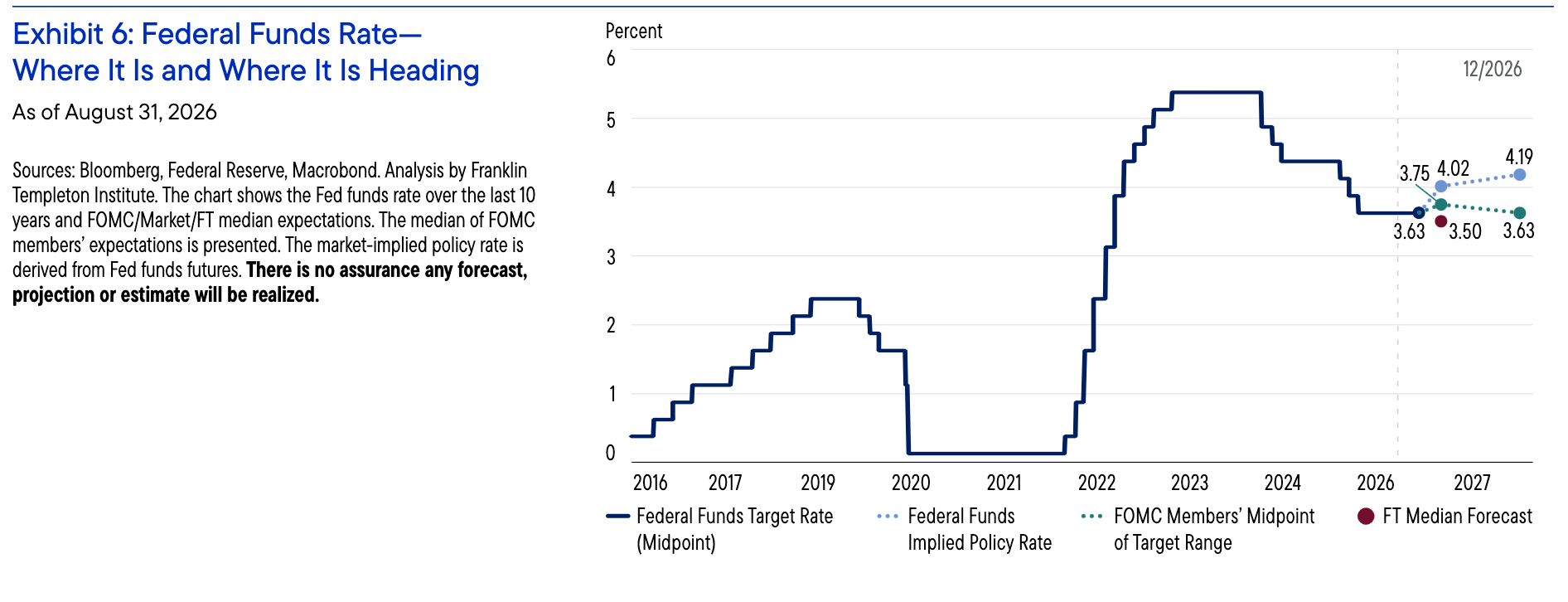
• The Fed could be on hold for at least most of the second half of 2026, as the central bank’s new leadership settles in and tries to find a consensus on future monetary policy amid stubbornly high inflation and a solid labor market.
• US investment-grade spreads are expected to end 2026 at 85 basis points (bps), up from a current level of 78 bps. The 10-year average spread is roughly 111 bps, which reflects very little stress in the system as credit quality remains high.
• US high-yield spreads are expected to end 2026 at 325 bps from a current level of 261 bps, versus the 10-year average spread of roughly 372 bps. Default rates are currently near 2.6% and will remain low at 2.5%. Their historical average is 3.2%.
• Emerging market debt spreads are expected to end 2026 at 225 bps from a current level of 156 bps. The 10-year average spread is roughly 289 bps.
• Municipal bonds remain a high-quality, diversifying investment option, with total returns expected to be roughly 3.75% in 2026.
• 30-year conforming fixed rate mortgages will fall from 6.7% to roughly 6.25% by the end of 2026.
• Our primary concerns are centered around geopolitics and the policies of the Fed and other major central banks.

This blog is an edited excerpt from Franklin Templeton’s recently released bi-annual Global Investment Management Survey.

WHAT ARE THE RISKS?
All investments involve risks, including possible loss of principal.
Fixed income securities involve interest rate, credit, inflation and reinvestment risks, and possible loss of principal. As interest rates rise, the value of fixed income securities falls.
Equity securities are subject to price fluctuation and possible loss of principal.
Investments in lower-rated bonds include higher risk of default and loss of principal. Changes in the credit rating of a bond, or in the credit rating or financial strength of a bond’s issuer, insurer or guarantor, may affect the bond’s value.
International investments are subject to special risks, including currency fluctuations and social, economic, and political uncertainties, which could increase volatility. These risks are magnified in emerging markets.
Alternative strategies may be exposed to potentially significant fluctuations in value.
Privately held companies present certain challenges and involve incremental risks as opposed to investments in public companies, such as dealing with the lack of available information about these companies as well as their general lack of liquidity.
Real estate securities involve special risks, such as declines in the value of real estate and increased susceptibility to adverse economic or regulatory developments affecting the sector.
Because municipal bonds are sensitive to interest-rate movements, a municipal bond portfolio’s yield and value will fluctuate with market conditions. Bond prices generally move in the opposite direction of interest rates. Thus, as prices of bonds in an investment portfolio adjust to a rise in interest rates, the portfolio’s value may decline. Changes in the credit rating of a bond, or in the credit rating or financial strength of a bond’s issuer, insurer, or guarantor, may affect the bond’s value.
Dividends may fluctuate and are not guaranteed, and a company may reduce or eliminate its dividend at any time.
IMPORTANT LEGAL INFORMATION
This material is intended to be of general interest only and should not be construed as individual investment advice or a recommendation or solicitation to buy, sell or hold any security or to adopt any investment strategy. It does not constitute legal or tax advice.

The views expressed are those of the investment manager and the comments, opinions and analyses are rendered as at publication date and may change without notice. The information provided in this material is not intended as a complete analysis of every material fact regarding any country, region or market.

Data from third party sources may have been used in the preparation of this material and Franklin Templeton Investments (“FTI”) has not independently verified, validated or audited such data. FTI accepts no liability whatsoever for any loss arising from use of this information and reliance upon the comments opinions and analyses in the material is at the sole discretion of the user.

Products, services and information may not be available in all jurisdictions and are offered outside the U.S. by other FTI affiliates and/or their distributors as local laws and regulation permits. Please consult your own professional adviser or Franklin Templeton institutional contact for further information on availability of products and services in your jurisdiction.

Issued by Franklin Templeton Investments Corp., 200 King Street West, Suite 1500 Toronto, ON, M5H3T4, Fax: (416) 364-1163, (800) 387-0830, www.franklintempleton.ca.

CFA® and Chartered Financial Analyst® are trademarks owned by CFA Institute.
