General

Buying a home with an Income suite? What you need to know

first-time-landlordBy Penelope Graham, Zoocasa

Special to the Financial Independence Hub

 As Canadian real estate becomes steadily more expensive, homebuyers are increasingly exploring new affordability options. Renting out a portion of your home to help offset mortgage costs has become a popular method – and with the price of an average detached house well past the $1 million mark in the Toronto real estate market, it may be the only way some buyers can move beyond condos and townhomes.

For these buyers, assuming the role of landlord in exchange for a bigger house or better neighbourhood seems a smart trade-off. However, renting out part of your property – especially when you also dwell there – can be a complicated undertaking, and requires extensive research and resources. Here’s what those considering the purchase of a home with secondary suite should take note of.

What is a secondary suite?

Also referred to as an income suite, secondary suites are separate units within a principal residence. It must have its own private entrance, kitchen, sleeping and living areas. In order to comply, and be protected by, your province’s Residential Tenancies Act (RTA), you cannot share any of these living facilities with your tenant, as they’re otherwise considered a boarder. Continue Reading…


What is goals-based investing?

Business People Employee Retirement Presentation Seminar ConceptBy James Gauthier, CIO, Justwealth

Special to the Financial Independence Hub

Most individuals are aware of the importance of investing – not everybody does it, but they know that it can be beneficial for their future.

For those who are able and engaged in investing, a good percentage will invest their savings through their financial institution, a financial advisor or some will do it on their own. Financial planning helps investors figure out questions such as “How much do I need to save?,” “How much can I spend?” or “What rate of return do I need to make?”

Before you attempt to answer these questions, you should be asking yourself the question “What is the objective of my investment?” The responses to this question can vary greatly, but might fall into one of the following categories:

• Saving for the short term (such as a down payment for a home in a few years)

• Saving for the long term (such as a retirement nest egg)

• Generating income (either as a primary or secondary source)

•Preserving your capital (looking to keep up with inflation or just very risk averse)

Continue Reading…

When and when not to hedge currency risk

depositphotos_16811249_s-2015-2By Tyler Mordy, Forstrong Global Asset Management

Special to the Financial Independence Hub

 An old Japanese proverb states “many a false step was made by standing still.”

So it is with currency exposures in investor portfolios. Consider the recent experience of Brazilian, Russian and even Canadian investors — to name a few countries with steeply depreciating exchange rates. By electing to remain invested in their domestic currency, they have all experienced a steep “loss” in their own global purchasing power (even if nominal values held up). An ostensibly conservative position has cost them dearly.

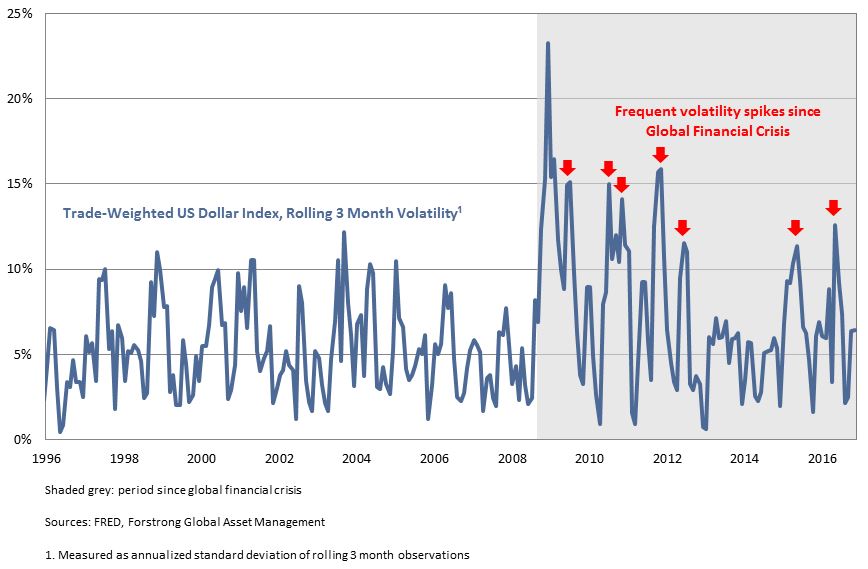
Welcome to the new, hyper-globalized world. Since the financial crisis, unorthodox policies — with central banks trying to outdo the effects of one another by plunging into a subterranean universe of quantitative easing and negative interest rates — have driven currency volatility much higher. Now, capital has a way of swiftly seeking out safe harbours and penalizing others who are not safeguarding their national currencies. Who would have thought the once-august Swiss franc would lose its safe haven status?

currency-chart-1-nov-2016

Indeed, currency exposures are having an outsized impact on portfolio returns. Currency-focused ETF vehicles could not have arrived at a better time, introducing yet another evolution in the portfolio management process.  Today, gaining global currency exposures is as easy as buying stocks.

Beyond the academic view

Continue Reading…

Appetite for ETFs to keep rising in 2017: BlackRock

members-warren-collier-big
Head of iShares Warren Collier (CETFA.ca)

The popularity of exchange-traded funds (ETFs) in Canada continues to surge and 31% of domestic investors now report they own ETFs, says BlackRock Canada’s first-ever ETF Pulse Survey, released Friday.

Furthermore, 93% of existing ETF owners and 38% of non-owners are interested in buying ETFs in the next 12 months. The survey suggests education plays a big role in the adoption of ETFs: more than half of Canadian investors plan to learn more about ETFs in 2017 and non ETF investors are more than twice as likely to seek out more ETF knowledge next year.

41% are replacing mutual funds with ETFs

Not surprisingly, the survey found that 41% of investors polled are choosing ETFs largely to replace mutual funds while 45% are doing so to replace individual stocks. Improved diversification was cited by 53% while 43% felt ETFs would help reduce their risk profile. BlackRock added that these findings are consistent with a Greenwich Survey of Canadian institutional ETF users, which pointed to a rise in ETF allocations among institutional investors in the coming year.

Continue Reading…

How TFSAs can aid your Victory Lap

depositphotos_43073977_xs-300x295My latest MoneySense Retired Money column on TFSAs is now online. You can read the whole thing by clicking on this highlighted link: How retirees can use TFSAs to save on tax.

I’m a huge fan of The Tax-free Savings Account or TFSA both for young people and for seniors, and everyone between.

It’s the single most powerful investment tax shelter available to Canadian investors. (For any American readers, the TFSA is roughly the equivalent of Roth IRAs).

So if you’re a member of the much-touted “Millennial” generation, you should move heaven or earth to maximize the annual $5,500 contribution as soon as you turn 18 – even if you have to solicit a “matching” contribution from your parents.

If you’ve not yet opened up a TFSA,  as of 2017 the cumulative TFSA room built up since the plan’s debut in 2009 will be $52,000. As I say in the column, for millennials the combination of the newly expanded Canada Pension Plan and a TFSA maximized from age 18 on means that by the time they are old enough to read the Retired Money column, they will be well positioned for retirement.

While late for Boomers, TFSAs can still be a boon in retirement

But as this particular MoneySense column has been dubbed “Retired Money,” the focus is on what the TFSA can do for near-retirees and seniors already retired. When it first came out in 2009, we aging baby boomers lamented the fact the TFSA hadn’t been available when we we were just starting out.

Continue Reading…