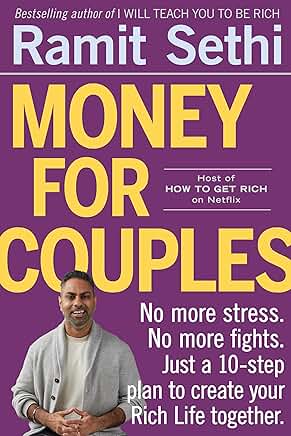
Having listened to a few episodes of Ramit Sethi’s podcast where he helps couples face and conquer their money issues, I looked forward to reading his book, Money for Couples.
In it, Sethi distills his experience helping hundreds of couples into strategies that cover a wide range of problems.
It’s clear that Sethi has the skills and experience necessary to help couples with their financial problems.
However, creating a book to help people solve these difficult issues on their own is a different challenge. I’m optimistic that this book will be helpful for some couples with big money problems.
For many couples, talking about money is painful and ends in a fight. A common theme throughout this book is that couples need to find a way to have money discussions that feel good. To this end, Sethi provides many strategies as well as actual scripts of what to say. These strategies go a long way to help draw in a spouse who avoids all talk about money.
Money personalities
Although many people think they’re just bad with money, “there’s no question you can get good at managing money, just like you became good at driving and speaking English.” The way forward depends on your money personality. Sethi sees four common money types: avoiders, optimizers, worriers, and dreamers (who think some big score will come soon to solve all their money problems).
The book gives specific advice for each money personality. For example, “Worriers change when they have skin in the game (for example, they manage part of the family finances), when they’re educated about money, and when their finances are extremely simple so they can understand them.” In the case of dreamers, “I have no advice, because you’re not reading this book.” Instead, Sethi offers advice to spouses of dreamers.
I saw myself a little bit in the optimizer personality description, but not much in the other personalities. Even the optimizer personality doesn’t fit well, though: I’ve never tried to maintain a budget and have only tracked spending a few times. I don’t seem to fit into any of these personalities. Perhaps, these are the money personalities of people who have money issues, and there are other money personalities for people who don’t have money issues. I’m not sure.
Moving toward a rich life
Sethi is known for saying people should stop focusing on $3 questions and start focusing on $30,000 questions. This is the difference between deciding whether to buy $3 coffee vs. big-ticket items like “automating investments,” “minimizing investment fees,” and “creating a debt -payoff plan.”
Some take this to mean that it’s always okay to spend small amounts. I’m not sure this is what Sethi means. In any case, as I see it, it’s a mistake to agonize over small amounts every day. Analyze how you spend money in small amounts, add up a full year’s worth of small amount spending in each category, and then decide if each category of spending fits in your financial plan. You now have a quick yes or no answer to every type of small amount for the next year. This frees up some mental bandwidth for thinking about bigger questions.
This shift to thinking about big money questions is an important part of what Sethi calls “designing your rich life vision.” When a couple agree on what really matters to them and how they want to live in the future, they can take steps to make their vision a reality. Otherwise, they might just continue wasting money on things they don’t care much about and never get where they’d really like to be.
As I read this book, I decided to do some of the exercises myself, and I squirmed a little as I got to the big questions about what kind of life I really want. These questions can be daunting, but they’re important. Even for a retiree like me who has already found the life I want for now, thinking about what I want my future to look like isn’t easy. Facing these questions and coming to agreement with a spouse matters.
Couples dynamics or … how to stop fighting over money
The book describes three common problematic couples dynamics: sitcom (where couples take jabs at each other to entertain others rather than really communicating), chaser/avoider, and innocent doe/enabler. For each dynamic, Sethi describes specific ways to break dysfunctional patterns, create meaningful communication, and handle money better. He also provides scripts of what healthy conversations about money look like.
After solving some of these emotional issues, couples are ready to move into some of the more numerical pursuits, like creating what Sethi calls a Conscious Spending Plan (CSP) and setting up an automated system of bank accounts and credit card accounts. A CSP lays out what percentage of income should go toward fixed costs, short-term savings, long-term investments, and guilt-free spending. Putting an end to feeling guilty every time you buy something is a dream for many people!
I’ve seen enough young couples mess up their finances to see the value in Sethi’s methods, but I wonder how many couples out there are like my wife and me. We kept all our accounts separate, which Sethi doesn’t recommend. We never automated our savings and just saved what was left over. This turned out to be a lot of money most of the time, despite the warnings from the Wealthy Barber, Sethi, and others that you must pay yourself first.
Although we’ve made good strides in spending meaningfully, my wife and I tend more toward underspending. Many joke about how they wish they (or their spouses) were underspenders, but it can be a real problem. The book mainly focuses on the more common problems relating to overspending, but it does have a subsection specifically about underspending.
Calling out businesses
One thing Sethi does that I find useful and amusing is calling out businesses to avoid. In one example, a couple closes their Wells Fargo account “because they are one of the worst predatory banks in the world.”
For many people, “their parents never talked about money, so when they reached adulthood, they were defenseless, left to make sense of the world against companies like Wells Fargo and Ameriprise as well as whole-life insurance scammers.”
Specific advice
Sethi advises couples to set a “worry-free spending number.” The idea is that anything under some threshold, like $20, is automatically not subject to criticism by a spouse. I find this lacks a time component. My wife and I have a number like this, but the threshold is very different depending on whether it is a one-off or if it’s daily. I can buy $1,000 worth of sports equipment a few times a year without a family discussion, but I can’t spend $200 on lunch a few times a week. Continue Reading…


 Posted By