Various people have asked me to weigh in on our inflation situation with a particular focus on what central bankers should do about rates going forward.
The ‘what to do’ elements include queries about when to hike, how much, how often and to what end.
I like to use metaphors and the one that fits here is one of having someone you care about climbing a ladder. In this scenario, the ‘friend’ is a mashup of the economy and markets (specifically, both the stock market and the real estate market), the ascension up the ladder is the seeming inexorable climb of prices and valuations, and the decision to tip the ladder over is the decision to raise rates. Here’s the problem …
Let’s say someone you care about is climbing a ladder and you have been given the task of holding the ladder steady, stable, and firmly rooted on the ground while that person climbs. In this case, “price stability” equals “ladder stability.” It’s a tall ladder and conditions are becoming increasingly perilous. As your friend ascends, it eventually becomes clear to you that communication has been lost: your friend is now so far up that they cannot hear your pleas to reverse course. It’s dangerous. You know it, but your friend keeps climbing higher.
Central bankers caught in a dilemma
In this scenario, you know that if you were to tip the ladder over, your friend would be seriously hurt. Conversely, you could do the ‘responsible thing’ and not tip the ladder over, but if you did that and your friend ended up falling from an even higher position, the consequences could be deadly. Central bankers are caught in the horns of a dilemma. Continue Reading…
A quick note to say Happy 2022 to all the Hub’s readers and supporters. We’ll be back to our regular blog-a-day rotation on Tuesday.
In the meantime, I’ll point readers to Dale Roberts’ excellent year-end market wrap for MoneySense, which was published Friday.
Click on the highlighted headline to access, but settle down with a coffee before you do: it’s quite a long read: Making Sense of the Markets: 2021.
It’s a thorough long read that looks at all the major market developments each month in 2021 and you’ll also see a number of prescient market calls made by Dale over the last few years, including an early call on Covid-19 itself, an early call on the Energy and Commodities recovery, and several others.
I’ve followed Dale for some years now: he famously tweets as @67Dodge and I now help edit his weekly MoneySense market wrap, seeing as I became MoneySense’s Investing Editor at Large a few months ago.
In normal years, I would move new money into the TFSA on January 1st but there’s probably no rush this year until Tuesday, Jan. 4, seeing as the Canadian market is closed Monday. (The US will be open that day though).
I’ve not decided exactly what to invest in but it will likely be inflation-related. Going back to Dale Roberts, you can glean a few ideas from his 2021 market wrap: things like short-term TIPS ETFs, or the Purpose Real Assets ETF, or energy/commodity plays.
Personally, I’ve been researching Ray Dalio’s All-Weather portfolio (google it for videos and articles, or try this Seeking Alpha link on it). I’ve concluded that our own family has sufficient US equity exposure but not enough in commodities or TIPS [Treasury Inflation Protected Securities] plays.
Dalio is a bit heavier on fixed-income than most, with a mix of long-term and short-term bonds. His recommended equity exposure is a bit lower, and he suggests 7.5% commodities and 7.5% in gold. Readers may therefore find Friday’s Hub article on gold of interest: A perfect storm for gold.
Every case is different of course. IF I were looking to boost US equity exposure, I’d certainly be considering the new Canadian Depositary Receipts (CDRs), more on which you can read on the Hub early in the new year. If we didn’t already own Berkshire Hathaway, I’d be tempted to add to it with the CDR version of Berkshire, seeing as it pays no dividends and would be a good value counterbalance to high-priced US tech stocks.
So by all means get your $6,000 (if available) into your TFSA early in 2022 but take a few days to figure out how to invest it.
The wild card is certainly Omicron. If you’ve not yet gotten your booster, I highly recommend it.
So again, have a happy, healthy and profitable 2022!
In December 1997, The Financial Times ran an article entitled “The Death of Gold.” Since then, the gold price in US dollars has increased 519% from $288 to $1,780. Today, after many political events and crises we have evidence of the continuous and in many ways spectacular growth of the gold price. This confluence of many current events is creating a perfect storm for gold to increase dramatically more than we imagined.
Currency Devaluation
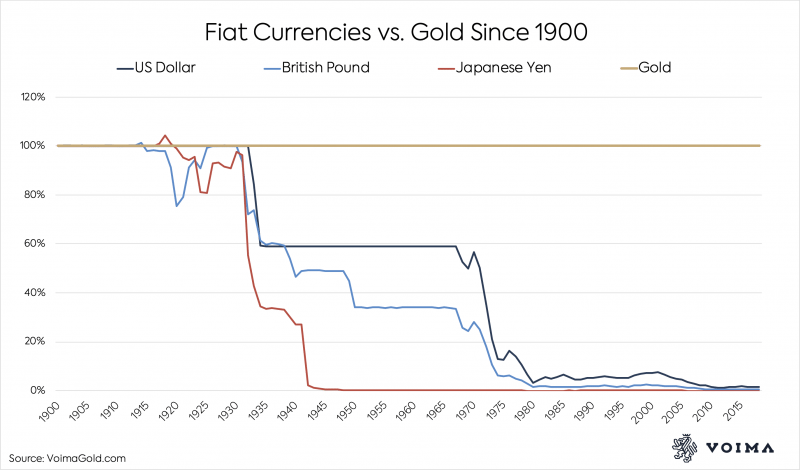
Typically, currency devaluation is always at the heart of a rising gold price. This has been taking place in all of the major fiat currencies, resulting in an average annual price increase in gold of over 10% since 2000.
“For the naïve there is something miraculous in the issuance of fiat money. A magic word spoken by the government creates out of nothing a thing which can be exchanged against any merchandise a man would like to get. How pale is the art of sorcerers, witches, and conjurors when compared with that of the government’s Treasury Department.” — Ludwig von Mises
Since 1900, all major fiat currencies have been devalued by over 90%.
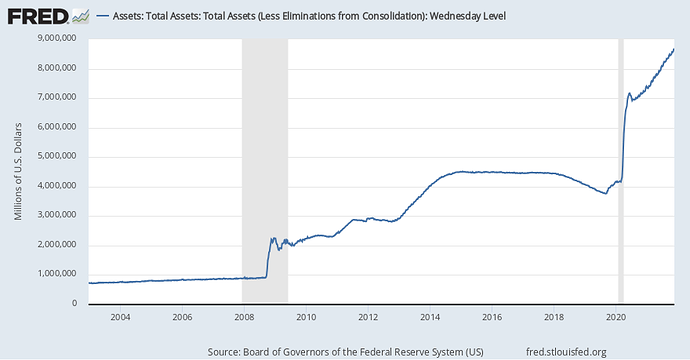
To understand currency devaluation, it is necessary to understand that all currency is created by governments issuing debt and then the central bank monetizing that debt by printing the currency. In 1960, the U.S. federal debt to GDP stood at 52.2%, whereas today it has grown to 125.9%. The Federal Reserve has increased its balance sheet by a historically unprecedented amount of over $7.5 trillion since 2008.
Because of this central bank policy, all western currencies are being devalued and this in turn leads to inflation.
“Nations are not ruined by one act of violence, but gradually and in an almost imperceptible manner by the depreciation of their circulating currency, through excessive quantity.”
— Nicholas Copernicus – 1525
“Fed Chairman Powell has pumped trillions of newly printed dollars into the system in order to prop up the financial markets, but in the process has unleashed a tsunami of inflation that is unlike anything we have seen since the 1970s.” — Michael Snyder
“For the first time in history, ALL the major central banks are printing money. One of two things will occur. If they continue to print, their respective currencies will lose their purchasing power, and we’ll have inflation or even hyper-inflation.”
As Currencies are Devalued, Price Inflation will inevitably follow
Inflation, as this term was always used everywhere and especially in North America, means increasing the quantity of money and bank notes in circulation and the quantity of bank deposits subject to check. But people today use the term ‘inflation’ to refer to the phenomenon that is an inevitable consequence of inflation, and that is the tendency of all prices and wages to rise.
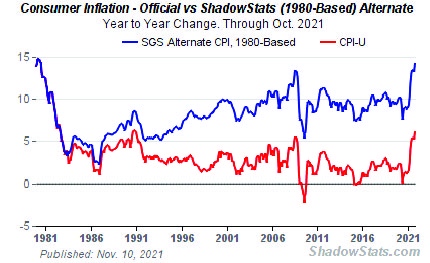
In October 2021, consumer inflation jumped to a four-decade high, the highest since the days of runaway inflation in the early 1980s. Headline year-to-year GDP inflation hit a 38-year-plus high of 4.53%.
According to John Williams of Shadowstats.com, if inflation was calculated using 1980s methodology, the CPI would be nearly 15%. Since treasury yields are about 2%, the true inflation-adjusted treasury yield would be about -13%.
Gold Rises Fastest When Real Yields Go Negative
Inflation is destined to go even higher in 2022. Many of the biggest corporations have already announced price increases that will take effect in 2022.
Declining GDP — Stagflation
“The…economy is facing a period of stagflation in which both growth and inflation disappoint.” — David Walton, Goldman Sachs
Stagflation is worse than a recession. It’s because stagflation combines the bad economic effects of a recession (stock declines, unemployment increases, housing market dips) with inflated prices. When this is dragged out over the long term, it becomes a problem that can have a big impact on societal habits.
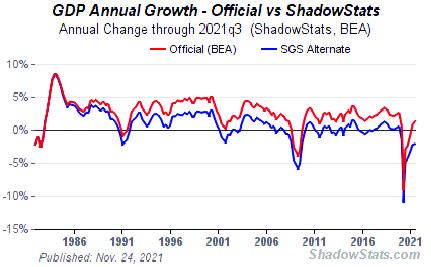
To make matters worse, we are already experiencing declining GDP together with increasing inflation. This is due to an unusual combination of supply chain disruptions and labour shortages due to COVID-19 policies that have been implemented in most western countries.
Supply Chain Disruptions
The COVID-19 pandemic impact and the disruptive government responses continue to have enormous negative impact on global supply chains. Beyond COVID-19, compounding profound governance incompetence, media bias, political conflicts, disintegration of society split by “Covid politics,” natural disasters, cybersecurity breaches, international trade disputes have negatively impacted supply chains leading to product shortages, distribution delays, and manufacturing disruptions. The lockdowns imposed in many countries have led to revenue declines and many bankruptcies, with many more to come. Making matters even worse is the implementation of vaccine mandates, causing over 4 million people to leave the workforce in the U.S. This will lead to other societal problems due to lack of first responders, nurses, firefighters, and police.
Some analysts expect that it will take years for the capacity constraints and backlogs to ease. Continue Reading…
Wine investing in North America is hitting the mainstream.
Historically, the wine investment category has been perceived as only for the wealthy or wine experts.
Although traditional HNW [High Net Worth] investors have been investing in portfolios of fine wine for years, it is still a new asset class for some.
However, new specialist services are opening up the fine wine investment universe. Cult Wines, whose story began in London, England in 2007, recently expanded into North America with offices in Toronto and New York. Known as ‘The Americas,’ our task is to build the awareness of fine wine and accessibility to the asset class. In addition, Cult Wines recently introduced a new platform, new product structure and new technology to better serve our clients.
Our expension into The Americas is helped by fine wine’s strong track record of consistent returns and low volatility. Currently, the asset class is enjoying a sustained rally with year-to-date returns over 13.7% through the end of October, as measured by the Liv-ex 1000, an index of some of the most sought-after investment wines from around the world.
The U.S. is the world’s largest Wine market
The US, the world’s largest wine market, is a natural fit for wine investment. 49% of Americans drink wine and 431 million cases of wine were sold in 2020. The US has been making some investment grade wines for decades and to the end of October, the California 50 wine index is the third best performing wine region globally with a year-to-date return of 16.5%. Continue Reading…
The continued rise in stocks, real estate, and almost every other asset class on the planet can be attributed to three things: liquidity, liquidity, liquidity. According to legendary investor Marty Zweig:
“In the stock market, as with horse racing, money makes the mare go. Monetary conditions exert an enormous influence on stock prices. Indeed, the monetary climate – primarily the trend in interest rates and Federal Reserve policy – is the dominant factor in determining the stock market’s major direction.”
In today’s markets, you don’t have to look very hard to find strong evidence of Zweig’s theory, which explains why stock markets were making fresh highs during successive outbreaks of Covid-19 and spiking unemployment. It also explains why approximately two thirds of stock returns over the past decade are attributable to multiple expansion rather than earnings growth. It’s hard to envision things turning south when real interest rates remain highly negative, and money is so freely available.
Something is happening here but it ain’t exactly clear what
For the first time in decades, the inflation genie is threatening to escape from its bottle. The abundant global liquidity that has been the primary driver of markets is threatened by the potential need to combat inflationary pressures, which have been rearing their head after a several-decade slumber.
Despite some disconcerting inflation readings over the past several months, it is possible that this phenomenon turns out to be a Covid-induced disruption in supply chains that will prove temporary. If this scenario prevails, then rates will remain fairly low, as will the probability that stocks will crater. Conversely, it is entirely possible that the recent uptick in inflation marks the beginning of a longer-lasting trend, in which case rates could rise materially, thereby increasing the chances of a severe decline in risk assets.
There are certainly some signs that suggest that at least a portion of the recent surge in inflation may have staying power. Bridgewater, the world’s largest hedge fund, recently wrote a research report called “It’s Mostly a Demand Shock, Not a Supply Shock, and It’s Everywhere.” The authors contend global production is back to normal levels following last year’s Covid-related disruptions. On the other hand, they claim global demand has exploded. Bankim Chadha, Chief U.S. Equity & Global Strategist at Deutsche Bank Securities, summarized his recent discussions with company executives:
“Most companies noted that supply chain issues kept them from fulfilling the underlying demand, which was much stronger than they had expected. They didn’t plan their supply chains to have a sustained surge in volume for 18 months. Labor availability and cost pressures show no signs of abating any time soon, a development that is new and not welcome. Companies are however very confident in their ability to raise prices.”
Although rates have risen modestly over the past few months, they have yet to rise materially. Both central banks and market participants remain skeptical that inflation will become a serious concern, which has prevented rates from spiking and provided stocks with sufficient “cover” to remain buoyant. On a rolling 10-year basis, equities are beating bonds in the U.S. by the largest margin since 1964. As long as the money is coming the mare will keep running. Continue Reading…


 Posted By
 Posted By