No doubt about it: at some point we’re neither semi-retired, findependent or fully retired. We’re out there in a retirement community or retirement home, and maybe for a few years near the end of this incarnation, some time to reflect on it all in a nursing home. Our Longevity & Aging category features our own unique blog posts, as well as blog feeds from Mark Venning’s ChangeRangers.com and other experts.
Cut The Crap Investing recently looked at the go-to chart on creating retirement income. The post looked at sustainable spend rates. The 4% “rule” suggests that you can start at a 4.2% spend rate, and then increase spending each year to adjust for inflation. That protects your spending power and lifestyle in retirement.
That said, the 4% rule is based on a very conservative 50/50 stock to bond allocation using U.S. assets. We might be able to boost the spend rate in retirement by adding more growth and more non-correlated assets.
In the above post and charts we see the challenges of a 5% or 6% spend rate with a traditional balanced portfolio.
Here’s a very good post that shows how we can potentially boost our spend rate. And the go-to table on boosting your retirement start date with gold, REITs, small cap value, and international stocks in the mix. The equity allocation is moved up to 70% as well.
From that post …
So instead of limiting your retirement portfolio to the S&P 500 and government bonds, think about diversifying with small-cap value and gold! If you don’t mind a little more complexity, go a step further with REITs, utilities, and international stocks. This level of diversification has done very well in the past. It includes at least one asset that does well in each type of economic situation.
That post offers a nod to the all-weather portfolio and utilities as a defensive asset. Readers will know I am a favour of both additions, especially the defensive sectors for retirement that includes consumer staples, healthcare and utilities (including pipelines and telco). I’m hopeful that the approach will allow us to boost our spend rate to the 5-6% range.
Canadian banks in 2024
At the beginning of the month we looked at investing in Canadian banks. I noted that it is difficult to pick the winners and there is a surprising variance in returns among the individual banks. Here’s the total returns in 2024. Continue Reading…
The following is an edited transcript of an interview conducted by financial advisor Darren Coleman of the Two Way Traffic podcast with eldercare expert Yvonne Dobronyi of YCD Consulting. It appeared on September 6th under the title ‘Planning for your parents and what it’s going to cost.’
Coleman says the single biggest financial blind spot for families when planning for the future is the rising cost of eldercare and Yvonne Dobronyi agrees.
An eldercare consultant who counsels individuals and families through her firm, YCD Consulting, Yvonne says the monthly outlay for a retirement home starts at $3,600 for a single studio suite without care, but once in-home resources are included the tab can go up to $20,000 a month.
“Families are in denial and don’t want to ask difficult questions about moving Mom or Dad to assisted-living accommodation,” says Yvonne, who added that more than half the families she sees aren’t prepared for dealing with one, never mind two, elderly parents.
She says many seniors don’t understand they need to sell their home or cottage and sometimes both in order to afford retirement living if they have limited savings. And that seniors may have to work beyond their retirement years to maintain a cash flow to pay their bills even if they’re mortgage-free.
The two experts discussed a range of issues to do with eldercare:
Who holds Power of Attorney for both property and healthcare, and what happens when one sibling has it and the other doesn’t?
The importance of keeping these documents, along with a will, updated passport and medical records, in a designated file that’s readily accessible by a trusted contact.
‘Free’ (government-funded) resources like personal care and light housekeeping services are available after assessment if you qualify but only for 2-4 hours and when staff is available.
Dealing with long wait lists for LTC (long-term care) homes, how to navigate the system, and making decisions during emotional stress.
Below is an edited transcript of the interview, focusing on the cost of eldercare housing services and families being prepared, or not prepared, for what can happen.
Darren Coleman
This is probably the single biggest blind spot most families have when they do their own planning. We can prepare for retirement, but this is where it tends to catch people off guard. I want to explore what life looks like when people suddenly have to figure out, how do I live independently for longer in my home, or what happens if I move into seniors’ housing.
Some families are well prepared, but more than half are not. They react to a situation, so all of a sudden you have a crisis. Mom has dementia and Dad’s been the caregiver and now Dad falls in the home and breaks his hip, so he has to go to hospital. Who’s going to manage Mom? That’s when families get together to figure out what sort of care is required. So some will go to hospital, and others try to manage Mom. My experience is that a lot of times they haven’t designated a power of attorney, completed a will or made funeral arrangements.
Darren Coleman
The reason I think most find they’re not prepared is that the timing of when people will need care is unknown. And people don’t know what these things cost.
Yvonne Dobronyi
Often, family members don’t know where they have an RRSP or GIC, or whether or not their home is sellable the way it is. It’s something that’s avoided because families are in denial and don’t want to ask difficult questions. But it’s our duty as family members to be well prepared and that might involve asking difficult questions.
Darren Coleman
Someone should take the lead in these things. It might be more of a formal meeting or a conversation with some structure to it.
Yvonne Dobronyi
Absolutely. You sit down and share information that will be kept confidential. And if something happens, family members are prepared and know what to do. But often this is not the case.
Darren Coleman
People may be dealing with these things while they’re in this emotional crisis. That’s not the best time to have that chat with your brother or sister about who’s going to look after Mom or Dad.
Yvonne Dobronyi
Very often a parent made a decision to give the power of attorney to one child and not the other two. Or two of them have the power of attorney and can’t agree on what the next steps might be. So one family member says we should move Mom and Dad into a retirement community or long-term care, and the other one says no.
Trusted contacts, Wills & Powers of Attorney
Darren Coleman
There’s a new administrative element for financial advisors in Canada now. It’s about adding a trusted contact to your file. So if people listening have not done this with their advisor, I recommend picking up the phone and saying I’d like to add that to my file. You mentioned the power of attorney and the will. We should point out there’s two kinds of power of attorney. Sometimes people will say, I have a will. Well, it doesn’t matter. The will only works once you’re gone, and the power of attorney is the document that works until you’re gone. So you need both of them.
Yvonne Dobronyi
The power of attorney is responsible for making decisions on behalf of that party in a healthcare capacity. Say the resident or patient has an extreme crisis situation and is now on life support. There needs to be that meeting to determine what is the best route. And that’s a difficult decision to make. I recommend you have more than one person be the power of attorney for care, so you can look at it closely and determine together what would be the best route. Continue Reading…
We provided a sneak preview of RetireMint late in August, which you can read here: Retirement needs a new definition. That was provided by RetireMint founder Ryan Donovan.
The MoneySense column goes into more depth, passing on my initial experiences using the program, as well as highlighting a few social media comments on the product and some user experiences provided by RetireMint.
RetireMint (with a capital M, followed by a small-case letter I rather than an e) is a Canadian retirement tool that just might affect how you plan for Retirement. There’s not a lot of risk as you can try it for free. One thing I liked once I gave it a spin is that it isn’t just another retirement app that tells you how much money you need to retire. It spends as much or more time on the softer aspects of Retirement in Canada: what you’re going to do with all that leisure time, travelling, part-time work, keeping your social networks intact and so on.
In that respect, the ‘beyond financial’ aspects of RetireMint remind me of a book I once co-authored with ex corporate banker Mike Drak: Victory Lap Retirement, or indeed my own financial novel Findependence Day. As I often used to explain, once you have enough money and reach your Financial Independence Day (Findependence), everything that happens thereafter can be characterized as your Victory Lap.
As Donovan puts it, this wider definition must “break free from the tethered association of solely financial planning.”
Donovan says roughly 8,000 Canadians will reach retirement every single week over the next 15 years. And yet more than 60% of them do not know their retirement date one year in advance, and more than a third will delay their retirement because they don’t have a plan in place.
Retirement not calendar date or amount in your bank account
Donovan says “Retirement has become so synonymous with financial planning, and so associated with ‘old age,’ that they’re practically inseparable. Yet, in reality, retirement is a stage of life, not a date on the calendar, an amount in your bank account, and is certainly not a death sentence.” He doesn’t argue that financial planning is the keystone of retirement preparation, as “you won’t even be able to flirt with the idea of retiring without it.” But it’s much broader in scope than that. As he puts it, this wider definition must “break free from the tethered association of solely financial planning.” Continue Reading…
There is a 4% “rule” that suggests you can spend about 4% of your portfolio value each year, with annual increases adjusted for inflation. And the idea is to create sustainable income that will last 30 years or more. This post looks to a Globe & Mail article (and chart) from Norm Rothery. We’re creating retirement income at various spend rates and looking at the outcomes.
The ‘problem’ with the 4% rule is that it is based on the absolute worst outcomes including retiring just before or during the Depression of 1929. In this post on MoneySenseJonathan Chevreau shows that in most periods (with a US-centric portfolio) a retiree could have comfortably moved that spend rate to the 6% range. If we use the 4% rule there’s a good chance we’ll leave a lot of money on the table. We will lead a lesser retirement compared to what the portfolio was offering. As always, past performance does not guarantee future results.
The 4% rule suggests that each $100,000 will create $4,000 in annual income with an inflation adjustment.
All said, we do need to manage the stock-market risk. Balanced portfolios are used for the 4% Rule evaluations. The portfolios are in the area of a 50% to 60% equities with the remainder in bonds. The studies will use the stock markets and the bond market indices. For example the S&P 500 (IVV) for U.S. equities and the aggregate bond index (AGG) for bonds. Investment and advisory fees will directly lower your spend rate. A 5% spend rate becomes a 3.0% spend rate with advisory and fund fees totalling 2%. Taxes are another consideration.
Creating retirement income
Here’s the wonderful post (sub required) from Norm Rothery.
And here’s the chart that says it all, creating retirement income from 1994 at various spend rates. A global balanced portfolio is used; I will outline that below.
As Norm states, your outcome is all about the start date. Here’s how to read the chart. Each line represents a spend rate and the current portfolio value from each start date. For example, on the far right we see the portfolio value from the 2024 start date. Of course, it’s still near the original $1 million. On the far left we see the current portfolio value (inflation adjusted) with a 1994 retirement start date. If we look at 2010 on the x axis (bottom) we see the current portfolio value from a 2010 start date. At a 5% spend rate, the portfolio value is near the original $1 million.
The portfolios have a 60/40 split between stocks and bonds, and more specifically put 40 per cent in the S&P Canada Aggregate Bond Index (Canadian bonds), 20 per cent in the S&P/TSX Composite Index (Canadian stocks), 20 per cent in the S&P 500 index (U.S. stocks), and 20 per cent in the MSCI EAFE Index (international stocks).
1994 was a wonderful retirement start date. In and around the year 2000 and just before 2008 provided unfortunate start dates. We see the 2000 start date with 5% and 6% spend rates go to zero.
Some retirees get lucky; some don’t.
That unfortunate retirement start date
In a separate post Norm looked at creating retirement income from that unfortunate year 2000 start date.
In a recent Sunday Reads post I looked at that chart and retiring during the dot com crash. You’ll find plenty of other commentary in that link, including what happened to the all-equity portfolio as it tried to take on that severe market correction. Also for consideration, it might be more about your risk tolerance and emotions compared to the portfolio math. That post also shows that retirees with more conservative portfolios feel free to spend more. Your emotions can certainly get in the way of your spending plans, and hence your retirement lifestyle. Continue Reading…
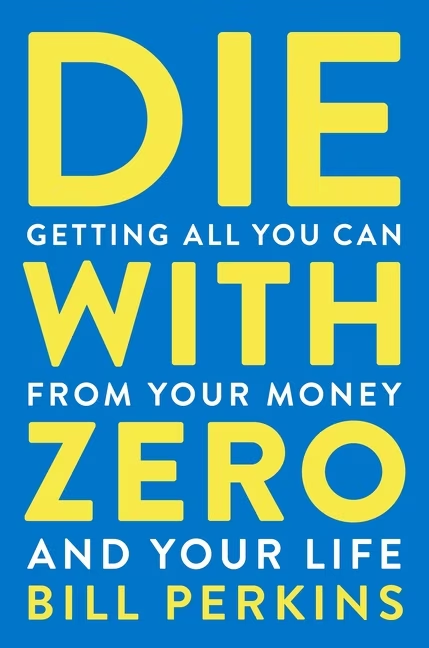
I start with Die with Zero because it most directly deals with the topic of money as we age. In fact, as most retirees know, one of the biggest fears behind the whole retirement saving concept is running out of money before you run out of life.
But it appears that many of us have become so fixated with saving for retirement, we may end up wasting much of our precious life energy, and being the proverbial richest inhabitant of the cemetery. For you super savers out there, this book may be an eye opener, as is the other book, 4,000 Weeks.
As I note in the column, this genre of personal finance started with Die Broke, by Stephen Pollan and Mark Levine, which I read shortly after it was first published in 1998. That’s where I encountered the amusing quip that “The last check you write should be to your undertaker … and it should bounce.”
The premise is similar in both books: there are trade-offs between time, money and health. Indeed, as you can see from the cover shot above, its subtitle is Getting all you can from your money and your life. As with another influential book, Your Money or Your Life, we exchange our time and life energy for money, which can therefore be viewed as a form of stored life energy. So if you die with lots of money, you’ve in effect “wasted” some of your precious life energy. Similarly, if you encounter mobility issues or other afflictions in your 70s or 80s, you may not be able to travel and engage in many activities that you may have thought you had been “saving up” for.
A treatise on Life’s Brevity and appreciating the moment
Amazon.com
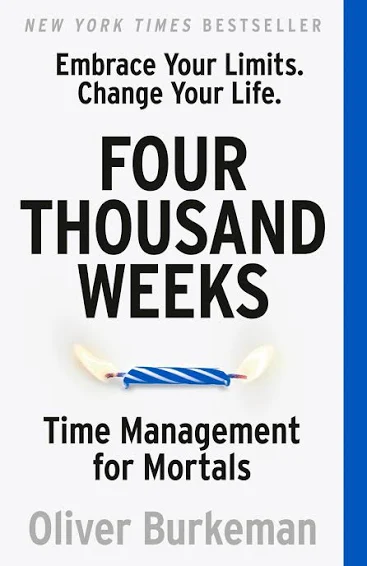
The companion book is Four Thousand Weeks : Time Management for Mortals, by Oliver Burkeman. If you haven’t already guessed, 4,000 weeks is roughly the number of weeks someone will live if they reach age 77 [77 years multiplied by 52 equals 4,004.] Even the oldest person on record, Jeanne Calment, lived only 6,400 weeks, having died at age 122.
I actually enjoyed this book more than Die with Zero. It’s more philosophical and amusing in spots. Some of the more intriguing chapters are “Becoming a better procrastinator” and “Cosmic Insignificance Therapy.” I underlined way too many passages to flag here but here’s a sample from the former chapter: “The core challenge of managing our limited time isn’t about how to get everything done – that’s never going to happen – but how to decide most wisely what not to do … we need to learn to get better at procrastinating.”


 Posted By




 Posted By