Longevity & Aging

No doubt about it: at some point we’re neither semi-retired, findependent or fully retired. We’re out there in a retirement community or retirement home, and maybe for a few years near the end of this incarnation, some time to reflect on it all in a nursing home. Our Longevity & Aging category features our own unique blog posts, as well as blog feeds from Mark Venning’s ChangeRangers.com and other experts.

Longevity Insurance vs. Credits: A Primer

This guest blog is excerpted from Moshe Milevsky’s recently published book, How to Build a Modern Tontine

By Prof. Moshe A. Milevsky, Ph.D.

Special to the Financial Independence Hub

I have been asked about the difference between a tontine – be it modern or medieval – and a conventional life annuity, purchased from a regulated life insurance company. Both might appear to perform similar tasks at first glance, but the differences are subtle and important and get to the essence of the distinction between longevity insurance versus longevity (or survivorship) credits.

One aspect of the life annuity story is the financial benefit of risk pooling, and the other is the insurance benefit and comfort from having a guaranteed income that you can’t outlive. Allow me to elaborate with a statement that some readers might find shocking. If you are 75 years old with $100,000 in your RRIF and would like to guarantee a fixed annual income for the rest of your life, there is absolutely no need to purchase a life annuity from an insurance company to achieve that goal. There are other options.

This might sound like something odd for a long-term annuity advocate to say. But the fact is that a non-insurance financial advisor can design a lovely portfolio of zero-coupon strip bonds that will do the job. That collection of bonds will generate $4,000 per year for the rest of your life, even if you reach the grand old age of 115. Ok, financial advisors need to eat too, so they may not do it for $100,000, but I’m sure that a lump sum of $1,000,000 will pique their interest and in exchange you will get $40,000 per year.

Moreover, with these strips, if you don’t make it all the way to the astonishing age of 115, they will continue to send those $4,000 (or $40K) to your spouse, children or favourite charity until the date you would have reached 115, if you had been alive. This collection of strips would be completely liquid, tradeable and fully reversable, although subject to the vagaries of bond market rates. For this I have assumed a conservative, safe and constant 2.5% discount rate across the entire yield curve, which isn’t entirely unreasonable in today’s increasing environment.

Stated technically, the present value of the $4,000 annual payments, for the 40 years between your current age 75 and your maximum age 115, is exactly equal to $100,000 when discounted at 2.5%. Yes, those numbers and ages were deliberately selected so my numerical example rhymes with the infamous 4% rule of retirement planning but has absolutely nothing to do with it.

Now, I’m sure you must now be thinking (or even yelling) “Moshe, but what if you live beyond age 115, eh? You will run out of money!”

Touché. Let’s unpack that common knee-jerk reaction to non-insurance solutions for a moment. To start with, the probability of reaching age 115 is ridiculously and unquantifiably low. If you do happen to be the one in a 100 million (or perhaps billion) that reaches age 115, I suspect you will have other things on your murky mind. Personally and post-covid, there is a very long list of hazards that worries me more than hitting 115.

Nobody really “runs out of money” in this century

Second and more importantly, nobody really “runs out of money” in retirement in the 21st century. That is plain utter fear-mongering nonsense. With CPP, OAS/GIS, the elderly will continue to receive some income for as long as they live even if they have completely emptied every piggy bank on their personal balance sheet. In fact, with tax-based means-testing you might get more benefits if you actually do empty your bank accounts.

Ok, so back to my prior claim and the supporting numbers, if you want a guaranteed (liquid, reversable, bequeathable) income for the rest of your life, you can exchange your $100,000 for a bunch of strip bonds and voila, you have created a sort of pension plan. My point here is that the primary objective isn’t a guaranteed lifetime of income: which anyone can create with a simple discount brokerage account and a DIY instruction manual. Continue Reading…

New retirement: Case study with Cascades Financial Solutions

Photo by Gustavo Fring

By Ian Moyer

(Sponsor Content)

A Canadian couple living in Nova Scotia are approaching retirement. Carlos is 64 and his wife Arlene is 61. They have one adult adopted child who lives on their own with the couple’s three grandchildren. Carlos and Arlene live close to their daughter and help with the grandchildren often, so being able to stay in their home is important.

After two extended careers in the public sector with a combined annual income of $180,000, Carlos and his wife Arlene decided it was time to retire beginning March of the following year.

Managing the family finances Carlos and Arlene were able to save the following for retirement:

Carlos

  • $250,000 Registered Retirement Savings Plan (RRSP), contributing $5500 annually until retirement
  • $31,500 annually from a Defined benefit pension
  • $ 21,000 in A Tax-Free Savings Account (TFSA), contributing $1500 annually

Arlene

  • $290,000 Registered Retirement Savings Plan (RRSP), contributing $5500 annually until retirement
  • $33,600 annually from a Defined benefit pension
  • $ 30,000 in A Tax-Free Savings Account (TFSA), contributing $1500 annually

Carlos and Arlene dream of traveling to various countries and plan to take 3 trips a year and assume they would need a total of $15,000 annually to do so for 8 years. After traveling they would like to contribute to Registered Education Savings Plans (RESP) for each of their grandchildren totalling $3000 a year.

More recently, when the market experienced volatility, Carlos’ portfolio took a big hit. Making adjustments to spending, Carlos was able to recuperate most of his losses and is now back on track with his goals.

“The more you learn, the more you earn.”
— Warren Buffett

A key consideration in Cascades is to take a look at the retirement budget: using their employment income as a starting point to determine how much retirement income they require. It is well known and generally accepted that you will require less income in your retirement years, but how much less? In making this determination the couple can consider they no longer have employment income deductions like CPP and employment insurance, retirement savings, costs related to traveling to work, retirement income tax credits, etc. Carlos used their employment income after these deductions, taxes, and employment expenses and compare that with the projected retirement income. Carlos assumes he would need approximately $120,000 annually.

Carlos believes he has a good understanding of financial planning strategies, but he finds decumulation a bit overwhelming and wanted to learn more to personalize his retirement income based on their needs: using Cascades Financial Solutions retirement Income planning software and to plan for his retirement.

After entering his data into Cascades Financial Solutions Carlos’ report determined the best retirement decumulation strategy would only allow him to receive an after-tax amount of $116,945 per year.

The couple has a few options to offset the$3,055 retirement income shortage.

Life Annuity option: The couple can consider allocating some of their savings to a life annuity that could help achieve a higher sustainable retirement income. These vehicles are a great way the shift the burden of making their money last forever and can often have attractive capital payout ratios throughout the retirement years due to their “mortality credits.” Continue Reading…

Beware the Retirement Risk Zone

I often recommend deferring CPP until age 70 to secure more lifetime income in retirement. It’s also possible to defer OAS to age 70 for a smaller, but still meaningful, increase in guaranteed income.

While the goal is to design a more secure retirement, there can be a psychological hurdle for retirees to overcome. That hurdle has to do with withdrawing (often significant) dollars from existing savings to fill the income gap while you wait for your government benefits to kick in.

Indeed, the idea is still to meet your desired spending needs in retirement – a key objective, especially to new retirees.

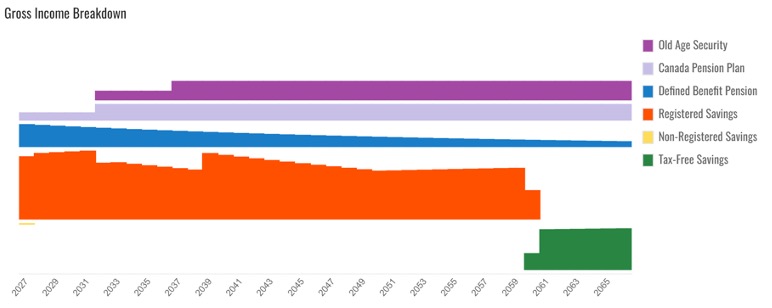
This leads to what I call the retirement risk zone: The period of time between retirement and the uptake of delayed government benefits. Sometimes there’s even a delay between retirement and the uptake of a defined benefit pension.

Retirement Risk Zone

The challenge for retirees is that even though a retirement plan that has them drawing heavily from existing RRSPs, non-registered savings, and potentially even their TFSAs, works out nicely on paper, it can be extremely difficult to start spending down their assets.

That makes sense, because one of the biggest fears that retirees face is the prospect of outliving their savings. And, even though delaying CPP and OAS helps mitigate that concern, spending down actual dollars in the bank still seems counterintuitive.

Consider an example of a recently divorced woman I’ll call Leslie, who earns a good salary of $120,000 per year and spends modestly at about $62,000 per year after taxes (including her mortgage payments). She wants to retire in nine years, at age 55.

Leslie left a 20-year career in the public sector to work for a financial services company. She chose to stay in her defined benefit pension plan, which will pay her $24,000 per year starting at age 65. The new job has a defined contribution plan to which she contributes 2.5% of her salary and her employer matches that amount.

Leslie then maxes out her personal RRSP and her TFSA. She owns her home and pays an extra $5,000 per month towards her mortgage with the goal of paying it off three years after she retires.

Because of her impressive ability to save, Leslie will be able to reach her goal of retiring at 55. But she’ll then enter the “retirement risk zone” from age 55 to 65, while she waits for her defined benefit pension to kick in, and still be in that zone from 65 to 70 while she waits to apply for her CPP and OAS benefits.

The result is a rapid reduction in her assets and net worth from age 55 to 70:

Retirement risk zone example 55-70

Leslie starts drawing immediately from her RRSP at age 56, at a rate of about 7.5% of the balance. She turns the defined contribution plan into a LIRA and then a LIF, and starts drawing the required minimum amount. Finally, she tops up her spending from the non-registered savings that she built up in her final working years.

When the non-registered savings have been exhausted at age 60, Leslie turns to her TFSA to replace that income. She’ll take that balance down from $216,000 to about $70,000 by age 70. Continue Reading…

4 ways Life Insurance can fund Retirement

Image by unsplash: James Hose jr

By Lucas Siegel

Special to the Financial Independence Hub

The infamous retirement crisis that’s been talked about for years just became real, with inflation and interest rates reaching record highs in the past few months. Consumer prices skyrocketed by 9.1% as of June 2022, the largest increase we’ve seen in 40 years. Couple that with a growing senior population living off a fixed income, many of which retired early during the pandemic, and you have yourself a massive problem.

Most senior Americans are unaware that their life insurance policy could be one of their most valuable liquid assets. Contrary to popular belief, life insurance isn’t just a way to care for loved ones after you die through the death benefit. In fact, permanent life insurance policies can also be used to access funds for retirement planning and healthcare when you need it most. Life settlements are legal throughout the US and regulated in all except six states, as well as the provinces of Quebec and Saskatchewan in Canada.

Regardless of age or financial standing, understanding the true value of your assets is essential to living out the retirement you deserve. Check out the following four ways you can use your life insurance policy to help fund retirement:

1.)   Sell your life insurance policy through a life settlement

For millions of Americans who own a life insurance policy, selling it through a life settlement can be a great way to access cash when it’s most needed. A life settlement involves selling a life insurance policy for lump-sum cash payment that is more than the cash surrender value, but less than the death benefit. Despite decades of industry innovation and growth, some 200 billion dollars[US$] in life insurance is lapsed each year that could have been sold as a life settlement.

While the life settlement process once took two to four months, AI technology has expedited the process, making it easier than ever the get a life settlement valuation. Policyholders can now use a free life settlement calculator to instantly see how much their policy is worth based on a few simple questions. Just as you track the value of your house on Zillow or your car on Autotrader, understanding the value of your life insurance policy is critical to make the best financial decisions for you and your family.

2.)   Obtain the cash value from a permanent policy

When you pay your premium on a permanent life policy, only a portion goes toward covering the cost of your life insurance. The remainder of these payments goes into an investment account where cash value can grow on a tax-deferred basis. As you age, you’ll also eventually be able to tap into the interest earnings from this investment account to help keep your policy active, thus bringing down your out of pocket premium payments. Essentially, the money in this account can be treated as emergency savings with tax advantages.

3.)   Borrow from your policy through a loan

Americans with whole life insurance that have accrued enough cash value to cover the debt can also use their policy as collateral through a whole life loan program. One major benefit is the interest rate will be much lower than what you’d see with credit card debt or an unsecured personal loan. This allows the policyholder to get a one-time, tax-free distribution that can be paid off with interest in life, or be withdrawn from your life insurance policy’s death benefit. Retirees might be able to go through their insurance carrier if whole life loans are offered, or utilize a third-party whole life loan program instead. Continue Reading…

Moshe Milevsky and Guardian Capital unveil a Modern Tontine in new Retirement solution

Moshe Milevsky

A revolutionary new approach to preserving portfolio longevity through a modern “Tontine” structure was unveiled Wednesday by Guardian Capital LP and famed author and finance professor Moshe Milevsky.

GuardPath™ Longevity Solutions, created in partnership between Guardian and Schulich School of Business finance professor Milevsky, is designed to address what Nobel Laureate Economist William Sharpe has described as the “nastiest, hardest problem in finance” 1

Announced in Toronto on September 7, a press release declares that the “ground-breaking step” aims to “solve the misalignment between human and portfolio longevity.” See also this story in Wednesday’s Globe & Mail.

Over the years, I have often interviewed Dr. Milevsky about Retirement, Longevity, Annuities and his unique take on how the ancient “Tontine” structure can help long-lived investors in their quest not to outlive their money. Milevsky has written 17 books, including his most recent one on this exact topic: How to Build a Modern Tontine. [See cover photo below.]

Back in 2015, I wrote two MoneySense Retired Money columns on tontines and Milevsky’s hopes that they would one day be incorporated by the financial industry. Part one is here and part two here. See also my 2021 column on another pioneering Canadian initiative in longevity insurance: Purpose Investment Inc.’s Longevity Pension Fund.

Addressing the biggest risks faced by Retirees

In the release, Milevsky describes the new offering as a “made-in-Canada” solution that addresses “the biggest risks facing retirees and are among the first of their kind globally. Based on hundreds of years of research and improvement and backed by Guardian Capital’s 60-year reputation for doing what’s right for Canadian investors, I am confident these solutions will revolutionize the retirement space.”

Milevsky’s latest book is on Modern Tontines

In an email to me Milevsky said: “You and I have talked (many times) about tontines as a possible solution for retirement income decumulation versus annuities. Until now it’s all been academic theory and published books, but I finally managed to convince a (Canadian) company to get behind the idea.”

In the news release, Guardian Capital Managing Director and Head of Canadian Retail Asset Management Barry Gordon said that “for too many years, Canadian retirees have feared outliving the nest egg they have worked so hard to create.” It has answered that concern by creating three solutions that aim to alleviate retirees’ greatest financial fears: The three solutions are described at the bottom of this blog.

With the number of persons aged 85 and older having doubled since 2001, and projections suggesting this number could triple by 2046,2 Guardian Capital says it “set out to create innovative solutions that this demographic could utilize when seeking a greater sense of financial security.”

Tontines leap from Pop Culture to 21st Century reality

Tontines were one of the most popular financial products for hundreds of years for individuals willing to trade off legacy for more income, Guardian says. Once in a  while the tontine shows up in popular culture, notably in the film The Wrong Box, where the plot revolves around a group of people hoping to be the last survivor in a tontine and therefore the recipient of a large payout.

“With our modern tontine, investors concerned about outliving their nest egg pool their assets and are entitled to their share of the pool as it winds up 20 years from now,” Gordon says, “Over that 20-year period, we seek to grow the invested capital as much as possible to maximize the longevity payout. Along the way, investors that redeem early or pass away leave a portion of their assets in the pool to the benefit of surviving unitholders, boosting the rate of return. All surviving unitholders in 20 years will participate in any growth in the tontine’s assets, generated from compound growth and the pooling of survivorship credits. This payout can be used to fund their later years of life as they see fit, and aims to ensure that investors don’t outlive their investment portfolio.” Continue Reading…