Building Wealth

For the first 30 or so years of working, saving and investing, you’ll be first in the mode of getting out of the hole (paying down debt), and then building your net worth (that’s wealth accumulation.). But don’t forget, wealth accumulation isn’t the ultimate goal. Decumulation is! (a separate category here at the Hub).

How to stay motivated while Pursuing Financial Independence

Image courtesy of Terkel

From setting specific financial goals for success to having someone hold you accountable, here are 18 answers to the question, “What are your best tips for how to stay motivated and disciplined in the pursuit of financial independence?”  

  • Stay Disciplined and Goal-Oriented
  • Tie Your Goals to a Tangible Item
  • Stay Educated
  • Equate Money to Your Time
  • Celebrate Small Wins Along the Way
  • Develop an Action Plan
  • Create a Budget
  • Invest in Yourself
  • Develop a Strong “Why”
  • Have Fun With It
  • Set Specific Financial Goals for Success
  • Balance Spending Now and Saving for the Future
  • Start Tracking Your Progress
  • Focus On the Big Picture
  • Be Present
  • Build a Support System
  • Set Yourself Micro-Goals Along the Way
  • Find a Financial Accountability Buddy

Stay Disciplined and Goal-Oriented

Staying motivated and disciplined while pursuing financial independence requires commitment. One approach to remaining committed is to practice goal-setting, breaking down big goals into smaller goals that are based on achievable objectives. For example, if you want to save $1,000 in 3 months, break your bigger goal of saving money into a series of monthly phases, setting benchmarks each month as you inch closer to achieving your end goal. This helps with momentum and development while moving towards your desired result. — Michael Alexis, CEO, swag.org

Tie Your Goals to a Tangible Item

One often overlooked way to accomplish this is to tie your goals to a tangible item, such as a savings jar or bank account. Visualize yourself with it when planning out what you need to do today and watch as your small contributions add up. 

Having this visual representation can be just the thing you need on days when you feel unmotivated and looking for an excuse not to save money. Taking ownership of your financial goals is the first step towards realizing those dreams – that’s what staying disciplined will help you achieve! — Tasia Duske, CEO, Museum Hack

Stay Educated

Continually educating yourself about personal finance is crucial in staying motivated and disciplined as you pursue financial independence. Of course, this starts with knowing how to budget and set boundaries for yourself. 

As you strive toward financial independence, it’s important that you know where your money is going and identify areas where you can cut back on spending. There are a variety of ways that you can budget your money, so explore those options and find a way that works for you. 

If you are one who likes to invest, stay up to date on current market trends so you don’t take any enormous risks that could cost you a lot of money. As you continue to stay informed and educated about personal finance, you will make informed decisions and avoid costly mistakes, which will ultimately help you achieve your goals. — Bill Lyons, CEO, Griffin Funding

Equate Money to your Time

Whether you make minimum wage or $100 an hour, we all trade time for money. Spending less money is one way to achieve greater financial independence. But when you’re struggling to cut expenses, one way to stay motivated is to understand how much time your money costs you. 

For example, if you’re toying with the idea of a $50 purchase, think of how much of your time it would take to make back that $50. How far would that put you behind? Would you be willing to spend that time getting that item?

Thinking about money in terms of minutes/hours of your life can help you exercise some restraint on impulse buys or unnecessary purchases. If you feel like it would be a waste of time, it’s probably a waste of money, too. — Alli Hill, Founder and Director, Fleurish Freelance

Celebrate Small Wins along the way

Achieving financial independence can be a long and difficult journey, and it’s easy to become discouraged if you only look at the result. You can keep your motivation and momentum going by celebrating minor victories along the way.

Set attainable short-term goals, such as paying off a credit card or increasing your monthly savings by a certain amount. When you achieve these objectives, take the time to recognize your accomplishments and reward yourself‌. 

As a reward for sticking with it, give yourself a small treat or indulge in a favorite activity. This will help you in maintaining your motivation and discipline, as well as making the journey to financial independence more enjoyable. –– Johannes Larsson, Founder and CEO, JohannesLarsson.com

Develop an Action Plan

It is important to develop a plan with realistic goals. Start by setting short-term goals that are achievable, such as saving a certain percentage of each paycheck or paying off the debt within a certain timeframe. 

Then, set longer-term goals for retirement savings or other goals related to financial independence. Having a plan will help keep you motivated and on track to achieving your financial goals. — Martin Seeley, CEO, Mattress Next Day Continue Reading…


Timeless Financial Tips #3: Tax-Planning as a Lifetime Pursuit

Lowrie Financial: Canva Custom Creation

By Steve Lowrie, CFA

Special to Financial Independence Hub

I would be remiss if I didn’t dedicate at least one post in my “Play It Again, Steve” series to everyone’s least favourite, but still significant topic: taxes.

It’s a good thing there’s no tax on writing about tax planning; if there were, I would surely owe a lot.

Here are six timeless techniques for reducing your lifetime tax load:

1. Fill up your tax-sheltered investment accounts.

Taxes primarily exist to raise money for government operations, but they also are often structured to encourage us to spend and save in particular ways. For example, there are:

If you’re saving anyway, you might as well take advantage of any available tax breaks for doing so. Each tax-sheltered, or “registered” account comes with different rules on whether the money goes in pre- or post-tax, and whether it comes back out as taxable or tax-free income. But all of them share a powerful, often overlooked advantage: Investments in all registered accounts grow tax-free.

So, fill up those registered accounts. Also, be sure to invest any of it you’re not going to need for a decade or more. The snowball effect of tax-sheltered investing should help you accumulate significantly more after-tax wealth than if it’s just sitting in cash.

2. Invest tax efficiently in and among your registered and taxable accounts.

There are endless ways to invest more tax-efficiently; here are a few of the greatest hits:

How you invest: Since you only incur taxes when you sell a holding, an obvious rule of thumb is to avoid unnecessary taxable trading. Build a durable portfolio you can stick with through thick and thin, and avoid chasing hot and cold stock picks and market conditions.

With whom you invest: Especially in your taxable accounts, avoid funds whose managers are actively picking stocks or timing the market. You won’t directly see their extra, unnecessary trades. But they’ll show up at tax time in the form of taxable capital gain distributions to unit holders: i.e., you. Worse, you could end up owing taxes on those invisible gains, whether the fund goes up or down in value. There are few more unpleasant surprises for an investor than a big, year-end tax bill on a fund that’s lost value.

Where you invest (asset location): Hold your relatively tax-inefficient assets (such as bonds and REITs) in tax-sheltered accounts, where the inefficiencies don’t matter as much. Hold your relatively tax-efficient assets (such as broad stock funds) in taxable accounts.

3. Remember, not all tax rates are the same. Aim for the less costly ones.

For personal taxable accounts and investment holdcos, some taxes cost less than others. Your most tax-efficient investing income comes in the form of capital gains, since they are taxed at lower rates than other sources such as interest or dividends. This, combined with asset location considerations, is another reason to avoid loading up on dividend stocks as a strategy for generating an income stream in retirement.

Don’t believe me? Consider these 2023 combined tax rates for Ontario:

Taxable Income Source 2023 Combined Tax Rate
Interest and other income 53.53%
Eligible dividends (mostly Cdn. companies) 39.34%
Capital gains 26.76%
It’s also worth keeping an eye on whether your annual income is approaching marginal tax rate thresholds. For example, in Ontario, if you make over $235,675 in 2023, you’ll be in the top bracket. If your annual income is approaching that figure, you and your accountant can look for sensible ways to avoid reaching it. Investment holdco owners have additional tax-planning tools available to help manage the income earned from corporation investments.

The Balanced Portfolio journey after a terrible 2022

Inverted Yield Curves & Recession: How smart are Markets?

Image Outcome/Creative Commons

By Noah Solomon

Special to Financial Independence Hub

Today’s Special: An Inverted Yield Curve with a Side Order of (Possible) Recession

In our discussions with clients over the past several months, the two frequent topics of conversation have been:

  1. The inversion of the U.S. Treasury curve, and
  2. The possibility of a recession occurring within the next few quarters.

In the following missive, I use a data-based, historical approach to explore the possible investment implications of these concerns.

How Smart is the Yield Curve?

The U.S. Treasury market has an impressive track record in terms of forecasting recessions. Going back to the late 1980s, every time the yield on 10-year U.S. Treasury bonds has remained below that of its two-year counterpart for at least six months, a recession has followed. Such was the case with the recession of the early 1990s, of the early 2000s, and of the global financial crisis.

When it comes to investing (as with many things), timing is critical. Given that yield curves do occasionally invert and that recessions do happen from time to time, it follows that every recession has been preceded by an inverted curve, and vice-versa. What makes the historical prescience of inverted yield curves so impressive is that the recessions which followed them did so within a relatively short period.

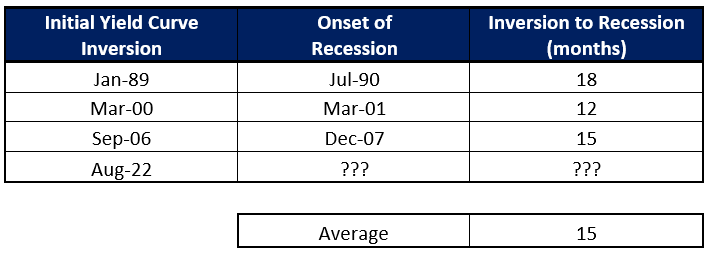
United States – Months from Yield Curve Inversion to Onset of Recession: 1989-Present

The table above covers the past three U.S. recessions, excluding the Covid-induced contraction of 2020, which I have omitted since it had nothing to do with macroeconomic factors, monetary policy, etc. As the table demonstrates, the time lag between yield curve inversions and economic contractions has ranged between 12 and 18 months, with an average of 15 months.

However, the yield curve’s impeccable record of predicting recessions has not been matched by its market timing abilities. As summarized in the following table, the S&P 500 Index has produced mixed results following past inversions in the Treasury curve.

S&P 500 Performance Following Yield Curve Inversions: 1989-Present

When the Treasury curve inverted at the beginning of 1989, stocks proceeded to perform well, returning 24.1% over the following two years. Conversely, when the curve became inverted in March 2000, the S&P 500 fared poorly, losing 21.5% over the same timeframe. The index suffered a similarly undesirable fate following the Treasury curve inversion in September 2006, when stocks suffered a two-year decline of 9.1%.

How Smart is the Stock Market?

In the past, the economy and equity markets have not been correlated. Stock prices are forward looking. Historically, equities have started to decline prior to peaks in economic growth and have tended to rebound in advance of economic recoveries.

The trillion-dollar question is not whether the market is smart, but whether it is smart enough. Do prices bake in a sufficient amount of bad news ahead of time so that they avoid further losses following the onset of recessions? Or do they lack sufficient pessimism to avoid this fate? Frustratingly, the answer depends on the recession!

S&P 500 Performance Following Start of Recessions: 1990-Present

Stocks managed to skate through the recession of the early 1990s unscathed. Following the peak of the economy in mid-1990, the S&P 500 Index went on to produce a total return of 27.2% over the next two years. Unfortunately, investors were not so lucky during the recession of the early 2000s, with stocks losing 24.6% in the two years after the recession began. Similarly, the recession of 2008 was no walk in the park for markets, with the S&P 500 falling 20.3% after the economy began contracting at the end of 2007. Continue Reading…

Franklin Bissett overweights defensive stocks over traditional Canadian sectors like Energy & Financials


Despite a looming recession acknowledged by most of the financial industry, Franklin Templeton Canada is relatively upbeat about the prospects for both Canadian stocks and fixed income over the short- to medium-term. In a Toronto event on Wednesday aimed at financial advisors and the press, Garey J. Aitken, MBA, CFA — Calgary-based Chief Investment Officer for Franklin Bissett Investment Management — described how he has been positioning his Franklin Bissett Canadian Equity Fund somewhat defensively. (There was also a webinar version of the event.)

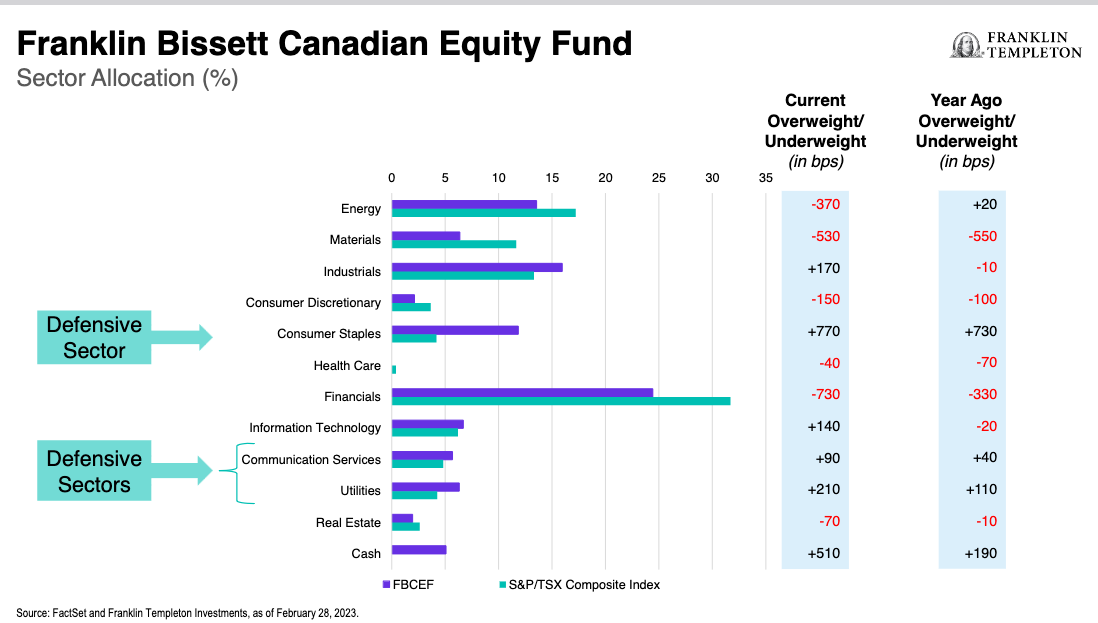
As you can see from the above breakdown of the fund, Aitken is way overweight defensive sectors like Consumer Staples relative to the index: the S&P/TSX composite. In Canada, consumer staples amounts to the major grocery stores like Loblaw and Metro: there’s little along the lines of such American staples giants as Proctor & Gamble or Colgate Palmolive. Aitken said his fund has owned Saputo Inc. since its IPO in the late 90s, and has long owned Alimentation Couche-Tard Inc.

The fund has been overweight consumer staples for more than a year: as the chart shows, he was overweight this defensive sector by a whopping 730 basis points a year ago and this year is even more overweight by 770 bps. He is also overweight the other big defensive sector, Utilities, by 210 bps, compared to overweight by 110 bps a year ago. The third major defensive sector globally is Health Care, but the Canadian stock market has only minimal exposure to that sector.

Aitken has moved from a small underweight position in industrials a year ago to a modest overweight in 2023 of 170 bps. And he is slightly overweight Information Technology by 140 bps, compared to a small underweight of 20 bps a year ago.

Underweight Energy, Financials & Materials

On the flip side, the fund has been and continues to be underweight in the three big sectors for which the Canadian stock market is famous: Energy, Financials & Materials. Financials (chiefly the big Canadian banks) were underweight 330 bps a year ago and Aitken has moved that to an even bigger 730 bps underweight this year. In Materials he has stayed largely pat, with a 530 underweighting today compared to a 550 bps underweighting a year ago.

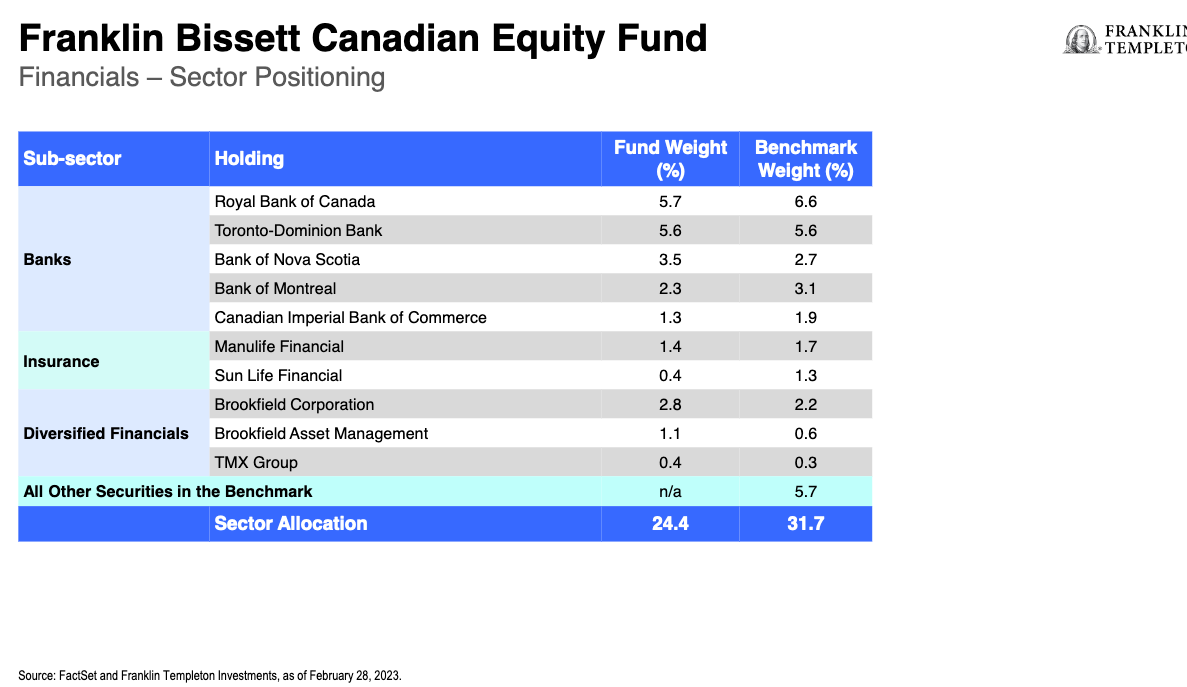
The chart below shows the fund’s holding in Canadian financials. You can see that among the big Canadian banks, the fund is over the index weighting only for the Bank of Nova Scotia, and is slightly overweight Brookfield Corp. and Brookfield Asset Management:


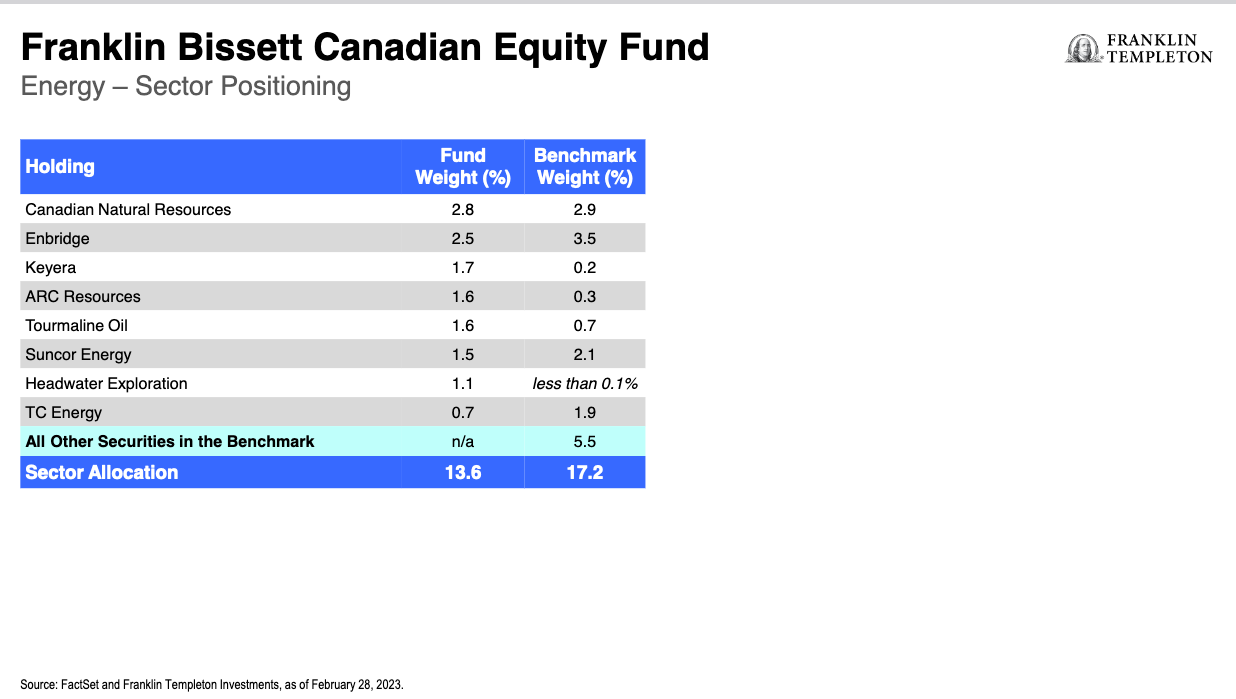
However, Aitken has moved Energy (Canadian oil & gas stocks, pipelines etc.) from a small 20 bps overweight position last year to a 370 bps underweighting in 2023. The chart below shows the major Energy holdings relative to the index, with overweights in certain less well-known names: 


Aitken remains slightly underweight Consumer Discretionary stocks, moving from a 100 bps underweight last year to 150 bps underweight currently. Real estate is almost flat: from a slight 10 bps underweighting a year ago to a small 70 bps underweight today.  Continue Reading…