Building Wealth

For the first 30 or so years of working, saving and investing, you’ll be first in the mode of getting out of the hole (paying down debt), and then building your net worth (that’s wealth accumulation.). But don’t forget, wealth accumulation isn’t the ultimate goal. Decumulation is! (a separate category here at the Hub).

A Retirement-ready portfolio of Canadian and U.S. stocks


By Dale Roberts, cutthecrapinvesting

Special to the Financial Independence Hub

In this post I’ll offer up charts on our U.S. stock portfolio and the Canadian stock portfolio. And I’ll put them together so that we can see how they work together. The total portfolio was designed to be retirement-ready. The fact that it beats the market benchmarks is a welcome surprise. At the core of the portfolio is wonderful Canadian dividend payers – the U.S. stocks fill in some portfolio holes. Let’s have a look at our U.S. and Canadian stock portfolio.

I recently received requests to share our U.S. stock portfolio holdings. While I often track that portfolio on Seeking Alpha (the land of stock pickers) that’s not a regular event on this blog. I have certainly shared the Canadian Wide Moat Portfolio on Cut The Crap Investing.

On Seeking Alpha, here is our U.S. stock portfolio. The post may be paywalled for those who have exceeded the 3 free reads on Seeking Alpha. Again, that’s why I will share some details here. But keep in mind, this is not advice. But you may be on the receiving end of some ‘good’ lessons on building the simple stock portfolio.

Skimming the dividend achievers index

In early 2015 I skimmed 15 of the largest-cap dividend achievers. What does skim mean? After extensive research into the portfolio “idea” I simply bought 15 of the largest cap dividend achievers. For more info on the index, have a look at the U.S. Dividend Apprecation Index ETF (VGG.TO) from Vanguard Canada. At the core is a meaningful dividend growth history working in concert with financial health screens. It leads to a high quality skew.

You will find that index ETF in the ETF portfolio for retirees post.

At Questrade you can buy ETFs for free.

I won’t get too deep into the methodology and how and why I constructed our portfolio in this post. I will offer more details in a post next week. Today, I will just get to the fun stuff – the holdings and the return charts and tables.

The U.S. Dividend Achievers

The 15 companies that I purchased in early 2015 are 3M (MMM), PepsiCo (PEP), CVS Health Corporation (CVS), Walmart (WMT), Johnson & Johnson (JNJ), Qualcomm (QCOM), United Technologies, Lowe’s (LOW), Walgreens Boots Alliance (WBA), Medtronic (MDT), Nike (NKE), Abbott Labs (ABT), Colgate-Palmolive (CL), Texas Instruments (TXN) and Microsoft (MSFT). Continue Reading…

Nobody knows what will happen to an Individual Stock

Image via Pixels/Tima Miroshnichenko

By Michael J. Wiener

Special to the Financial Independence Hub


When I’m asked for investment advice and I say “nobody knows what will happen to an individual stock,” I almost always get nodding agreement, but these same people then act as if they know what will happen to their favourite stock.

In a recent case, I was asked for advice a year ago by an employee with stock options.  At the time I asked if the current value of the options was a lot of money to this person, and if so, I suggested selling some and diversifying.  He clearly didn’t want to sell, and he decided that the total amount at stake wasn’t really that much.  But what he was really doing was acting as though he had useful insight into the future of his employer’s stock.

He proceeded to ask others for advice, clearly looking for a different answer from mine.  By continuing to ask others what they thought about the future of his employer’s stock, he was again contradicting his claimed agreement with “nobody knows what will happen to an individual stock.”

How a seemingly token amount can become a painful loss

Fast-forward a year, and those same options are now worth about 15 times less.  Suddenly, that amount that wasn’t that big a deal has become a very painful loss.  He has now taken advantage of a choice his employer offers to receive fewer stock options in return for slightly higher pay.  It’s hard to be sure without seeing the numbers, but in arrangements I’ve seen with other employers, a better strategy is to take the options and just sell them at the first opportunity if the stock is far enough above the strike price.  Again, he’s acting as though he has useful insight into the future of his employer’s stock.

The lesson from this episode isn’t that people should listen to me.  I’m used to people asking me for advice and then having my unwelcome advice ignored.  What I find interesting is that even if I can get someone to say out loud “I don’t know what’s going to happen to any individual stock,” they can’t help but act as though either they know themselves, or they can find someone who does know.

Michael J. Wiener runs the web site Michael James on Money, where he looks for the right answers to personal finance and investing questions. He’s retired from work as a “math guy in high tech” and has been running his website since 2007.  He’s a former mutual fund investor, former stock picker, now index investor. This blog originally appeared on his site on Sept. 20, 2022 and is republished on the Hub with his permission. 

An Ode to Dividends

By Noah Solomon

Special to the Financial Independence Hub 

Companies that pay sustainable dividends have provided the best returns over time, including during periods of elevated inflation.

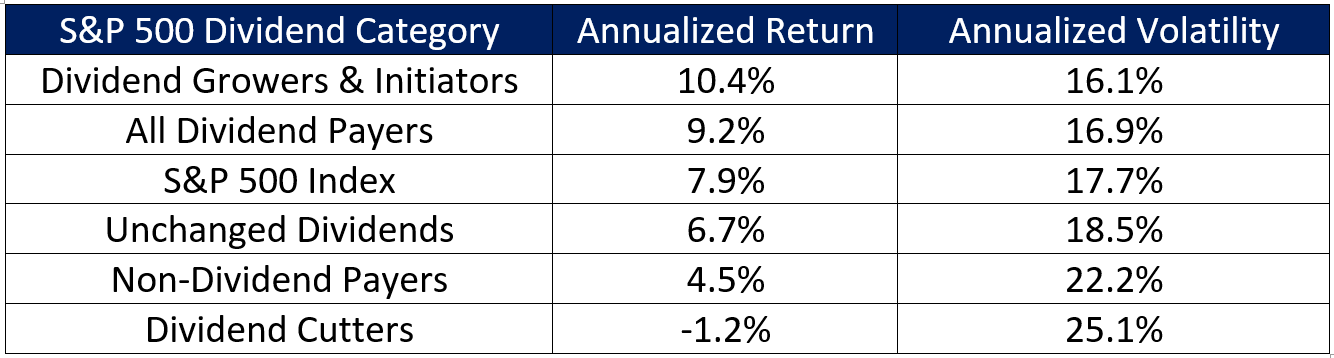
Ned Davis Research (NDR) studied the relative performance of S&P 500 stocks according to dividend category from 1973-2020. Their findings are summarized in the following table:


Returns by Dividend Category (1973-2020)

Over the past 48 years, dividend-paying stocks have outperformed their non-dividend paying counterparts by 4.7% on an annualized basis. When coupled with the power of compounding, this difference is nothing short of astronomical. A $1 million investment in dividend payers over the period would have been valued at $68,341,836 as of the end of 2020, which is $60,070,380 higher than the value of only $8,271,456 for the same amount invested in non-dividend paying stocks.

Within the dividend-paying complex, dividend growers and initiators have been the clear champions, with an annualized return of 10.4% vs. 9.2% for all dividend-paying stocks. A $1 million investment in dividend growers and initiators would be valued at $115,482,326, which is $47,140,940 more than the same amount invested in all dividend payers.

Not only have dividend-paying companies outperformed their non-dividend paying counterparts, but they have done so while exhibiting lower volatility.

NDR’s study also examined the relative performance of dividend payers vs. non-payers in various macroeconomic environments. Specifically, their research set out to ascertain how the outperformance of dividend vs. non-dividend paying stocks has been impacted by inflation, economic growth, and interest rates.

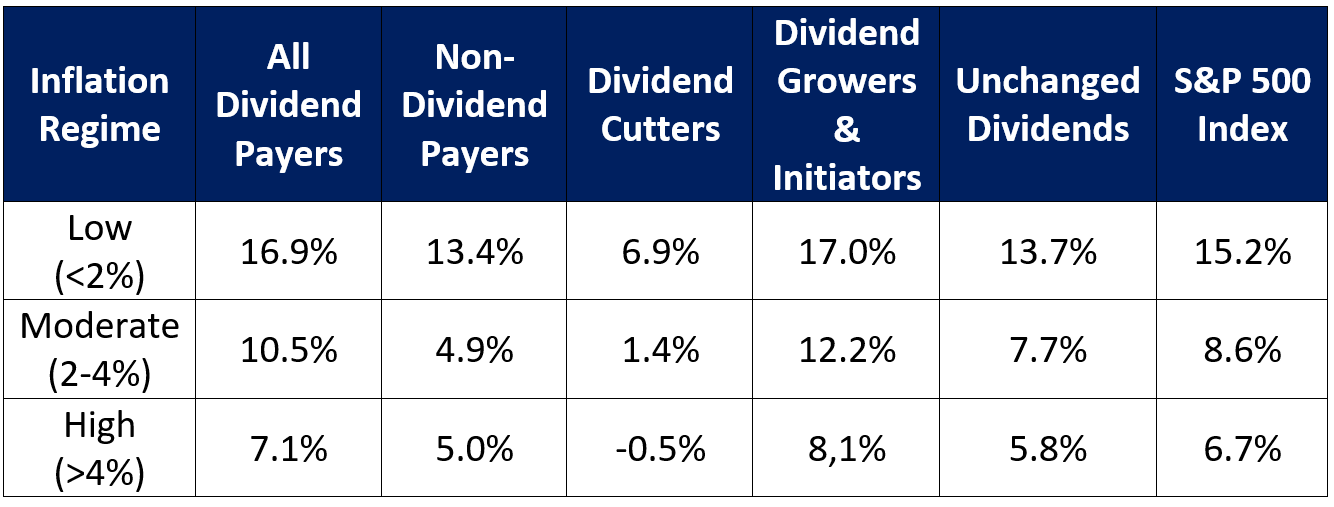
Inflation’s Impact on Returns by Dividend Category (1973-2020)

Dividend-paying stocks have on average outperformed their non-dividend paying counterparts regardless of whether inflation has been low, moderate, or high.

Unsurprisingly, dividend growers and initiators outperformed other dividend-paying companies during periods of moderate to high inflation.

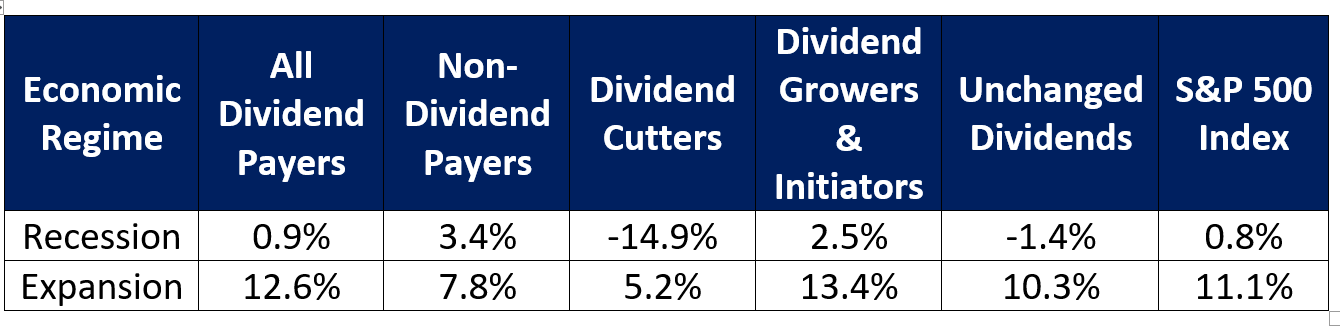
The Economy’s Impact on Returns by Dividend Category (1973-2020)

During recessions, dividend-paying stocks have underperformed non-payers by 2.5% on an annualized basis. This shortfall pales in comparison to their 4.8% outperformance during economic expansions, especially considering that economies spend far more time expanding than contracting. Continue Reading…

This is your Investment Brain on Pessimism

Lowrie Financial: Canva Custom Creation

By Steve Lowrie, CFA

Special to the Financial Independence Hub

I’m no psychic. But I bet I can still correctly divine what’s on most investors’ minds these days.

Pessimism, bordering on despair …

Have you been reading the headlines, viewing your investment portfolio, and assuming the worst is yet to come? Welcome to your painful crash course on what market risk really looks like—and more importantly, how it feels.

Most investors say they’re ok living with periodic market risk, as long as it helps them achieve better returns over the long run. We accept (in theory) that tolerating the interim damage done to our own investment portfolios will help us meet our long-term financial goals.

But that’s investment risk in theory. Since it’s been a long time since we’ve encountered an extended bear market climate, you may have forgotten or never known the reality of it. It may not have clicked then, when significant market declines happen, it is usually due to despairingly bad news … amplified by headlines screaming how things are only going to get worse from here.

The reality is, when we’re in the middle of a storm of stuff, our behavioural biases make it very difficult to believe we’ll ever see better days.

Now and Then Investment News

History informs us otherwise. Even in the current climate, there have been plenty of days when stock markets have delivered positive outcomes. Some days, it’s even been very positive.

How does the popular financial media (aka, “group think central”) report the good news? They have a gloomy story to tell, because that’s what’s been selling lately. So, they dig up market pundits who downplay the uptick. They discount the event as being a “short covering,” “relief rally,” “dead cat bounce,” or some other meaningless adage, rather than accurately reporting that this is just how efficient markets operate every day. Without a scrap of plausible evidence, their confident conclusion is that the markets must soon continue their downward spiral.

A relevant question is: What is the pundit’s track record? You have to dig hard to find the data, but even those with the best reputation score less than a coin flip across their body of forecasts. (Actually only 46.9% accurate according to this study.)

On the subject of forecasting generally, David Booth, the co-founder of Dimensional Fund Advisors, recently offered this very practical insight:

Do you really want to invest your hard-earned savings—the money you’ll need for your kids’ college or your own retirement—based on someone’s hunch or wish?

What Goes Down …

From an analytic perspective, the general economy does have its work cut out for it over the foreseeable future. But, believe it or not, I remain optimistic about staying invested in our financial markets, and I think you should be too.

While I’m admittedly an optimist by nature, I’m also evidence-based. So, let’s look at what we know, and how it shapes what to prepare for—i.e., financial markets that should continue to deliver solid rewards to patient investors in the years ahead.

Let’s start with one of those pictures to replace a thousand words. Compliments of our friends at Dimensional Fund Advisors, here’s what U.S. stock and bond markets have done in the past after stumbling into bear market territories. Defying gravity, it would seem what goes down in financial markets has typically gone back up — and kept going over time.

lowrie dimensional equity returns to 2021
*Dimensional Fund Advisors LLP – Past performance, including hypothetical performance is not a guarantee of future results. Indices are not available for direct investment; therefore, their performance does not reflect the expenses associated with the management of an actual portfolio. In USD. Market declines or downturns are defined periods in which the cumulative return from an a peak is -20% or lower for equities and -2% or lower for fixed income. Returns are calculated for the 1-, 3-, and 5 year look-ahead periods beginning the day after the respective downturn thresholds are exceeded. The bar chart shows the average returns for the 1-, 3-, and 5-year periods following the 20% for equities and 2% for fixed income thresholds. For the 20% threshold, there are 15 observations for 1-year look-ahead, 14 observations for 3-year look-ahead, and 13 observations for 5-year look-ahead. For the 2% threshold, there are 29 observations for 1-year look-ahead, 26 observations for 3-year look-ahead, and 25 observations for 5-year look-ahead. See “Index Descriptions” in the appendix for descriptions of Fama/French index data. Eugene Fama and Ken French are members of the Board of Directions of the general partner of, and provide consulting services to, Dimensional Fund Advisors SP. Bloomberg data provided by Bloomberg.

As always, we can’t guarantee that’s what will happen this time. Nor is it going to be pleasant to wait for markets to likely do what they’ve done before. But one thing is for sure: If you sell out of today’s markets or make significant changes, you’ll lock in at today’s lows, despite the logic and data that suggests we should expect above-average returns over the next few years. In past posts, I’ve referred to this as one of the Big Mistakes in investing.

Markets, Economies, and Different Drummers

You may also have noticed that financial market pricing is often quite out of sync with economic indicators, especially in more volatile markets. The economy will stumble … and markets will end higher for the day. Or the economy will catch a break, and stock prices drop. Continue Reading…

Earning income from dividends: reality or fantasy?

By Anita Bruinsma, CFA

Clarity Personal Finance

Special to the Financial Independence Hub

Getting an income from dividends is a concept that is often mentioned in the personal finance world. It can seem like an elusive concept – a unicorn – or perhaps something for the super-rich or those with investment gurus at their disposal. In reality, though, anyone with some savings can earn dividends and it doesn’t require much expertise.

A dividend is a cash payment made by a company to its shareholders. Shareholders are simply people who own stock (or shares) in their company. If I own shares of TD Bank, I get $3.56 per year for every share I own. It might not sound like much, but if I invest $3,000 in TD Bank today, I’d be in line to get $132 over a year. It adds up!

Let’s get something straight though: living entirely off dividends requires a lot of money available to invest. It’s not a reality for most people.

Here are a few numbers to give you context. In order to earn $40,000 a year (before tax) from dividends, you’ll need a portfolio of about a million dollars to invest in stocks.* You’ll then have to pay tax on these dividends (except for those that are earned within your TFSA). As you can see, living off dividends isn’t a strategy available to most people.

If you are looking to supplement your income to maybe pay for your annual vacation, you can earn $5,000 a year (all figures are before tax) with $125,000 to invest. For $10,000 a year, you’ll need about $250,000.

Dividends have more benefits that just giving you cash flow – they also give you a reasonably reliable investment return and can protect against inflation. A company that has a long history of paying a dividend and consistently growing it over time provides a quasi-guaranteed return on a stock. (No dividend is guaranteed but it can be consistent and dependable.) Even though the stock prices goes up and down (unreliable), you’ll get the dividend (reliable). Even better, many companies increase their dividend year after year, sometimes at a rate higher than inflation, so dividends can help protect you from the ravages of inflation too.  You can read more about dividends in a prior blog post.

DRIPs

For those who don’t need the additional cash flow, another way of benefitting from dividends is to reinvest them. There are two ways to receive a dividend: it can be paid in cash into your account or it can be paid to you in shares. This is called a Dividend Reinvestment Plan, or DRIP. If you sign up for a DRIP, you’ll receive additional shares of the company you are invested in. For example, if you own BCE (Bell), and you own 100 shares, you’ll be entitled to a dividend payment of $368 every year. You could get that in cash, or you could get 6 more shares of BCE. This is great because then next year you’ll get a dividend on 106 shares – and the snowball keeps rolling.

There is important roadblock to this strategy for a lot of people: if you want to earn dividends, you have to invest the cash in dividend-paying stocks or funds. This means that if all of your savings amounts to $125,000, and you want to earn $5,000 in dividends, you will need to invest all of it and you will not be well-diversified nor will you have any money in less volatile investments like bonds or GICs. You also need to ensure you have enough money that isn’t invested in the market to use in emergencies or for near-term uses.

Dividend ETFs

If you’ve decided that you want income from dividends and you’re comfortable with having your savings invested in the market, you might asking “Now what?” How do you get these dividends flowing? Well, you’ll need to find investments that pay dividends, preferably reliable, consistent, high, and growing ones. Unless you have a large portfolio, the most efficient and the simplest way to invest for dividends it to put your money in a high dividend-paying exchange traded fund. This kind of ETF will invest in companies that pay high dividends and as an investor, this money will flow through to you via fund distributions, which you can choose to take as cash or re-invest in more units of the fund (like a DRIP).

To find an appropriate ETF, do a Google search for “high dividend yielding ETFs” and drill down into a few. There are three things to look at when choosing which to invest in:

  1. What is the yield? Higher is better.
  2. Does it invest in a broad swath of the stock market? Avoid ones that invest in a specific sector.
  3. What is the MER, or annual fee? The fees on these ETFs are higher than broad market ETFs but you can find a high yielding ETF for less than 0.20% per year.

Yield is the most relevant number to look at with dividend investing. It’s simply a measure of how much income you will get as a percent of the amount you invest. It’s like an interest rate on a GIC: if a GIC pays 4% interest, you get $40 for every $1,000 you invest. If a stock has a dividend yield of 4% you’ll get $40 of dividends for every $1,000 you invest. (Dividends don’t happen in nice round numbers like that, though.) If an ETF has a 4% yield, you’ll get $40 in distributions from the fund.

Although I am not usually a proponent of stock picking, this is one situation where I feel that owning individual, high-dividend paying stocks can be okay. If you have enough money to own a number of stocks, you could put together a portfolio of high-quality dividend stocks that have a long track record of paying and growing their dividends. In Canada, this list would probably include Canadian banks, telecom companies and utilities, among others. For example, a portfolio consisting of TD Bank, Royal Bank, Manulife, BCE, Telus, Enbridge, Fortis and Algonquin Power yields more than 5% right now.

Are you still with me? If that last paragraph made you want to stop reading, please don’t! If you’re not into investing in individual stocks, keep it simple and go the ETF route. Here are a few Canadian ones to look at:

iShares S&P/TSX Composite High Dividend ETF (XEI)

Vanguard FTSE Canadian High Dividend Yield Index (VDY)

BMO Canadian Dividend ETF (ZDV)

(Note: You can also buy U.S. and international dividend ETFs.)

The yields on these ETFs and on dividend-paying stocks are quite high right now. This is because the stock market has fallen. As the price of a stock falls, the dividend yield increases because you need to spend less per share to get the same dividend. To demonstrate, let’s look at BCE (Bell). BCE pays a dividend of $3.68 per year. If the stock is trading at $63 (as it was a year ago) you pay $63 to get a $3.68 dividend, which is a 5.8% yield ($3.68/$63). Today, BCE is trading at $57 which means it has a yield of 6.5% ($3.68/$57). (If you are ticked off at the amount of your internet, cable and cell phone bill with Bell, offset it with some sweet dividends!)

Living off dividends? Probably a pipe dream. Adding some cash flow, getting a good return on your investment, and fighting inflation? Not a unicorn – it’s totally doable!

*Assumes a 4% dividend yield.

Anita Bruinsma, CFA, has 25 years of experience in the financial industry. As a long-time investor, Anita is passionate about demystifying investing to make is accessible to more people. After a long and satisfying career in the world of banking and wealth management, including 15 years managing mutual funds with a Canadian bank, Anita started Clarity Personal Finance, and now helps people learn to better manage their finances, including how to invest for themselves.