Building Wealth

For the first 30 or so years of working, saving and investing, you’ll be first in the mode of getting out of the hole (paying down debt), and then building your net worth (that’s wealth accumulation.). But don’t forget, wealth accumulation isn’t the ultimate goal. Decumulation is! (a separate category here at the Hub).

Doing the math on investment fees: the math isn’t pretty

A few weeks ago I invited readers to share their portfolio details with me so I could help ‘do the math’ on their investment fees. Many of you did, and the results weren’t pretty. From accounts loaded with deferred sales charges (DSCs), management expense ratios (MERs) in the high 2 per cent range, and funds overlapping the same sectors and regions, it was a predictable mess of over-priced products.

The worst of the bunch: the number of portfolios filled with segregated funds.

I’ve highlighted segregated funds as the biggest offender when it comes to fees for two reasons:

1.) The MER on segregated funds are higher than most mutual funds (which we know are already high enough). I looked at one portfolio that held a suite of segregated funds from Industrial Alliance called Ecoflex, with MERs of 2.99, 3.26, and 3.29 per cent;

2.) Segregated funds were exempt from CRM2 disclosure rules because they are considered insurance products. Investors receive the fund facts sheet, which still express fees in percentage terms rather than breaking them down and disclosing in dollar terms.

Doing the math on your investment fees


Keep in mind most readers were looking for me to do the math on their investment fees for portfolios valued at $250,000 or more. One reader, a soon-to-be retiree, had an average MER of 3.13 per cent for his $412,000 portfolio.

I told him he paid nearly $13,000 in investment fees last year and asked if he thought he was getting good value for his fees. He said he hadn’t met with his advisor in three years, despite repeated attempts to get together to discuss his retirement plan.

Another reader held $300,000 in high-fee mutual funds with Investors Group. She recognized the fees, but was on the fence about switching because she was in the middle of the deferred sales charge schedule:  a penalty that would cost her $10,000 if she sold the funds and transferred to a robo-advisor. Continue Reading…

The 2018 MoneySense ETF All-Stars

The 2018 edition of the MoneySense ETF All-Stars has just been published: you can read the whole article by clicking on the highlighted headline: The Best ETFs for 2018.

The “All-Star” portfolio consists of a 7-person expert panel plus myself. While the number of ETFs trading in Canada have reached 583, the All-Star list is now at 20, up from 14 a year ago. We added one to each existing category (except international equity) and
created a new category: the panel was unanimous in declaring the three new Vanguard Asset Allocation ETFs as All-Stars. See the Hub’s February 1st commentary on the launch of those three new products: Gamechanger.

In addition to adding the new category we call “One Decision” Packages, the panel added a single new ETF in three of the four existing categories: Canadian equities, US Equities and Fixed Income. We stood pat on the three international equity ETFs, although that asset class is also covered by the new Vanguard products.

Canadian equities

New in Canadian equities is the BMO S&P TSX Capped Composite IDX ETF (ticker ZCN), which expands the list from the returning three picks: Vanguard FTSE Canada ;All-cap Index ETF (VCN/TSX) XIC: the iShares Core S&P/TSX Capped Composite Index ETF; and HXT: Horizons S&P/TSX 60 ETF.

The panel was unanimous in retaining all three of these picks, since the trio maintain the lowest management fees among the segment, and HXT is particularly tax efficient and low cost for non-registered portfolios. But the panel agreed with Forstrong’s recommendation to add ZCN, which has the same rock-bottom annual fee of 0.05% as VCN and XIC. ZCN now has more assets than VCN.

US Equities

The panel agreed to add a fourth pick to the US all-cap space, again from BMO: BMO S&P500 Index ETF (CAD), ticker ZSP. As the Forstrong team observed, ZSP’s fee of 0.08 is the same as VFV’s and the fund now has the most assets of the four core US ETFs.

Two of our returning US equity picks are the hedged and unhedged versions of Vanguard Canada’s S&P 500 ETFs: VSP and VFV respectively, plus the iShares Core S&P US Total Market ETF (XUU.)

Fixed Income

The panel added a sixth ETF to the existing lineup of fixed-income ETFs: the iShares Core Canadian Short Term Bond Index ETF (XSB). Continue Reading…

“So what do you make of bitcoin?” – question from a curious investor

Bitcoin, blockchain, initial token offerings  … yikes!  As financial headlines dedicate an increasing amount of coverage to this relatively new area, it’s left many investors scratching their heads.  What is bitcoin?  Do I need to know about this?  Am I missing out on an opportunity?   Below we present a question and answer that we hope investors might find helpful.

From a curious investor: 

So what do you make of bitcoin?  I am interested in your views on it as both an ‘investment’ and as a game changer.  Much to my annoyance, although I believe the world banks are inflating the money supply and the price of hard assets, this has not shown up in the price of gold.

I do not understand it at all. A friend of a friend has become a millionaire and yes he sold enough to make it real money …

Our response

While we’re by no means experts, we’ve thought about this and where we’re at with bitcoin is that while it may be a game changer, we wouldn’t invest in it as an asset in its own right.

Let me back up a bit.

The underlying technology that allows for the creation of bitcoin and other crypto-currencies , blockchain, is complex but the concept is not complex.  Essentially, rather than having a centralized system such as an accounting system or bank where the data is all held and processed centrally, blockchain allows for the data and processing to be decentralized.

They refer to it as distributed ledger technology.   It’s out there on the web, accessible to anyone but encrypted and secure.  Digital or crypto-currencies are just a really interesting application of this blockchain distributed ledger technology.  Up until now, it’s really only been national central banks that have been able to issue currencies and lots of middlemen (banks, brokers, other lenders) have developed to help manage the system and they all take a little off the top to help keep the system running.  Digital currencies can be huge disrupters of this status quo, cutting out middlemen and removing the central banks from the process entirely (maybe).

Bitcoin just happens to be the leading crypto-currency at this point.  There are lots of other ones as well as what’s referred to as crypto-tokens which not only serve as a medium of exchange but also have some other utility attached to them like they allow you to buy something or to receive a service (loyalty programs are a bit like this).  It’s still very early days in terms of any of these being a reliable medium of exchange.  For example for bitcoin the average transaction settlement time is around 45 minutes and often can be days.  Imagine being at the grocery store and wanting to pay with bitcoin from your digital wallet and you have to stand there for 6 hours before the grocer gets confirmation that you have sufficient bitcoin and can transfer it to the grocer’s digital wallet.  Your ice cream would have melted by then.  People also want a medium of exchange to be stable.  Bitcoin and other crypto currencies are wildly volatile.

Blockchain is a game changer

That said, I do believe the people that say blockchain and the application of it to crypto-currencies is a game changer.   I don’t know where it ends up or even if bitcoin will remain as the main crypto-currency but this could be a massive change.  Continue Reading…

U.S. Inflation: A case of high anxiety?

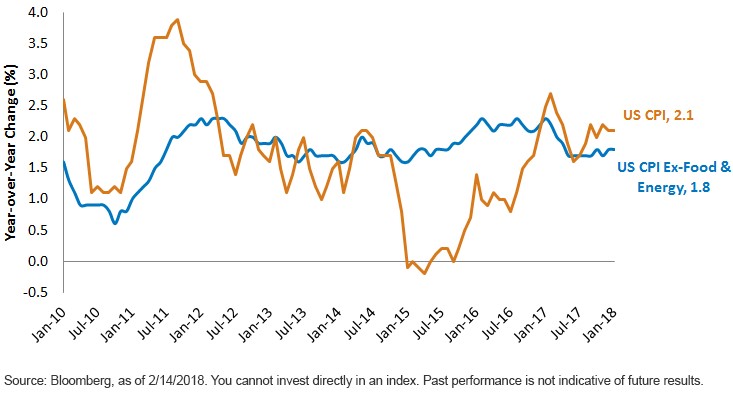
U.S. CPI vs. U.S. CPI ex-Food & Energy Year-over-Year Change from 1/31/2010 to 1/31/2018

By Kevin Flanagan, WisdomTree Investments

 Special to the Financial Independence Hub

There is no doubt that inflation fear has reared its ugly head early in 2018, impacting the money and bond markets in rather noteworthy fashion. Some key headline-grabbing measures, such as wages and the Consumer Price Index (CPI), have come in above consensus forecasts to start the year, fueling a case of high anxiety for the fixed income arena. Naturally, the million (or should it be billion?) dollar question is: Are these heightened inflation fears warranted?

As we entered the new year, consensus forecasts for inflation were that readings at both the overall and core (ex-food and energy) levels would essentially remain unchanged. Interestingly, economists’ projections have been revised upward of late and now post slightly elevated readings. Indeed, the CPI is now expected to come in at a year-over-year rate of +2.3%, or 0.2 percentage points (pp) higher than the prior projection. The alternate measure, the personal consumption expenditures (PCE) price index, has been changed to a +1.9% increase (also up 0.2 pp), with the core PCE gauge being lifted 0.1 pp to +1.8%. The bottom line is that these revised estimates now all look for some modest increase from 2017 levels.

What about the Federal Reserve (Fed)? For now, all investors have to go by is the policy makers’ December projections. The March FOMC meeting, scheduled for March 21st, will be the Fed’s next chance to make any potential adjustments to their prior forecasts.. The preferred measure is the PCE price index, and the policy makers provide projections for both the overall and core PCE gauges. The Fed’s central tendency estimate is similar to the revised market consensus, with a range of +1.7% to +1.9% for each index. It should be noted that both the economists’ and the Fed’s current PCE projections still fall below the +2.0% target laid out by the policy makers.

Let’s take another look

So, let’s take another look at the aforementioned wages and CPI numbers. Continue Reading…

My journey to Passive Index Investing, Part 2

By Dr. Networth

Special to the Financial Independence Hub

After reading My Journey to Passive Index Investing – Part 1, you may think that I have it in for financial advisors.  I don’t.   I believe the majority of financial advisors truly want to help their clients, but either their hands are tied or they have misguided beliefs.

The way financial advice compensation is structured creates a situation which, unfortunately, benefits the financial industry more than the individual investor.   There are also some financial advisors who truly believe active management beats out passive index investing over the long-term, despite high commissions/MERs and strong evidence which says otherwise.  Stay away from these financial advisors, since they have “drank the Kool-Aid.”

I believe a financial advisor with a CFP designation should have a fiduciary responsibility to create a comprehensive financial plan.  This includes insurance, estate planning, portfolio management (using low-cost ETFs/funds), as well as “holding your hand” during the inevitable market corrections.

Is advice worth 1 or 2% in fees?

How much is that worth?   This is a difficult question to answer. I don’t think it is worth the typical 1-2% in fees, which most banks and financial firms charge, especially if you have a large portfolio.  With the implementation of “Robo-advisors” and financial advisors that charge flat-fee or hourly-based (not tied to commissions on products), consumers are now beginning to have more choice for financial advice at a lower cost.

As you may recall, Part 1 ended with me as a newbie staff physician  in 2009 with little financial knowledge and an idea planted in my mind to “check out ETFs.”

It wasn’t until 2010 when I came across an article in the Globe and Mail, by Rob Carrick, where he rated the best personal finance blogs of 2010.  One of the blogs caught my eye: “Canadian Couch Potato,” written by Dan Bortolotti, which has been the best resource for index investing in Canada.

 

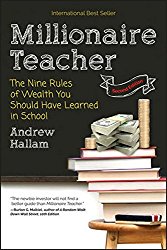
Through CCP, I came across another Canadian personal finance blogger by the name of Andrew Hallam, and his book “Millionaire Teacher.  The Nine Rules of Wealth You Should have Learned in School“, which was  originally published in 2011 (updated in 2017).

Hallam’s book is worth the price of admission,  since he has read a ton of personal finance/investing books, and has summarized succinctly in his book.  If you still have doubts whether passive investing beats active investing over the long-term those doubts will be put to rest after reading Chapter 3.   Physicians practice evidence-based medicine, because research backs it up.  The same concept should apply when it comes to investing. The enormous amount of evidence in favour of passive investing is, in my opinion, equivalent to a “Grade A” recommendation in evidence-based medicine. 

I have read my fair share of excellent finance books/blogs, but everything that you need to know about personal finances and index investing in Canada can be essentially found in these two resources.   If you read Hallam’s book and CCP’s blog (in particular his “Model Portfolios“), then you will:

  • Know more than the majority of financial advisors out there

  • Understand that the #1 determinant of your long-term investment returns is your asset allocation (% stocks: % bonds)

  • Understand that the #2 determinant of your long-term investment returns is to keep fees/MERs low by using low-cost index ETFs/funds, which will outperform the majority of actively-managed funds

  • Understand how to manage your own portfolio with low cost ETFs with minimal effort/time  

If you spend a bit of your time with these two resources, then you will eventually be able to save 1-2% MER each year by managing your own portfolio. 1-2% savings on a $1 million dollar portfolio will be $10,000-$20,000 per year, every year, for the rest of your life. That is a considerable amount of money which can be used on your family instead, such as taking 1 or 2 nice family vacation trips per year. For the equivalent amount, how many hours would you need to work at your job?

Once everything has been set up, you only require 30 minutes per month to manage this portfolio.  It really isn’t that difficult, as Loonie Doctor explains. However, taking that first step to managing your portfolio can be frightening and may fill you with self-doubt.   Comparable to a medical student learning a new procedure/skill – “See one, do one, teach one”.  These 2 resources will help you with the “See one” part.  At some point, you will need to take the plunge.   Follow that with sharing your knowledge with others, and you will become an “expert” in DIY passive index investing.

Analysis Paralysis

A point I would like to mention is the “law of diminishing returns” when it comes to learning about index investing.   After a certain point, any additional time spent learning about the nuances of index investing will probably not result in better returns, and may in fact, cause analysis paralysis: Continue Reading…