
Building Wealth

For the first 30 or so years of working, saving and investing, you’ll be first in the mode of getting out of the hole (paying down debt), and then building your net worth (that’s wealth accumulation.). But don’t forget, wealth accumulation isn’t the ultimate goal. Decumulation is! (a separate category here at the Hub).

Response to an investor who frets “the markets are going to crash”

With recent market volatility, many investors have been voicing legitimate concerns about the future direction of markets and what they might do about it.  What direction are we headed for the remainder of the year?  How can we avoid the crash?  Below we present a question and answer that we hope investors might find helpful.

From a concerned investor with impressively good timing (question received January 8 of this year):

Looking at the investment and political scene now – Trump, NAFTA, Dow at record highs, bull market into it’s 8th year, Iran protests — we think the chance of a significant pull-back on the stock market is imminent.

We are beginning to feel, with what’s going on today, that a major pull back could be on the books: like 2008.

What do you think?

Our response:

Dear concerned investor,

To begin with, you are not the only ones expressing those concerns to us. It does seem the market has been on a strong trajectory for quite some time although we usually recommend investors not worry about the market hitting an “all time high” despite how often it’s cited as a signal of sorts by the financial media/analyst community.

The market is always hitting all time highs (Graham wrote this piece on the topic recently that we’d recommend reading: “I’m nearing retirement and the stock market is at an all-time high….what should I do? It is relevant for this discussion generally). We have also noticed an uptick in the volume of negative market commentary.

Doom and gloom reporting became an industry in itself after the last market downturn! This commentary did seem to become more fervent beginning about a year ago (with the US election maybe?) although with hindsight of course it would have been unfortunate to divest at that point or at several other points during the year when news flow seemed particularly grim.

As you know, stock markets are volatile: sometimes that volatility is coincident with changes to the surrounding political and economic environment, sometimes the market anticipates those changes and sometimes it lags. Without the risk of volatility and downturn and uncertainty generally, markets would not deliver the strong long-term returns we seek as investors.

Success comes from riding out volatility, not timing it

In fact, evidence would suggest that investment success is driven more by riding out volatility than by trying to time it. The data on mutual fund returns and money flows shows very clearly that investors actually earn returns significantly lower than the funds they invest in due to poor timing decisions. When markets turn down, investors tend to pull money out. Investors also tend to pile in during times of market euphoria. I think we’re just not hard-wired psychologically to deal with market volatility. The “fight or flight” instinct doesn’t serve us well in this case. The evidence does not support market timing as a successful investment strategy. Continue Reading…

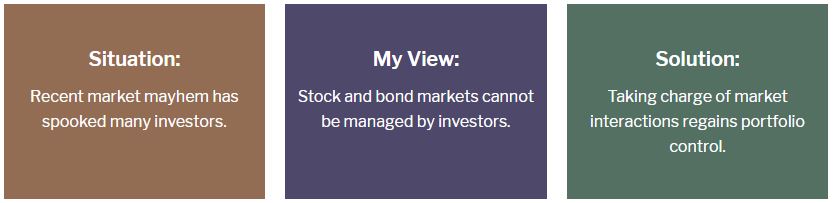
Regain portfolio control amid market mayhem

“To conquer fear is the beginning of wisdom.”
—Bertrand Russell (1872–1970), British philosopher

Investors have been enjoying the fruits of rising markets. A nine-year upside since the March 2009 lows, to be more precise. Conventional wisdom expected that stocks continue to deliver as economic conditions are likely to remain healthy.

Suddenly, everyone is wallowing in fears. Worries about global economies, recurring volatility and market jitters are back on stage. Investors are wondering what to do with the nest egg amid the crazy mayhem.

“Markets can’t be managed, so focus on your interaction with the markets.”

I recommend that you act wisely. Move slowly. Don’t give up. Don’t throw in your towels. The solution is simpler than you think.

Repeat after me: “I am not in control of my nest egg – the stock and bond markets are.” This is your first and most important admission.

Expect market corrections and surprises any time. Market mayhem is a normal occurrence, in both directions. You’ll be afforded little time, if any, to react. Fretting and worrying about the volatility does not help anyone. Your task is to regain as much control as possible.

Recent market haircuts are graphic reminders of the curve balls of investing. Zeroing in on simple practices reduces the hazards of stepping in a sink hole along your investing roadway.

Adopted Wisdom

I have adopted these timeless steps. You should too:

  • What matters most is how the portfolio fares, not the market outcomes.
  • Markets can’t be managed, so focus on your interactions with the markets.

Continue Reading…

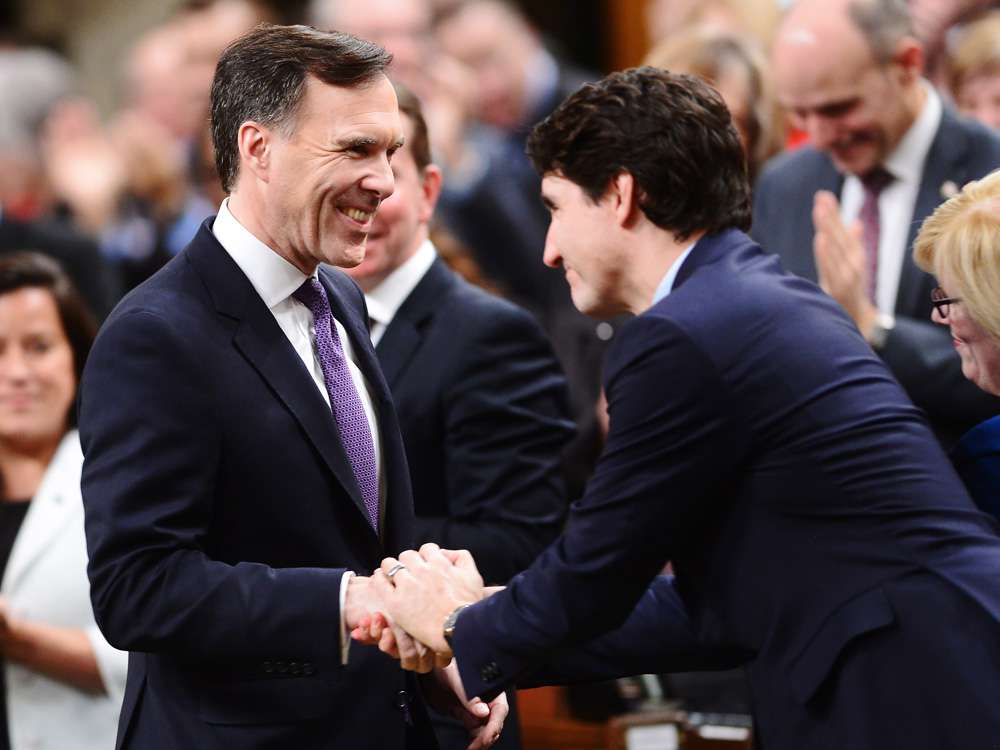
Federal budget 2018: Just what you’d expect from a Liberal government well into its mandate

The Liberals’ 2018 federal budget that descended on us on Tuesday afternoon is pretty much what you’d expect from the Justin Trudeau administration at this slightly-past-the-midway point of its mandate: lots of spending on things like gender pay equity, parental leave, native rights. Another stab at sin taxes, with a carton of 200 cigarettes going up by $1 and a proposal for excise duties on cannabis if and when marijuana becomes legal in July. A bit of business tax reform scaled down from the measures that so incensed small business last fall. As for balancing Ottawa’s books? Not so much.

The CBC’s web site provides this overview: Liberals spend billions to close gaps for working women, indigenous families. If you want to do straight to the source, click on the Finance Canada site here.

Here’s the Globe & Mail’s overview that went up soon after 4 pm:  Federal budget highlights: 12 things you need to know. In case you’ve met the paywall limit on free views, it reports that the budget is in line with previous estimates from Finance Canada, which means deficits for the “foreseeable future.”  Pay equity legislation is proposed for federal government employees and federal regulated sectors. And $447 million will be spent over 5 years to create a new indigenous Skills and Employment Training Program (replacing the Aboriginal Skills and Employment Training Strategy).  And another $1.4 billion or more over 6 years is proposed for First Nations child and family services.

A National Pharmacare program is being “consulted” on. More detail on passive income and private corporations: companies with more than $150,000 in passive income will no longer be eligible for the small business tax rate, while those with under $50,000 oil passive income will not be affected. In between is a formula. Also more than half a billion will go to Cybersecurity, and $3.8 billion over 5 years will go to “support science.”  And journalism has not been forgotten: the budget proposes $50 million over 5 years to support journalism in “underserved communities.”

At the National Post, this piece looks at 5 ways average Canadians could be impacted by the federal budget. MoneySense‘s Julie Cazzin totes up 15 ways Budget 2015 will impact your wallet. There’s something for everyone, Cazzin writes, but no real showstoppers. Julie also looks at 5 measures that directly impact Canadian families. Another MoneySense writer looks at the implications for small business owners.

Carrick sees 7 changes affecting personal finances

Here’s Rob Carrick’s piece on 7 changes that could affect your finances. Carrick writes in the Globe that Ottawa will be modernizing deposit insurance, replace the Canada Working Income Tax Benefit with the introduction of a Canada Workers Benefit, which raises benefits by up to  $170 a year in 2019 for single parents and couples, while raising the level at which the benefit is phase out from $32,339 to $36,483. The Sears bankruptcy appears to have stimulated consultation on pension security, while as of June 2018 an extra five weeks of parental benefits will be available when parents share parental leave. (Yes, Justin Trudeau’s government wishes to encourage more men to take pat leave!) There is also an expansion of the medical expense tax credit and a move to strengthen the oversight of bank sales practices by the federal Financial Consumer Agency of Canada.

Coyne: Budget has nothing to do with budgeting; Ivison: Liberals show their cunning

Back at the National Post, you can get useful video insights from columnists Andrew Coyne, John Ivison and William Watson here. Coyne’s column is titled Liberals deliver a federal budget that has nothing to do with budgeting, or the economy.  In it, he wryly observes that the Liberals are pandering “to every conceivable Liberal client group and policy cult: environmentalists, seasonal EI recipients, multiculturalism, official language groups, regional development, all the way to the media … And, of course, feminists.”

John Ivison’s column is headlined “In their third federal budget, Trudeau’s Liberals show their cunning.”

Finally, for a sober look from the tax and accounting pros at KPMG, read this overview.

My take? How about addressing pension inequity between public and private sectors?, not just gender pay inequity?

Continue Reading…

In wealth transfer, communication is as important as inheritance

By Jim Greenwood, CFP

Special to the Financial Independence Hub

What’s the most difficult thing to talk about with your children? For many of us, discussing plans for our estate is pretty high on the list. Talking about your will and your own passing can be uncomfortable. According to a recent IPC Private Wealth survey of Canadians with at least $500,000 in investable assets, 58 per cent have not talked to their heirs about instructions for their estate, both financial and personal.

Having the inheritance discussion is very important, largely because of the consequences after your passing if you don’t have the talk. Perhaps one child wants to keep the vacation property while the other wants to sell, creating financial discord among siblings. Or there is a dispute about one’s final wishes upon death. The consequences are many and varied, and can be different for each family but equally devastating.

Holding the family meeting

As a financial planner myself, I can tell you that I am very happy to host or attend a family meeting, which should include the executor. It takes the pressure off you. Just let your children know that your advisor recommends having beneficiaries present during part of your estate planning process.

Or say you want to hold a meeting on your own. Beforehand, ask your advisor for coaching on approach and content. You’ll feel a lot more comfortable during the family meeting.

At my firm, we believe there are two main themes to a wealth transfer meeting. The first is about values. Share your views of money and wealth, ask your children what money means to them, and have a discussion. Tell your children what it took to create your wealth. Talk about the idea of a legacy – helping out your children and grandchildren with the hope that your children will do the same. Why discuss these ideas? You want to guide your children to a place where they feel appreciative, not entitled. Where they are trustworthy, not irresponsible.

The second theme is all about your will. Talk about how you’d like your legacy to be managed, and go through the distribution of assets, explaining the reasons for your decisions. This is where you discover if any of your bequests could unintentionally lead to conflicts between children, delays in estate administration, or your will being contested. If any problems arise, you’ll have the opportunity to resolve them — and you’ll be thankful you uncovered the issues now.

Wealth transfer for blended families

If you’re in a blended family, you have an additional layer of estate planning. Take the case of an individual in a second marriage who has children from the first marriage, and needs to provide for both the spouse and children. Continue Reading…

5 small steps to improve your physical health & 5 for your financial health

Duke University conducted a two-year study of 218 healthy adults of normal weight to determine if a modest, sustained calorie reduction would show appreciable benefits. The plan was to reduce calories consumed by 25 per cent, but participants were unable to achieve that much.

(Author’s note: I sure couldn’t do it! A 25% reduction in my 2,000 daily calories would leave me staggering around at only 1,500 per day.)

Participants were able, however, to cut calories by an average of about 12 per cent.  This smaller change allowed them to stick to the plan without any adverse effect on mood (wherein lies a useful message in itself). The results? Lowered blood pressure; decreased insulin resistance; as well as a drop in several predictors of cardiovascular disease.

But the most appreciable result concerned C-reactive protein, a substance produced by the liver and a marker of inflammation in the body. The participants’ C-reactive levels plunged by almost half: a remarkable 47%!

It’s a no brainer that poor dietary habits would exacerbate internal inflammation. But very often this is an invisible menace (see my article ‘The Truth About Inflammation’, October 2015). Most of us remain blissfully unaware of any chronic inflammation cascading throughout our bodies. Yet this exposes us to chronic health risks as a result of knocking the body out of whack. In my case, I had the aforesaid silent inflammation and observable inflammation, which I felt in my poor old joints. And I am pretty convinced that chronic inflammation was one factor in my developing cancer.

An elevated C-reactive protein level can be a valid identifier of inflammation in the body. So, if just a 12% calorie restriction can reduce this marker by almost 50%, this is as good information as that available to an insider trader.

In the blindness of youth, so many of us can compromise our health in a mad dash for wealth. But from the other end of the lifespan, a good many seniors would gladly sacrifice some wealth for even a smidgen of better health. Those who don’t make time for their health early on in life more often have to make time for illness later.

5 ways to improve your physical health

So, if you are young, young at heart, worried that you are no longer young, here is some insider information. Five smart, little investments you can make, the aggregate interest of which, over time, will have compound into positive health returns. Continue Reading…