Building Wealth

For the first 30 or so years of working, saving and investing, you’ll be first in the mode of getting out of the hole (paying down debt), and then building your net worth (that’s wealth accumulation.). But don’t forget, wealth accumulation isn’t the ultimate goal. Decumulation is! (a separate category here at the Hub).

BMO’s Low Volatility ETFs are built differently — Why that’s a Win for your Portfolio

Image courtesy BMO/Getty Images

By Zayla Saunders, BMO ETFs

(Sponsor Blog)

Markets are noisy right now. Between trade talks, shifting rate expectations and recession whispers, there’s no shortage of turbulence. That’s why low-volatility strategies are back in focus: and BMO’s lineup is standing out.

Not all low-vol ETFs are created equal. In fact, BMO’s low-volatility ETFs have been quietly dominating their corner of the market. Here’s what’s working with the approach and the key differentiators of the methodology.

Source: Morningstar as of March 31, 2024 2

Smart, Targeted Methodology

BMO doesn’t just take the market and strip out the riskiest names. Its methodology is precise, practical, and time tested

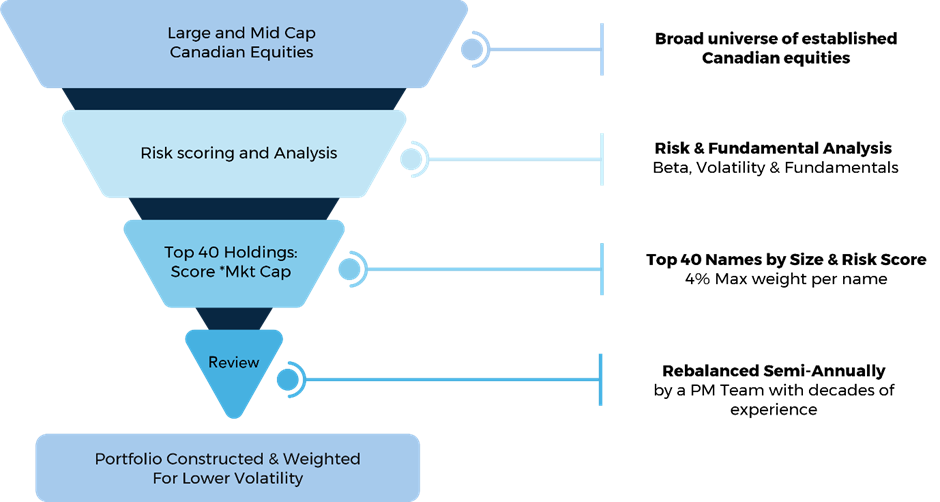
Step 1: The Starting Point

BMO begins with a broad universe of stocks that are the largest and most liquid from a particular region — say, Canada or the U.S. — and then ranks them based on historical return volatility (also known as beta). Lower is better here.

Step 2: Ranking

Next, the securities are ranked and selected based on their beta, with lowest betas carrying the highest weight in the portfolio. Beta is calculated using 5-year window, with more weight on recent data. Then the team engages in a fundamental review of securities held.

Step 3: Sector Constraints

Unlike some low-vol strategies that end up extremely overweight in defensive sectors (hello, utilities and consumer staples), BMO imposes sector caps. Why? To ensure diversification and avoid concentration risk. That means that while there will be a tilt towards defensive sectors, you’re building a balanced, resilient portfolio.

The Burning Question: Why ‘Beta’?

Beta and Standard deviation are two of the most common ways to measure a fund’s volatility. The key difference is that beta measures a stock’s volatility relative to the market as a whole, while standard deviation measures the risk of individual stocks.

This is where BMO ETFs stands apart in their strategy: The BMO ETF Low Volatility Strategy uses beta as the primary investment selection and weighting criteria. By constructing ETFs with lower beta securities, the BMO ETF Low Volatility Strategy gives investors access to portfolios that are designed to provide growth while reducing exposure to market risk. Over the long term, low beta stocks may benefit from smaller declines during market corrections and still increase during advancing markets. Additionally, they tend to be more mature and provide higher dividend yield than the broad market.

Beta is a risk metric that measures an investment’s sensitivity to fluctuations in the broad market (market sensitivity). The broad market is assigned a beta value of 1.00, an investment with a beta less than 1.00 indicates the investment is less risky relative to the broad market.

So why now?

Low volatility has always had its place: particularly for long-term investors looking to stay invested through all market cycles, or those who tend to be more emotional around volatility in their portfolio. But right now, the case is even stronger: Continue Reading…

Buying an Annuity versus Equities

Billy Kaderli, RetireEarlyLifestyle.com

By Billy and Akaisha Kaderli

RetireEarlyLifestyle.com

Special to Financial Independence Hub

I read an article by Mark Hulbert titled Why retirees are better off safe than sorry.

This article was about retirement satisfaction and asked if having little money, a reasonable amount of money or lots of money made a difference.

I have followed Mark’s writings for years and was surprised that Mark, to make his point, was hawking annuities.

Mark explains that you could put $100,000 into an annuity and receive $501 per month guaranteed for your lifetime. This equates to $6,012 per year or a 6% return.

My perspective and why

Here’s the problem that I have with this.

Inflation. As inflation has heated up after years being quiet, your $501 monthly check is going to buy you less and less over time. The erosion of buying power will not be noticed at first but over the years it certainly will. This is a huge negative for me.

Once you turn your money over to the annuity company, you no longer have control of it and possibly it is no longer part of your estate. This means you cannot leave it to your spouse, a child, grandchild or your favorite cause. And remember, your annuity is only as good as the company that backs it. If they have dereliction in management or other calamities you could be getting back pennies on the dollar. It happens.

In the example with this annuity It will take you about 16.5 years to break even with your investment.

What if you die before that?

My suggestion

There are other options if you have $100K and want a 6% yield for income and still keep control of the asset.

For instance, you could purchase any or all of these high yielding dividend-paying stocks.

AT&T (T) yield 4.04%

Plains All American Pipeline (PAA) yield 9.10%%

Energy Transfer (ET), yield 7.32%

Exxon Mobil (XOM), yield 3.84%

Main Street Capital (MAIN) yield 5.51%

In this example, you could put $20,000 into each of the above for a 5.96% average yield or $5,962 per year income. Also, there is potential for these equities to increase in value as well as raise their dividends. So, in this case, you have the possibility of being able to reinvest any amount over the 6% giving you the opportunity to increase your holdings while still covering the $6,000 annual income.

Other options

However, if you are not comfortable owning three out of the five stocks in the energy field, for more diversification, you could purchase DVY, IShares Select Dividend ETF with a portfolio of 100 different companies and with a 3.72% yield.

The idea here is to receive the 3.72% dividend distributions and sell off $2,280 worth of shares annually to make the 6% yield.

How is that done? You invest 100K into DVY taking the quarterly dividends which amount to a 3.72% yield. After one year-and-a-day (so that you meet the long-term capital gains requirement), you sell off $2,280 worth of shares.

DVY 10 Year Total Return = +9.40%

In this example based on the past 10-year performance of DVY, your principal would have grown to approximately $109,400, year one, which is a 9.4% annual total return. You receive $3720.00 in dividend income and $2280.00 in capital gains = $6000.00, leaving approximately $103,400 invested.

We all know that past performance is no indication of future results, but there are no guarantees in retirement, investments, nor annuities.

See the performance chart below. Continue Reading…

Unlock Healthcare Value and Monthly Income | HHL & HHLE

Image courtesy Harvest ETFs

By Ambrose O’Callaghan, Harvest ETFs

(Sponsor Blog)

The U.S. healthcare sector has faced unique challenges in late 2024 and the first half of 2025. Last year, we provided an in-depth look at global healthcare as a long-term opportunity and examined some of the catalysts and innovations that were impacting the sector. Today, the U.S. and global healthcare space continues to evolve while combatting headwinds in some key areas.

The state of U.S.  healthcare equities

Healthcare performed relatively well in the early part of 2025, despite broader trade uncertainty and macroeconomic headwinds. The medical technology and tools sub-sector experienced some short-term volatility that was driven by the uncertainty surrounding tariffs. That comes as little surprise, considering companies in the space reliance on oversees manufacturing and revenue generation.

Domestic names, like those in Managed care and select Biopharmaceuticals, remained relatively insulated during this period. This stemmed from an easing in the tariff narrative, which was triggered by a sharp drop in several macroeconomic indicators that included manufacturing activity and consumer confidence. As we progressed further into 2025, a cloud of uncertainty crept into healthcare. That contributed to some recent volatility across several sub-sectors. In this article, we have provided some recent catalysts to help investors make sense of the current situation in healthcare.

Drug pricing in 2025

On May 12, 2025, President Donald Trump signed an Executive Order (EO) titled “Delivering Most-Favored-Nation Prescription Drug Pricing to American Patients.” This EO proclaimed that the Trump administration “will take immediate steps to end global freeloading and, should drug manufacturers fail to offer American consumers, the most-favoured-nation lowest price, my Administration will take additional aggressive action.”

Ultimately, the aim is to align U.S. drug prices more closely with lower prices paid internationally. This EO echoes a summer 2020 Trump-era EO that was blocked in court and failed to be implemented. The current version faces similar hurdles. There is no bipartisan backing for the policy, the legality surrounding it is dubious, and there is opposition among both Democrat and Republican lawmakers.

All of these make the implementation of this EO unlikely. However, we could see pilot programs within the Department of Health and Humans Services (HHS), making attempts to fold the current EO’s proclamations into future IRA negotiations, or more comprehensive legislative proposals.

In addition, there are those who have predicted the policy could reduce the research and development (R&D) budgets further. That could potentially impact innovation and companies that have been propelled due to strong R&D spending. However, the risk may truly lie in the negative sentiment that continues to emerge in the news cycle.

Vaccine market uncertainty

The appointment of Robert F. Kennedy Jr. as the United States Secretary of Health has damaged sentiment for healthcare companies that manufacture vaccines. RFK Jr. is a vocal “vaccine sceptic.” Moreover, the Trump administration has pursued leadership changes at the Food and Drug Administration (FDA), which raises questions about stricter vaccine approval processes going forward.

Merck & Co, the U.S.based pharmaceutical giant, with its vaccine-related businesses, has felt the pressure. In addition to the political uncertainty, a recent CMS technical document has added to the complexity in the vaccine arena. The report suggested that reformulated drugs may no longer be classified as “new” for Medicare negotiations. This development could impact companies with operations in the “combination therapy” space like Johnson & Johnson’s Darzalex Faspro, or Bristol Myers’ subcutaneous version of Opdivo. That could affect future patent projections as well. Continue Reading…

The stock market and politics: a Case Study in Applied EMH Testing

Image courtesy Pixabay: Sergei Tokmakov

By John De Goey, CIM, CFP

Special to Financial Independence Hub

I have long been interested in the interplay between politics and the stock market. We had a fascinating real world case study that played out in real time last month.

Those who know me will likely know that I have long been a proponent of the Efficient Market Hypothesis, which was put forward by Nobel Laureate Eugene Fama as a means of explaining capital market behaviour. It comes in three forms: weak, semi-strong, and strong: each representing different levels of market efficiency.

The Weak form asserts that all past market prices and data are fully reflected in current stock prices. Therefore, technical analysis methods, which rely on historical data, are deemed useless as they cannot provide investors with a competitive edge. However, this form doesn’t deny the potential value of fundamental analysis.

The Semi-strong form extends beyond historical prices and suggests that all publicly available information is instantly priced into the market. This includes financial statements, news releases, economic indicators, and other public disclosures. Therefore, neither technical analysis nor fundamental analysis can yield superior returns consistently.

Finally, the Strong form asserts that all information, both public and private, is fully reflected in stock prices. Even insiders with privileged information cannot consistently achieve higher-than-average market returns. This form is criticized because it conflicts with securities regulations that prohibit insider trading.

Examples supporting EMH

While the EMH has faced criticisms and challenges, it remains a prominent theory in finance that has significant implications for investors and market participants. It has been both supported and challenged by various market phenomena. Here are some notable examples supporting EMH:

Random Walk Theory: Stock prices appear to follow a ‘random walk,’ meaning past prices do not predict future movements, something that is disclosed and disclaimed on every prospectus.

Index Fund Performance: Passive index funds often outperform actively managed funds, suggesting that markets efficiently price securities, especially once fees are taken into account.

Earnings Announcements: Stock prices quickly adjust to new earnings reports, reflecting the semi-strong form of EMH.

Examples challenging EMH

The obvious example that challenges EMH is the existence of stock market bubbles. Events like the Dot-Com Bubble and the 2007-2009 Global Financial Crisis show that prices can deviate significantly from intrinsic values and for prolonged periods of time. Such anomalies suggest that while markets are generally efficient, behavioral biases and structural factors can lead to inefficiencies, include macro-level mispricings. A well-known industry chestnut is that “markets can remain irrational longer than you can stay solvent.” Here’s where the story gets interesting …< Continue Reading…

Emergency Saving Hacks for the Gig Economy Worker

Image from Unsplash/Robert Anasch

By Devin Partida

Special to Financial Independence Hub

Freelancers are growing in abundance. The gig economy benefits from the rise of digital platforms connecting workers to customers for short-term employment. While the whole setup affords freedom and flexibility for many, it also comes with financial uncertainty.

Unlike traditional employees, gig workers don’t have a steady paycheck that comes through from month to month. There are also no work benefits nor guaranteed work hours. The unpredictability of gigs can make it difficult for people in the industry to save and build an emergency fund.

Why Gig Workers need an Emergency Fund more than ever

An emergency fund is any gig worker’s safety net. Your unique circumstance as a freelance worker makes income inconsistent and paid sick leave non-existent. This lack of employer-sponsored benefits necessitates creating your own cushions. However, financial planning is even more challenging as a gig worker :  medical emergencies, vehicle breakdowns or slow business months can become financial disasters without proper savings.

Building an emergency fund ensures you’ll be prepared when income dips or unexpected expenses arise.

Smart Saving Strategies for Gig Workers

It’s challenging, sure, but that doesn’t mean it’s impossible. Here are ways to help you start your savings journey:

Automate Your Savings From Gig Payments

Every time you receive your paycheck, set up an automatic transfer to a high-yield savings account. Some banks allow their users to automate transfers so they can set aside a portion of every deposit. If your bank doesn’t, you can do the same with apps like Digit, Qapital or Chime.

Automating your savings allows you to set it up once and forget you’re actively saving in an emergency fund. Even 5% to 10% of each payment can add up to a significant amount over time.

Use High-Yield Savings Accounts

Keep your emergency funds in a savings account with high returns rather than a checking account that pays very little interest. A high-yield savings account is an accessible and secure place to save your emergency stash. You’ll earn competitive interest while the money is idle and can withdraw cash whenever needed. Many online banks offer this benefit so you can grow your savings.

One word of caution, though: You should not put all your money in one high-yield savings account. Diversifying them creates better financial resilience.

Implement the “Pay Yourself First” Strategy

Robert Kiyosaki popularized the “pay yourself first” scheme. This method means prioritizing your saving goals before your expenses. If you treat your savings like a monthly nonnegotiable expense, you ensure you funnel some money toward financial security over discretionary spending.

Budget Based on your Lowest Income Month

Because gig work is unpredictable, you should budget every month as if it’s slow. Calculate your lowest earning month and structure your essential expenses accordingly. Put any excess in your savings fund.

Cut Unnecessary Expenses and Redirect to Savings

Do you eat out more often than you should, or buy new clothes you don’t always wear? Are you being tempted to swipe your credit card for every purchase? Assess areas in your life where you most indulge in spending money.

Knowing where your money goes can reduce shelling out where you don’t need it. Cancel unused subscriptions and opt for public transportation rather than Uber to your location. Cook at home instead of dining out and take advantage of discounts and cashback rewards. Every dollar saved can go toward building your financial cushion.

Leverage Microinvesting Apps for Small Gains

Microinvesting allows you to start saving with minimal capital, often investing spare change from day-to-day purchases. Apps like Acorns and Stash round up your purchases and invest the spare change. While not suitable as a primary emergency fund, these microinvestments are perfect for beginners and those with limited funds to supplement their savings over time.

Diversify your Income Streams

Decrease your financial vulnerability by tapping into multiple income sources. Consider taking on different types of gigs to ensure a steady flow of earnings. Whether freelancing, online tutoring or renting out a spare room, extra income streams can help you save more consistently. Continue Reading…