Building Wealth

For the first 30 or so years of working, saving and investing, you’ll be first in the mode of getting out of the hole (paying down debt), and then building your net worth (that’s wealth accumulation.). But don’t forget, wealth accumulation isn’t the ultimate goal. Decumulation is! (a separate category here at the Hub).

“Of Course . . . But Maybe” — How to cultivate sober second thoughts on various financial decisions

By Robb Engen, Boomer & Echo

Special to the Financial Independence Hub

Comedian Louis C.K. closed his 2013 comedy special Oh My God with a hilarious (albeit crude) bit called, “Of course . . . but maybe.” I thought it would be fun to apply the same thinking to personal finance and some of the situations we run into every day.

On sense of entitlement
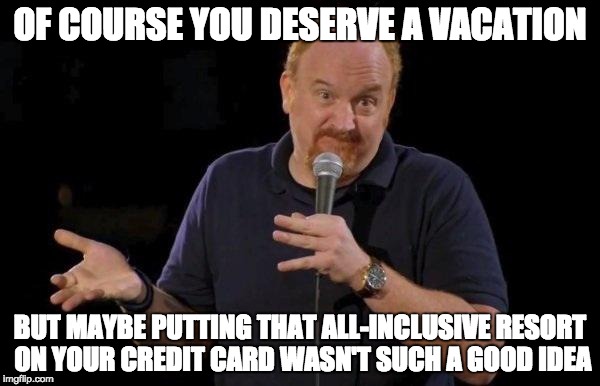
Of course you deserve a vacation. You worked hard all year, and sure, while you didn’t make much progress paying off your credit-card debt, and your New Year’s resolution to reign-in the impulse shopping was busted by February, a week spent soaking up the tropical sun will re-charge your batteries and give you a fresh start on your financial goals.

But maybe you shouldn’t add to your debt-misery by putting that all-inclusive resort vacation on your credit card. Maybe burying your head in the sand won’t make your financial problems go away. Maybe you should hold off on the tropical vacation for a year or two while you get a handle on your finances. Maybe then you can truly say, “I deserve this.”

On education and doing what you love

Of course you should go to University and study whatever you want. Of course you should find your passion, however long it takes. You can be whatever you want. You can do whatever you want. Post-secondary education is an investment in your future.

Related: When doing what you love doesn’t pay the bills

But maybe spending $100,000 and eight-years of your life on that double-major in history and fine arts, only to spend the next few years working as a Starbucks barista, wasn’t the wisest use of your time and money.

On investing in mutual funds

Of course mutual funds offer an easy way for investors to put their hard-earned savings into a diversified basket of stocks and bonds. You can start investing with as little as $25 per month and build up your portfolio without any transaction costs.

But maybe you didn’t notice the annual management expense ratio eating into your returns. Maybe, as Vanguard founder Jack Bogle estimates, the 2.5 per cent a year in fees over a typical investor’s lifetime means that an astounding 80% of compounding returns ends up in the hands of the manager, not the investor. And maybe your financial advisor is really a salesperson in disguise, recommending funds that may not be in your best interest.

On insurance needs

Of course you should buy insurance to protect your loved ones in case something terrible should happen to you. Of course you want to provide for your dependents in case you die or become disabled.

Related: 5 myths about insurance

But maybe asking your insurance broker if you need insurance is like asking your barber if you need a haircut. Maybe if you are single and have no dependents you might not need life insurance. Maybe a simple term life insurance policy that pays off your debts and provides 5-10 years of income for your spouse and children is all the insurance you need. And maybe mortgage life insurance and balance protection insurance really just protect the bank at your expense.

On budgeting and tracking expenses

Of course you don’t need a budget. You have a great handle on your finances. You pay yourself first. You’re debt-free. You live within your means.

But maybe if you spent three months tracking your spending you’d discover several hundred dollars a month worth of unaccounted for expenses in categories such as dining out, gifts, and “miscellaneous.”

On home ownership

Of course you should aspire to own your own home one day. After all, you’re just throwing your money away on rent every month. Why not build up some equity of your own? And with house prices continuing to rise, of course it’s better to get into the market now before you’re priced out forever.

But maybe home ownership isn’t the panacea it’s made out to be. Maybe new expenses, such as property taxes, home maintenance, and lawn care cost more than you thought. A big-fat mortgage means you can’t afford to save for retirement, or even the odd dinner out. It turns out that maybe renting was a lot cheaper and gave you the freedom to pursue and achieve your other financial goals. (See also The Real Cost of Buying Your Home.)

RobbEngenIn addition to running the Boomer & Echo website, Robb Engen is a fee-only financial planner. This article originally ran on his site on August 16th and is republished here with his permission. See also Boomer & Echo’s 5th Anniversary contest, with prizes galore (including a copy of Findependence Day). 

“Stop Doing” # 3: Stop Investing Without a Plan

stevelowrie
Steve Lowrie

By Steve Lowrie, Lowrie Financial 

Special to the Financial Independence Hub

We’re on a roll with our “STOP Doing” ideas. In prior posts, we advised you to STOP feeding on junk media and STOP reacting to market noise.

Today, we’ll cover a great way to stop doing nearly every other bad investment idea out there: STOP trying to invest without a plan. Typically, this plan should come in the form of a detailed Investment Policy Statement (IPS) – a written agreement that you and anyone else who is helping you manage your money signs off on initially, and whenever you make changes to it.

Why be so formal about it? As a financial advisor, I often field questions from family, friends or acquaintances, asking me what I think about some current hot investment tip. The specific “opportunity” changes each time, but the reason I’m being asked about it does not. It’s almost always after strong past performance has captured everyone’s attention. A recent example: I was golfing with a friend last Sunday who proceeded to tell me about the great recent returns from Apple and Google. “If I had only had the guts to buy Apple at $6,” he bemoaned, “I would be really rich now.”

I think he was hoping I could name the next big Apple for him so, this time, he could get in on the action. Instead, I concentrated on my golf game – and mulled over how some things never change and some lessons are rarely learned.

The importance of a formal Investment Policy Statement

Continue Reading…

Weekly Wrap: ORPP gets flak, investors watch weights, the worst form of debt

2_hc1oqU
Ontario premier Kathleen Wynne (Twitter.com)

First an apology that there was no weekly wrap last weekend because of a long weekend I took up in cottage country. Summer is fast fading!

This week the big macroeconomic story was China’s devaluation and the consequent negative impact on global markets. Probably the least confusing and most insightful analysis of this story was in The Economist, titled The Devaluation of the Yuan: The Battle of Midpoint.

On the retirement front in this country, the controversial story was the Ontario Government’s unveiling of the details of the much-loathed ORPP, or Ontario Retirement Pension Plan. This appears to becoming an election issue as the animosity between Stephen Harper and Ontario premier Kathleen Wynne heats up. We did weigh in with a recap on the Hub, which you can find here.

Note the references to two studies that came out hours before the official ORPP announcement, providing a little grist for the mill for both fans and foes of the plan. My own take on this will be in an upcoming Motley Fool blog but the main critiques of the ORPP — and there were many — are summarized below.

10 reasons ORPP should be T-ORPP-EDOED

Continue Reading…

How RRSP meltdown strategies could jeopardize your retirement

1
Patrick McKeough, TSInetwork.ca

By Patrick McKeough, TSInetwork.ca

Special to the Financial Independence Hub

Investment tip: “RRSP meltdown strategies promise to ease your tax burden on withdrawals, but these complicated manouvres are usually more lucrative for brokers than for investors.”

Investors sometimes ask us what we think of the so-called “RRSP meltdown.” This is a strategy that would let them make withdrawals from their RRSPs without paying income tax.

How the RRSP meltdown works

When you take money out of your RRSP, you have to pay tax on your withdrawal at the same rate as ordinary income in the year you make the withdrawal. However, under an RRSP meltdown strategy, you would offset the additional tax by taking out an investment loan and making the interest payments from funds you withdraw from your RRSP (the withdrawals must be equal to the interest payment).

Since the interest on the loan is tax deductible, the tax on the RRSP withdrawal is cancelled out. This, in theory, results in zero tax owing on your withdrawal.

You can then use the investment loan to buy dividend-paying stocks, which you would use to provide income during retirement. Dividend-paying stocks also have the advantage of being very tax efficient.

RRSP meltdown by the numbers

Continue Reading…

Ontario Retirement Pension Plan to roll out from 2017 to 2020

Minister Robb with Ontario Premier Kathleen Wynne, Northern Development and Mines Minister Michael Gravelle, HOM Tony Negus and Consul General/Senior Trade and Investment Commissioner Portia Maier.
Ontario premier Kathleen Wynne (Wikipedia)

The National Post today reports the Ontario Government has revealed more detail today about its oft-criticized Ontario Retirement Pension Plan or ORPP. As it reported in a later update, staff at the province’s bigger employers will have to start paying into the plan by 2017, with a full rollout by 2020.

Employers will be exempt only if they already offer a mandatory Registered Pension Plan that Ontario deems comparable to the ORPP.

In 2022, Ontario residents who are 65 or older can start drawing benefits from the ORPP. Full-time or part-time workers  can  start contributing at 18 and continue until they turn 70.

While Premier Wynne has not released cost estimates of the program, the Post reported the plan will collect 1.9% of a workers’ income up to $90,000 from both employers and employees to a total of 3.8%, or a combined total of $3,420 a year

Meanwhile, proponents and critics of the plan got a little more ammunition from two different retirement reports produced by the Fraser Institute and the Mowat Centre.

Released Tuesday, the Fraser Institute report is titled Lessons for Ontario and Canada from Forced Retirement Savings Mandates in Australia. It suggests that if Canada really needs more “forced” retirement savings, Ontario should look for global examples that could be alternatives to its current plans for the ORPP. For example, it should look at Australia’s “superannuation” program, a contribution-based scheme to which both employers and employees must contribute. Australia’s system of “individual accounts” provide more flexibility and choice than, for example, the Canada Pension Plan (CPP.)

Like the CPP, the ORPP is a “collective” pension plan that pay out defined benefits over a lifetime. The paper by the Mowat Centre (titled Lower Risk, Higher Reward: Renewing Canada’s Retirement Income System) says the Australian plan has had “mixed” success because as a Defined Contribution plan it doesn’t guarantee a set income for life, as does the CPP and DB pensions in general.

Middle-to-upper income earners may need more help

Continue Reading…